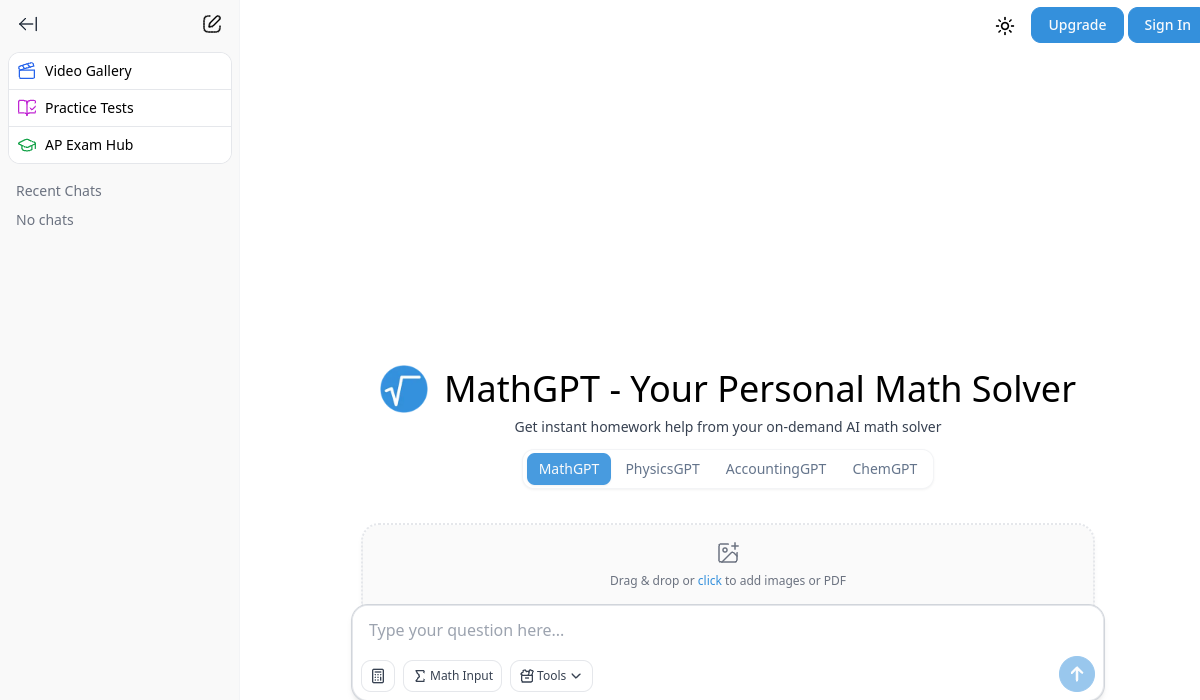
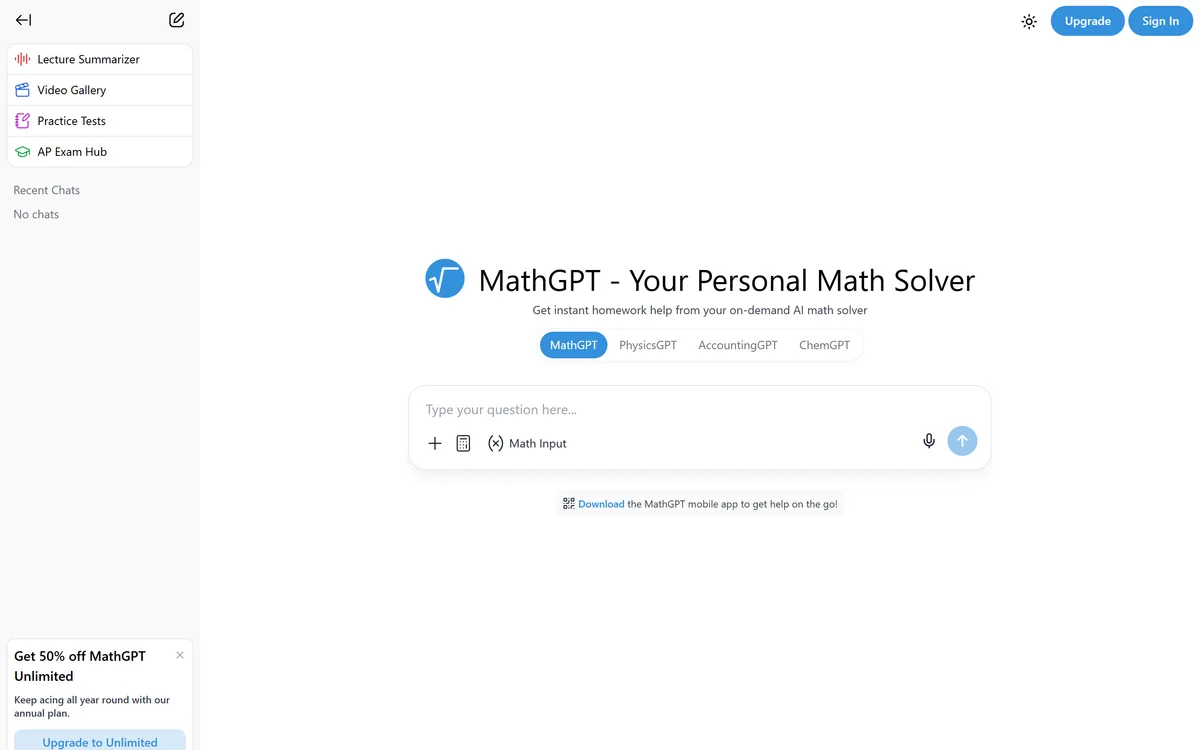
MathGPT solves maths, physics, chemistry and accounting problems from text, photos or PDFs, returning step-by-step working, generated video explanations with diagrams and voiceover, interactive practice quizzes and graphs. It was built by two engineering students and states plainly that it can make mistakes.
math-gpt.org8 viewsAdded January 5, 20262.4M+ visitors
MathGPT's interface, captured 9 September 2026.
Where Does Homework Help Become Cheating?
MathGPT is positioned as a homework helper offering instant help and step-by-step solutions, and it is worth being direct about the line rather than pretending it does not exist.
The distinction is not the tool. It is what you do with the output.
Working through a solution you did not produce, understanding each step, and then solving a similar problem unaided is studying — it is what a worked example in a textbook has always been, and textbooks have printed them for a century.
Copying the steps onto a submitted assignment is not, and it does not become studying because the source was a website rather than a classmate.
The reason this matters practically rather than morally is that maths is cumulative in a way most subjects are not. A student who passes a fractions assignment without understanding fractions does not get away with it — they meet the same gap in algebra, then again in calculus, with interest. The quiz feature is the honest test of which side of the line you are on, which is why it is the most valuable thing on the site.
A student who passes a fractions assignment without understanding fractions meets the same gap again in algebra, with interest.
Why Language Models Get Arithmetic Wrong
The footer states plainly that MathGPT can make mistakes and that important steps and calculations should be double-checked. That warning is more important than it looks, and the reason is architectural.
Language models predict text. Arithmetic is not a text-prediction problem — it is a deterministic procedure — and a model producing the most likely next token in a multiplication is doing something structurally unlike calculating.
The result is a specific and dangerous failure mode. The reasoning is often correct while the number is wrong: the right method, the right steps, and an arithmetic slip in the middle that propagates to a confidently stated final answer.
That is worse than being obviously wrong, because a student checking whether the approach looks right will conclude it does. Modern systems mitigate this by calling out to actual computation rather than generating digits, and whether a given tool does so is rarely disclosed.
Which makes the disclaimer the correct behaviour rather than a legal hedge. A maths tool that tells you to check its arithmetic is being honest about the technology it is built on — the same honesty LabReportAI and other academic tools should be held to.
Video Explanations And Why They Suit Maths
MathGPT claims to be first in providing on-demand AI-powered video explanations with animations, diagrams and voiceover, generated for the specific question and able to read diagrams from the original problem.
Video is a better fit for maths than for almost any other subject, and the reason is about what a static solution hides.
Written working shows the states a problem passes through. What it cannot show is the transformation between them — why this term moved, what the substitution actually did, how the shape changes when the parameter does. Students who are stuck are usually stuck precisely there, between two lines that both look fine.
Animation shows the transformation directly, which is why the best maths teaching on the internet has been video for fifteen years.
Reading diagrams out of the original problem is the technically harder claim and the more useful one. A geometry question is largely its diagram, and a solver that can only read the text is answering a different question from the one that was set.
Attempt the problem before looking at the solution.
Read the working, not the answer.
Check the arithmetic yourself — the site tells you to.
Generate a quiz on the same topic and take it unaided.
If you cannot pass the quiz, you did not learn it.
Checking A Solution You Did Not Produce
Between the step-by-step working, the graphing tool and the quizzes sits a use case the site does not emphasise and which is probably its best: verification.
A student who has done the work and wants to know whether they got it right is in a completely different position from one who has not started.
Comparing your own working against a generated solution is genuinely educational, because disagreement is informative. Where the two diverge is exactly where your misunderstanding is, and that is far more useful than a tick or a cross at the end.
It also inverts the arithmetic problem. If you calculated one answer and the tool calculated another, you now know to check both — which is the correct response to a technology that reasons well and computes unreliably.
Graphing supports the same habit. Seeing whether a function looks the way your algebra implies is a sanity check students are rarely taught to perform, and it catches sign errors and misplaced terms faster than rechecking the working line by line.
Built By Students, And What That Shows
The site states MathGPT was created by two engineering students at a named university who experienced the difficulty of learning complex maths themselves, and that it has served more than two million students across 150-plus countries.
Founder provenance is usually marketing. Here it shows up in the product decisions.
The features that would not exist if this were built by people optimising for engagement are the ones that point away from it: quizzes that test whether you learned, working shown rather than answers given, and a disclaimer telling you to verify the arithmetic.
An engagement-optimised homework tool gives the answer fastest, because that is what a student under deadline wants at eleven at night. Building the slower, more educational path suggests the makers remember being the student.
The scale claim needs the usual reading — two million unique students is a reach figure covering everyone who ever used it once, and the surrounding subject solvers for physics, chemistry and accounting suggest a company expanding across the homework market rather than deepening one subject. A full curriculum is a different proposition again, as LittleLit AI shows, and ESAI handles what comes after school entirely.
Learning Maths With A Solver Beside You
A solver used one way builds understanding and used the other way builds a gap you will meet again next term.
This sequence is the difference between the two.
Attempt every problem yourself first, even badly.
Compare your working against the solution rather than reading it cold.
Find the first line where you diverge — that is your misunderstanding.
Recalculate the arithmetic independently, as the site advises.
Generate a quiz on the topic and take it without help.
Ask the follow-up question when a step still does not make sense.
MathGPT: Coverage And Limits
Origin
Created by two engineering students at a named university, per the site
Subject solvers
MathGPT, PhysicsGPT, ChemGPT and AccountingGPT
Maths coverage
Algebra, geometry, calculus, statistics and word problems
Input formats
Typed text, photographs and PDFs
Step-by-step
Solutions broken into steps with concept explanations
Video explanations
Generated per question with diagrams, animations and voiceover
Diagram handling
Stated as able to read diagrams and steps from the original problem
Quizzes
Custom interactive practice questions on any topic
Other tools
Graphing software, a lecture summariser, practice tests and an exam hub
Mobile
Apps on the iOS App Store and Google Play
Claimed reach
Over two million unique students across 150-plus countries
Stated caveat
The footer warns it can make mistakes and that important steps should be double-checked
MathGPT: A Solver That Shows Working
Step-by-step solutions rather than answers, across algebra, geometry, calculus, statistics and word problems.
Generated video explanations with diagrams, animations and voiceover, built for the specific question asked.
Interactive practice quizzes on any topic, which is the feature that points at learning rather than finishing.
Four subject solvers — maths, physics, chemistry and accounting — with photo and PDF input.
A plain warning that it can make mistakes, which is honest and unusually rare in this category.
Key features of MathGPT
Step-by-step solutions with concept explanations
Generated video explanations per question
Diagram reading from photographed problems
Interactive practice quiz generation
Graphing tools
Physics, chemistry and accounting solvers
Lecture summarising and practice tests
iOS and Android apps
Pros & cons
Pros
7
Shows working rather than only answers
Generated quizzes are the honest test of whether you learned anything
Video suits maths better than any other subject, because it shows transformations
Reading diagrams out of a photographed problem is the harder and more useful capability
States plainly that it can make mistakes and should be double-checked
Photo and PDF input matches how students actually have their homework
Feature choices point away from engagement optimisation
Cons
7
Whether arithmetic is calculated or generated is not disclosed
No published accuracy testing for a tool whose output is checkable
Nothing addresses the line between help and substitution on graded work
The student count is a lifetime reach figure rather than active use
Four subject solvers suggests breadth rather than depth in any one
Correct reasoning with a wrong number is the hardest error for a student to spot
A discount countdown sits above the educational content
Best For
Students checking their own attempted working
Learners who need a worked example their textbook lacks
Anyone stuck between two lines that both look correct
Students revising a topic before an exam
People who will take the quiz afterwards
MathGPT Against Other Homework Helpers
Study tools differ by whether they teach, answer or assess.
You attempted the problem and want to know where you went wrong.
A worked example is what your textbook does not give you.
Seeing a transformation animated would unstick you.
You will take the quiz afterwards to test whether it landed.
You are revising a topic you already covered once.
Close the tab when
The assignment is graded and you have not attempted it.
You would copy the steps rather than understand them.
Your institution's policy prohibits AI assistance.
The arithmetic matters and you would not check it.
You are relying on it to avoid learning a foundation you will need again.
More Study And Maths Tools
Other tools across curricula, subject help and academic writing.
LittleLit AI — a full curriculum rather than a solver
ESAI — applications at the end of the school journey
LabReportAI — academic writing needing the same caution
Praktika — practising a skill rather than solving problems
Khoj — an assistant over your own notes and textbooks
MathGPT: Read From The Solver Pages
Last checked . Read from math-gpt.org in a browser session on the date above, including the footer. The screenshot was captured at the same time.
Positioned as an AI math solver, calculator and homework helper
Four subject solvers displayed: MathGPT, PhysicsGPT, ChemGPT and AccountingGPT
Coverage stated across algebra, geometry, calculus, statistics and word problems
Input stated as text, photographs or PDFs
Step-by-step solutions described as explaining key concepts and calculations along the way
AI video explanations described with diagrams, animations and voiceover, generated per question
Stated as able to understand diagrams and steps from the original problem
Custom interactive quizzes described as adapting to learning pace
Graphing software, a lecture summariser, practice tests and an exam hub all present
Described as created by two engineering students at a named university
Over two million unique students across 150-plus countries claimed
Footer states plainly that MathGPT can make mistakes and that important steps and calculations should be double-checked
What we could not confirm: whether arithmetic is computed by calling out to a calculation engine or generated as text, which determines how often the numbers are wrong; how the video explanations are produced; what the two million student figure counts; whether any accuracy testing has been published; whether the platform has any policy or safeguard around graded assignments; and pricing, including the annual discount promoted on the page. We did not submit a problem.
Editor's Verdict
3.5/5
MathGPT does two things that separate it from a plain answer engine: it shows working, and it generates practice quizzes — both of which point at learning rather than at finishing. The video explanations are a genuinely novel format for a subject where seeing a diagram move helps. It also carries an unusually honest footer warning that it can make mistakes and that important steps should be double-checked, which is exactly right for a category built on a technology that is bad at arithmetic. What it does not address is the line between help and substitution. AInexfinder Editor Score: 3.5/5.
MathGPT pricing
AInexfinder does not list plan prices or billing details. For current pricing, plans, and trials, visit the official MathGPT website.
Vendor pricing, credits, and billing policies change over time. Always confirm on the official site before you buy.
Frequently asked questions
What is MathGPT?
An AI solver covering maths, physics, chemistry and accounting from text, photos or PDFs, returning step-by-step working, generated video explanations with diagrams and voiceover, interactive practice quizzes and graphs.
Is using it cheating?
It depends entirely on what you do with the output. Working through a solution, understanding each step and then solving a similar problem unaided is studying. Copying the steps onto a graded assignment is not, whatever the source.
Why does that matter beyond the rules?
Because maths is cumulative. A student who passes a fractions assignment without understanding fractions meets the same gap in algebra, then again in calculus. The quiz feature is the honest test of which side of the line you are on.
Why do AI tools get arithmetic wrong?
Because language models predict text and arithmetic is a deterministic procedure. Producing the most likely next token in a multiplication is structurally unlike calculating, which is why the site warns you to double-check important steps.
What does that failure look like?
Correct reasoning with a wrong number. The right method, the right steps, and an arithmetic slip in the middle propagating to a confidently stated answer. That is harder to spot than being obviously wrong, because the approach looks fine.
Why are video explanations better for maths?
Because written working shows the states a problem passes through and not the transformation between them — why a term moved, what a substitution did. Students who are stuck are usually stuck exactly there, and animation shows it directly.
What is the best way to use it?
Attempt the problem first, then compare your working against the solution rather than reading it cold. Where the two diverge is precisely your misunderstanding, which is far more useful than a tick at the end.
Why generate a quiz?
Because it tests whether the explanation landed. Reading a solution and feeling that it made sense are not the same as being able to do the next one, and a quiz taken unaided is the only honest way to tell them apart.
Can it read a photo of my homework?
Yes — text, photos and PDFs are all accepted, and the site states it can read diagrams and steps from the original problem. That last part matters for geometry, where the diagram largely is the question.
How much should I trust the answer?
Check the arithmetic yourself, exactly as the footer advises. A tool that tells you to verify its calculations is being honest about the technology it is built on, and taking that advice is the difference between a study aid and a wrong answer.
Daniel reviews AI tools the slow way — by actually using them on real projects. His reviews cover what works, what breaks, and who each tool is genuinely a good fit for.
Daniel and the AInexfinder editorial team research MathGPT using public product information, listing evidence, and (when available) hands-on checks. Scores reflect listing completeness and transparency — not paid placement.
Listings may include affiliate or sponsored placements, which are labeled when present. Editorial scores and cons are not sold. See our affiliate disclosure and review methodology.
LUCA is a K-12 reading intervention platform that analyses student reading at the phoneme level rather than the word level, identifying skill gaps in real time. It reports a 17.4 words-per-minute average fluency gain and 763,000+ grapheme-phoneme mappings, delivered through SoundScout, StoryGen and Assessment Intelligence.
RemNote combines outlining, handwriting, PDF annotation and spaced-repetition flashcards in one document, generating cards, quizzes and summaries from PDFs, slides, lecture transcripts and video, with an exam scheduler that works backwards from a date you set.
Question AI is a homework-helper app that scans a question and returns step-by-step answers across school subjects, plus AI writing, search, translation and summarizing. Its study uses are legitimate; using it to hand in answers or graded work crosses academic-integrity lines, which we weigh honestly.
Gizmo is a mobile-first study app that turns your notes, PDFs, slides and YouTube videos into AI-generated quizzes and flashcards, built around active recall so revision becomes a habit rather than a chore.
StudyFetch turns course material — PDFs, slides, lecture recordings, YouTube videos, photographed notes — into flashcards, quizzes, summaries and an AI tutor called Spark.E that answers only from your uploaded content.
ThetaWise is a STEM study tool covering maths, science and engineering with step-by-step solutions, a Tutor Mode that guides through hints, generated animated video lessons, practice quizzes, flashcards and Desmos graphing, stating 765,781 students.