Khoj is an applied artificial intelligence company building in the open. It ships three products: Open Paper, a research workbench with verifiable citations; Pipali, a desktop AI co-worker running locally; and the Khoj app, a second brain with agents and automations across your documents and the web.
Most AI products are a service you send your work to. That arrangement is convenient, and it quietly decides several things for you: where your documents sit, what the system can be asked, and whether any of it will still exist in two years.
A smaller group of companies build differently — in the open, locally, with the mechanics visible. The trade is usually rough edges in exchange for understanding what you are running.
Khoj sits firmly in that second group, and it has split the work into three products rather than one, which turns out to be the most useful thing about it.
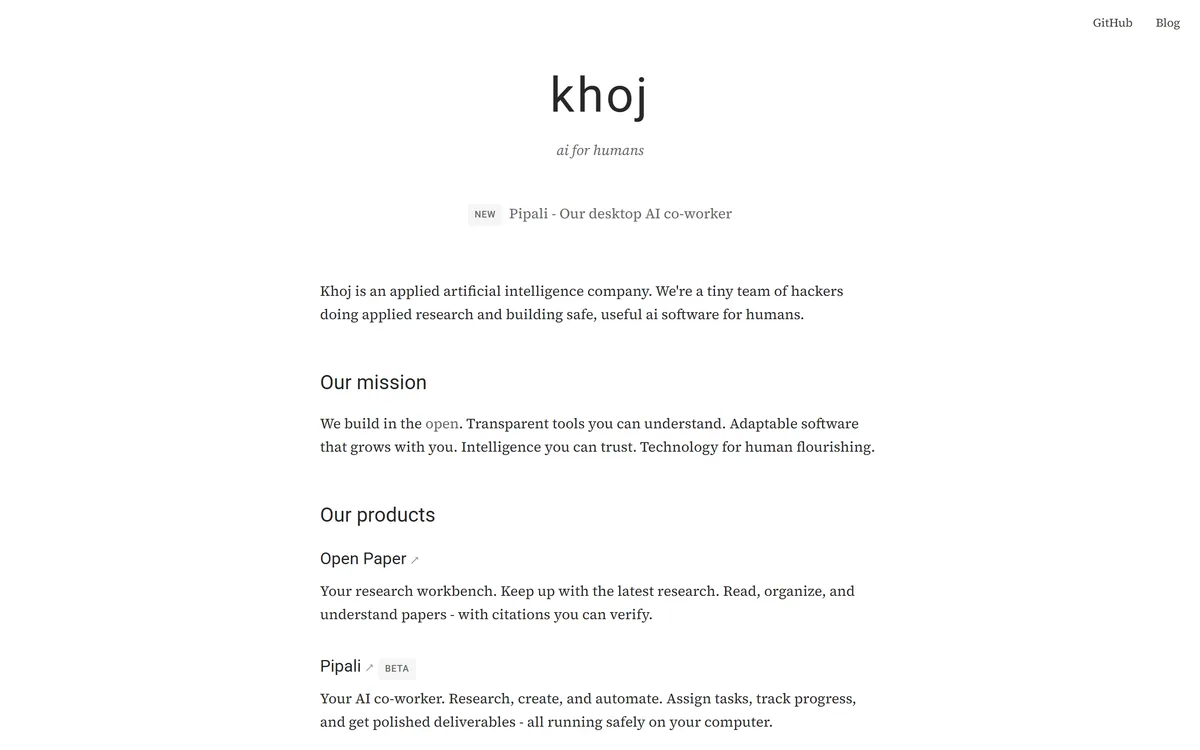
Khoj's homepage, captured 9 September 2026, showing Open Paper, Pipali and the Khoj app.
What Does Building In The Open Buy You?
Khoj states its mission as building in the open — transparent tools you can understand, adaptable software that grows with you, intelligence you can trust, technology for human flourishing.
That is a values statement, and values statements are cheap. What makes this one checkable is the word transparent, because transparency is either present in the repository or it is not.
The practical benefits are concrete rather than ideological. You can see what the software does with your data, you can run it yourself if the company changes direction, and you are not dependent on a pricing decision made by someone else.
The adaptability claim matters most for the second-brain use case. An assistant over your own documents is only useful if it fits how you actually organise things, and closed products impose their model of that on you.
The honest counterweight is that open does not mean maintained. Software you can run yourself is still software somebody has to update, and a small team's open project can go quiet in a way a funded product usually does not — which is worth weighing against tools like GitBook that make the opposite trade.
Open does not mean maintained. Software you can run yourself is still software somebody has to update.
Why Local Execution Matters For Agents
Pipali is described as an AI co-worker that researches, creates and automates, with tasks running safely on your own computer.
Running on your machine changes two things, and the second is the important one.
The obvious change is privacy: material never leaves the device, which resolves the whole class of questions about retention, training use and jurisdiction that hosted assistants raise.
The subtler change is capability. An agent on your computer can open your files, use your applications and act in your actual environment — which is what people actually want from a co-worker, and what a hosted assistant fundamentally cannot do without you uploading everything first.
The costs are real too: it consumes your machine's resources, it is limited by what your hardware can run, and an agent with genuine access to your filesystem is a different risk profile from one confined to a chat window. Browser-driving agents such as Simular face the same trade from the other direction.
Open Paper, Pipali And The Khoj App
The three products target genuinely different problems, and picking the wrong one is the most likely way to be disappointed.
Open Paper is a research workbench — keeping up with literature, reading, organising and understanding papers, with citations you can verify. The verification part is what makes it a research tool rather than a summariser, because in academic work a citation you cannot check is worthless.
Pipali is the agent: assign tasks, track progress, get polished deliverables, locally. It is the most ambitious of the three and it is in beta, which the site labels honestly.
The Khoj app is the assistant layer — build agents, schedule automations, research across your documents and the web, turning any AI model into a personal assistant. Model-agnostic is the notable part, since it means you are not committed to one provider's roadmap.
The split is unusually clean. Most companies would have shipped these as three modes of one product and made all three worse; keeping them separate means each can assume something specific about what you are doing.
Pick the product by the job, not by the brand — the three barely overlap.
Use Open Paper where citation verification is the point, not summarisation.
Treat Pipali as beta software with real filesystem access.
Check what hardware local execution actually needs before committing.
Prefer model-agnostic assistants if provider lock-in worries you.
Reading Citations You Can Actually Verify
Open Paper's stated promise — citations you can verify — sounds modest and is the entire difference between a research tool and a liability.
The failure it addresses is specific. General assistants summarising academic literature produce fluent paragraphs attached to references that may be approximate, misattributed, or entirely invented, and the fluency is what makes it dangerous.
In academic and clinical work that is not a minor inconvenience. A citation is a claim that a specific finding exists in a specific place, and one that does not survive checking undermines everything around it.
Verifiable citation means the link from assertion to source is preserved and clickable, so checking is a second rather than an afternoon. Verification friction determines whether verification happens.
It is the same structural principle grounded legal AI relies on — the reason CoCounsel makes so much of linked authority — applied to research literature, where the volume is higher and the checking is done by people with less time.
The Risk Of A Tiny Team
Khoj describes itself as a tiny team of hackers doing applied research, which is refreshing and also the main thing a buyer should weigh.
Three products from a small team is a lot of surface area. Each needs maintenance, security updates and support, and small teams historically ship the interesting product and let the other two drift.
That is not a criticism so much as a planning input. It suggests picking the product that is clearly the company's centre of gravity and treating the others as bonuses rather than dependencies.
The open-source posture mitigates this considerably. If a product goes quiet you retain the ability to run it, which is a meaningfully better position than a hosted service being switched off with ninety days' notice.
The mitigation is not complete, though: running abandoned software yourself is a real cost, and it usually arrives at the least convenient time. Budget for that possibility rather than assuming it away.
Choosing Between Khoj's Three Products
The mistake with a multi-product company is signing up for the brand and then finding the wrong tool in front of you.
This sequence picks by the job and tests the specific claim each product rests on.
Decide which problem you have — reading papers, automating desktop work, or searching your own documents.
For Open Paper, test citation verification on a paper you already know well.
For Pipali, check the hardware requirements before assuming your machine can run it.
Give a beta agent a low-stakes task first, since it has real access to your files.
For the Khoj app, connect one document source and test retrieval before adding more.
Check the repository's recent activity, since open only helps if somebody is maintaining it.
Khoj: Three Products, Built In The Open
Open Paper — a research workbench for reading and organising papers, with citations you can verify.
Pipali (beta) — a desktop AI co-worker that runs safely on your own computer rather than in a datacentre.
The Khoj app — a second brain with agents, scheduled automations and research across your docs and the web.
Built in the open, with transparency and adaptability stated as the company's mission rather than a feature.
A tiny team, self-described as hackers doing applied research — which is both the appeal and the risk.
Khoj: Products And Company
Company
Khoj, described as an applied artificial intelligence company
Team
Self-described as a tiny team of hackers doing applied research
Approach
Building in the open
Open Paper
A research workbench for reading, organising and understanding papers, with verifiable citations
Pipali
A desktop AI co-worker running on your own computer, in beta
Khoj app
A second brain with agents, scheduled automations and research across docs and the web
Model support
Turns any AI model into a personal assistant, per the site
Mission language
Transparent tools, adaptable software, intelligence you can trust
What we could not confirm: pricing for any of the three products, or which are free; the operating entity and its jurisdiction, which the footer gives only as a product name; which models are supported and what hardware local execution requires; what licence the open-source components carry; how the Khoj app indexes documents and where that index lives; and how actively each of the three repositories is maintained, which is the question the open-source posture makes most important. We did not install anything.
Editor's Verdict
4.1/5
Khoj describes itself as a tiny team of hackers doing applied research and building in the open, and everything about the product line follows from that. The three products are unusually well differentiated — a research workbench with verifiable citations, a desktop co-worker that runs on your own machine, and an assistant over your documents — and each targets a failure the hosted alternatives share. Local execution in particular is a real position rather than a marketing claim. What tempers the score is that a tiny team building three products is a genuine risk, and the site publishes very little about how any of them work. AInexfinder Editor Score: 4.1/5.
Khoj pricing
AInexfinder does not list plan prices or billing details. For current pricing, plans, and trials, visit the official Khoj website.
Vendor pricing, credits, and billing policies change over time. Always confirm on the official site before you buy.
Frequently asked questions
What is Khoj?
Khoj is an applied AI company building in the open. It ships three products: Open Paper, a research workbench with verifiable citations; Pipali, a desktop AI co-worker in beta that runs on your own computer; and the Khoj app, a second brain with agents and automations across your documents and the web.
Which Khoj product do I need?
They barely overlap, so pick by job. Reading and organising academic papers is Open Paper. Automating desktop work is Pipali. Searching and reasoning across your own documents is the Khoj app. Signing up for the brand and finding the wrong tool is the usual disappointment.
Why does local execution matter?
Two reasons, and the second is the bigger one. Privacy is obvious — material never leaves the device. But an agent on your machine can also open your files, use your applications and act in your real environment, which is what people actually want and hosted assistants cannot do.
What is the downside of running locally?
It consumes your machine's resources, is limited by what your hardware can run, and gives an agent genuine filesystem access — a materially different risk profile from a chat window. Give a beta agent low-stakes tasks first.
Why do verifiable citations matter?
Because general assistants summarising literature produce fluent paragraphs attached to references that may be approximate, misattributed or invented — and fluency is what makes that dangerous. A citation is a claim that a finding exists in a specific place; one that fails checking undermines everything near it.
Does building in the open actually help me?
Concretely, yes: you can see what the software does with your data, run it yourself if the company changes direction, and avoid depending on someone else's pricing decision. The counterweight is that open does not mean maintained.
Is a tiny team a problem?
It is a planning input rather than a disqualifier. Three products is a lot of surface area for a small team, and small teams historically ship the interesting one and let the others drift. Pick the product that is clearly the centre of gravity and treat the rest as bonuses.
What does model-agnostic mean here?
The Khoj app is described as turning any AI model into a personal assistant, so you are not committed to one provider's roadmap, pricing or availability. That matters more over multi-year horizons than any single model's current capability.
How should I evaluate it?
Test the specific claim each product rests on. For Open Paper, check citation verification on a paper you already know. For Pipali, check hardware requirements first. For the app, connect one document source and test retrieval before adding more.
What should I check before relying on it?
Recent repository activity. The open-source posture is the main protection against a small team's product going quiet, and it only helps if somebody is actually maintaining the code you would be inheriting.
Daniel reviews AI tools the slow way — by actually using them on real projects. His reviews cover what works, what breaks, and who each tool is genuinely a good fit for.
Daniel and the AInexfinder editorial team research Khoj using public product information, listing evidence, and (when available) hands-on checks. Scores reflect listing completeness and transparency — not paid placement.
Listings may include affiliate or sponsored placements, which are labeled when present. Editorial scores and cons are not sold. See our affiliate disclosure and review methodology.
Claude is Anthropic's AI assistant, available on web, desktop, mobile, and in Chrome, with Projects for persistent context, Artifacts for generated documents and apps, Skills, Connectors, and Claude Code for developers.
Perplexity AI is an answer engine that runs live web searches and returns cited answers, with Deep Research for long agentic reports, Spaces for persistent projects, the Comet browser, and the Sonar API for developers.
ChatGPT is OpenAI's AI assistant, covering conversation, document and image work, web browsing, Projects, Tasks, custom GPTs, agent actions, and the Codex coding agent, across web, desktop, and mobile.
JAIS Chat is a bilingual Arabic and English conversational assistant launched by Core42, part of the UAE's G42 group. It runs on the Jais family of Arabic large language models developed by Inception with MBZUAI and Cerebras, and is built to handle Arabic dialects and cultural context rather than translated English.
Kimi is Moonshot AI's assistant, running on its K3 model and positioned for agentic coding and knowledge work. Its interface opens on a set of output surfaces — slides, sheets, documents, websites, design, deep research and a multi-agent Swarm — alongside scheduled tasks, projects and a desktop app.
Reka is an AI research lab building omni models — Spark, Edge, Flash and Core — that process video, image, audio and text in a single architecture rather than bolting modalities together. It also runs Reka Cloud for training and deployment, video infrastructure available by API or MCP, and a training-data division.