Reka is an AI research lab building omni models — Spark, Edge, Flash and Core — that process video, image, audio and text in a single architecture rather than bolting modalities together. It also runs Reka Cloud for training and deployment, video infrastructure available by API or MCP, and a training-data division.
Almost every well-known AI model — Claude and Gemini included — started as text and had other senses added later. Vision was bolted on, audio was bolted on, and the result works well while quietly betraying its origin: the system reasons in language and translates everything else into it first.
That distinction has consequences for anything involving the physical world. Understanding a video is not reading a description of frames; it involves motion, timing, sound and the relationship between them, and a model that converts all of that into text before thinking about it loses most of what mattered.
Reka's position is that models should be multimodal from the start. Whether that produces measurably better results is the question the company's public materials do not currently answer — but the bet itself is coherent, and the people making it have relevant history.
What Does Reka Build?
Natively multimodal models — Spark, Edge, Flash and Core — that process video, image, audio and text in one architecture rather than stitching separate models together.
The stated goal is the physical world, not the chat window: foundational intelligence for things that see and hear rather than assistants that read.
Video infrastructure is a distinct product: tagging, reasoning over, searching and clipping large volumes of video, available by API, MCP or an app.
Reka Cloud handles training and deployment of models on its own infrastructure.
The team is the credential — more than 50 researchers and engineers from Google DeepMind and Meta, including people who worked on Gemini and Veo.
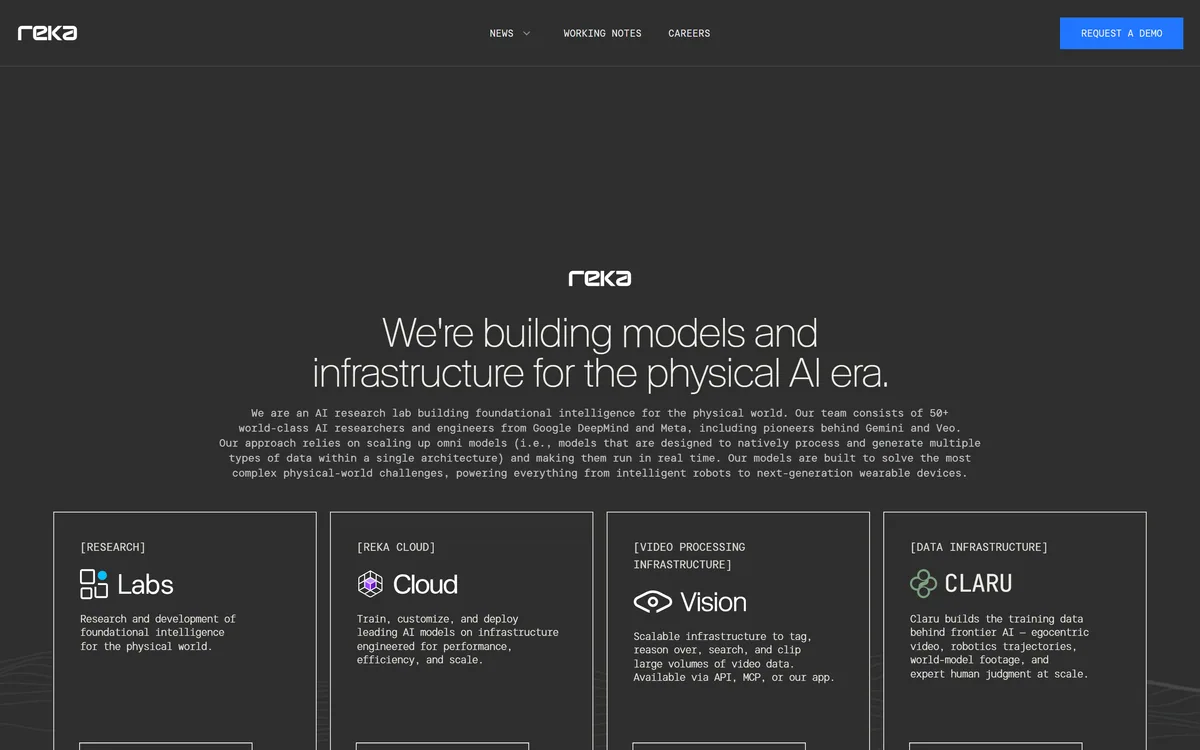
Reka's homepage, captured 9 September 2026. The framing is a research lab building for the physical world rather than a product company selling an assistant.
What Does Natively Multimodal Actually Mean?
Reka describes building omni models that process multiple data types within a single architecture for real-time performance, across video, image, audio and text.
The distinction matters and is worth making concrete. A pipeline approach handles video by extracting frames, captioning them with a vision model, transcribing the audio with a speech model, and giving a language model the resulting text. It works, and it throws away almost everything that made it video: the timing between a sound and a movement, the way something accelerates, the fact that two things happened at once.
A natively multimodal model takes the modalities together, so those relationships remain available to it. In principle that is what allows a model to answer questions a pipeline structurally cannot — whether an action looks unsafe, whether a sound came from the thing on screen, whether a sequence happened in the order someone claims.
The real-time framing points at the same target. A pipeline accumulates latency at every stage, which is fatal for anything reacting to the world as it happens.
The honest position for a reader is that this is architecturally sound and, from public materials, unquantified. No benchmarks are published on the site, so how much the approach buys in practice remains an open question you would have to test.
A pipeline that captions frames and transcribes audio has already discarded the thing that made it video: what happened at the same time as what.
Why Four Models Rather Than One?
Reka names Spark, Edge, Flash and Core, and a range like that tells you more about the intended use than any single flagship would.
The naming follows a convention now common across the industry — a small model for constrained environments, mid-sized models trading capability against speed and cost, and a flagship for the hardest work.
Edge is the interesting one given the company's stated focus. A model built to run on a device rather than in a data centre is what robotics, cameras and industrial sensing actually need, because those settings have latency budgets measured in milliseconds and often no reliable network at all.
For a buyer, the practical question is where the boundaries fall: what Edge can do that Spark cannot, what you give up choosing Flash over Core. None of that is published, so it becomes a conversation with the company rather than something you can evaluate in advance.
Video Infrastructure Is The Concrete Product
Alongside the models, Reka offers infrastructure to tag, reason over, search and clip large volumes of video, available via API, MCP or its own app.
This is the most immediately usable thing the company sells, and it addresses a genuinely unsolved problem. Organisations accumulate enormous video archives — security footage, broadcast libraries, recorded operations, inspection footage — and almost none of it is searchable in any meaningful way. Finding the moment something happened means someone watching, which at scale means it never happens.
Search that understands content rather than filenames changes what an archive is, in a way generation tools such as Runway ML do not address at all. Asking for every instance of a particular activity, or every clip where two things co-occur, turns storage into something you can query.
MCP support is a forward-looking inclusion, because it means an AI agent can query the video layer directly rather than through a bespoke integration.
The questions to ask before committing are the ones the site does not answer: how long indexing takes for a given volume, what accuracy looks like on your kind of footage, and — for security and industrial video especially — where the data sits and who can reach it.
Test on your worst footage, not a demo reel: low light, compression artefacts, poor angles.
Measure indexing time against a realistic archive size before assuming it scales.
Establish where video is processed and stored, which for security footage is a governance question.
Check whether search recall or precision matters more for your use, and test the one you care about.
Confirm what happens to your index if you stop paying, since re-indexing an archive is not free.
Who Is Actually Behind Reka?
The site states more than 50 researchers and engineers from Google DeepMind and Meta, including pioneers behind Gemini and Veo.
For a research lab this is a more meaningful credential than a customer logo wall would be, and it should be read for what it is. Building frontier multimodal models is not a matter of applying known techniques; it is a small field, and the people who have actually shipped a frontier video model are countable. A team drawn from that group has done the thing before.
It also explains the company's shape. Alongside the models sit Reka Cloud for training and deployment and a data division, CLARU, supplying training data — egocentric video, robotics trajectories, world-model footage. That vertical spread is what a lab builds when it intends to control the whole chain rather than fine-tune someone else's weights.
The data division is a genuine strategic asset. Egocentric video and robotics trajectories are exactly the data that is scarce for physical-world models and cannot simply be scraped, and owning that supply is a durable advantage in a way a model architecture is not.
What the credential does not tell you is what the models can currently do, and no benchmark on the site answers that.
Evaluating Reka Without Published Benchmarks
With no benchmarks, context lengths or pricing published, evaluation has to happen through the company. That is normal for a lab selling to enterprises, and it means going in with your own tests rather than reacting to theirs.
The bar is step three. A natively multimodal model should beat a pipeline on questions about timing and co-occurrence; if it does not, the architectural argument is not paying off for your use.
Prepare your own evaluation set before any demo — twenty clips from your real footage with known answers you wrote down first.
Include questions a captioning pipeline would fail: what happened at the same time as something else, whether a sound matches the action, what order events occurred in.
Run the same set against a conventional pipeline you already use. The gap between them is the entire case for native multimodality.
Ask directly for context length, latency figures and the capability boundaries between Spark, Edge, Flash and Core, since none is published.
If you need on-device inference, establish exactly what hardware Edge runs on and what it gives up against Flash.
Get data residency, retention and training-use terms in writing before any real footage leaves your network.
What Reka Does Not Publish
It is worth being direct about the gaps, because they are the reason this listing scores where it does rather than higher.
No context lengths are stated for any model. No benchmarks or evaluation results appear on the site. There is no statement about whether any weights are open or self-hostable, which for a company targeting edge and robotics is a question buyers will certainly ask. No pricing exists in public. No customer names appear. No funding detail is given.
None of that is unusual for a research lab at this stage, and several of these are ordinarily settled in a sales conversation. But the aggregate effect is that a prospective buyer can read the entire site and still not know what they would be getting.
There is a Trust Center in the footer alongside terms, privacy and responsible AI pages, which is where security and compliance answers would live — worth reading before a demo rather than after.
The practical consequence is that Reka is currently a company you evaluate by talking to, not by reading. For an enterprise procurement that is manageable; for a developer wanting to try something this afternoon, it is a closed door.
Multimodal Model Vocabulary
Four terms that explain what Reka is claiming and why it would matter.
Natively multimodal
A single model architecture trained across modalities together, rather than separate models chained by text. Preserves timing and co-occurrence, which pipelines discard.
Omni model
Reka's term for a model handling video, image, audio and text in one system. In practice a synonym for natively multimodal, used to distinguish from vision-plus-language models.
Edge inference
Running a model on a device rather than in a data centre. Necessary where latency budgets are milliseconds or the network is unreliable — robotics, cameras, vehicles.
Egocentric video
Footage captured from a first-person viewpoint, as a person or robot sees it. Scarce, hard to scrape, and among the most valuable training data for physical-world models.
Reka's Model Line, Listed
Company type
AI research lab building foundational models
Stated focus
Foundational intelligence for the physical world
Models
Spark, Edge, Flash and Core (with Edge 2 referenced)
Modalities
Video, image, audio and text, processed natively together
Video infrastructure
Tag, reason over, search and clip large volumes of video
Video access
API, MCP, or Reka's own app
Cloud offering
Reka Cloud for training, customising and deploying models
Your problem is understanding video at volume — security, broadcast, inspection or operational footage nobody can watch.
You need inference on a device rather than in a data centre, where Edge is the point of the range.
Your questions involve timing and co-occurrence, which captioning pipelines structurally cannot answer.
You are building for robotics or physical sensing, which is the company's stated target rather than an afterthought.
You can run an enterprise evaluation, since there is no self-serve path to try anything.
Not worth pursuing when
You want an assistant for writing, coding or analysis, where established general models are far better documented.
You need published specifications to make a decision, since context lengths, benchmarks and pricing are all absent.
You want to try something today — there is no self-serve access on the pages we read.
You need generative video rather than video understanding, which is a different category entirely.
Your procurement requires an open-weights or self-hosting option, which is not addressed publicly.
Other Model Providers And Video Tools
Compare on what a model was built to do — analysis and generation are different problems that share a modality.
Gemini — the best-documented multimodal alternative, with public pricing and specifications
Claude — stronger for reasoning and writing, if the physical world is not your problem
Runway ML — video generation rather than video understanding
Inworld AI — real-time interactive systems, an adjacent physical-adjacent use
AssemblyAI — if the modality you actually need understood is audio
Checking Reka's Public Claims
Last checked . Read from reka.ai, including the footer, with the screenshot above captured in the same session.
Company described as an AI research lab building foundational intelligence for the physical world
Models named on the site as Spark, Edge, Flash and Core, with Edge 2 also referenced
Models described as natively multimodal omni models processing video, image, audio and text within single architectures for real-time performance
Reka Cloud described as training, customising and deploying models on its own infrastructure
Video infrastructure described as tagging, reasoning over, searching and clipping large volumes of video, available via API, MCP or the company's app
Data division CLARU described as supplying training data including egocentric video, robotics trajectories and world-model footage
Team stated as more than 50 researchers and engineers from Google DeepMind and Meta, including people who worked on Gemini and Veo
Footer read directly and confirmed to carry Careers, Documentation, Trust Center, Terms, Privacy Policy and Responsible AI Ethics
What we could not confirm: no context lengths are stated for any model; no benchmarks or evaluation results are published; there is no statement on open weights or self-hosting, which matters for a company targeting edge deployment; no pricing, customer names or funding detail appears on the pages we read; no company legal name or headquarters is given; and there is no self-serve access, so nothing here reflects tested model performance.
Editor's Verdict
4.0/5
Reka scores well because it is pursuing something structurally different from the assistant race: models that handle video, image, audio and text inside one architecture rather than chaining separate systems, aimed at the physical world rather than the chat window. A four-model line spanning edge devices to a flagship is the right shape for that, and a team drawn from the people who built Gemini and Veo is a real signal. It loses ground because almost nothing a buyer needs is published — no context lengths, no benchmarks, no open-weights position, no pricing — so the site tells you what Reka believes but not what you would actually be getting. AInexfinder Editor Score: 4.0/5.
Reka pricing
AInexfinder does not list plan prices or billing details. For current pricing, plans, and trials, visit the official Reka website.
Vendor pricing, credits, and billing policies change over time. Always confirm on the official site before you buy.
Frequently asked questions
What is Reka?
Reka is an AI research lab building natively multimodal models — Spark, Edge, Flash and Core — that process video, image, audio and text within a single architecture. It also sells video infrastructure for tagging, searching and clipping large archives, runs Reka Cloud for training and deployment, and operates a training-data division called CLARU.
What does natively multimodal mean?
It means one model trained across modalities together, rather than separate models chained by text. A pipeline handles video by captioning frames and transcribing audio, which discards timing and co-occurrence — what happened at the same time as what. A native model keeps those relationships available, which is what allows questions a pipeline structurally cannot answer.
Which Reka model should I use?
The range runs Spark, Edge, Flash and Core, following the industry convention of small through to flagship. Edge is the notable one, built for on-device inference where latency budgets are milliseconds or the network is unreliable. The capability boundaries between them are not published, so this becomes a conversation with the company rather than a specification you can read.
Is Reka free, and how much does it cost?
No pricing is published on the pages we read, and there is no self-serve access. Evaluation goes through the company. That is normal for a research lab selling to enterprises, but it means a developer cannot try anything today, and it is the main practical barrier to considering Reka against better-documented alternatives.
Are Reka's models open source?
The site makes no statement about open weights or self-hosting on the pages we read. That gap matters more for Reka than for most labs, because a company targeting edge devices and robotics will be asked about on-device deployment as the first question — ask it directly before assuming either answer.
How does Reka compare with Gemini?
Gemini is a general-purpose multimodal assistant with public documentation, pricing and benchmarks. Reka is aimed at physical-world understanding, including edge deployment, and publishes almost none of those. If you need documented specifications to decide, Gemini is evaluable today; Reka requires a conversation, and its argument is architectural focus rather than breadth.
What is Reka's video infrastructure for?
Making large video archives searchable by content rather than by filename — tagging, reasoning over, searching and clipping. It targets a real gap: security footage, broadcast libraries, inspection and operational video accumulate endlessly and are effectively unsearchable, so finding a moment means someone watching, which at scale never happens.
How good are Reka's models?
There is no public basis for an answer — no benchmarks or evaluation results appear on the site. The architectural argument is coherent, and the team's history at Google DeepMind and Meta is a substantive credential, but neither tells you what the models currently do. Bring your own evaluation set to any demo rather than reacting to theirs.
Who founded Reka and who works there?
The site states a team of more than 50 researchers and engineers drawn from Google DeepMind and Meta, including people who worked on Gemini and Veo. In frontier multimodal modelling that is a meaningful signal, because the group of people who have actually shipped such a model is small. No company legal name or headquarters is published.
Is Reka suitable for a startup?
Probably not yet, unless your problem is specifically physical-world video understanding and you can run an enterprise evaluation. With no self-serve access, no published pricing and no benchmarks, the friction of adoption is high. A startup wanting multimodal capability today will move faster with a documented general model.
Daniel reviews AI tools the slow way — by actually using them on real projects. His reviews cover what works, what breaks, and who each tool is genuinely a good fit for.
Daniel and the AInexfinder editorial team research Reka using public product information, listing evidence, and (when available) hands-on checks. Scores reflect listing completeness and transparency — not paid placement.
Listings may include affiliate or sponsored placements, which are labeled when present. Editorial scores and cons are not sold. See our affiliate disclosure and review methodology.
Claude is Anthropic's AI assistant, available on web, desktop, mobile, and in Chrome, with Projects for persistent context, Artifacts for generated documents and apps, Skills, Connectors, and Claude Code for developers.
Perplexity AI is an answer engine that runs live web searches and returns cited answers, with Deep Research for long agentic reports, Spaces for persistent projects, the Comet browser, and the Sonar API for developers.
ChatGPT is OpenAI's AI assistant, covering conversation, document and image work, web browsing, Projects, Tasks, custom GPTs, agent actions, and the Codex coding agent, across web, desktop, and mobile.
JAIS Chat is a bilingual Arabic and English conversational assistant launched by Core42, part of the UAE's G42 group. It runs on the Jais family of Arabic large language models developed by Inception with MBZUAI and Cerebras, and is built to handle Arabic dialects and cultural context rather than translated English.
Kimi is Moonshot AI's assistant, running on its K3 model and positioned for agentic coding and knowledge work. Its interface opens on a set of output surfaces — slides, sheets, documents, websites, design, deep research and a multi-agent Swarm — alongside scheduled tasks, projects and a desktop app.
Duck.ai is DuckDuckGo's free AI chat that gives anonymised access to a selection of popular models from major providers, with image creation and a deliberately light, privacy-first footprint. It is a privacy-focused front-end rather than its own frontier model.