Duck.ai is DuckDuckGo's free AI chat that gives anonymised access to a selection of popular models from major providers, with image creation and a deliberately light, privacy-first footprint. It is a privacy-focused front-end rather than its own frontier model.
Most AI chat tools ask you to trade some privacy for capability: your prompts are tied to an account and often used to improve the model. Duck.ai, from DuckDuckGo, is built around the opposite instinct, giving you popular models while keeping your identity out of the exchange.
It offers free, anonymised chat with a selection of models from major providers, plus image creation, in the same lightweight, privacy-first style as the rest of DuckDuckGo. It is a front-end to others' models rather than a frontier system of its own, which makes it a different proposition from an answer engine like Perplexity AI.
This review covers how Duck.ai keeps a chat private, who it fits, how it stays free, and where it leaves heavier users wanting more.
Duck.ai gives anonymised, free access to several popular AI models from DuckDuckGo.
Duck.ai, The Private-Chat Brief
Duck.ai is DuckDuckGo's privacy-first chat front-end: free access to a selection of popular models from major AI providers.
Privacy is the point: DuckDuckGo anonymises requests so the underlying providers do not see who you are.
It is a front-end, not a model: it routes to others' models rather than running its own frontier system.
It is deliberately light: quick chat and image creation, without the deep features of a full paid assistant.
Anonymised Access To Popular Models, Free
Duck.ai's core idea is to let you use well-known AI models without handing your identity to the companies behind them. DuckDuckGo sits in the middle and anonymises your requests, so the providers process your prompt but do not see who sent it, and your chats are not tied to a personal profile for advertising.
That is the whole value proposition, and it is a real one. For people who are uneasy about their prompts being linked to them or used to train models, a privacy-first layer over capable models is genuinely useful, especially for everyday questions they would rather not attach to an account.
It is important to be precise about what this does and does not mean. Anonymisation addresses who the provider sees, not a promise that no data ever touches a third party; DuckDuckGo's own privacy terms describe the arrangement, and that is what to read if the details matter to you.
So the fair framing is that Duck.ai is a privacy-conscious convenience: capable models, free, with the identifying layer stripped out, rather than a maximally private self-hosted setup. For most people that is a sensible and welcome middle ground.
Duck.ai is a privacy-conscious convenience: capable models, free, with the identifying layer stripped out, rather than a maximally private self-hosted setup.
How Does Duck.ai Keep A Chat Private?
The experience is two things: the privacy mechanics, and a deliberately small feature set around them.
Anonymised Requests And Several Models
Duck.ai lets you pick from a selection of popular models from major providers and routes your request through DuckDuckGo so the provider does not receive your identity. DuckDuckGo states it does not use your chats to train models and has agreements limiting the providers' retention, which is the substance behind the privacy claim.
Because it is a front-end, you are using the same families of models you would elsewhere, just without the account linkage. If your need is cited answers from the live web rather than private chat, a search-first tool such as Exa solves a different problem; Duck.ai is about private conversation with general models.
Image Creation And A Deliberately Light Footprint
Alongside text chat, Duck.ai includes AI image creation, and the whole thing is kept intentionally lightweight: fast to open, simple to use, without the plugins, memory and deep integrations of a full paid assistant. That minimalism is a feature for its audience, not a gap.
The trade-off is that power users will hit limits quickly. There is no deep document workspace or research pipeline; for structured research you would still reach for something like Consensus. Duck.ai is for quick, private interactions, and it is honest about being exactly that.
Who Duck.ai Fits Among Chat Users
Duck.ai suits privacy-conscious people who want to use capable AI models for everyday questions without tying those prompts to a personal account, and who value DuckDuckGo's track record on not profiling users. For quick, private chat it is an easy, free choice.
It also suits anyone who wants a no-friction way to try several popular models side by side without separate sign-ups, and people who like the light, fast, unbundled experience rather than a feature-heavy assistant.
It fits less well power users who need memory, file handling, long context projects or deep integrations, and anyone who needs the very latest frontier features the moment they ship, since a front-end offers a curated, sometimes trailing, selection. The exact model lineup changes, so check the app for what is currently offered.
How Duck.ai Stays Free To Use
Duck.ai is free, in keeping with DuckDuckGo's model of funding its products through privacy-respecting search advertising rather than charging per chat. There is no price to reproduce here because, at the level reviewed, it is simply free to use.
The value question is therefore unusually simple: if the privacy model and the available models meet your needs, the cost is zero, which is a strong position for everyday use. The limits are on features and model choice, not on your wallet.
The sensible way to think about it is as a free, private default for quick AI questions, with a paid, feature-rich assistant kept in reserve for the heavier work where Duck.ai's deliberate minimalism runs out.
An Easy Way To Try Duck.ai
Because it is free and light, trying Duck.ai is low-commitment; judge it on privacy comfort and whether the models meet your everyday needs.
Open Duck.ai and ask a few of the everyday questions you would normally type into a chatbot.
Switch between the available models and compare the answers on your own tasks.
Read DuckDuckGo's privacy terms so you understand exactly what anonymisation covers.
Try the image creation if that is useful to you.
Note where you hit a wall: memory, files, long context or integrations.
Pass/fail: Duck.ai is right if its privacy model and light feature set fit your everyday use.
Keep a fuller assistant for the heavier work Duck.ai is deliberately not built for.
Duck.ai Privacy Facts
What it is
DuckDuckGo's privacy-first AI chat front-end
Models
A selection of popular models from major providers
Privacy
Requests anonymised so providers do not see who you are
Cost
Free to use
Images
AI image creation included
Account
Usable without the usual personal sign-in friction
Nature
A front-end, not its own frontier model
Specifics
Exact model lineup changes; check the app
Key features of Duck.ai
Anonymised AI chat
Selection of popular models
Free to use
AI image creation
Lightweight, fast interface
No profiling of chats
Low sign-in friction
DuckDuckGo privacy backing
Pros & cons
Pros
5
Genuine privacy-first approach
Free access to capable models
Simple and fast to use
Try several models in one place
Backed by DuckDuckGo's privacy record
Cons
5
A front-end, not its own frontier model
No memory, files or long-context projects
Limited integrations and advanced features
Model lineup can trail the newest releases
Anonymisation is not self-hosted privacy
Best For
Private everyday chat
Privacy-conscious users
Trying multiple models free
Light, quick questions
No-account AI use
Duck.ai Compared With Other Chat Front-Ends
The useful comparison is with other ways to get AI answers, by what each optimises for.
People who want to try several models without sign-ups
Fans of a light, fast, unbundled experience
Those happy with a free, no-friction default
When Duck.ai Leaves You Wanting More
Power users needing memory, files or long context
People wanting deep integrations and plugins
Anyone needing the newest frontier features immediately
Users who want a dedicated cited-answer research engine
Those needing maximal, self-hosted privacy guarantees
How We Sampled Duck.ai
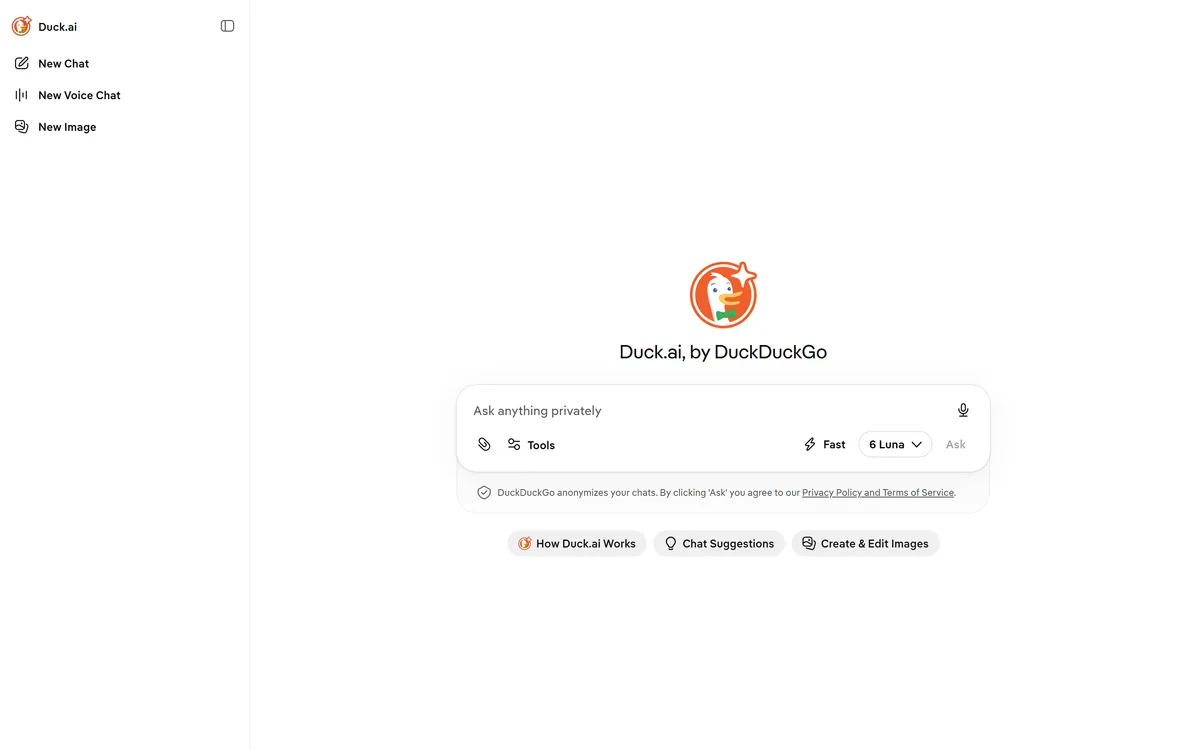
Last checked . Read from duck.ai during this check, with the screenshot above captured at the same time.
DuckDuckGo's privacy-first AI chat front-end
Free access to a selection of popular models
Requests anonymised so providers do not see your identity
AI image creation included
A deliberately light, simple interface
A front-end to others' models, not its own frontier model
Privacy handling described in DuckDuckGo's terms
An exact model lineup that changes over time
No price to reproduce, as the reviewed service is free
Duck.ai anonymises who the provider sees; read DuckDuckGo's privacy terms for the exact arrangement. It is a lightweight front-end, not a full assistant, and its model lineup changes, so check the app for what is currently offered.
Other Chat And Privacy Tools
An answer engine, a search API and a research tool to weigh alongside Duck.ai.
Duck.ai earns 4.0 as a clean, honest execution of a specific idea: free, anonymised access to a selection of popular AI models, backed by DuckDuckGo's privacy record, with image creation and a deliberately light footprint. It is a front-end rather than a frontier model, so power users will quickly outgrow its lack of memory, files and deep integrations, and its model lineup can trail the newest releases. But as a private, free default for everyday AI questions, it does exactly what it sets out to do. AInexfinder Editor Score: 4.0/5.
Duck.ai pricing
AInexfinder does not list plan prices or billing details. For current pricing, plans, and trials, visit the official Duck.ai website.
Vendor pricing, credits, and billing policies change over time. Always confirm on the official site before you buy.
Frequently asked questions
What is Duck.ai?
Duck.ai is DuckDuckGo's free, privacy-first AI chat. It gives anonymised access to a selection of popular models from major providers, plus AI image creation, in a deliberately lightweight interface. It is a front-end to others' models rather than its own frontier system.
Is Duck.ai really private?
DuckDuckGo anonymises your requests so the underlying providers do not see who you are, states it does not use your chats to train models, and has agreements limiting provider retention. That addresses who sees your identity; read DuckDuckGo's privacy terms for the exact details.
Is Duck.ai free?
Yes. At the level reviewed, Duck.ai is free to use, in keeping with DuckDuckGo's model of funding products through privacy-respecting search advertising rather than charging per chat. The limits are on features and model choice, not on cost.
Which models does Duck.ai use?
It offers a curated selection of popular models from major AI providers, letting you switch between them. The exact lineup changes over time as providers and versions update, so check the app for what is currently available rather than relying on a fixed list.
Does Duck.ai have its own AI model?
No. Duck.ai is a front-end that routes your chat to models from other providers while anonymising the request. You are using the same families of models you might elsewhere, but without your identity being attached to the conversation.
Can Duck.ai create images?
Yes, it includes AI image creation alongside text chat. Like the rest of the product, the image feature is kept simple and quick rather than offering the deep controls of a dedicated image-generation tool, in line with its lightweight design.
Who is Duck.ai best for?
Privacy-conscious people who want capable AI for everyday questions without tying prompts to a profile, and anyone who likes a light, fast, free experience. It is less suited to power users needing memory, file handling, long context or deep integrations.
What are Duck.ai's main limitations?
It is deliberately minimal: no memory, no file workspace, no long-context projects and limited integrations, and its curated model lineup can trail the newest frontier releases. For heavier work you would keep a fuller paid assistant alongside it.
Is Duck.ai as private as self-hosting?
No. Anonymisation keeps your identity from the providers and avoids profiling, which is a strong middle ground, but it still routes prompts to third-party models. If you need maximal privacy with no third party involved, a self-hosted open-weight model is the stricter option.
Can I use Duck.ai for sensitive or confidential work?
Its anonymisation keeps your identity from the providers and avoids profiling, which helps for everyday privacy, but prompts still reach third-party models. For genuinely sensitive or confidential material, read DuckDuckGo's terms and consider whether any third-party model is appropriate, or use a self-hosted option for the strictest control.
Daniel reviews AI tools the slow way — by actually using them on real projects. His reviews cover what works, what breaks, and who each tool is genuinely a good fit for.
Daniel and the AInexfinder editorial team research Duck.ai using public product information, listing evidence, and (when available) hands-on checks. Scores reflect listing completeness and transparency — not paid placement.
Listings may include affiliate or sponsored placements, which are labeled when present. Editorial scores and cons are not sold. See our affiliate disclosure and review methodology.
Claude is Anthropic's AI assistant, available on web, desktop, mobile, and in Chrome, with Projects for persistent context, Artifacts for generated documents and apps, Skills, Connectors, and Claude Code for developers.
Perplexity AI is an answer engine that runs live web searches and returns cited answers, with Deep Research for long agentic reports, Spaces for persistent projects, the Comet browser, and the Sonar API for developers.
ChatGPT is OpenAI's AI assistant, covering conversation, document and image work, web browsing, Projects, Tasks, custom GPTs, agent actions, and the Codex coding agent, across web, desktop, and mobile.
JAIS Chat is a bilingual Arabic and English conversational assistant launched by Core42, part of the UAE's G42 group. It runs on the Jais family of Arabic large language models developed by Inception with MBZUAI and Cerebras, and is built to handle Arabic dialects and cultural context rather than translated English.
Kimi is Moonshot AI's assistant, running on its K3 model and positioned for agentic coding and knowledge work. Its interface opens on a set of output surfaces — slides, sheets, documents, websites, design, deep research and a multi-agent Swarm — alongside scheduled tasks, projects and a desktop app.
Reka is an AI research lab building omni models — Spark, Edge, Flash and Core — that process video, image, audio and text in a single architecture rather than bolting modalities together. It also runs Reka Cloud for training and deployment, video infrastructure available by API or MCP, and a training-data division.