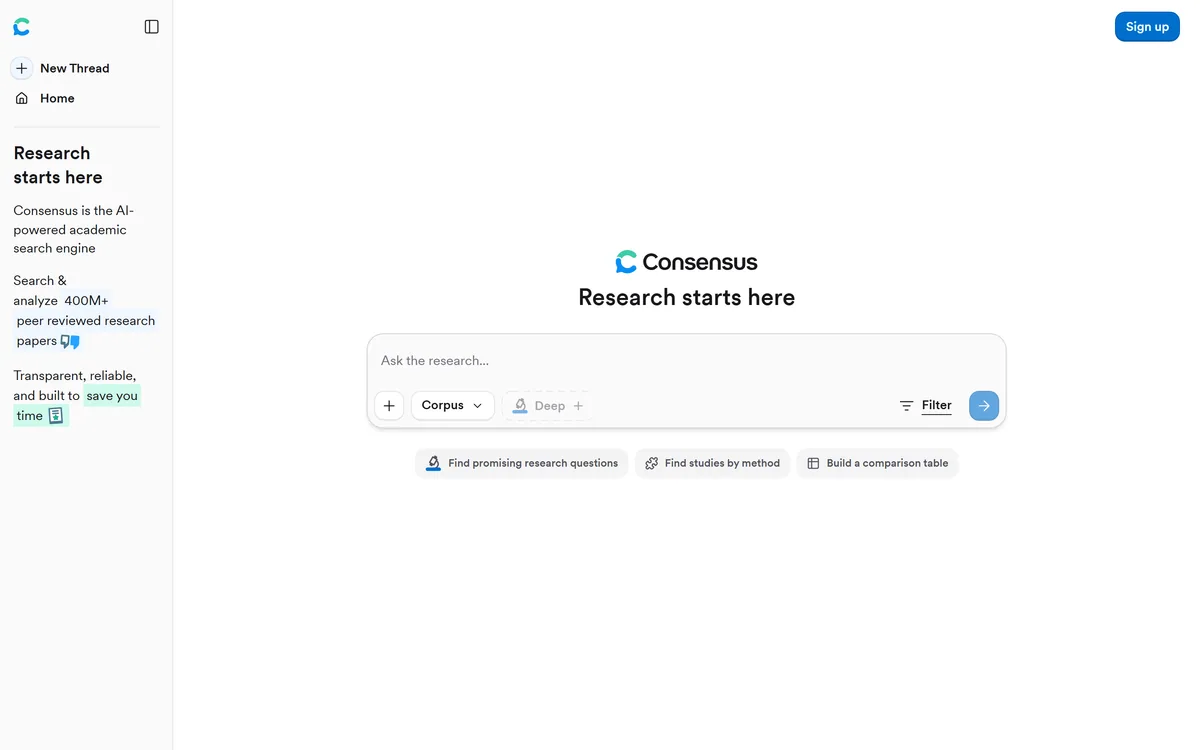
Consensus is an AI-powered academic search engine that searches and analyses hundreds of millions of peer-reviewed research papers, with a Deep Search that automates literature review, a Medical mode for clinical sources, and natural-language filters, used across university libraries.
consensus.app7 viewsAdded December 8, 2025268K visitors
General AI search will confidently answer a research question from whatever is on the open web. Consensus takes a stricter path: answer from peer-reviewed literature, and show the papers.
It is an AI academic search engine over hundreds of millions of research papers, with a Deep Search that automates literature review, a Medical mode for clinical sources, and natural-language filters, used across 170+ university libraries. It sits among research tools like Gemini Notebook and consumer search like Perplexity AI, distinguished by its peer-reviewed foundation.
This review covers how Consensus runs a literature review, who it suits, how it prices research access, and where another tool fits better.
Consensus searches and analyses peer-reviewed literature to speed up research.
Consensus, The Research Brief
Consensus is an AI academic search engine: it searches and analyses hundreds of millions of peer-reviewed papers.
Deep Search automates literature review: building a search strategy, expanding terms and exploring the citation graph.
It is grounded in real research: drawing on peer-reviewed literature and licensed full-text content, with citations.
It has a Medical mode: narrowing to top clinical guidelines and journals for trusted medical answers.
Consensus Research Facts
What it is
An AI-powered academic search engine
Corpus
Hundreds of millions of peer-reviewed papers
Deep Search
Automated literature-review strategy
Medical mode
Top clinical guidelines and journals
Grounding
Peer-reviewed literature, with citations
Filters
Natural-language (timeframe, population, design)
Reach
170+ university libraries, 10M+ users (vendor)
Access
Freemium with paid plans
An AI Search Engine Built On Peer-Reviewed Papers
Consensus's defining choice is its corpus: instead of the open web, it searches and analyses peer-reviewed research papers, hundreds of millions of them, including licensed full-text content from leading publishers. For anyone who needs defensible answers, that foundation is the whole value.
That is the difference between a plausible answer and a cited one. Consensus is built to save research time without sacrificing academic rigour, surfacing what the literature actually says and letting you see the studies behind it.
Its adoption signals back this up: it reports partnerships with 170+ university libraries and millions of users across students, researchers and clinicians. Those are vendor-stated, but the institutional footprint is a meaningful indicator for a research tool.
The difference is between a plausible answer and a cited one. Consensus answers from peer-reviewed literature and lets you see the studies behind it.
How Does Consensus Run A Literature Review?
Two capabilities do the heavy lifting: Deep Search, and the modes and filters that keep results rigorous.
Deep Search Across Millions Of Papers
Deep Search turns days of literature review into minutes: it builds a comprehensive search strategy, expands key terms, identifies conflicting arguments and explores the citation graph, then synthesises what the research agrees and disagrees on, with sources.
That automated-review depth is where it goes beyond a search box. A source-grounded tool like Gemini Notebook works from documents you supply; Consensus brings the whole peer-reviewed corpus and the review strategy to the question.
Medical Mode And Natural-Language Filters
A Medical mode narrows to high-quality clinical sources, clinical guidelines and top medical journals, for trusted clinical answers, and natural-language filters let you specify timeframe, population, study design and more directly in the prompt, which Consensus applies automatically.
Those controls are what make it rigorous rather than merely fast. A consumer AI search like Perplexity AI answers general questions from the web; Consensus is purpose-built for evidence from the literature, which is a different and narrower job.
Who Consensus Suits Among Researchers
Consensus suits researchers, graduate students, academics and clinicians who need evidence-based answers grounded in peer-reviewed literature, and who do real literature reviews where speed without rigour is no help.
It especially suits anyone doing systematic or semi-systematic reviews, where Deep Search's strategy-building and citation-graph exploration save substantial time, and clinicians who want answers from trusted medical sources via Medical mode. The institutional library access makes it practical at universities. For discovery through an indexed citation database rather than an AI synthesis, a tool like Web of Science Research Assistant approaches the same literature from a different angle.
It suits less well someone wanting quick general-knowledge answers, where a consumer AI search is faster and broader, and anyone outside research who does not need peer-reviewed grounding. And, as always with AI, you should still read the cited papers rather than trusting a synthesis blindly.
How Consensus Prices Research Access
Consensus is freemium: a free tier to search, paid plans for more (including Deep Search and advanced use), plus institutional access through university libraries and organisation plans. We do not publish prices, which change; check the site.
For an individual researcher, the value question is whether it meaningfully speeds literature review and surfaces evidence you would otherwise miss, which for anyone doing real reviews it usually does.
Many users get it through a university library, so check whether your institution already provides access before paying individually, and use the free tier to judge the quality of its answers on your own topics.
A Neat Way To Try Consensus
Because the point is rigorous, cited answers, test Consensus on a real research question you know well.
Ask a research question in your own field and check whether the cited papers are relevant and real.
Run a Deep Search on a topic you have reviewed before and compare its synthesis to what you know.
Use natural-language filters (timeframe, population, design) and confirm it applies them correctly.
If clinical, try Medical mode and judge the quality of the sources it narrows to.
Check whether your university library already provides access before paying.
Pass/fail: Consensus is worth it if it speeds real literature review and surfaces evidence you trust.
Always read the cited papers; do not treat the synthesis as a substitute for the sources.
Consensus Research Terms
Peer-reviewed
Research that has been evaluated by other experts before publication; the standard for credible academic evidence.
Literature review
A structured survey of existing research on a topic; Deep Search automates much of the search and synthesis.
Citation graph
The network of which papers cite which; exploring it helps find key and related work.
Systematic review
A rigorous, method-driven review of all relevant studies on a question; the kind of work Deep Search can accelerate.
Key features of Consensus
Academic search over peer-reviewed papers
Deep Search literature review
Citation-graph exploration
Agreement-and-disagreement synthesis
Medical mode for clinical sources
Natural-language filters
Cited answers
University library access
Pros & cons
Pros
5
Grounded in peer-reviewed literature, with citations
Deep Search automates real literature review
Medical mode for trusted clinical answers
Natural-language filtering keeps results rigorous
Wide institutional adoption
Cons
5
Not for quick general-knowledge questions
Corpus and usage figures are vendor-stated
Still requires reading the cited sources
Narrower than open-web search by design
Best value may come via a library you already have
Best For
Researchers and academics
Graduate students
Clinicians
Systematic reviewers
University library users
Consensus Among Other Research Tools
The useful comparison is with other research and search tools, on grounding and scope.
Last checked . Read from consensus.app during this check, with the screenshot above captured at the same time.
An AI-powered academic search engine over peer-reviewed papers
A corpus of hundreds of millions of research papers
Deep Search that automates literature-review strategy
Exploration of the citation graph and conflicting arguments
A Medical mode narrowing to clinical guidelines and top journals
Natural-language filters for timeframe, population and design
Stated use across 170+ university libraries and 10M+ users
A freemium model with paid and institutional access
No plan prices reproduced here, in line with this site's pricing policy
Consensus's corpus size and usage figures are vendor-stated. As with any AI research tool, read the cited papers rather than treating the synthesis as a substitute for the sources.
Editor's Verdict
4.3/5
Consensus earns 4.3 for doing research search the rigorous way: answering from a corpus of hundreds of millions of peer-reviewed papers with citations, a Deep Search that genuinely automates literature review, a Medical mode for clinical sources, and natural-language filters that keep results evidence-based. It is narrower than open-web search by design and its corpus figures are vendor-stated, but for researchers and clinicians it is a strong, defensible tool, provided you still read the sources. AInexfinder Editor Score: 4.3/5.
Consensus pricing
AInexfinder does not list plan prices or billing details. For current pricing, plans, and trials, visit the official Consensus website.
Vendor pricing, credits, and billing policies change over time. Always confirm on the official site before you buy.
Frequently asked questions
What is Consensus?
Consensus is an AI-powered academic search engine that searches and analyses a corpus of hundreds of millions of peer-reviewed research papers, including licensed full-text content. It offers a Deep Search that automates literature review, a Medical mode for clinical sources, and natural-language filters, and is used across university libraries.
How is Consensus different from general AI search?
General AI search answers from the open web and can be confidently wrong. Consensus answers from peer-reviewed literature and shows the papers behind its answers, so you get cited, evidence-based results rather than a plausible-sounding synthesis of whatever is online. That grounding is its whole value.
What is Deep Search in Consensus?
Deep Search automates literature review: it builds a comprehensive search strategy, expands key terms, identifies conflicting arguments and explores the citation graph, then synthesises where the research agrees and disagrees, with sources. It aims to turn days of review into minutes for a defined question.
Does Consensus have a medical mode?
Yes. Its Medical mode narrows results to high-quality clinical sources, clinical guidelines and top medical journals, for trusted, quick clinical answers. It is aimed at clinicians and medical researchers who need evidence from the most reliable medical literature rather than the general corpus.
Is Consensus free?
It is freemium: a free tier to search, paid plans for more including Deep Search, and institutional access through university libraries and organisation plans. We do not publish prices; check the site, and check whether your university already provides access before paying individually.
Who is Consensus for?
Researchers, graduate students, academics and clinicians who need evidence-based answers grounded in peer-reviewed literature and who do real literature reviews. It is especially useful for systematic or semi-systematic reviews, and less suited to quick general-knowledge questions a consumer search answers faster.
Can I trust Consensus's answers?
Its answers are grounded in peer-reviewed literature and cited, which is far more defensible than open-web AI search, but you should still read the cited papers rather than treating the synthesis as a substitute. The citations are there precisely so you can verify the evidence yourself.
How big is Consensus's research corpus?
The vendor states it draws on hundreds of millions of research papers, including licensed full-text content from leading publishers, with figures cited in the 250M-400M+ range. Those numbers are vendor-stated, but the institutional adoption across 170+ university libraries supports that it is a substantial corpus.
How does Consensus compare to Gemini Notebook?
Gemini Notebook grounds answers in sources you supply, so it is about your own documents; Consensus brings the whole peer-reviewed corpus and an automated review strategy to a question. Many researchers use both: Consensus to survey the literature, a notebook to work deeply with chosen sources.
Can Consensus filter results precisely?
Yes. You can specify timeframes, populations, study designs and more in natural language directly in your prompt, and Consensus applies the right filters automatically. That lets you narrow to, say, large human studies from the past five years, which keeps results rigorous rather than merely fast.
Daniel reviews AI tools the slow way — by actually using them on real projects. His reviews cover what works, what breaks, and who each tool is genuinely a good fit for.
Daniel and the AInexfinder editorial team research Consensus using public product information, listing evidence, and (when available) hands-on checks. Scores reflect listing completeness and transparency — not paid placement.
Listings may include affiliate or sponsored placements, which are labeled when present. Editorial scores and cons are not sold. See our affiliate disclosure and review methodology.
Elicit is an AI research assistant for scientific literature. It searches across more than 125 million papers, screens and extracts data at systematic-review scale, and produces research reports where every claim carries a sentence-level citation back to its source.
AnswerThis is an AI research assistant for literature reviews that searches a large database of papers and trials, checks citations and claims against their sources, supports PRISMA- and Cochrane-style systematic reviews, and helps draft, revise and collaborate on research writing.
Gemini Notebook is Google's research and thinking tool, grounded in sources you upload rather than the open web. Renamed from NotebookLM on 16 July 2026, it now also runs code in a secure cloud environment and syncs notebooks with the Gemini app.
LUCA is a K-12 reading intervention platform that analyses student reading at the phoneme level rather than the word level, identifying skill gaps in real time. It reports a 17.4 words-per-minute average fluency gain and 763,000+ grapheme-phoneme mappings, delivered through SoundScout, StoryGen and Assessment Intelligence.