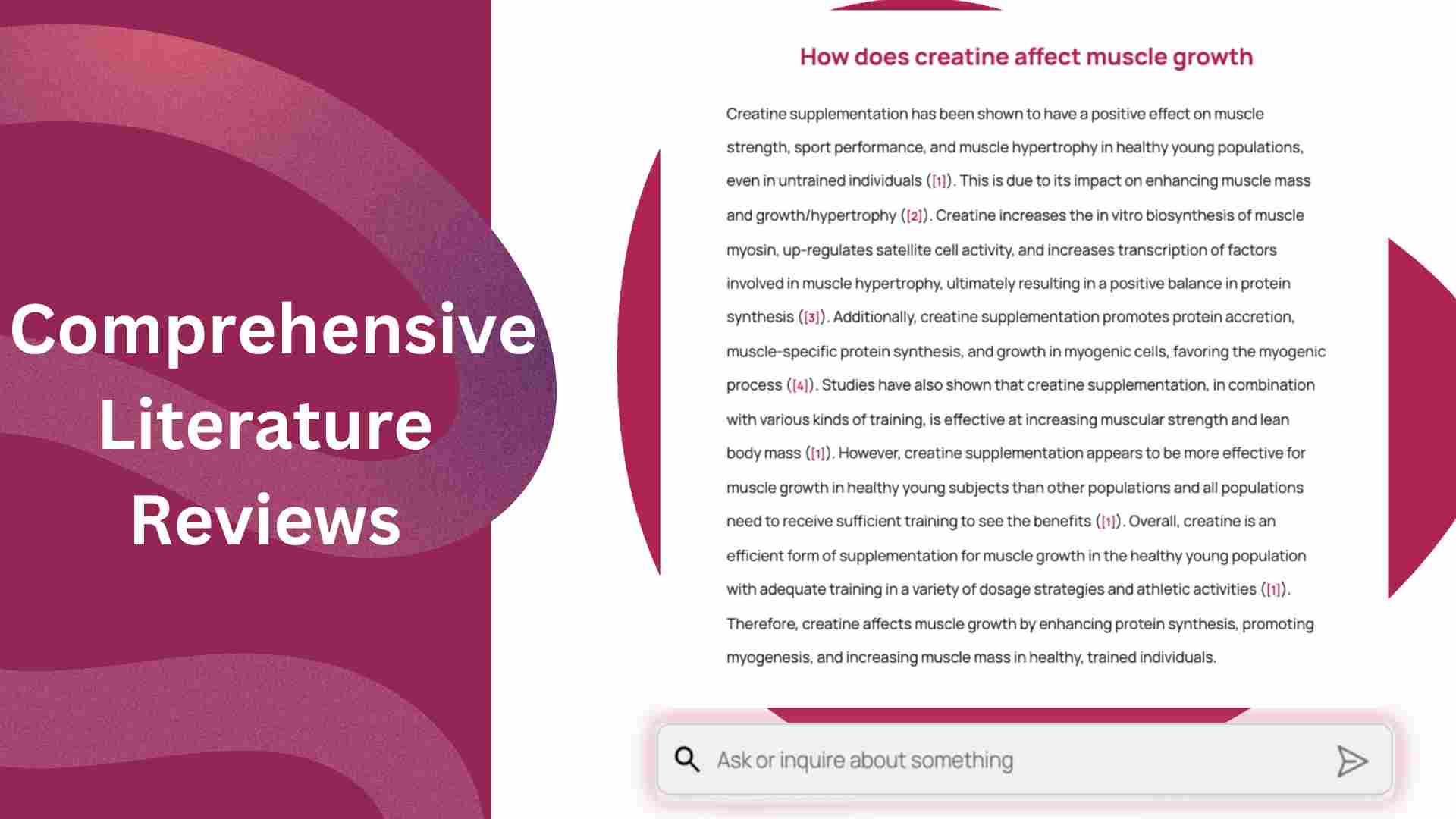
AnswerThis is an AI research assistant for literature reviews that searches a large database of papers and trials, checks citations and claims against their sources, supports PRISMA- and Cochrane-style systematic reviews, and helps draft, revise and collaborate on research writing.
answerthis.io9 viewsAdded April 3, 202632K visitors
Literature reviews can take weeks of searching and screening before writing begins, and generic AI chatbots make it worse by inventing sources. AnswerThis is built specifically to speed up research while keeping citations honest.
It searches a database of over 300 million papers and sources, judges relevance, checks citations and claims against the original papers, and supports systematic-review workflows alongside drafting and collaboration. It sits next to research tools like Consensus, with a stronger emphasis on full review workflows and verification.
This review covers how AnswerThis checks its citations, which researchers it suits, how free and paid use are structured, and where you still need to check its work.
AnswerThis searches research papers and checks citations for literature reviews.
AnswerThis, The Lit-Review Brief
AnswerThis is an AI literature-review assistant: search a large paper database and screen for relevance.
Citation checking is the headline: it checks sources and statements against the papers they came from.
It supports systematic reviews: PRISMA- and Cochrane-style workflows, with logged, exportable steps.
Researchers stay responsible: verify key claims yourself and follow your institution's rules on AI-assisted writing.
AnswerThis Literature-Review Facts
What it is
An AI research assistant for literature reviews
Database
300M+ papers, trials and sources (vendor-stated)
Verification
Citations and claims checked against sources
Systematic reviews
PRISMA- and Cochrane-style workflows
Writing
Draft, revise, annotate and collaborate
Citations
2,000+ citation styles (vendor-stated)
Backing
Backed by Y Combinator (vendor-stated)
Access
Free to start, with paid and enterprise plans
An AI Research Assistant Built Around Verified Citations
AnswerThis is designed around the problem that makes general AI risky for research: hallucinated or misquoted sources. Its central promise is that every source and statement is checked against the paper it came from, so unverified material does not slip into a draft.
It starts from search, reading across a very large database of papers, trials and PDFs and judging whether each result is actually relevant to your question, which is where much of a literature review's time goes.
From there it supports the full workflow: identifying gaps, structuring systematic reviews in PRISMA- or Cochrane-compliant ways, drafting and revising, storing sources and collaborating, with steps logged and exportable for reviewers and regulators.
The honest framing is that AnswerThis can make research dramatically faster and more traceable, but automated checks are not a guarantee. Researchers remain responsible for reading key papers, judging study quality and following their field's and institution's rules on AI use.
That matters most in medicine and science, where a single misattributed finding can mislead readers, reviewers or patients, so tools that make every claim traceable to its source address a real professional risk rather than a cosmetic one.
AnswerThis can make research faster and more traceable, but researchers remain responsible for reading key papers and judging study quality.
How Does AnswerThis Check Its Citations?
The tool's value comes from verification-first search and workflows built for formal reviews.
Searching 300M+ Papers With Source Checks
You upload a draft or ask a question, and AnswerThis searches its database of papers and sources, screens for relevance and checks each cited statement against the source text. That addresses the most common failure of chatbots used for research: confident claims backed by sources that do not say what is claimed.
For quick, evidence-based answers to a research question, Consensus is a strong search-first option; AnswerThis goes further into managing a full review.
Systematic Reviews, Drafting And Collaboration
AnswerThis supports systematic literature reviews aligned with PRISMA and Cochrane conventions, lets you draft and revise within the tool, annotate sources, build personal libraries, format in thousands of citation styles and collaborate with co-authors, with each step logged.
For proofreading and citation formatting of finished work, Scribbr is a familiar choice, and Litero offers source-based writing support for students working within their institution's rules.
Which Researchers AnswerThis Suits
AnswerThis suits academics, PhD students, medical and clinical teams, and research groups conducting literature reviews or systematic reviews, especially where traceability and citation accuracy matter for publication or regulators.
It suits teams that juggle several tools for search, notes, references and writing, since it combines those steps and keeps context together.
Research teams can also use it to divide screening work, keep shared libraries and maintain a record of decisions, which helps when a review is updated months later or when a co-author needs to understand why papers were included or excluded.
It suits less well casual users who only need a quick answer, and it does not replace methodological expertise in study selection, bias assessment and synthesis, which systematic reviews depend on.
Students should use it within their institution's academic-integrity rules: as a research and organisation aid, with their own reading and writing, rather than to produce work they submit as their own without disclosure.
How AnswerThis Structures Free And Paid Use
AnswerThis lets you start for free, with paid plans for heavier use and enterprise options for institutions. We do not publish prices, which change; check the site.
The value question is time saved on searching and screening, plus the reduced risk of citation errors, against the subscription. For researchers running regular reviews, that can be substantial.
The sensible approach is to run a review on a topic you already know well, compare its results and citation checks with your own knowledge, and decide based on accuracy as much as speed.
Institutions and research groups should also ask about team plans, how unpublished manuscripts and uploaded PDFs are handled, and how activity logs can be exported for audit or peer review.
Testing AnswerThis On A Topic You Know
Because research depends on accuracy, test AnswerThis on a topic where you can judge its output.
Pick a research question in a field you know well.
Run a search and compare the papers it surfaces with those you expect.
Check several citation verifications by reading the original passages yourself.
Try a structured systematic-review workflow if that is your use case.
Draft a short section and confirm every claim traces to a real source.
Pass/fail: AnswerThis is worth it if it saves time while its checks hold up.
Follow your institution's rules on disclosing AI-assisted work.
Key features of AnswerThis
Search across 300M+ papers
Relevance screening
Citation and claim verification
Systematic-review workflows
Draft and revise tools
Source annotation
2,000+ citation styles
Team collaboration
Pros & cons
Pros
5
Verification-first approach to citations
Covers search through drafting
Supports formal systematic reviews
Traceable, exportable steps
Free to start
Cons
5
Checks are not a guarantee
Does not replace methodological expertise
Database coverage varies by field
Integrity rules apply for students
Figures are vendor-stated
Best For
Literature reviews
Systematic reviews
Clinical research
PhD research
Citation-heavy writing
AnswerThis Compared With Search-First Research Tools
The useful comparison is with other research and writing tools.
Anyone expecting AI to replace methodological expertise
Students submitting AI-drafted work as their own
Fields poorly covered by its database
Those skipping their own source checks
The Paper Trail Behind Our AnswerThis Review
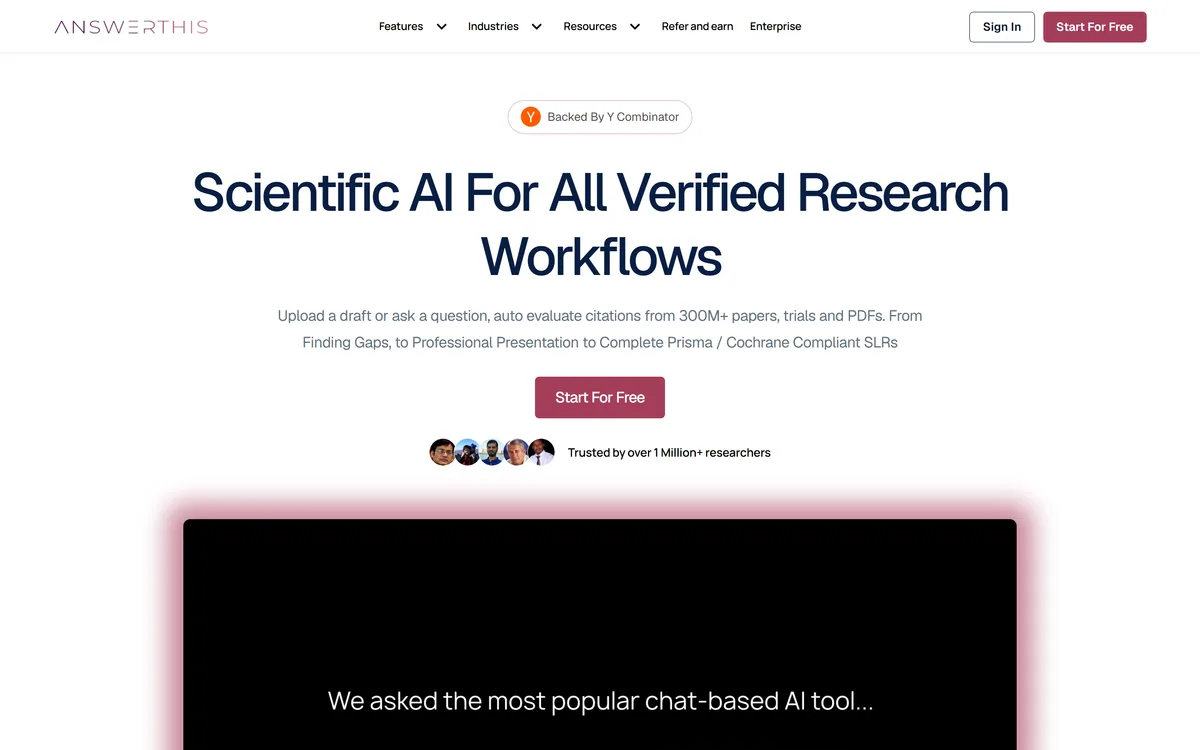
Last checked . Read from answerthis.io during this check, with the screenshot above captured at the same time.
An AI research assistant for literature reviews
Search across a database of 300M+ papers and sources (vendor-stated)
Relevance screening of results
Citation and claim checks against source papers
PRISMA- and Cochrane-style systematic-review support
Drafting, revision, annotation and collaboration
Logged, exportable research steps
Y Combinator backing and user figures stated by the vendor
Free start with paid and enterprise plans
No prices reproduced here, in line with this site's pricing policy
Automated citation checks reduce risk but are not a guarantee; read key papers yourself. Students should follow institutional rules on AI-assisted writing. User and database figures are vendor-stated.
Research Tools To Pair With AnswerThis
A research search engine, a proofreading tool and a writing aid to pair with AnswerThis.
AnswerThis earns 4.0 as a research assistant built around the biggest risk of AI in research, unreliable citations: it searches a large paper database, screens for relevance, checks claims against their sources and supports PRISMA- and Cochrane-style systematic reviews through to drafting and collaboration. It can save researchers serious time while improving traceability. Automated checks are not infallible and methodological judgement stays with the researcher, and students must follow their institution's rules on AI-assisted work. AInexfinder Editor Score: 4.0/5.
AnswerThis pricing
AInexfinder does not list plan prices or billing details. For current pricing, plans, and trials, visit the official AnswerThis website.
Vendor pricing, credits, and billing policies change over time. Always confirm on the official site before you buy.
Frequently asked questions
What is AnswerThis?
AnswerThis is an AI research assistant for literature reviews. It searches a large database of papers and sources, screens for relevance, checks citations against original papers and supports systematic reviews, drafting and collaboration.
Does AnswerThis make up sources?
Its design focuses on preventing that: each source and statement is checked against the paper it came from. Automated checks are not perfect, so read key passages yourself before relying on them.
Can AnswerThis do systematic reviews?
It supports systematic-review workflows aligned with PRISMA and Cochrane conventions, with logged steps. Methodological judgement about inclusion, bias and synthesis remains the researcher's job.
How many papers does AnswerThis search?
The vendor states its database covers over 300 million papers, trials and sources. Coverage varies by field, so check that key journals in your area are included.
Is AnswerThis free?
You can start for free, with paid plans for heavier use and enterprise options for institutions. We do not publish prices, which change; check the site.
Can students use AnswerThis?
Yes, as a research and organisation aid. Follow your institution's academic-integrity rules: read the sources yourself, write your own work and disclose AI assistance where required.
Who is AnswerThis best for?
Academics, PhD students, medical and clinical teams and research groups running literature or systematic reviews where citation accuracy and traceability matter.
How does AnswerThis compare to Consensus?
Consensus is a research search engine that gives evidence-based answers from papers. AnswerThis goes further into managing a full review, including verification, drafting and collaboration.
Can AnswerThis format citations?
Yes. It supports thousands of citation styles and lets you store sources in personal libraries, which helps when writing up a review.
Are AnswerThis's figures reliable?
Database size, user numbers and speed claims are vendor-stated. Judge it on a topic you know well by checking its results and citation verifications yourself.
Daniel reviews AI tools the slow way — by actually using them on real projects. His reviews cover what works, what breaks, and who each tool is genuinely a good fit for.
Daniel and the AInexfinder editorial team research AnswerThis using public product information, listing evidence, and (when available) hands-on checks. Scores reflect listing completeness and transparency — not paid placement.
Listings may include affiliate or sponsored placements, which are labeled when present. Editorial scores and cons are not sold. See our affiliate disclosure and review methodology.
Elicit is an AI research assistant for scientific literature. It searches across more than 125 million papers, screens and extracts data at systematic-review scale, and produces research reports where every claim carries a sentence-level citation back to its source.
Gemini Notebook is Google's research and thinking tool, grounded in sources you upload rather than the open web. Renamed from NotebookLM on 16 July 2026, it now also runs code in a secure cloud environment and syncs notebooks with the Gemini app.
Consensus is an AI-powered academic search engine that searches and analyses hundreds of millions of peer-reviewed research papers, with a Deep Search that automates literature review, a Medical mode for clinical sources, and natural-language filters, used across university libraries.
LUCA is a K-12 reading intervention platform that analyses student reading at the phoneme level rather than the word level, identifying skill gaps in real time. It reports a 17.4 words-per-minute average fluency gain and 763,000+ grapheme-phoneme mappings, delivered through SoundScout, StoryGen and Assessment Intelligence.