Litero is an AI writing assistant pitched as an ethical, source-based partner: a citation tool over 100M+ sources, outline builder, autosuggest, plagiarism checker and AI detector, alongside a humanizer whose presence sits awkwardly with its integrity framing.
An honest note Litero markets itself as an 'ethical', source-based writing partner and includes an AI detector, which are integrity-positive. But its toolset also includes a humanizer, which can be used to make AI text evade detection. We credit the citation-first framing and flag that tension, placing responsibility on the user to follow their institution's rules.
AI writing tools sit on a spectrum from 'do the work for you' to 'help you do it better'. Litero positions itself firmly at the helpful end, a source-based partner that pushes citations and calls itself ethical AI.
It offers a citation tool scanning 100M+ sources, an outline builder, autosuggest, a plagiarism checker and an AI detector, and explicitly tells users to treat it as a partner, not a substitute. That citation-first framing puts it near human-plus-AI services like Scribbr, and it shares Scribbr's one awkward feature: a humanizer.
This review covers what Litero puts in a writer's hands, how to use it within your institution's rules, how it prices, and the honest caveat that keeps its score in the middle.
Litero leans on citations and an ethical-use framing, with a humanizer in the toolset.
Litero, The Fair Summary
Litero is a source-based AI writing partner: it foregrounds citations over 100M+ sources and frames itself as 'ethical' AI.
The citation-first angle is genuinely useful: it suggests relevant, legit sources so you cite as you write.
It pairs writing tools with integrity tools: outline builder, autosuggest, plagiarism checker and an AI detector.
One honest caveat: it also ships a humanizer, which sits awkwardly beside its integrity framing.
A Source-Based Writing Partner, With A Caveat
Litero's best idea is to make citation the centre of the workflow rather than an afterthought. Its citation tool scans a large library and suggests relevant, legitimate sources as you write, which nudges toward grounded, honest writing instead of unsupported AI text.
The framing reinforces that: the site repeatedly calls itself ethical AI and quotes an educator saying to treat it as a partner, not a substitute, and to follow your institution's policies. That is the right message, and more than many writing tools bother to say.
The caveat, which we state up front, is that the same toolset includes a humanizer, a feature whose purpose is to make AI-written text read as human and, in practice, evade AI detection. That sits awkwardly beside the integrity framing and the AI detector it also offers.
Litero's best idea is to make citation the centre of the workflow, not an afterthought, nudging toward grounded, honest writing rather than unsupported AI text.
What Does Litero Put In A Writer's Hands?
The toolset splits cleanly into the parts that help you write well and the one that needs a careful word.
Citations, Outlines And Autosuggest
The clearly valuable tools are the citation finder (100M+ sources), an outline builder to structure a piece, autosuggest to beat writer's block, a plagiarism checker and an easy export. Used together, these support doing your own work better rather than replacing it.
For understanding the subject you are writing about, a guided-learning tool like Khanmigo complements Litero, which polishes and grounds the writing rather than teaching the material underneath it.
The Humanizer-And-Detector Tension
Litero offers an AI detector that highlights likely AI-generated text so you can rewrite it in your own voice, which is integrity-positive. But it also offers a humanizer, and a humanizer exists to make AI text pass as human, which is the opposite goal.
Shipping both is a genuine tension, the same one that pulls a tool like a source-based research app such as Gemini Notebook into clearer, citation-only territory. Used to refine your own wording, a rewriter is fine; used to disguise generated work, it crosses the line your institution draws.
Using Litero Within Your Institution's Rules
The honest line, which Litero itself gestures at, is that the tool is only as ethical as its use. Finding and citing sources, structuring an argument, checking for accidental plagiarism, and rewriting your own clumsy sentences are all legitimate.
Running AI-generated text through the humanizer to beat a detector is not, and no 'ethical AI' label changes that. The feature's existence does not oblige you to misuse it, but it makes misuse easy, which is why we flag it rather than wave it through.
So the guidance is simple: use the citation, outline and checking tools freely, keep the rewriter for your own words, leave the humanizer alone for anything assessed, and follow your institution's policy on AI, which Litero explicitly tells you to do.
How Litero Handles Free And Paid
Litero is freemium: you can try it free with no card, and paid plans unlock more. We do not publish prices, which change; check the site.
For the legitimate uses, citations, outlines, checking, the free tier is a reasonable way to judge whether the source suggestions and workflow actually improve your writing.
The value question is whether its citation-first workflow saves you real time on grounded writing; for students and researchers who cite heavily, a tool that surfaces relevant sources as you write is a genuine help, provided you steer clear of the humanizer on graded work.
A Careful Way To Test Litero
Because Litero is mostly helpful with one risky feature, test the good parts and leave the rest alone.
Draft a real piece and use the citation tool to find and add legitimate sources.
Try the outline builder and autosuggest to structure and unblock your own writing.
Run the plagiarism checker to catch accidental overlap before submission.
Use the rewriter only to improve sentences you wrote, not to disguise generated text.
Do not run AI-generated text through the humanizer for any assessed work.
Pass/fail: Litero is worth it if the citation-first workflow improves your own writing.
Follow your institution's rules on AI tools, as Litero itself advises.
Is Litero An Honest Writing Aid?
Where Litero Genuinely Helps
Finding and citing legitimate sources as you write
Structuring a piece with an outline
Beating writer's block with autosuggest
Checking your own work for accidental plagiarism
Rewriting your own sentences more clearly
Where Litero Needs Caution
Running generated text through the humanizer to evade detection
Handing in AI-written work as your own
Any assessed task your institution bars AI from
Treating the 'ethical AI' label as a free pass
Using it to avoid learning the material
Litero Writing Assistant Facts
What it is
A source-based AI writing assistant
Headline
Citation tool over 100M+ sources
Writing tools
Outline builder, autosuggest, export
Integrity tools
Plagiarism checker and AI detector
Caveat
Also ships a humanizer
Framing
Markets itself as 'ethical' AI, partner not substitute
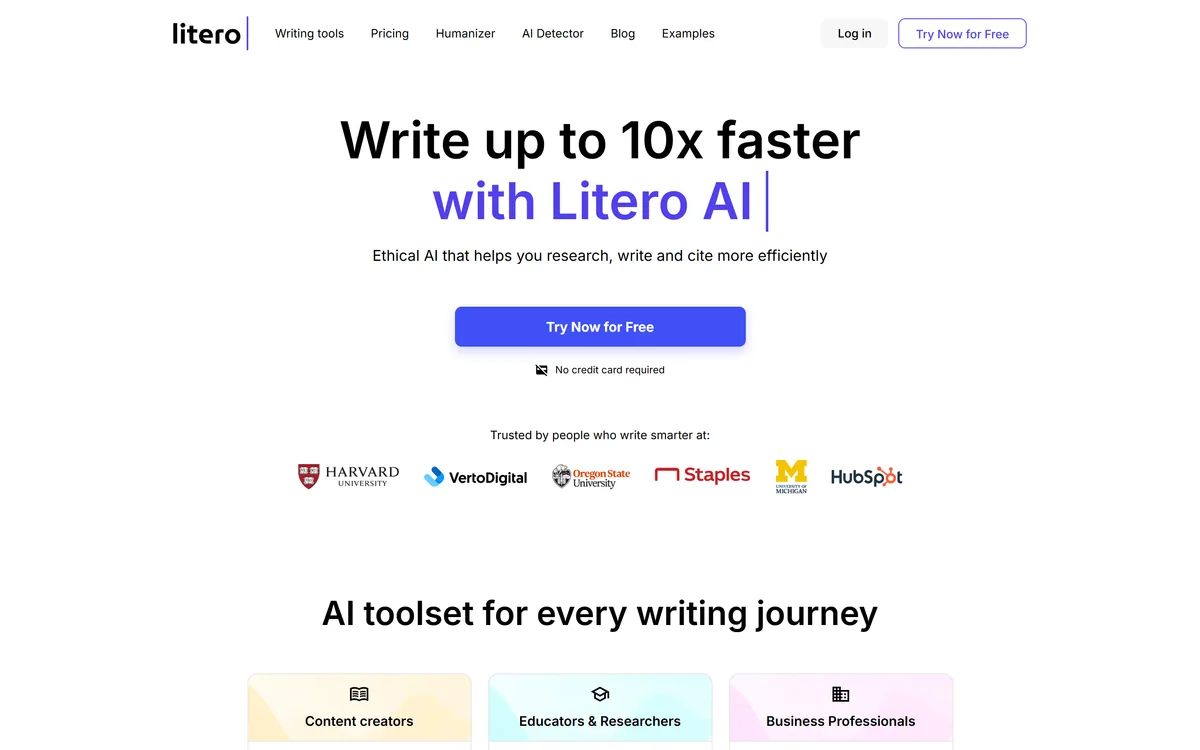
Last checked . Read from litero.ai during this check, with the screenshot above captured at the same time.
A source-based AI writing assistant framed as 'ethical' AI
A citation tool scanning a stated 100M+ sources
An outline builder and AI autosuggest
A plagiarism checker and an AI detector
A humanizer within the toolset
On-page guidance to treat it as a partner and follow institution policy
Audiences across content creators, educators and professionals
A freemium model with paid plans
No plan prices reproduced here, in line with this site's pricing policy
Litero's citation-first, ethical framing and its AI detector are integrity-positive, but it also ships a humanizer that can be used to evade detection. We flag that tension; responsibility for honest use, within institution rules, sits with the user.
Editor's Verdict
3.5/5
Litero earns 3.5 for a genuinely good central idea, a source-based writing partner that foregrounds citations over a large library and frames itself as ethical AI, backed by outline, autosuggest and integrity tools. The score sits in the middle for one honest reason: it also ships a humanizer that can be used to evade the very detection it offers, so its ethics rest on the user following their institution's rules. AInexfinder Editor Score: 3.5/5.
Litero pricing
AInexfinder does not list plan prices or billing details. For current pricing, plans, and trials, visit the official Litero website.
Vendor pricing, credits, and billing policies change over time. Always confirm on the official site before you buy.
Frequently asked questions
What is Litero?
Litero is an AI writing assistant that positions itself as an ethical, source-based partner. It offers a citation tool over a stated 100M+ sources, an outline builder, autosuggest, a plagiarism checker and an AI detector, alongside a rewriter and humanizer, and tells users to treat it as a partner rather than a substitute.
Is Litero ethical to use?
Its citation-first workflow and AI detector are integrity-positive, and it explicitly advises following your institution's policy. But it also ships a humanizer that can be used to make AI text evade detection, so the tool's ethics ultimately depend on how you use it, not on its 'ethical AI' label.
Why does Litero score 3.5?
Because it is mostly a helpful, citation-grounded writing aid but ships one feature, a humanizer, that undercuts its own integrity framing by helping AI text pass as human. That tension holds the score in the middle; the citation, outline and checking tools on their own would rate higher.
What is the humanizer concern?
A humanizer rewrites AI-generated text so it reads as human, and in practice that means evading AI detectors, including the kind Litero itself offers. Using it to refine your own wording is fine; using it to disguise generated work as your own breaches most institutions' academic-integrity rules.
What are Litero's genuinely useful tools?
The citation finder over a large source library, the outline builder, autosuggest for beating writer's block, the plagiarism checker and easy export. Used together, these support doing your own work better, finding sources, structuring, checking, rather than replacing the writing itself.
Is Litero free?
It is freemium: you can try it free with no card, and paid plans unlock more. We do not publish prices, which change; check the site. The free tier is a reasonable way to judge whether its source suggestions and workflow actually improve your writing before paying.
How is Litero different from Scribbr?
Both pair writing tools with integrity tools and, awkwardly, a humanizer. Scribbr's core is human proofreading plus a large free knowledge base; Litero's core is a citation-first AI workflow over a large source library. Both require the user to stay within their institution's rules.
Can Litero help me cite sources?
Yes, that is its strongest feature. Its citation tool scans a stated 100M+ sources and suggests relevant, legitimate ones as you write, which encourages grounded, properly cited writing rather than unsupported AI text. You still review and confirm the sources fit your argument.
Does Litero teach me the subject?
No. Litero helps you write and cite rather than teaching the underlying material. For understanding a subject, a guided-learning tutor is a better fit; many writers use a tutor to grasp the topic and a tool like Litero to structure, source and polish the writing.
Who should use Litero carefully?
Any student or researcher doing assessed work. Use the citation, outline and checking tools freely, keep the rewriter for your own sentences, and leave the humanizer alone for graded work. Always check your institution's rules on AI tools, which Litero itself advises you to do.
Daniel reviews AI tools the slow way — by actually using them on real projects. His reviews cover what works, what breaks, and who each tool is genuinely a good fit for.
Daniel and the AInexfinder editorial team research Litero using public product information, listing evidence, and (when available) hands-on checks. Scores reflect listing completeness and transparency — not paid placement.
Listings may include affiliate or sponsored placements, which are labeled when present. Editorial scores and cons are not sold. See our affiliate disclosure and review methodology.
ESAI helps students find what actually distinguishes them — their patterns, values and formative moments — and shape it for college applications, internships and first jobs. Brandi, a voice agent, talks it out with them, and the platform was designed by former college advisors and admissions officers.
LabReportAI helps students write lab reports, analyse data and produce graphs and tables from raw results. It is described as fine-tuned for life sciences with PhD-level tutoring and analysis, states original work checked for plagiarism, and reports 1,000+ student users.
EssayGrader is an AI essay-grading tool for teachers that scores writing against your own rubric and state standards, drafts revision-focused feedback, and imports whole classes from Google Classroom, Canvas or Schoology, with a published accuracy benchmark against teacher scores.
LUCA is a K-12 reading intervention platform that analyses student reading at the phoneme level rather than the word level, identifying skill gaps in real time. It reports a 17.4 words-per-minute average fluency gain and 763,000+ grapheme-phoneme mappings, delivered through SoundScout, StoryGen and Assessment Intelligence.
Gizmo is a mobile-first study app that turns your notes, PDFs, slides and YouTube videos into AI-generated quizzes and flashcards, built around active recall so revision becomes a habit rather than a chore.