EssayGrader is an AI essay-grading tool for teachers that scores writing against your own rubric and state standards, drafts revision-focused feedback, and imports whole classes from Google Classroom, Canvas or Schoology, with a published accuracy benchmark against teacher scores.
essaygrader.ai6 viewsAdded May 21, 202516K visitors
Grading a stack of essays well is one of the most time-consuming parts of teaching, and rushing it shortchanges students. EssayGrader is built to give teachers that time back by scoring writing against their own rubric and standards and drafting the feedback students actually need.
It grades narrative, argumentative and expository writing against your rubric plus state standards, draws on an established feedback model, and plugs into the LMS workflow teachers already use. It sits firmly on the teacher's side of the desk, alongside classroom tools like Conker, as an assistant for the educator rather than a shortcut for the student.
This review covers how EssayGrader marks an essay, who it serves, how it prices, and where it is not the right fit, including how to read its accuracy claim honestly.
EssayGrader scores essays against a teacher's rubric and state standards and drafts feedback.
EssayGrader Classroom Facts
What it is
An AI essay-grading tool for teachers and schools
Core
Score a whole class against your rubric in minutes
Writing types
Narrative, argumentative, expository and more
Standards
Rubrics plus standards (50 states, AP, Common Core, IB)
Rubrics
800+ built-in standards rubrics or upload your own
Feedback
Revision-focused, based on an established model
LMS
Google Classroom, Canvas, Schoology import and share
Accuracy
Within 1 point of teacher scores 94% of the time (vendor benchmark)
EssayGrader, The Grading Brief
EssayGrader is an AI grader for teachers: it scores a whole class of essays against your own rubric and state standards in minutes.
Feedback is the point: it drafts step-by-step, revision-focused comments rather than just a number, based on an established feedback model.
It fits the LMS workflow: import classes from Google Classroom, Canvas or Schoology, review, and share back.
It is a teacher's assistant, not a replacement: a published accuracy benchmark is reassuring, but teacher review of scores and feedback remains essential.
Grading A Whole Class Against Your Own Rubric
EssayGrader's core function is to grade a full class of essays against the rubric and standards a teacher chooses, not a generic scale, and to do it in minutes rather than hours. That rubric alignment is what makes the output usable: a grade that does not reflect what you actually assess is just noise.
The product is explicit that it is built for teachers and schools, aimed at the educator doing the grading, not the student producing the essay. That framing keeps it on the right side of the classroom-AI line, which matters a great deal when so many AI writing tools blur into helping students generate the work in the first place.
Crucially, its feedback is designed to help students revise and improve without handing them answers, drawing on a recognised feedback model. That is a meaningful design choice: good feedback is the part of grading that most improves learning and the part teachers have least time for.
So the fair framing is that EssayGrader targets the highest-value, most time-consuming part of a teacher's week, consistent scoring and useful feedback, while leaving the teacher in charge of the final judgement. It is an assistant to a professional, not an autonomous grader.
EssayGrader targets the most time-consuming part of a teacher's week while leaving the teacher in charge of the final judgement.
How Does EssayGrader Mark An Essay?
The workflow is rubric-and-standards grading inside the LMS, and the accuracy question that sits underneath any AI grader.
Rubrics, State Standards And LMS Upload
You pick from 800+ built-in standards rubrics or upload your own, then upload a whole class from Google Classroom, Canvas, Schoology or drag-and-drop, and EssayGrader scores each essay against both your rubric and the relevant standards, which it supports across all 50 US states plus AP, Common Core and IB. You then review scores, add personal comments, and share back through the LMS.
That end-to-end fit with the tools teachers already grade in is what makes it practical. A writing-integrity tool like Scribbr helps on the student's side with citations and checking; EssayGrader is squarely the teacher's grading and feedback assistant.
A Published Accuracy Benchmark, Read Honestly
EssayGrader publishes an accuracy benchmark: against an external dataset of 22,000 essays from The Learning Agency, it reports that its scores matched or landed within one point of teacher scores 94% of the time. That is an unusually concrete and welcome claim for this category, and it is a point in its favour that the figure is specific and tied to a named dataset.
Read honestly, it is still a vendor-reported benchmark on one dataset, not a guarantee for your assignments, and 'within one point' is not the same as identical. The right conclusion is confidence that the grading is credible enough to build on, paired with the discipline of teacher review. A feedback-oriented classroom tool like Class Companion addresses adjacent needs; here the headline is grading accuracy you can sanity-check.
Who EssayGrader Serves In A School
EssayGrader serves teachers who grade meaningful volumes of writing against rubrics and standards and want the repetitive scoring and first-draft feedback done faster, so they can spend their time on the judgement and the personal comments that matter most.
It suits schools and departments wanting consistency across many teachers and classes, since everyone can grade against shared rubrics and standards, and teachers with large or mixed classes where timely feedback is otherwise impossible to sustain.
It fits less well teachers who grade only a handful of essays, where setup outweighs the saving, highly idiosyncratic assignments that resist rubric scoring, and anyone unwilling to review AI output, since responsible use requires a teacher to check scores and feedback before they reach students. Its adoption and accuracy figures are vendor-reported.
How EssayGrader Is Priced For Schools
EssayGrader offers a free way to start, including grading a batch of essays at no cost, with paid plans for more volume, and it markets school and district options. We do not publish prices, which change; check the site.
The value question is straightforward for anyone grading regularly: measured against the hours it removes each grading cycle, a tool that scores a class in minutes and drafts usable feedback is an easy case, provided the quality holds up on your assignments.
Because there is a free entry point, the sensible approach is to grade a real set of essays you have already marked yourself, compare EssayGrader's scores and feedback against your own, and only scale up once you trust it on the writing you actually set.
A Practical Way To Trial EssayGrader
Because trust in the scores is everything, trial EssayGrader against essays you have already graded yourself.
Pick or upload the exact rubric and standards you grade against.
Upload a real class, ideally one you have already marked, via your LMS.
Compare EssayGrader's scores with your own and note where they differ and by how much.
Read the drafted feedback and judge whether it genuinely helps students revise.
Add your personal comments and share back through the LMS to test the full loop.
Pass/fail: EssayGrader is worth it if scores and feedback hold up on your own assignments.
Treat the 94%/within-one-point benchmark as vendor-reported; verify it on your writing.
Does EssayGrader Fit Your Teaching?
Educators EssayGrader Helps
Teachers grading meaningful volumes of writing
Those who grade against rubrics and state standards
Schools wanting consistency across classes
Large or mixed classes needing timely feedback
Teachers already working in Google Classroom, Canvas or Schoology
When EssayGrader Does Not Fit Your Room
Teachers grading only a handful of essays
Highly idiosyncratic assignments that resist rubrics
Anyone unwilling to review AI scores and feedback
Subjects outside the standards it covers well
Those treating the accuracy benchmark as a guarantee
Key features of EssayGrader
Rubric-aligned grading
State-standards scoring
800+ built-in rubrics
Custom rubric upload
Revision-focused feedback
LMS import and share
Whole-class batch grading
Multiple writing types
Pros & cons
Pros
5
Scores a whole class in minutes
Aligns to your rubric and standards
Feedback aimed at helping students revise
Fits the existing LMS workflow
Publishes a concrete accuracy benchmark
Cons
5
Still requires teacher review of output
Accuracy figure is a vendor benchmark, not a guarantee
Less value for very small grading loads
Idiosyncratic assignments resist rubric scoring
Adoption figures are vendor-reported
Best For
High-volume essay grading
Rubric and standards alignment
Schools wanting consistency
Large or mixed classes
LMS-based workflows
EssayGrader Against Other Classroom Tools
The useful comparison is with other classroom and writing tools, by whose side of the desk they serve.
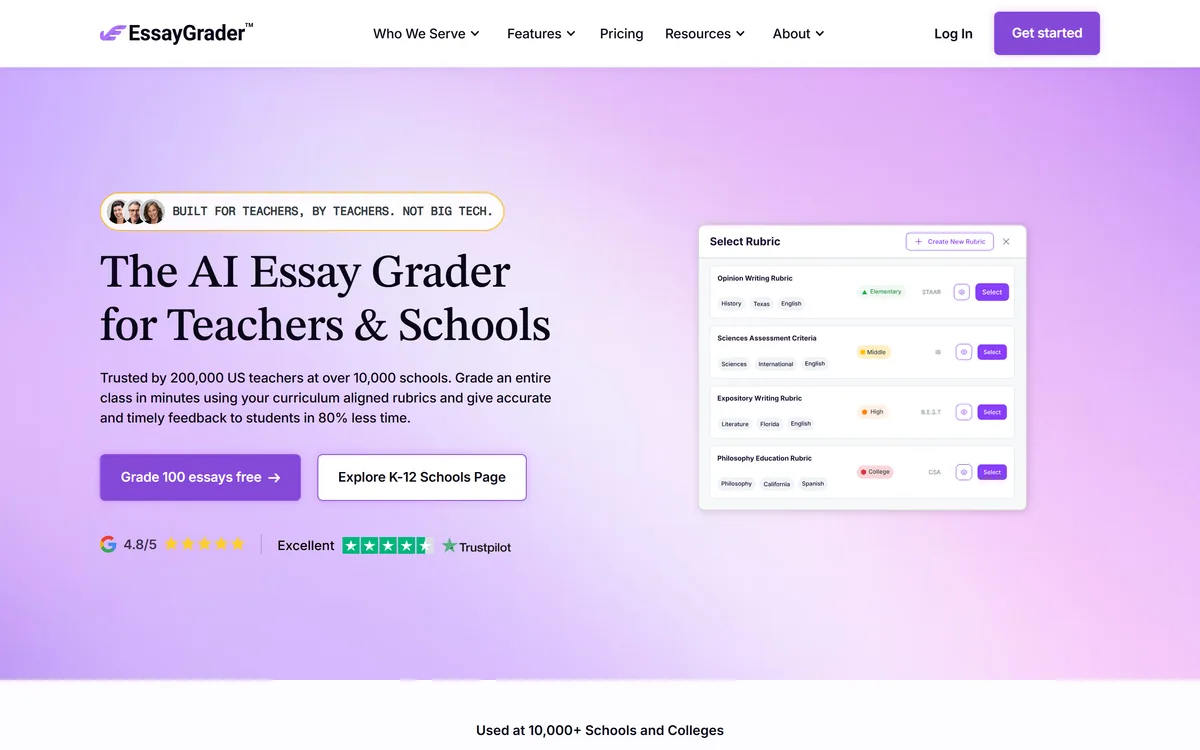
Last checked . Read from essaygrader.ai during this check, with the screenshot above captured at the same time.
An AI essay-grading tool built for teachers and schools
Scoring against your own rubric and state standards
Support across 50 US states plus AP, Common Core and IB
800+ built-in rubrics or uploading your own
Revision-focused feedback based on an established model
Import whole classes from Google Classroom, Canvas or Schoology
A published accuracy benchmark against teacher scores
A free way to start, with paid and school plans
Adoption figures (teachers, schools, essays) stated by the vendor
No prices reproduced here, in line with this site's pricing policy
EssayGrader is a teacher's assistant, not an autonomous grader; teacher review of scores and feedback remains essential. Its 'within one point 94% of the time' accuracy figure is a vendor-reported benchmark on one external dataset, so verify it on your own assignments.
Other Teaching And Grading Tools
A quiz maker, a feedback tool and a student-side writing aid to weigh alongside EssayGrader.
EssayGrader earns 4.1 as a focused, teacher-side grading assistant: it scores a whole class against your own rubric and state standards in minutes, drafts revision-focused feedback based on an established model, and fits the Google Classroom, Canvas and Schoology workflow teachers already use. It stands out for publishing a concrete accuracy benchmark against teacher scores, which is reassuring, though it remains a vendor-reported figure on one dataset and teacher review is still essential. For teachers grading at volume, it targets exactly the right work. AInexfinder Editor Score: 4.1/5.
EssayGrader pricing
AInexfinder does not list plan prices or billing details. For current pricing, plans, and trials, visit the official EssayGrader website.
Vendor pricing, credits, and billing policies change over time. Always confirm on the official site before you buy.
Frequently asked questions
What is EssayGrader?
EssayGrader is an AI essay-grading tool for teachers and schools. It scores a whole class of essays against your own rubric and state standards, drafts revision-focused feedback, and imports and shares through LMS platforms like Google Classroom, Canvas and Schoology.
Is EssayGrader for teachers or students?
Teachers. It is built for the educator doing the grading, not the student writing the essay, which keeps it on the right side of the classroom-AI line. Its purpose is to speed up scoring and feedback for teachers, not to help students produce work.
How accurate is EssayGrader?
The vendor reports that, benchmarked against an external dataset of 22,000 essays from The Learning Agency, its scores matched or landed within one point of teacher scores 94% of the time. That is concrete and reassuring, but it is a vendor-reported benchmark on one dataset, so verify it on your own assignments and keep reviewing scores.
Can I use my own rubric and standards?
Yes. You can upload your own rubric or choose from 800+ built-in standards rubrics, and it scores against standards across all 50 US states plus AP, Common Core and IB. That alignment is what makes its grades usable rather than generic.
Does EssayGrader just give a score?
No. Alongside scoring, it drafts step-by-step, revision-focused feedback based on an established feedback model, designed to help students improve without handing them answers. Good feedback is the part of grading that most helps learning and that teachers have least time for.
Does EssayGrader replace the teacher?
No. It is an assistant that drafts scores and feedback for the teacher to review, adjust and personalise before sharing. Responsible use requires teacher oversight; the tool handles the repetitive first pass, while the professional judgement stays with the educator.
How much does EssayGrader cost?
It offers a free way to start, including grading a batch of essays at no cost, with paid plans for more volume and school or district options. We do not publish prices, which change; check the site, and trial it on essays you have already graded first.
Who is EssayGrader best for?
Teachers who grade meaningful volumes of writing against rubrics and standards, and schools wanting consistency across classes. It is less useful for teachers grading only a few essays, highly idiosyncratic assignments, or anyone unwilling to review the AI's scores and feedback.
Which LMS platforms does EssayGrader work with?
It imports whole classes from Google Classroom, Canvas and Schoology, or by drag-and-drop, and shares results back through the LMS. Fitting the tools teachers already grade in is a large part of what makes it practical day to day.
Can students use EssayGrader to cheat?
EssayGrader is a teacher-facing grading tool, not a writing or answer generator for students, so it is not designed as a shortcut for producing work. Its purpose is to help teachers score and give feedback faster, keeping it on the assessment side of the classroom rather than the student-output side.
Daniel reviews AI tools the slow way — by actually using them on real projects. His reviews cover what works, what breaks, and who each tool is genuinely a good fit for.
Daniel and the AInexfinder editorial team research EssayGrader using public product information, listing evidence, and (when available) hands-on checks. Scores reflect listing completeness and transparency — not paid placement.
Listings may include affiliate or sponsored placements, which are labeled when present. Editorial scores and cons are not sold. See our affiliate disclosure and review methodology.
ESAI helps students find what actually distinguishes them — their patterns, values and formative moments — and shape it for college applications, internships and first jobs. Brandi, a voice agent, talks it out with them, and the platform was designed by former college advisors and admissions officers.
LabReportAI helps students write lab reports, analyse data and produce graphs and tables from raw results. It is described as fine-tuned for life sciences with PhD-level tutoring and analysis, states original work checked for plagiarism, and reports 1,000+ student users.
Litero is an AI writing assistant pitched as an ethical, source-based partner: a citation tool over 100M+ sources, outline builder, autosuggest, plagiarism checker and AI detector, alongside a humanizer whose presence sits awkwardly with its integrity framing.
LUCA is a K-12 reading intervention platform that analyses student reading at the phoneme level rather than the word level, identifying skill gaps in real time. It reports a 17.4 words-per-minute average fluency gain and 763,000+ grapheme-phoneme mappings, delivered through SoundScout, StoryGen and Assessment Intelligence.
RemNote combines outlining, handwriting, PDF annotation and spaced-repetition flashcards in one document, generating cards, quizzes and summaries from PDFs, slides, lecture transcripts and video, with an exam scheduler that works backwards from a date you set.