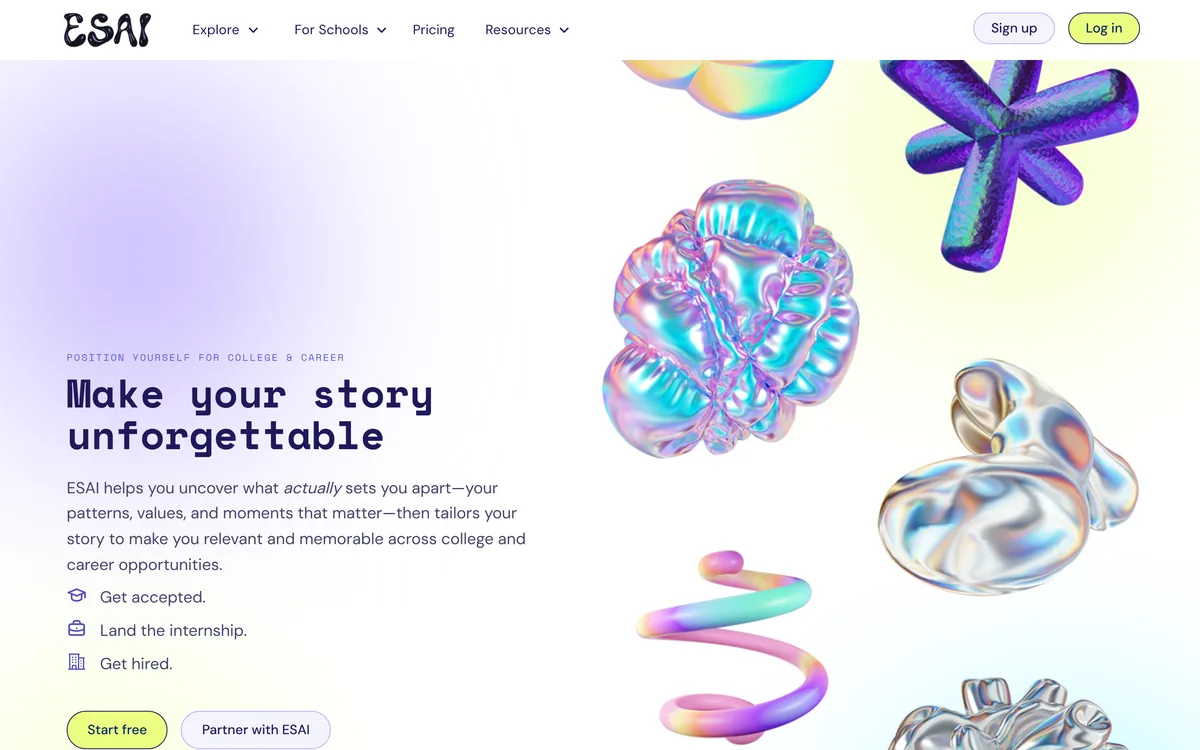
ESAI helps students find what actually distinguishes them — their patterns, values and formative moments — and shape it for college applications, internships and first jobs. Brandi, a voice agent, talks it out with them, and the platform was designed by former college advisors and admissions officers.
The personal statement is the strangest task a seventeen-year-old is ever asked to complete: write six hundred words about who you are, for strangers, in a genre you have never read.
Most of them respond by writing what they think is expected, which is exactly what an admissions reader has already seen four hundred times that week.
ESAI's approach is to work on the input rather than the output — find what actually distinguishes this student, then help them say it themselves.
ESAI's homepage, captured 9 September 2026.
ESAI: Your Story, Not Your Essay Written
Coaching rather than ghostwriting — the site's own framing is levelling up an application without outsourcing your voice.
Brandi, a 24/7 voice agent, so students talk their story out instead of staring at a blank document.
Designed by former college advisors and admissions officers, which is the credential that counts here.
Two tracks: college admissions, and career decisions for internships and first jobs.
Three named layers — narrative, contextual and identity intelligence — for knowing yourself, your options and how to land it.
Where Is The Line On Admissions Help?
This question sits under every product in this category, and ESAI answers it more directly than most: designed by former college advisors and admissions officers to empower students to tell their own stories, ethically and authentically, and elsewhere, without outsourcing your voice.
The line itself is not actually ambiguous, and it is worth stating plainly.
Help with thinking, structure and revision has always been acceptable and always existed. Teachers read drafts. Parents ask what you meant. Paid counsellors have coached applicants for decades, which is precisely the advantage ESAI frames itself as democratising.
What is not acceptable is submission of work that is not yours. An essay a machine wrote, submitted under a student's name, is a false representation to the institution — and colleges increasingly ask applicants to attest that the writing is their own.
The distinction that matters is who is doing the thinking. A tool that asks questions and reflects your answers back is on one side of it; a tool that produces finished prose from a prompt is on the other, and no amount of framing changes which is which.
The line is not who typed it. It is who did the thinking, and whether the person whose name is on it could defend every sentence.
What Admissions Readers Are Actually Looking For
Understanding why the coaching approach is not merely the ethical option but the more effective one requires knowing what happens to an essay when it arrives.
An admissions reader gets a few minutes per application and has read thousands. What registers is specificity — a detail so particular it could only belong to one person, which is the opposite of the polished, general, impressive-sounding essay most applicants produce.
Generated prose is structurally bad at this. A model produces the statistically expected sentence, and the expected sentence is exactly what a reader has seen before. Fluency is not scarce in this pile; particularity is.
This is why the site's emphasis on surfacing patterns and moments from a student's actual life is the correct mechanism rather than a softer alternative to writing the essay.
It also survives the interview. A student who found their own story can talk about it under questioning; one submitting something they did not generate is exposed the first time somebody asks a follow-up — which is the same reason rehearsal tools matter alongside the writing.
Brandi And Talking Your Story Out Loud
Brandi is described as a 24/7 voice agent that helps you talk it out so that you stand out, getting to know what makes you distinctive and translating experiences into a story before matching you to opportunities.
Voice is the right modality here for a specific reason, and it is not novelty.
Ask a teenager to write about a formative experience and you get careful, self-conscious prose. Ask them to talk about it and you get the actual story — with the detail, the aside and the thing they had not thought was important, which is usually the part worth using.
Writing invites editing before the thought is finished. Speaking does not, which is why journalists interview rather than send questionnaires.
The availability matters too. Application anxiety does not keep office hours, and a student who can work through an idea at eleven at night is more likely to arrive at something real than one waiting for a Thursday appointment — the same argument that makes conversational rehearsal in Teal's interview practice and similar tools useful.
Talk before you write — the spoken version has the details.
Keep the specific and strange bits; those are what a reader remembers.
Never submit a sentence you could not explain under questioning.
Check each institution's stated policy on AI assistance.
Read the essay aloud to someone who knows you and watch their face.
Reading The Savings And Acceptance Numbers
Three figures anchor the page: more than 750,000 students, 220 million dollars saved by families in private counselling expenses, and 657 universities accepting ESAI applicants.
The middle one is the most interesting and the least verifiable.
A savings figure of that shape requires two assumptions: that each student would otherwise have hired a private counsellor, and a price for the counselling they did not buy. Neither is stated, and the first is almost certainly untrue of most of the 750,000.
The third figure needs the same care. Universities accepting ESAI applicants is not a measure of the product — it is a measure of where its users applied. Any tool with three-quarters of a million users will have people admitted to hundreds of institutions.
The underlying point survives the arithmetic, though, and it is a real one. Professional admissions counselling is expensive and unequally distributed, and software that puts structured guidance in front of students who could never have bought it is doing something genuinely worthwhile — which is a better argument than the number.
Two Tracks And The Career Half
The platform splits into a college track for admissions and a career track for internships and first jobs, with the same underlying method: surface the story, map it to opportunities, make it land.
The career half is the more interesting extension, because the problem is genuinely the same one.
A first-year student writing a cover letter faces exactly what an applicant faces: little formal experience, no idea what is relevant, and a strong instinct to write what they think is expected. The advice — be specific, be yourself, describe what you actually did — is identical.
Carrying one story framework across both is a real advantage over buying separate tools, since the work of figuring out what you are good at does not need doing twice.
The listed surfaces run wide, though — essays, hooks, program discovery, major matching, scholarships, personal branding, resumes, internships and graduate applications — and a platform covering that much will be stronger at some than others. The essay and voice work is clearly the centre; the rest is worth testing before relying on it. For the resume itself a dedicated builder such as Kickresume goes considerably deeper, and Cover Letter Copilot does the same for the letter.
Applying Without Losing Your Own Voice
The failure mode in application season is not doing too little. It is producing something technically competent that sounds like everybody else.
This sequence keeps the student's own material at the centre where it belongs.
Talk through three experiences out loud before writing anything.
Pick the one with the most specific detail, not the most impressive.
Draft it yourself, badly, before asking any tool for feedback.
Use the coaching on structure and clarity rather than on sentences.
Check the AI policy of every institution you are applying to.
Read the final essay aloud — if it does not sound like you, start again.
ESAI: Tracks And Evidence
Positioning
Positioning students for college and career by surfacing their own story
Stated ethic
Levelling up an application without outsourcing your voice
Design credential
Built by former college advisors and admissions officers, per the site
Voice agent
Brandi, described as a 24/7 voice agent for talking your story out
Tracks
College admissions and career decisions
Named layers
Narrative intelligence, contextual intelligence and identity intelligence
Surfaces covered
Essays, essay hooks, program discovery, major matching, scholarships, personal branding, resumes, internships and graduate applications
Claimed students
More than 750,000
Claimed savings
220 million dollars in private counselling expenses avoided by families
Claimed reach
657 universities accepting ESAI applicants
Testimonials
Named students with institutions including Yale, Michigan and Cincinnati
Other pages
A founder page, a press page, partner and school programmes, and an AI certification
Should Students Use ESAI For Applications?
Use the coaching when
A student cannot see what makes them distinctive, which is normal at seventeen.
Private counselling was never going to be affordable.
Talking is easier for them than writing, which it usually is.
The same story work is needed for internships as for college.
Structure and revision are the gaps rather than ideas.
Write it unaided when
The student would let it produce sentences they could not defend.
An institution's policy prohibits AI assistance of any kind.
A school counsellor is already doing this work well.
The application needs subject-specific expertise, like a portfolio or audition.
The temptation to submit generated prose would be too strong.
Key features of ESAI
Voice-led story discovery with Brandi
College admissions track
Career track for internships and first jobs
Essay and essay hook coaching
Program discovery and major matching
Scholarship guidance
Personal branding and resume support
Graduate application support
Pros & cons
Pros
7
Coaches the student to write rather than writing for them, and says so
Voice is the right modality — teenagers talk about themselves better than they write
Former admissions officers is the credential that actually matters here
Specificity, which coaching produces, is what admissions readers reward
One story framework carries across college and career applications
Available at eleven at night, when application anxiety actually happens
Puts structured guidance in front of students who could never buy counselling
Cons
7
The savings figure rests on unstated assumptions about counselling take-up
Universities accepting applicants measures where users applied, not product effect
The individual advisors behind the design are not named
Nine listed surfaces means some are inevitably shallower than others
The ethical line still depends on the student, not the software
No stated behaviour if a student asks it to write the essay outright
Subject-specific applications with portfolios or auditions need other help
Best For
Students who cannot see what makes them distinctive
Families for whom private admissions counselling is out of reach
Teenagers who talk more easily than they write
Students applying for internships as well as college
Schools looking to extend guidance beyond one counsellor's caseload
ESAI Against Other Admissions Tools
Application tools differ by whether they coach, write or organise.
What we could not confirm: the assumptions behind the 220 million dollar savings figure, since neither a counselling price nor a take-up rate is stated; what 657 universities accepting ESAI applicants measures, given it reflects where users applied rather than any product effect; which admissions officers designed the platform or at which institutions; how the tool behaves if a student asks it to write an essay outright; and pricing, which sits on a separate page. We did not create a student account.
Editor's Verdict
4.0/5
ESAI has taken the harder and more defensible position in a category full of essay-writing services: it coaches students to find and shape their own story rather than producing one for them, and it says so explicitly. The voice agent is the mechanism that makes that work, because most seventeen-year-olds can talk about themselves far better than they can write about themselves. Former admissions officers designing it is the credential that matters. The headline numbers are the weak part, and the ethical line still ultimately depends on the student rather than the software. AInexfinder Editor Score: 4.0/5.
ESAI pricing
AInexfinder does not list plan prices or billing details. For current pricing, plans, and trials, visit the official ESAI website.
Vendor pricing, credits, and billing policies change over time. Always confirm on the official site before you buy.
Frequently asked questions
What is ESAI?
A platform that helps students surface what distinguishes them — their patterns, values and formative moments — and shape it for college applications, internships and first jobs. Brandi, a voice agent, talks it through with them.
Does it write essays for students?
Its stated position is the opposite — levelling up an application without outsourcing your voice, and empowering students to tell their own stories. Coaching on structure and revision is what it describes rather than producing finished prose.
Where is the line on admissions help?
Not who typed it, but who did the thinking. Teachers reading drafts and counsellors coaching applicants have always been acceptable. Submitting work you did not produce is a false representation, and colleges increasingly ask applicants to attest otherwise.
Why is coaching more effective than generation?
Because admissions readers reward specificity, and a model produces the statistically expected sentence — which is exactly what a reader has already seen four hundred times. Fluency is not scarce in that pile; particularity is.
Why a voice agent rather than a chat box?
Ask a teenager to write about a formative experience and you get self-conscious prose. Ask them to talk about it and you get the actual story, including the aside they had not thought was important — which is usually the usable part.
Is the 220 million dollar savings figure meaningful?
It rests on two unstated assumptions: that each student would otherwise have hired a private counsellor, and a price for the service they did not buy. The underlying point — that counselling is expensive and unequally available — is real without the number.
What does 657 universities accepting ESAI applicants mean?
That students who used it were admitted to 657 institutions. It measures where the user base applied rather than any effect of the product, and any tool with three-quarters of a million users would produce a similar figure.
Should students check their college's AI policy?
Yes, every one they apply to, before writing anything. Policies vary and are changing quickly, and the safest working rule is never to submit a sentence you could not explain and defend under questioning.
Does it help with internships too?
That is the career track, and it is the same underlying problem — little formal experience, no idea what is relevant, and a strong instinct to write what you think is expected. Carrying one story framework across both saves real work.
What should a student do first?
Talk through three experiences out loud, then pick the one with the most specific detail rather than the most impressive. Draft it themselves, badly, before asking any tool for feedback — the bad draft is where the real material is.
Daniel reviews AI tools the slow way — by actually using them on real projects. His reviews cover what works, what breaks, and who each tool is genuinely a good fit for.
Daniel and the AInexfinder editorial team research ESAI using public product information, listing evidence, and (when available) hands-on checks. Scores reflect listing completeness and transparency — not paid placement.
Listings may include affiliate or sponsored placements, which are labeled when present. Editorial scores and cons are not sold. See our affiliate disclosure and review methodology.
LabReportAI helps students write lab reports, analyse data and produce graphs and tables from raw results. It is described as fine-tuned for life sciences with PhD-level tutoring and analysis, states original work checked for plagiarism, and reports 1,000+ student users.
Litero is an AI writing assistant pitched as an ethical, source-based partner: a citation tool over 100M+ sources, outline builder, autosuggest, plagiarism checker and AI detector, alongside a humanizer whose presence sits awkwardly with its integrity framing.
LUCA is a K-12 reading intervention platform that analyses student reading at the phoneme level rather than the word level, identifying skill gaps in real time. It reports a 17.4 words-per-minute average fluency gain and 763,000+ grapheme-phoneme mappings, delivered through SoundScout, StoryGen and Assessment Intelligence.
RemNote combines outlining, handwriting, PDF annotation and spaced-repetition flashcards in one document, generating cards, quizzes and summaries from PDFs, slides, lecture transcripts and video, with an exam scheduler that works backwards from a date you set.
Question AI is a homework-helper app that scans a question and returns step-by-step answers across school subjects, plus AI writing, search, translation and summarizing. Its study uses are legitimate; using it to hand in answers or graded work crosses academic-integrity lines, which we weigh honestly.