
CareerEd is a free AI cover letter generator. You paste a job posting and your resume, and it returns a tailored letter in under a minute. It also generates interview thank-you notes and publishes a library of cover letter and resume examples by role.
Cover Letter Copilot
Verified
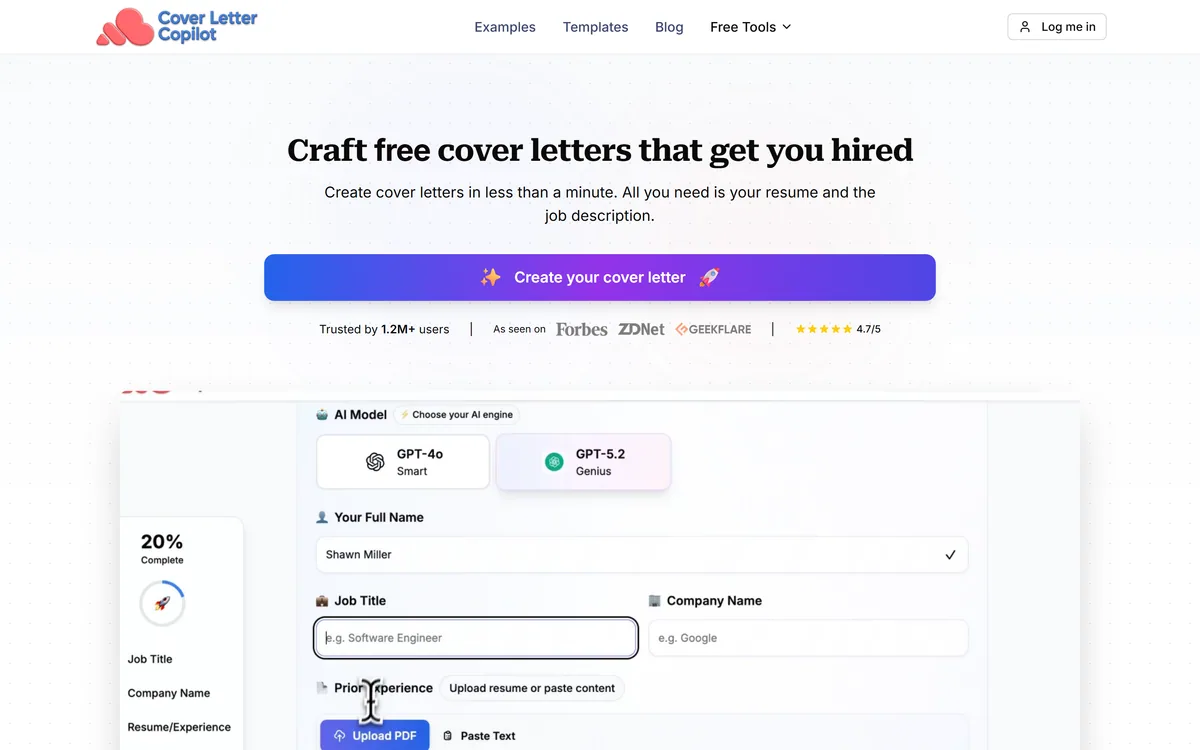
Cover Letter Copilot generates a tailored cover letter from your resume and a job description in under 60 seconds, with tone controls, paragraph-level regeneration and a built-in editor. It claims 1.2M+ users, 2M+ letters generated across 150+ countries, and is contactable at ben@coverlettercopilot.ai.
3.7Editor Score
coverlettercopilot.ai8 viewsAdded June 20, 20253K visitors
The cover letter is a strange survival. Almost nobody defends it, a large share of hiring managers never read it, and yet the field is still there and still required, so it still has to be written.
That produces the specific misery this tool addresses: writing the fifteenth letter of a job search, at eleven at night, for a role you are not certain about, having already said everything on your resume.
Cover Letter Copilot's answer is to make the first draft cost a minute. What you do with the minute you saved is the part that determines whether it works.
Cover Letter Copilot: A Draft In A Minute
- Resume plus job description in, letter out, with the site claiming under 60 seconds.
- Paragraph-level regeneration and tone controls — casual, professional or bold — inside a rich text editor.
- 1.2M+ users and 2M+ letters claimed, across 150+ countries.
- An ATS framing that repeats a widely circulated statistic which is worth treating carefully.
- Made in New York, with a named contact address rather than an anonymous form.
Do Cover Letters Still Matter?
The honest answer is: unevenly, unpredictably, and enough that skipping them is a bad bet.
In some processes the letter is read carefully and is the reason an application progresses. In others it is never opened by anyone. You cannot tell which from the outside, and the field is usually mandatory in both.
That asymmetry is what makes generation sensible rather than lazy. The cost of a weak letter is close to zero in the processes that ignore them, and the cost of no letter is elimination in the ones that do not.
Where letters genuinely earn their place is when they answer a question the resume raises — a career change, a gap, why this specific company. Those are exactly the things a resume cannot express and a paragraph can.
So the useful mental model is that the generic parts of a letter should cost you nothing, and the one paragraph that says something only you could say deserves all of your remaining attention. That is the correct division of labour with a tool like this.
The generic parts of a letter should cost you nothing. The one paragraph only you could write deserves all your remaining attention.
What The ATS Claim Really Means
The site states that 70% of cover letters never reach a human because of ATS filters, and that its AI is trained on thousands of successful applications and 100K+ recruiter feedbacks.
Statistics of this shape circulate widely in the careers-advice industry and are rarely traceable to a published source, so the sensible posture is to treat the direction as plausible and the number as unverified.
What is true is that applicant tracking systems parse and rank applications, and that a document they cannot read properly is a problem. What is less true is the folklore around it — that specific formatting tricks or keyword density decide outcomes.
The practically useful version is simple: use the words the job description uses, because a system matching terms will match terms, and a human reader will also notice you addressed what they asked for. That is not gaming anything.
Where this matters is that optimising for an imagined filter can make a letter worse for the human who does read it. Keyword-stuffed prose reads as keyword-stuffed prose, and the same tension runs through search-oriented writing tools such as SEO.AI.
Resume Plus Job Description Equals Draft
The input model is a resume upload plus a job description link and a target company, producing a tailored letter.
This is the right pair of inputs, because tailoring is the only thing that distinguishes a useful cover letter from a form letter, and tailoring requires both sides of the match.
A tool given only your resume writes about you, which you have already covered. A tool given only the job description writes about the role, which they already know. Given both, it can at least connect the two, which is the actual assignment.
The quality ceiling is set by what your resume contains. If it lists responsibilities rather than outcomes, the letter will restate responsibilities more fluently, and fluent restatement of nothing is exactly what hiring managers recognise instantly.
So the highest-leverage preparation is upstream: a resume with specific, concrete accomplishments produces letters with specific, concrete claims. That is a document worth fixing once before generating anything, and it improves every application afterwards.
- Fix the resume first — the letter cannot contain what the resume lacks.
- Use the job description's own vocabulary, for both the filter and the reader.
- Rewrite one paragraph entirely by hand, in your own voice.
- Delete any sentence that would be true of any candidate for any role.
- Read it aloud before sending; generated prose fails that test audibly.
Where Generated Letters Give Themselves Away
Anyone who reads applications at volume can identify a generated cover letter quickly, and it is worth knowing the tells so you can remove them.
The first is symmetry. Generated prose produces paragraphs of similar length with similar structure, and human writing is lumpier — a two-line paragraph next to a six-line one is a sign of a person.
The second is enthusiasm without specifics. Phrases like excited by your mission and drawn to your innovative approach appear in every generated letter because they are true of every company and therefore say nothing.
The third is the absent detail. A letter that could be sent to three companies with the name swapped is the default output of any generator, and one concrete sentence about something you actually know about this organisation defeats it entirely.
The fourth is unnaturally even competence — no clumsy sentence, no idiosyncratic phrasing, nothing anyone would have written differently. Reading the draft aloud catches most of these, and rewriting a paragraph by hand catches the rest.
The Tools Around A Job Search
A cover letter is one artefact in a process with several, and it is not the one that most affects outcomes.
The resume matters more, because it is read first and it determines whether the letter is opened at all. Time spent making accomplishments concrete there pays off across every application rather than one.
Finding the right roles matters more still. Applying carefully to eight well-matched positions beats applying quickly to eighty, and the tooling for that side of the search — job discovery and tracking, which products like Wobo address — is more consequential than any generator.
Interview preparation matters most of all, since it is the stage where outcomes are actually decided, and it is the stage people prepare for least because the earlier stages are more visibly effortful.
The reason this framing matters is that generation makes volume cheap, and cheap volume is a trap. A tool that lets you send forty applications an evening will produce forty rejections faster than the old method did.
The follow-up is the underrated one. A short, specific email after an application or an interview is read far more often than a cover letter, takes two minutes, and is exactly the kind of writing assistants like WriteMail.ai handle well.
Making A Generated Letter Sound Like You
The difference between a useful draft and an obvious one is about ten minutes of work, applied in the right places.
This sequence spends that time where it changes the outcome rather than on polishing sentences that were never going to matter.
- Update your resume with concrete outcomes before generating anything.
- Generate the draft, then read it aloud once without editing.
- Delete every sentence that would be true of any candidate for any job.
- Rewrite one paragraph completely by hand, saying something only you could say.
- Add one specific detail about this company that required actually looking.
- Break the rhythm — vary a paragraph length, keep an ordinary phrasing you would use.
Is This Worth Using For Your Applications?
Generate a draft when
- You are applying to enough roles that writing each letter from nothing is unrealistic.
- The letter field is mandatory and you cannot tell whether anyone reads it.
- You freeze at a blank page and need something to react to.
- Your resume is already strong and concrete, so the draft has material to use.
- You will spend the saved time on the one paragraph that matters.
Start from scratch when
- This is a role you genuinely care about and can write about specifically.
- Your resume lists responsibilities rather than outcomes, which the letter will inherit.
- You would send the draft unedited, which is worse than a short honest letter.
- You are in a field where a distinctive writing sample is itself part of the assessment.
- You are using generation to apply faster rather than to apply better.
Cover Letter Copilot: Numbers And Contact
| Product type | AI cover letter generator |
|---|---|
| Inputs | Resume upload, job description link, target company |
| Stated speed | Under 60 seconds to a complete draft |
| Editing | Built-in rich text editor with paragraph-level regeneration |
| Tone options | Casual, professional, bold |
| Users claimed | 1.2M+ |
| Letters claimed | 2M+ generated |
| Reach claimed | 150+ countries |
| Displayed rating | 4.7 / 5, per the site |
| Free tools | Thank you letter generator, LinkedIn headline generator, job description keyword finder |
| Location | Made in New York, per the footer |
| Contact | ben@coverlettercopilot.ai |
| Copyright | © 2026 Cover Letter Copilot |
Key features of Cover Letter Copilot
Cover letter generation from a resume and job description
Target company field for tailoring
Built-in rich text editor
Paragraph-level regeneration
Tone adjustment between casual, professional and bold
ATS match analysis display
Free thank-you letter and LinkedIn headline generators
A job description keyword finder
Pros & cons
Pros
7- Removes the blank-page problem, which is the actual obstacle for most applicants
- Takes both resume and job description, which is what tailoring requires
- Paragraph-level regeneration beats regenerating the whole letter
- An editor built in acknowledges the draft is a starting point
- Free adjacent tools cover other awkward application artefacts
- A named contact address rather than an anonymous support form
- Tone controls make the register adjustable to the industry
Cons
7- The 70% ATS statistic is uncited and widely circulated without a traceable source
- Output quality is capped by whether your resume states outcomes or responsibilities
- Generated letters have recognisable tells unless you rewrite part by hand
- Makes high-volume applying cheap, which is usually the wrong strategy
- No registered operating entity named in the footer
- Resume storage and retention are not described, despite handling personal data
- Which models generate the text is unstated
Best For
- Active job seekers applying to many roles at once
- Career changers who need the same explanation phrased for different employers
- Anyone who stalls at a blank page but edits well
- Applicants facing mandatory letter fields in bulk application systems
- People with a strong, concrete resume to generate from
Cover Letter Copilot Against Other Job Tools
Job-search tools split by which stage of the process they touch.
| Tool | Stage | What it produces | Best for |
|---|---|---|---|
| Cover Letter Copilot | Application | A tailored cover letter draft | Volume applications where letters are mandatory |
| Wobo | Search and tracking | Better-matched roles | The stage that affects outcomes more |
| Bolto | The employer's side | Recruiting and hiring workflow | Understanding what happens after you apply |
| WriteMail.ai | Follow-up | Emails after the application | The messages a letter cannot cover |
| Scribeist | General writing | Longer-form content | Writing beyond applications |
More Career And Writing Tools
Products covering the stages of a job search either side of the letter.
- Wobo — finding and tracking roles worth applying to
- WriteMail.ai — follow-up email after you have applied
- Bolto — the recruiting side of the same process
- Scribeist — writing beyond job applications
- StoryLab.ai — short-form copy where a distinctive line matters
Cover Letter Copilot: What The Site Claims
Last checked . Read from coverlettercopilot.ai in a browser session on the date above, with the screenshot captured alongside.
- Positioned as creating free cover letters from a resume and job description
- Stated as producing a complete personalised draft in under 60 seconds
- Inputs confirmed as resume upload, job description link and target company
- Built-in rich text editor with paragraph regeneration and tone options confirmed
- Tone options shown as casual, professional and bold
- Claims of 1.2M+ users, 2M+ cover letters and 150+ countries displayed
- A 4.7 / 5 rating displayed
- Stated that 70% of cover letters never reach a human because of ATS filters
- Stated as trained on 100K+ recruiter feedbacks
- Free tools listed for thank-you letters, LinkedIn headlines and job description keywords
- Footer confirms made in New York, ben@coverlettercopilot.ai, and © 2026 Cover Letter Copilot
What we could not confirm: the source behind the 70% ATS statistic, which the site does not cite and which circulates widely in careers advice without a traceable origin; what the 100K+ recruiter feedbacks consist of or how they were obtained; whether user and letter counts refer to registered accounts or unique people; the operating company, since the footer names a product and a location rather than a registered entity; where uploaded resumes are stored and for how long, which matters because they contain personal data; and which models generate the letters. We did not generate a letter.
Editor's Verdict
3.7/5Cover letters are a genuinely bad piece of hiring infrastructure that persist anyway, and a tool that makes them cost a minute instead of forty is solving a real problem in the only way available. The product is well shaped for it — resume plus job description in, editable draft out, paragraph-level regeneration and tone control — and the built-in editor is the right call, since the draft is a starting point. What holds the score down is the ATS framing, which is a widely repeated claim about how screening works rather than a verifiable one, and the fact that a generated letter still reads like a generated letter unless you do real work on it. AInexfinder Editor Score: 3.7/5.
Cover Letter Copilot pricing
AInexfinder does not list plan prices or billing details. For current pricing, plans, and trials, visit the official Cover Letter Copilot website.
Visit official website for pricingVendor pricing, credits, and billing policies change over time. Always confirm on the official site before you buy.
Frequently asked questions
What is Cover Letter Copilot?
Cover Letter Copilot generates a tailored cover letter from your resume and a job description, claiming a complete draft in under 60 seconds. It includes a rich text editor, paragraph-level regeneration and tone controls, and claims 1.2M+ users and 2M+ letters across 150+ countries.
Do cover letters still matter?
Unevenly and unpredictably. Some processes read them carefully; others never open them, and you cannot tell which from outside. That asymmetry is what makes generation sensible: a weak letter costs nothing where they are ignored, and no letter is elimination where they are not.
Is the 70% ATS statistic true?
Treat the direction as plausible and the number as unverified. Statistics of this shape circulate widely in careers advice without a traceable published source. What is true is that tracking systems parse and rank applications; the folklore about formatting tricks is much weaker.
How should I handle keywords then?
Use the words the job description uses. A system matching terms will match terms, and a human reader will notice you addressed what they asked for — so it is not gaming anything. The failure is stuffing, which reads as stuffing to the person who does open the letter.
Why does my resume matter so much here?
Because the letter cannot contain what the resume lacks. If yours lists responsibilities rather than outcomes, the tool will restate responsibilities more fluently — and fluent restatement of nothing is exactly what experienced readers recognise instantly. Fix the resume once and every letter improves.
How do people spot a generated cover letter?
Four tells: paragraphs of unnaturally even length and structure, enthusiasm without specifics, nothing that could not be sent to three companies with the name swapped, and no clumsy sentence anywhere. Reading it aloud catches most of them.
What should I edit before sending?
Delete every sentence true of any candidate for any job, rewrite one paragraph entirely by hand in your own voice, and add one specific detail about this company that required actually looking. That is roughly ten minutes and it is the difference.
Should I use it to apply to more jobs?
That is the trap. Cheap volume produces rejections faster, not offers. Applying carefully to eight well-matched roles beats applying quickly to eighty, and the time generation saves is best spent on selection and preparation rather than on more applications.
When should I write the letter myself?
When you genuinely want the role and can say something specific about it, and when a distinctive writing sample is itself part of the assessment. Those are the cases where a generated draft costs you more than it saves.
What happens to my uploaded resume?
The site does not describe storage or retention on the pages we read, and a resume is a dense package of personal data — full employment history, education, sometimes an address. Worth checking the privacy terms before uploading, which is true of any application tool.
Reviews
Log in to write a review.
User Reviews
No reviews yet. Be the first to share your experience with Cover Letter Copilot.
Reviewed by Daniel Reed
Assigned reviewer
Daniel ReedSenior AI Tools Reviewer
Daniel reviews AI tools the slow way — by actually using them on real projects. His reviews cover what works, what breaks, and who each tool is genuinely a good fit for.
Hands-on reviewsProduct testingAI software
Daniel and the AInexfinder editorial team research Cover Letter Copilot using public product information, listing evidence, and (when available) hands-on checks. Scores reflect listing completeness and transparency — not paid placement.
- Last verified
- Methodology
- How we review AI tools
- Sources used
- coverlettercopilot.ai
- AInexfinder listing fields (features, pros/cons, description)
- Public vendor pages when available
- Editorial policy
- Listings may include affiliate or sponsored placements, which are labeled when present. Editorial scores and cons are not sold. See our affiliate disclosure and review methodology.
Related tools
ApplyArc pairs a Kanban job tracker with eighteen AI tools built around one loop: paste a job posting, paste your CV, read the gap analysis, fix the gaps, then apply. It runs on Azure OpenAI, is operated by a registered UK company, and states that your data is never used for training.
FreemiumWriting & Content
Jobsuit AI is a resume builder from Jobsuit AI PTE. LTD. that analyses a CV against a job description, flags missing keywords and content gaps, tailors the document to the role, writes matching cover letters and tracks applications.
FreemiumWriting & Content
Kickresume builds resumes and cover letters from typographer-designed templates, scores them against an applicant tracking system checker, tailors each one to a specific job description, and adds interview practice, career mapping, a job board and application tracking around them.
FreemiumWriting & Content

Copy.ai has become an AI-native go-to-market platform: workflows and agents that run prospecting, lead processing, deal coaching, ABM, and CRM enrichment across Salesforce, HubSpot, Gong, Outreach, and 2,000+ integrations.
FreemiumWriting & Content

Writesonic has become an AI search growth platform — tracking whether your brand appears across 10 AI platforms, running optimisation and citation work through an Action Center, and reporting results against traffic and revenue.
FreemiumWriting & Content
Compare:Cover Letter Copilot vs CareerEdCover Letter Copilot vs ApplyArcCover Letter Copilot vs Jobsuit AICover Letter Copilot vs Kickresume
Cover Letter Copilot alternatives Explore More
Embed this listing on your site
Featured on AInexfinder