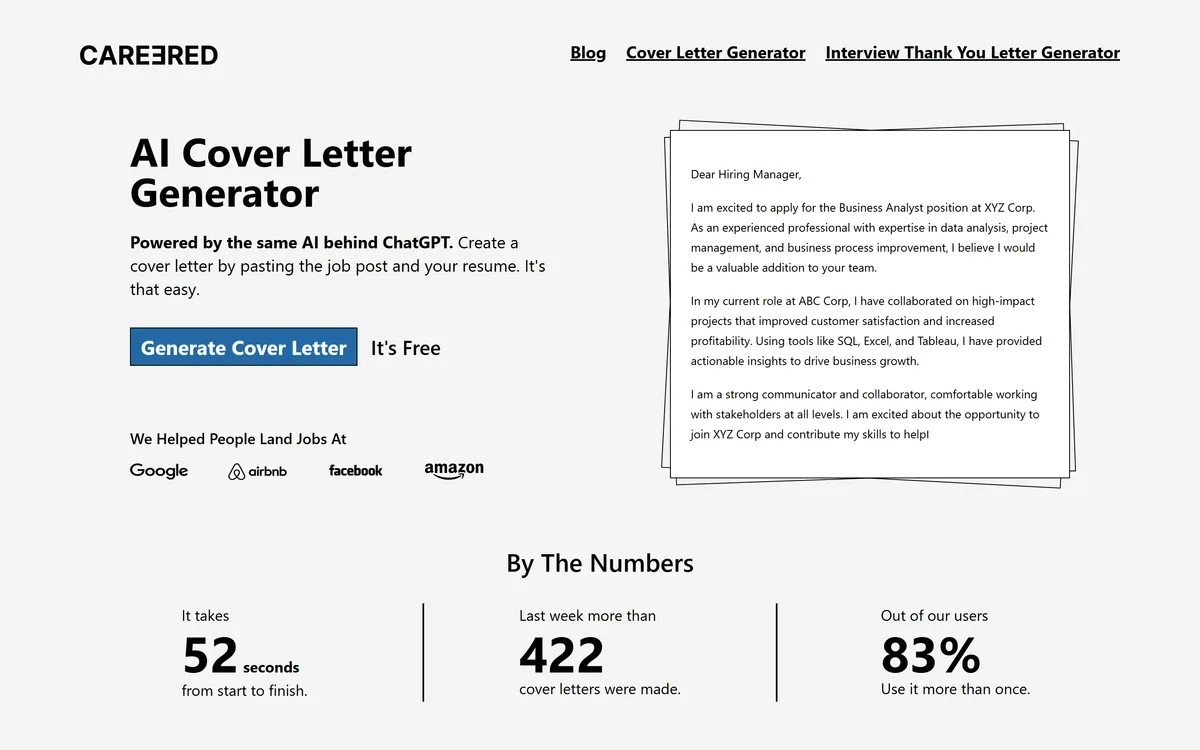
CareerEd is a free AI cover letter generator. You paste a job posting and your resume, and it returns a tailored letter in under a minute. It also generates interview thank-you notes and publishes a library of cover letter and resume examples by role.
careered.ai12 viewsAdded February 5, 20267K visitors
There is a specific, universal moment of paralysis in job hunting: the resume is done, the application is open, and there is an empty box asking for a cover letter. Most people write something stiff, or copy last time's, or skip it.
CareerEd exists entirely for that moment. Paste the posting, paste the resume, get a letter. That is the whole product, and the discipline of not being anything more is worth taking seriously in a category where everything else wants a subscription and a dashboard.
This review covers what it actually produces, why the job-posting input matters more than the model does, what the free-and-simple positioning costs you, and when you would be better served by Teal or a full application tracker instead.
A single-purpose tool in a category full of subscriptions — which is either the appeal or the limit.
The Short Version For Job Seekers
CareerEd is a free AI cover letter generator that takes a job posting and your existing resume and returns a tailored letter, with no account tier to climb and nothing to install.
The vendor states the whole process takes 52 seconds, which is the actual product claim — it is competing with the blank page, not with a writing suite.
A second generator writes interview thank-you notes, the follow-up almost everyone skips and that costs nothing to send.
It is built on the same underlying technology as ChatGPT, per the vendor, so the difference is the prompt structure and the job-posting input rather than a proprietary model.
Around it sits a free library of examples — cover letters, resumes and articles by specific role, which is genuinely useful reference material even if you never generate anything.
What It Is And What It Offers
Category
AI cover letter and job application writing
Primary tool
Cover letter generator, free to use
Secondary tool
Interview thank-you letter generator
Inputs
A job posting and your existing resume
Stated speed
52 seconds from start to finish
Underlying technology
Vendor states it is powered by the same AI behind ChatGPT
Stated usage
More than 422 cover letters generated in the week shown at the time of this check
Stated repeat use
83% of users generate more than once, per the vendor
Free resources
Library of cover letter examples, resume examples and career articles by role
Example roles covered
Includes research analyst, radiologic technologist, talent acquisition recruiter, ramp agent, site reliability engineer and Salesforce Marketing Cloud developer
Account required
Not for the core generator
Company research approach
Vendor states it analyses publicly available resumes to identify effective application patterns
The Job Posting Is Doing Most Of The Work
It is tempting to evaluate a tool like this on the model behind it. That is the wrong axis, and the vendor is refreshingly upfront that the technology is the same one everybody has.
What determines output quality here is the input structure, and specifically the requirement to paste the actual job posting. That single constraint is why the result is usable.
A cover letter fails in a predictable way: it describes the applicant rather than connecting the applicant to this role. Generic letters read as generic because they never had the posting in front of them.
Feeding the posting in forces the mapping. The letter picks up the language the employer used, echoes the responsibilities they listed, and addresses the requirements they named — which is exactly what a careful human writer does manually and what most applicants skip under time pressure.
This is also why you could reproduce most of the value in a general chat model with a well-built prompt. The tool's contribution is that it enforces the good prompt every time, and removes the decision about how to ask.
The letter is good because it read the job posting, not because of the model. That is the entire trick, and it is a real one.
The Thank-You Note Is The Underrated Half
The second generator gets far less attention than the first and arguably delivers more advantage per use.
Post-interview thank-you notes occupy a strange position. Recruiters and hiring managers consistently report noticing them, they cost nothing, they take five minutes, and the large majority of candidates never send one.
The reason is not laziness. It is that writing one is awkward. Say too little and it is empty; say too much and it reads as desperate; reference the conversation badly and it is worse than silence.
A generator that produces a serviceable, correctly-pitched note removes exactly that awkwardness. The realistic outcome is not that a note wins you the job — it is that it keeps your name in front of a panel during the two days they are deciding.
Edit it before sending. A thank-you note that references something specific from the conversation is meaningfully better than one that does not, and only you know what that was.
What Free And Single-Purpose Actually Costs
The narrowness is a genuine feature and it also draws a hard line around what this tool can do for you.
It does not track applications the way Teal does. It does not tell you which of the forty roles you applied for you have heard back on, which is the actual administrative burden of a serious job search.
It does not analyse or rewrite your resume. A cover letter tailored to a posting sitting on top of a resume that Resume Worded would score badly is an odd combination, and the resume is what gets read first.
It does not do ATS keyword matching against the posting, which is the specific service that Rezi, Teal and Jobscan-style tools sell.
And it does not know you. It knows what is on your resume, which is a compressed and formal version of your experience with all the interesting parts removed. The strongest line in most cover letters is something that was never on the resume in the first place.
No application tracking or pipeline view across multiple roles
No resume analysis, scoring or rewriting
No interview preparation beyond the thank-you note
No memory between sessions — each generation starts from nothing
How To Get Something Sendable Out Of It
Treat the output as a structured first draft rather than a finished letter, and the tool becomes considerably more useful.
The generated letter will be correctly organised, appropriately formal, and accurate to your resume. What it will not have is a reason for the reader to remember you, because that reason is not in the inputs you gave it.
Paste the complete job posting, including the responsibilities section people usually skip.
Use your most current resume, not the one you happen to have open.
Generate, then delete the opening line — it is almost always the weakest sentence in an AI cover letter.
Replace one paragraph with something specific: a number, a named project, or why this company rather than any company.
Read the whole thing aloud once. Anything you would not say out loud in an interview should not survive.
Reading The Usage Figures Honestly
Two numbers appear on the site and both deserve a proportionate reading rather than a dismissal.
More than 422 cover letters in a week, and 83% of users generating more than once. Neither is audited and both are self-reported, which is normal for this kind of counter.
The scale figure is modest, and it is worth saying so plainly — this is a small tool rather than an established platform. That is not a criticism of the output, but it is relevant if you were expecting a large product with a support team behind it.
The repeat-use figure is the more interesting of the two. For a free tool with no account requirement, people coming back is the strongest available signal that the output was worth using, since there is no subscription keeping anyone there.
The site also names Google, Airbnb, Facebook and Amazon as places its users have been hired. Read that as it is meant — an aggregate claim about users, not a claim that any employer endorses or uses the tool.
Is A Free Generator Enough For Your Search?
Handy When
You are applying to a handful of roles and the cover letter is the only blocker
You have a solid resume already and just need it mapped onto a specific posting
You want something with no signup, no subscription and no data commitment
You have an interview coming up and no idea how to write the follow-up note
You want free examples for a specific job title to see what good looks like
Do It Yourself When
You are running a serious search across dozens of roles and need tracking
Your resume itself is the weak link — fix that first
You need explicit ATS keyword analysis against each posting
You are applying somewhere that explicitly asks for a hand-written personal statement
The role is senior enough that the letter is genuinely the deciding document
Key features of CareerEd
Free AI cover letter generation from a job posting and a resume
Interview thank-you letter generation
No account required for the core generator
Library of cover letter examples organised by job title
Library of resume examples by role
Career and application advice articles
Output ready to copy straight into an application form
Pros & cons
Pros
5
Genuinely free with no account required, which is rare in this category
Requiring the actual job posting is what makes the output specific rather than generic
The thank-you note generator addresses a step most candidates skip entirely
Doing one thing and stopping is a real virtue against bloated career platforms
The free example library is useful reference even if you never generate a letter
Cons
5
No application tracking, so it does not touch the real admin burden of a job search
No resume analysis or rewriting, and the resume is what gets read first
No explicit ATS keyword gap analysis against the posting
Usage figures suggest a small tool rather than an established platform
Output is competent but unmemorable unless you edit in something only you know
Best For
Job seekers applying to a small number of roles
Anyone stuck on the cover letter box in an application form
Candidates who need a thank-you note after an interview
Career changers looking at examples for unfamiliar job titles
People who want a working tool without a subscription
CareerEd Against The Paid Application Tools
The gap between these is scope rather than quality — most of the paid tools do the cover letter too, as one feature among many.
Kickresume — template-led resume and cover letter building
Enhancv — resume design where visual presentation matters
Resume Worded — scoring and feedback on a resume you already have
What This Review Verified
Last checked . Read from careered.ai during this check, with the screenshot above captured at the same time.
Cover letter generator offered free, taking a job posting and a resume as input
Stated completion time of 52 seconds from start to finish
Interview thank-you letter generator offered as a second tool
Vendor states the tool is powered by the same AI behind ChatGPT
Usage counter showing more than 422 cover letters generated in the week displayed
Repeat-use figure of 83% stated by the vendor
Free library of cover letter examples, resume examples and career articles present
Example pages published for specific roles including site reliability engineer, radiologic technologist and Salesforce Marketing Cloud developer
Vendor describes analysing publicly available resumes to identify effective application patterns
Employer names on the site presented as places users were hired, not as customers or endorsements
No plan prices published here, in line with this site's pricing policy
Usage and repeat-use figures are self-reported by the vendor and not independently audited. Employers named on the site are described as places users have been hired and should not be read as endorsements. Pasting a resume into any web tool means sharing personal data — check the privacy policy if that matters to you.
Editor's Verdict
3.5/5
CareerEd has an AInexfinder Editor Score of 3.5/5.
CareerEd pricing
AInexfinder does not list plan prices or billing details. For current pricing, plans, and trials, visit the official CareerEd website.
Vendor pricing, credits, and billing policies change over time. Always confirm on the official site before you buy.
Frequently asked questions
Is CareerEd's cover letter generator really free?
Yes — the cover letter and thank-you note generators are offered free with no account required. The surrounding library of examples and articles is free too.
How long does it take to generate a cover letter?
The vendor states 52 seconds from start to finish. That figure is really telling you what it competes with, which is the twenty minutes most people spend staring at an empty box.
Will employers know my cover letter was written by AI?
Unedited output has a recognisable shape — a soft opening line, even paragraph lengths, no specific detail. Delete the first sentence and replace one paragraph with something concrete and it stops reading as generated.
Does CareerEd help with my resume too?
No. It writes cover letters and thank-you notes from a resume you already have. If the resume is the weak part of your application, tools like Rezi, Teal or Resume Worded are the right place to start.
Is CareerEd better than just using ChatGPT?
It uses the same underlying technology and its advantage is structure: it enforces pasting the actual job posting every time, which is the step that makes a letter specific. With a good saved prompt you can get the same result from a general model.
Should I still send a thank-you note after an interview?
Most candidates do not, which is precisely why it is worth doing. It will not win you a role on its own, but it keeps your name in front of the panel while they are deciding — and it costs five minutes.
Is it safe to paste my resume into CareerEd?
You are sharing personal data with a third party, which is true of every tool in this category. Read the privacy policy for retention and processing terms, and consider redacting your address and phone number before pasting if that concerns you.
Daniel reviews AI tools the slow way — by actually using them on real projects. His reviews cover what works, what breaks, and who each tool is genuinely a good fit for.
Daniel and the AInexfinder editorial team research CareerEd using public product information, listing evidence, and (when available) hands-on checks. Scores reflect listing completeness and transparency — not paid placement.
Listings may include affiliate or sponsored placements, which are labeled when present. Editorial scores and cons are not sold. See our affiliate disclosure and review methodology.
ApplyArc pairs a Kanban job tracker with eighteen AI tools built around one loop: paste a job posting, paste your CV, read the gap analysis, fix the gaps, then apply. It runs on Azure OpenAI, is operated by a registered UK company, and states that your data is never used for training.
Jobsuit AI is a resume builder from Jobsuit AI PTE. LTD. that analyses a CV against a job description, flags missing keywords and content gaps, tailors the document to the role, writes matching cover letters and tracks applications.
Cover Letter Copilot generates a tailored cover letter from your resume and a job description in under 60 seconds, with tone controls, paragraph-level regeneration and a built-in editor. It claims 1.2M+ users, 2M+ letters generated across 150+ countries, and is contactable at ben@coverlettercopilot.ai.
Kickresume builds resumes and cover letters from typographer-designed templates, scores them against an applicant tracking system checker, tailors each one to a specific job description, and adds interview practice, career mapping, a job board and application tracking around them.
Copy.ai has become an AI-native go-to-market platform: workflows and agents that run prospecting, lead processing, deal coaching, ABM, and CRM enrichment across Salesforce, HubSpot, Gong, Outreach, and 2,000+ integrations.
Writesonic has become an AI search growth platform — tracking whether your brand appears across 10 AI platforms, running optimisation and citation work through an Action Center, and reporting results against traffic and revenue.