CareerEd is a free AI cover letter generator. You paste a job posting and your resume, and it returns a tailored letter in under a minute. It also generates interview thank-you notes and publishes a library of cover letter and resume examples by role.
Jobsuit AI
Verified
Jobsuit AI is a resume builder from Jobsuit AI PTE. LTD. that analyses a CV against a job description, flags missing keywords and content gaps, tailors the document to the role, writes matching cover letters and tracks applications.
3.9Editor Score
jobsuit.ai9 viewsAdded March 24, 20263K visitors
Every careers adviser gives the same advice: tailor your CV to each role. Every job seeker ignores it, and for an entirely rational reason. Genuinely rewriting a CV against a job description takes half an hour or more, and someone making forty applications does not have twenty hours to spend on formatting.
Jobsuit AI, run by Singapore-registered Jobsuit AI PTE. LTD., is built around collapsing that cost. Paste a job description, and it compares your CV against it, names the missing keywords and content gaps, and produces a tailored version — plus a matching cover letter and a tracker for where everything went.
This review covers what the analysis genuinely does, what 'ATS-optimised' can and cannot mean, why the tracker matters more than it sounds, and where a tool like this stops being able to help.
The Honest Summary For A Job Seeker
- The real feature is tailoring speed. Everyone knows a CV should match the job; almost nobody does it because it takes forty minutes per application.
- Keyword gap analysis is the mechanical part — comparing your CV against a job description and naming what is missing.
- ATS scores are estimates, not readings from the employer's actual system. No external tool can see how a specific company's software will parse your file.
- Application tracking is quietly the most underrated feature, because tailoring twenty CVs means twenty different documents to keep straight.
- Operated by Jobsuit AI PTE. LTD., a Singapore-registered company, with a Discord community alongside the product.
Product, Company And Coverage
| Company | Jobsuit AI PTE. LTD., Singapore |
|---|---|
| Category | AI resume builder, analyser and tailoring tool |
| Named features | Resume Analysis, Resume Tailoring, Resume Agent, ATS-friendly Templates, Cover Letter Generator, Job Application Tracker |
| Analysis covers | ATS fit, missing keywords, content gaps, improvement recommendations |
| Inputs | Upload an existing resume or build from scratch; paste a job description |
| Outputs | Tailored resumes, cover letters, resume scores, keyword recommendations |
| Templates | Designed to be recruiter-scannable and parseable by applicant tracking systems |
| Tracking | Central record of target roles, tailored documents and application progress |
| Example roles cited | Business analysts, UX researchers, marketing associates, data analysts, product designers, software engineers, finance analysts, sales executives, project managers |
| Community | Discord |
| Site sections | Resume builder, tailoring, analysis, examples, cover letters, FAQs |
Will Jobsuit Help Your Job Search?
Useful To You If
- You are applying to many roles and currently send the same CV to all of them
- You know tailoring works but cannot spend half an hour per application doing it
- Your CV has a heavy design layout that may be parsing badly
- You lose track of which version of your CV went where
- You struggle to write the summary section or frame a career gap
Of Limited Use If
- You are hiring at senior level, where narrative and network outweigh keyword alignment
- Your applications come through referrals rather than portals
- You have no master CV yet — tailoring a weak base produces optimised weak applications
- You would accept every suggestion without reading it
- The roles genuinely do not match your experience, which no wording fixes
What The Analysis Actually Measures
Resume Analysis evaluates ATS fit, identifies missing keywords, spots content gaps and recommends improvements. Understanding what each of those means keeps expectations sensible.
Missing keywords is the most reliable part, because it is a genuine comparison between two documents. If the job description says 'stakeholder management' six times and your CV never says it, that is a fact, and it is one people miss constantly — they describe the work without using the words the role uses.
Content gaps is softer. It identifies requirements the job lists that your CV does not address, which is useful for catching the qualification you have but forgot to mention. It cannot distinguish between something you neglected to write down and something you genuinely cannot do.
ATS fit is where care is needed, and the next section deals with it properly.
What 'ATS-Optimised' Can Honestly Promise
Applicant tracking systems are the software employers use to receive and filter applications, and an entire advice industry has grown around them — much of it overstated.
Here is what is genuinely true. ATS software parses documents, and parsing does fail: heavy multi-column layouts, text inside images, unusual fonts and tables can all produce a mangled record. A clean, conventionally structured document really does survive this better, which is what an ATS-friendly template is for.
Here is what is not knowable from outside. Every employer configures their system differently, few publish how they weight anything, and no external tool can see what a specific company's instance will do with your file. Any score you are shown is that tool's estimate against its own model of how these systems behave — a useful proxy, not a reading from the employer's software.
The wider point is that ATS filtering is rarely the actual barrier people imagine. Most applications fail because there were three hundred of them and forty were better matched. A well-parsed CV gets you read; it does not get you shortlisted.
A score of 92 is that tool's opinion of your CV. The employer's system has not seen it yet, and would not tell you either way.
Tailoring, Without Tipping Into Fiction
Resume Tailoring adapts a CV to a specific job description by aligning your experience with the role's requirements. Used well, this is legitimate and effective. Used badly, it becomes a problem.
The legitimate version reframes true things. The same project can honestly be described as data analysis, stakeholder management or process improvement depending on which the role cares about — you are choosing emphasis, not inventing history.
The illegitimate version happens quietly, when a keyword suggestion for a technology you touched once becomes a bullet implying fluency. Nobody decides to lie; the document simply drifts under repeated optimisation.
The discipline is straightforward and worth stating: read every tailored version as if you are about to be interviewed on it, because you are. Any sentence you would not want to be asked to expand on for five minutes should not be there.
- Reframe real work in the role's language — legitimate and effective
- Move relevant experience up and cut what the role does not care about — legitimate
- Add a skill you have but did not list — legitimate, and a common genuine gap
- Adopt a keyword for something you barely touched — the line worth not crossing
- Accept every suggestion without reading it — how a CV becomes indefensible without anyone deciding to lie
The Tracker Is Doing Real Work
The Job Application Tracker centralises target roles, tailored documents and application progress, and it is easy to dismiss as an add-on.
It is not, because tailoring creates a filing problem. Send the same CV to forty employers and there is one document. Tailor forty and there are forty, and six weeks later a recruiter calls about a role you barely remember and asks about something on a version you cannot locate.
Turning up to an interview unable to recall what your own CV claimed is a specific and avoidable humiliation. A tracker linking each application to the exact document sent is what makes per-role tailoring survivable at volume.
The Resume Agent — an interactive chat that acts as a career counsellor for refining sections — is the other supporting piece, most useful for the parts people write worst: the summary, and the framing of a career gap or a change of direction.
Using It Without Outsourcing Your Judgement
The tool rewards being used at the right point in a process you still control.
- Write a strong master CV yourself first. Everything downstream is a variation on it, and tailoring a weak base produces well-optimised weak applications.
- Paste the real job description rather than the job title — the whole analysis depends on having the actual text to compare against.
- Read the keyword gaps and decide individually. Accept the ones that describe work you genuinely did; ignore the rest.
- Check the tailored version against your own memory of the job, not against the score.
- Generate the cover letter after the CV is settled, so the two say the same thing.
- Log every application in the tracker with the exact document sent, on the day you send it.
- Before any interview, reread the specific version that employer received rather than your master copy.
Where A CV Tool Stops Helping
Volume applications are not a strategy, and a tool that makes applying faster makes it easier to apply badly at scale. Twenty tailored applications to roles you are genuinely suited to beat two hundred optimised ones to roles you are not.
Referrals still outperform everything. A CV that arrives with an internal recommendation is read differently from one that arrives through a portal, and no amount of keyword alignment substitutes for that.
And the tool cannot fix a mismatch. If the role wants seven years and you have two, tailoring changes the wording, not the arithmetic. Recognising when the answer is 'apply anyway and expect nothing' versus 'this is not the role' is judgement software does not have.
Senior and specialist hiring in particular runs on narrative, network and demonstrated results. Structural CV optimisation matters most at the volume end of the market, and diminishes as seniority rises.
Key features of Jobsuit AI
Resume analysis covering ATS fit, missing keywords and content gaps
Resume tailoring against a pasted job description
Resume Agent, an interactive chat for refining individual sections
ATS-friendly templates designed to parse cleanly and scan well
Cover letter generation aligned to the tailored resume
Job application tracker linking roles, documents and progress
Build from scratch or upload an existing resume
Downloadable output for submission
Pros & cons
Pros
5- Collapses the cost of per-role tailoring, which is the advice everyone gets and nobody follows
- Keyword gap analysis is a genuine document comparison rather than a guess
- The application tracker solves the filing problem that tailoring creates
- Clean templates address the real, documented failure mode of CV parsing
- The Resume Agent helps most with the sections people write worst — summaries and career gaps
Cons
5- ATS scores are estimates against the tool's own model, not readings from an employer's system
- Repeated optimisation can drift a CV towards claims you cannot defend in an interview
- Makes it easier to apply badly at scale, which is not a strategy
- Least useful at senior level, where narrative and network outweigh keyword alignment
- Cannot fix a genuine experience mismatch, only the wording around it
Best For
- Graduates and early-career applicants making many applications
- Career changers who need existing experience reframed for a new field
- Anyone currently sending one identical CV to every role
- Applicants whose designed CV may be parsing badly in employer systems
- People who have lost track of which CV version went to which employer
Jobsuit Beside Other Career Tools
These overlap on CV work but differ on what they are actually optimising.
| Tool | Core function | Job-description matching | Best for |
|---|---|---|---|
| Jobsuit AI | Analysis, tailoring, cover letters, tracking | Yes — paste the description and compare | High-volume applicants who want per-role tailoring |
| Kickresume | Resume building with designed templates | Present but not the focus | People who want a polished document first |
| ApplyArc | Application assistance and workflow | Yes | Managing the application process end to end |
| Careered | AI career and application support | Yes | Broader career guidance alongside documents |
| Grammarly | Writing correctness and clarity | No | The final proofread before anything is sent |
Other Tools For A Job Search
Documents, process and writing quality are separate problems in an application.
- Kickresume — template-led resume building if the document itself needs work first
- ApplyArc — application workflow support across the whole search
- Careered — broader career guidance rather than document optimisation alone
- Grammarly — the proofread that should happen before any CV is sent
- Spiral — voice-matched writing, useful for cover letters that sound like you
Checked Against Jobsuit's Site
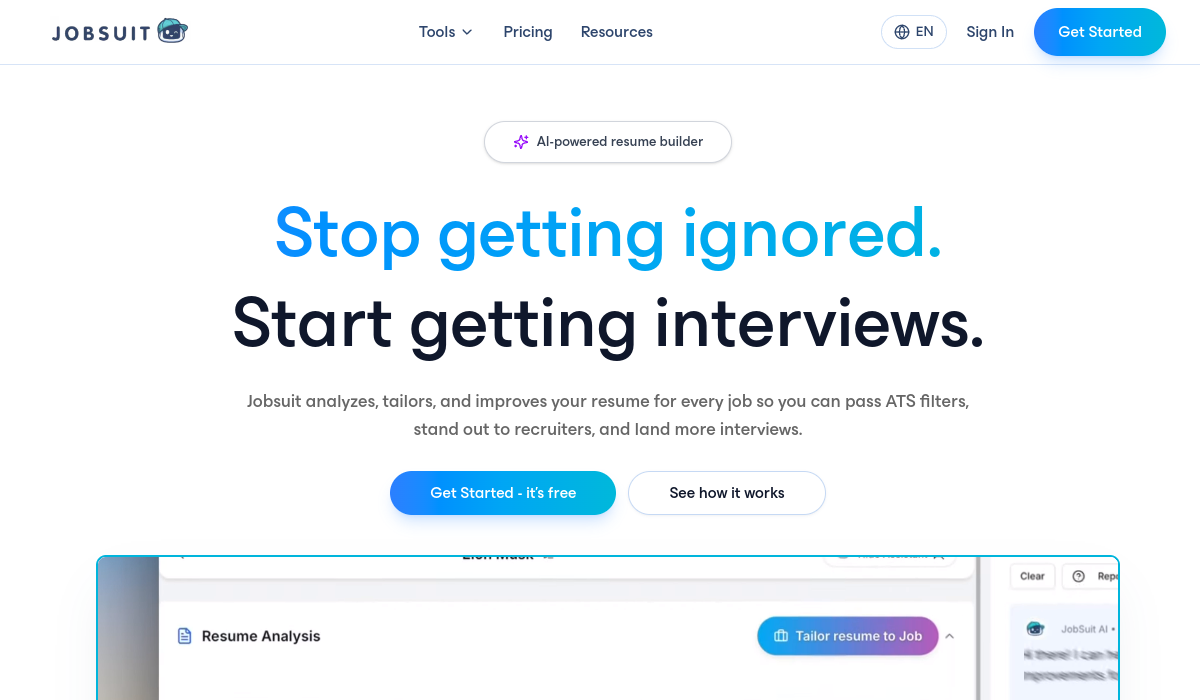
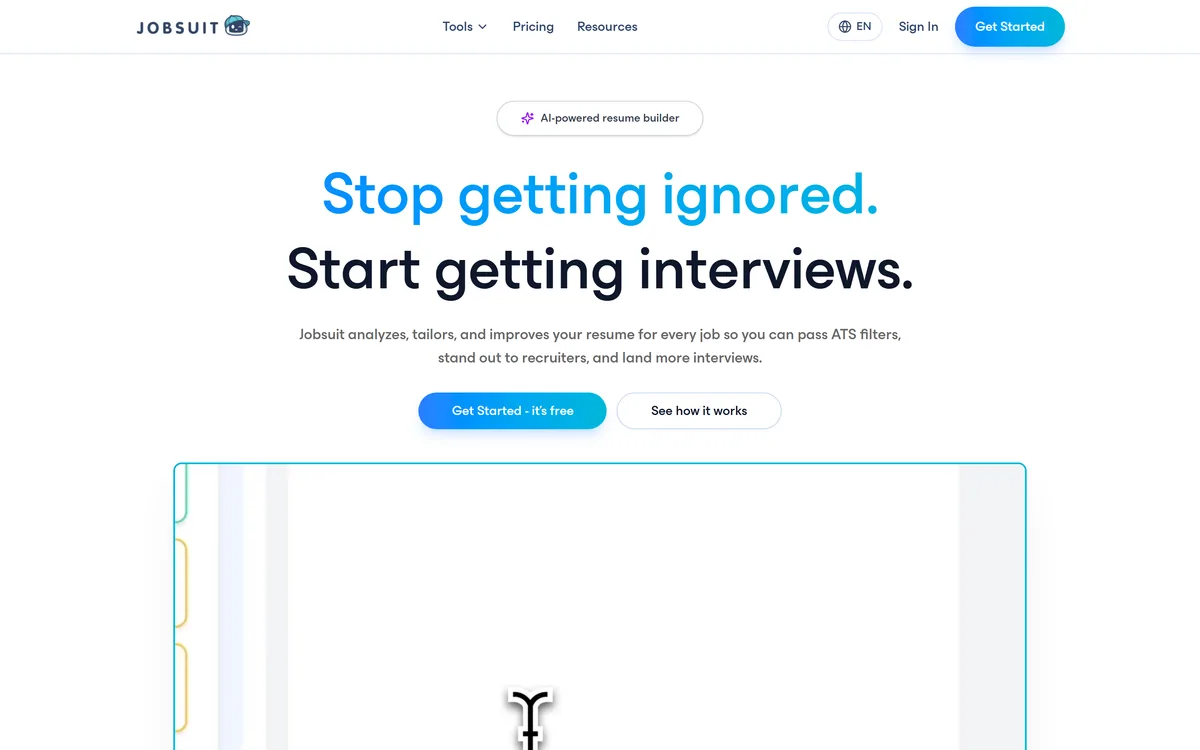
Last checked . Read from jobsuit.ai during this check, with the screenshot above captured at the same time.
- Feature names — Resume Analysis, Resume Tailoring, Resume Agent, ATS-friendly Templates, Cover Letter Generator, Job Application Tracker — listed on the site
- Resume Analysis described as covering ATS fit, missing keywords, content gaps and improvement recommendations
- Inputs described as uploading an existing resume or building from scratch, with job descriptions pasted for tailoring
- Company identified on the site as Jobsuit AI PTE. LTD.
- Example roles referenced on the site across analyst, design, engineering, marketing, finance, sales and project management functions
- Privacy policy, terms of service, pricing, FAQs, contact and Discord links present in the site footer
- No plan prices published here, in line with this site's pricing policy
The discussion of applicant tracking systems reflects how such software generally behaves and is not a claim about Jobsuit's accuracy. No external tool can read a specific employer's ATS configuration, so any score shown by any product in this category is an estimate against its own model.
Editor's Verdict
3.9/5Jobsuit AI has an AInexfinder Editor Score of 3.9/5.
Jobsuit AI pricing
AInexfinder does not list plan prices or billing details. For current pricing, plans, and trials, visit the official Jobsuit AI website.
Visit official website for pricingVendor pricing, credits, and billing policies change over time. Always confirm on the official site before you buy.
Frequently asked questions
Can Jobsuit guarantee my CV passes ATS filters?
No, and neither can any other tool. Employers configure their systems differently and do not publish how they weight things, so no external product can see what a specific company's software will do with your file. What a clean, conventionally structured document genuinely does is parse reliably — which is worth having.
What does the resume score actually mean?
It is Jobsuit's estimate of fit against its own model of how these systems behave, based on comparing your CV with the job description you pasted. Treat it as a signal about keyword and content alignment, not as a reading from the employer's system.
Is tailoring a CV to each job dishonest?
Not when it reframes true things. The same project can honestly be described as data analysis or stakeholder management depending on what the role wants. The line is adopting a keyword for something you barely touched — read every tailored version as if you will be interviewed on it, because you will.
Why does the application tracker matter?
Because tailoring creates forty documents where you used to have one. Six weeks later a recruiter calls about a role you half remember, and you need to know exactly what that version claimed. Linking each application to the document sent is what makes tailoring survivable at volume.
Should I use it for senior roles?
It will help less. Senior and specialist hiring runs on narrative, network and demonstrated results rather than structural keyword alignment. The value of this category is highest at the volume end of the market and falls as seniority rises.
Will it write my cover letter?
Yes, aligned to the tailored resume. Generate it after the CV is settled so the two say the same thing — a cover letter that contradicts the CV it accompanies is worse than no cover letter.
Does making applications faster actually help?
Only up to a point. Twenty tailored applications to roles you genuinely suit beat two hundred optimised ones to roles you do not. A tool that lowers the cost of applying also lowers the cost of applying badly, and that judgement stays with you.
Reviews
Log in to write a review.
User Reviews
No reviews yet. Be the first to share your experience with Jobsuit AI.
Reviewed by Daniel Reed
Assigned reviewer
Daniel ReedSenior AI Tools Reviewer
Daniel reviews AI tools the slow way — by actually using them on real projects. His reviews cover what works, what breaks, and who each tool is genuinely a good fit for.
Hands-on reviewsProduct testingAI software
Daniel and the AInexfinder editorial team research Jobsuit AI using public product information, listing evidence, and (when available) hands-on checks. Scores reflect listing completeness and transparency — not paid placement.
- Last verified
- Methodology
- How we review AI tools
- Sources used
- jobsuit.ai
- AInexfinder listing fields (features, pros/cons, description)
- Public vendor pages when available
- Editorial policy
- Listings may include affiliate or sponsored placements, which are labeled when present. Editorial scores and cons are not sold. See our affiliate disclosure and review methodology.
Related tools
ApplyArc pairs a Kanban job tracker with eighteen AI tools built around one loop: paste a job posting, paste your CV, read the gap analysis, fix the gaps, then apply. It runs on Azure OpenAI, is operated by a registered UK company, and states that your data is never used for training.
FreemiumWriting & Content
Kickresume builds resumes and cover letters from typographer-designed templates, scores them against an applicant tracking system checker, tailors each one to a specific job description, and adds interview practice, career mapping, a job board and application tracking around them.
FreemiumWriting & Content
Cover Letter Copilot generates a tailored cover letter from your resume and a job description in under 60 seconds, with tone controls, paragraph-level regeneration and a built-in editor. It claims 1.2M+ users, 2M+ letters generated across 150+ countries, and is contactable at ben@coverlettercopilot.ai.
FreemiumWriting & Content

Copy.ai has become an AI-native go-to-market platform: workflows and agents that run prospecting, lead processing, deal coaching, ABM, and CRM enrichment across Salesforce, HubSpot, Gong, Outreach, and 2,000+ integrations.
FreemiumWriting & Content

Writesonic has become an AI search growth platform — tracking whether your brand appears across 10 AI platforms, running optimisation and citation work through an Action Center, and reporting results against traffic and revenue.
FreemiumWriting & Content
Compare:Jobsuit AI vs CareerEdJobsuit AI vs ApplyArcJobsuit AI vs KickresumeJobsuit AI vs Cover Letter Copilot
Jobsuit AI alternatives Explore More
Embed this listing on your site
Featured on AInexfinder