CareerEd is a free AI cover letter generator. You paste a job posting and your resume, and it returns a tailored letter in under a minute. It also generates interview thank-you notes and publishes a library of cover letter and resume examples by role.
ApplyArc
Verified
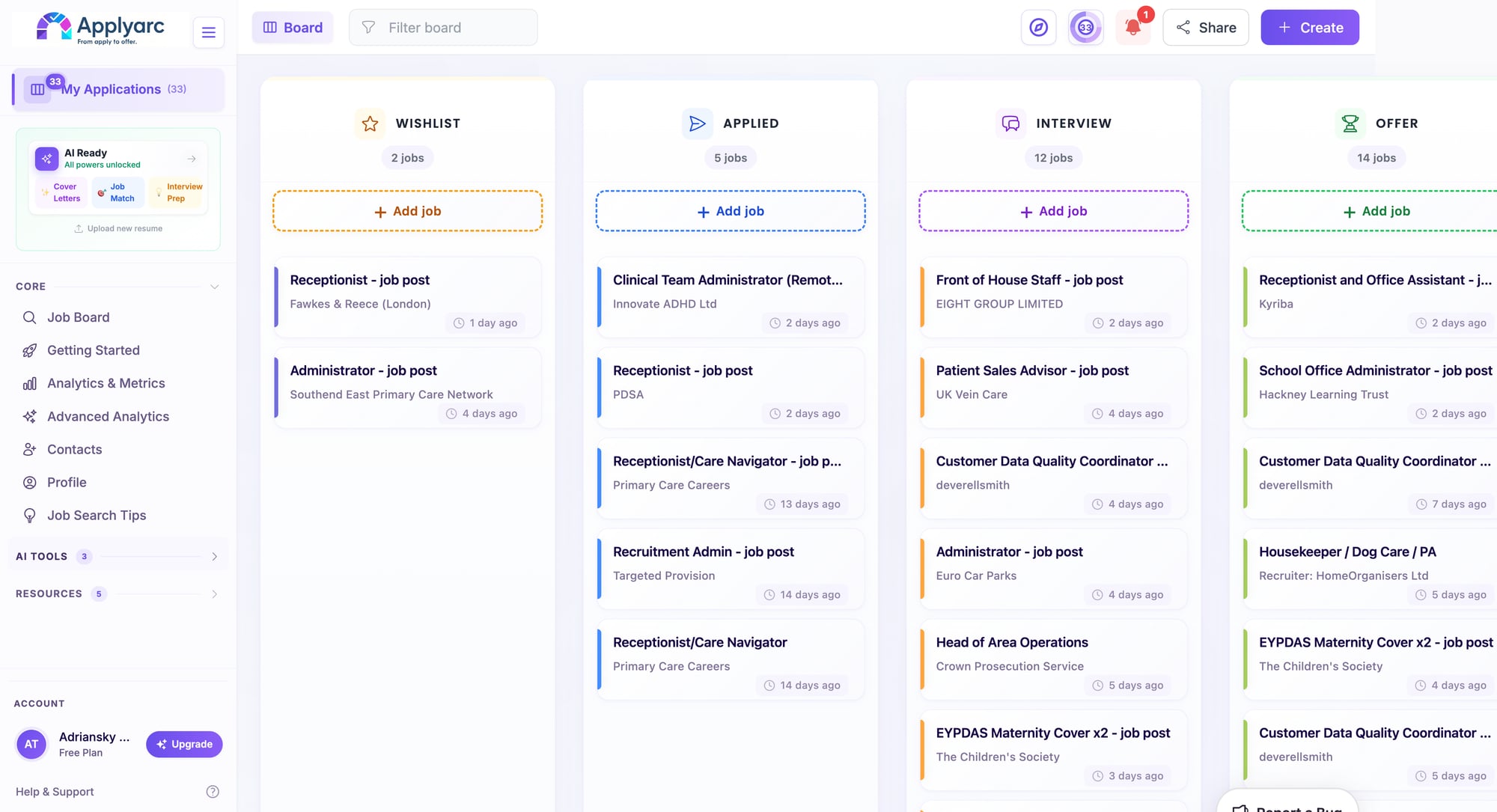
ApplyArc pairs a Kanban job tracker with eighteen AI tools built around one loop: paste a job posting, paste your CV, read the gap analysis, fix the gaps, then apply. It runs on Azure OpenAI, is operated by a registered UK company, and states that your data is never used for training.
3.9Editor Score
applyarc.com10 viewsAdded January 28, 20266K visitors
Most AI job-search tools are text generators with a tracker bolted on — Rezi builds the document, Kickresume designs it. ApplyArc is the reverse, and that ordering is the most useful thing about it.
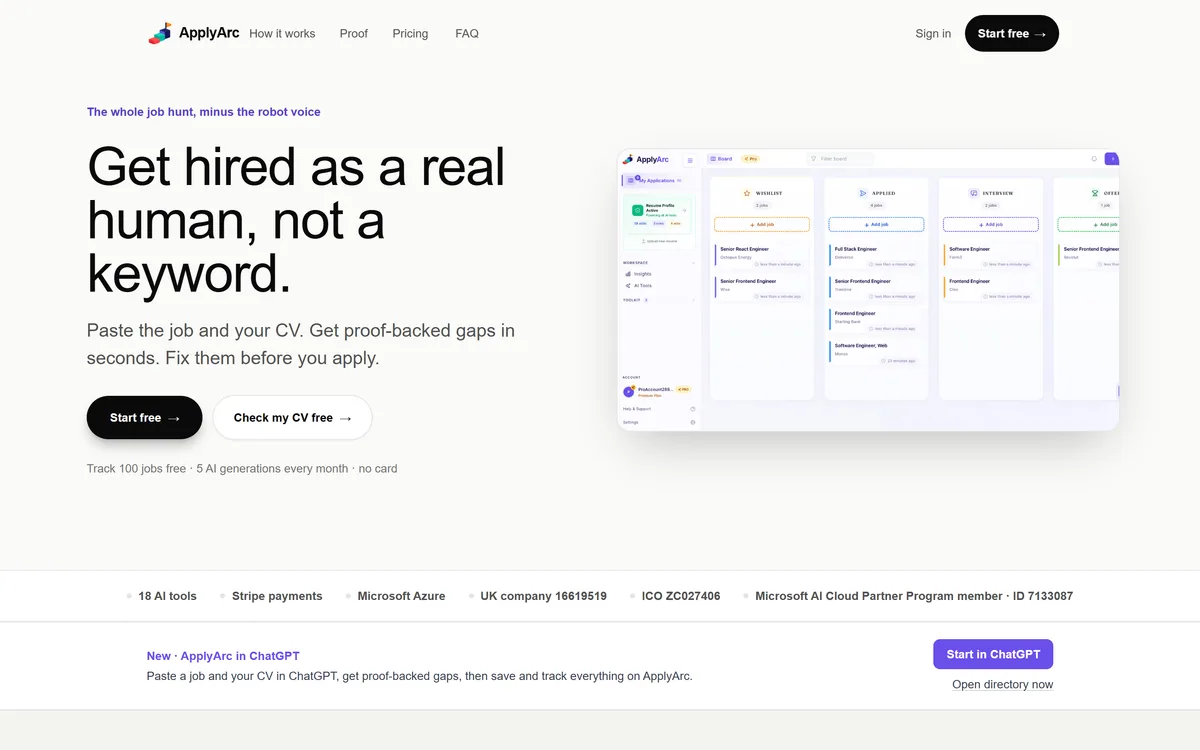
The product's centre of gravity is a Kanban board that moves a role from wishlist to applied to interview to offer. Every AI feature exists to move a card one column to the right. That sounds like a small distinction until you have used the alternative — a chat box that produces a polished cover letter for a job you will forget you applied to.
This review covers what the eighteen tools actually do, the one claim the vendor makes that deserves scrutiny, how the product handles a CV full of personal data, and the specific case where you should not use it at all.
The Tracker-First Summary
- It is a tracker first and a writer second — a wishlist/applied/interview/offer board sits at the centre, and the eighteen AI tools hang off it rather than the other way round.
- The core loop is a gap check, not a rewrite: paste the posting, paste your CV, read what is missing, decide what to change yourself.
- Built on Azure OpenAI with a stated no-training policy, hosted on Microsoft Azure, with Stripe handling payment — an unusually specific disclosure for a tool this size.
- Operated by ApplyArc Ltd, a registered UK company with a published company number and an ICO data-protection registration, and the site says the founder answers support personally.
- A free tier exists with a capped tracker and a small monthly allowance of AI generations; paid access is sold as a short one-off pass or as a recurring subscription.
The Gap Check Is The Product
Strip away the feature list and ApplyArc does one thing: it reads a job posting and your CV side by side, then tells you what the posting asks for that your CV does not evidence.
That is a narrower promise than a claim to write your resume for you, and a considerably more honest one. A gap list is checkable — you can look at the posting and confirm whether it really asked for Kubernetes. A generated CV is not checkable in the same way, because you have no baseline to compare it against and the fluency of the output actively discourages you from looking.
The tailoring tool that follows the scan is described as fact-checked, meaning it is constrained to material already in your CV rather than free to invent. This matters more than it sounds. The failure mode of every AI resume tool is quiet embellishment: a two-month contract becomes a year, a supporting role becomes ownership, and you discover the discrepancy in an interview.
Where the loop gets genuinely useful is repetition, in a way a one-shot document scorer such as Resume Worded is not built for. Running the same CV against ten postings in the same role family surfaces the gap that appears every time — and that recurring gap is real career information, not application advice.
A gap list you can verify against the posting is worth more than a rewritten CV you cannot verify against anything.
What The Match Score Is, And What It Is Not
The scanner reports a match score. Read it as one model's opinion of keyword and requirement overlap, not as a prediction of what any employer's system will do.
No third-party tool has access to the ranking logic inside Workday, Greenhouse or SuccessFactors. Those systems differ by vendor, by version, and by how the individual recruiter configured the knockout questions — and in a great many cases the first filter is a human reading for twenty seconds, not software at all.
So the score is useful as a relative signal: version B scores higher than version A against this posting, so version B is probably better aligned. It is not useful as an absolute threshold, and any tool that tells you a number guarantees an interview is selling certainty it cannot hold.
Eighteen Tools Is A Lot For One Engineer
The site counts eighteen AI tools: the scanner, the tailor, cover letters, interview prep with mock rounds, a career coach with daily planning, company research, outreach scoring, salary negotiation scripts, job matching and more.
The site also says ApplyArc is built and supported by a single engineer who answers support personally. Both things can be true, and together they describe the product's real risk. Breadth built by one person means the two or three tools you use will likely be good and the remaining fifteen will be thin.
That is not a criticism of the founder so much as arithmetic; a larger competitor such as Teal can staff each feature properly. The practical response is to work out, in your first session, which two tools you would actually return to, and judge the product on those alone.
There is a countervailing benefit worth stating. Small operators ship fixes fast, and a support email answered by the person who wrote the code beats a tiered helpdesk at a larger competitor. If you report a genuine bug here, someone who can fix it will read it.
- Worth your time — the gap scan, because it is checkable and repeatable.
- Worth your time — the tracker, because application volume is genuinely unmanageable in a spreadsheet past about thirty roles.
- Worth a look — mock interview rounds, useful mainly for rehearsing out loud rather than for the model's judgement of your answers.
- Treat with care — salary scripts and outreach scoring, where generic advice is common and the stakes of following it are high.
- Ignore until proven — anything you would not have gone looking for on its own.
Test It Against Your Own CV In Twenty Minutes
This is the trial that tells you whether ApplyArc fits how you actually job-hunt. It costs one session on the free tier and it does not require a payment method.
The bar to clear is in step three. If the tool cannot find three fair gaps in a CV you already know was rejected, it is not reading the posting closely enough to be worth a subscription.
- Pick a job posting you have already been rejected for. You know the outcome, which makes this a test rather than a guess.
- Run the scan against the CV you actually sent. Read the gap list before looking at the score, and mark each gap as fair, unfair or simply wrong.
- Count the fair ones. Three or more gaps that you genuinely could have evidenced and did not means the tool is reading the posting properly.
- Now run the tailor on those gaps only. Read every changed line and ask whether you would defend it under questioning in an interview.
- Log five live roles on the tracker board and leave them a week. If you did not open the board again, the tracker is not solving a problem you have — and the tracker is the product.
One Claim That Needs Reading Carefully
ApplyArc's headline differentiator is that its output sounds less machine-written than its competitors'. The supporting evidence is an internal comparison the vendor ran in February 2026: five tools, ten lines of output each, counting how many lines gave the tool away. ApplyArc reports one tell against a typical three elsewhere.
Take the finding seriously and the method lightly. It is a vendor testing itself against rivals it selected, with a sample of ten lines, scored on a judgement — whether a line gave the tool away — that the vendor also defined. Nothing about that is improper, and it is more disclosure than most competitors offer. It is simply not independent evidence.
The underlying point is sound regardless. AI-written application text has recognisable tells: three-part sentences that build to nothing, the word passionate, an opening line that restates the job title back at the reader. If a tool avoids them, that is worth something on a desk reading two hundred letters.
Test it directly rather than trusting the number. Generate one cover letter, read it aloud, and count the sentences you would not say to a person. That takes two minutes and it is the only benchmark that matters for your writing and your field.
Handing Over A CV Is Handing Over A Dossier
A CV is one of the densest personal-data documents most people own: full name, contact details, employment history, education, sometimes an address and a date range that implies your age. Uploading one is a real disclosure, and the question of where it goes deserves a direct answer.
ApplyArc gives a more specific answer than most. It names Azure OpenAI as the model provider and states that your data is not used for training, names Microsoft Azure as the storage layer and Stripe as the payment processor, and identifies itself as a member of the Microsoft AI Cloud Partner Program with a stated partner ID.
It also publishes the things a UK company can be held to: a company number for ApplyArc Ltd, an ICO data-protection registration, and separate privacy, terms, cookies, security and refund pages linked from the footer. That combination is checkable in public registers, which is the point of it.
None of this makes the upload risk-free. It does mean there is a named legal entity in a jurisdiction with an enforcing regulator, which is a materially better position than a tool that publishes only a support address.
- Redact your street address before uploading — it is rarely needed on a modern CV and it is the single most sensitive line on the page.
- Use the free tier for the first pass so you can judge the output before the account holds a full application history.
- Read the refund page before buying a short pass, because a one-off pass and a subscription are cancelled in different ways.
- If your current employer does not know you are looking, remember that the tracker now holds a list of every company you have approached.
How ApplyArc Charges
There is a free tier and it is usable rather than decorative: the tracker holds a substantial number of roles and a small monthly allowance of AI generations is included, which is enough to run the twenty-minute test above.
Paid access comes in two shapes. A short one-off pass covers an intensive burst — the week you are pushing out applications before a deadline — and does not renew. A recurring subscription covers a longer search, billed monthly or over a three-month term, and lifts both the tracker cap and the generation allowance.
The one-off pass is the more interesting option and it is rare in this category. Job searches are episodic; most competitors are priced as though yours is permanent. Paying for a defined burst and stopping is a better match for the actual shape of the problem.
What we do not publish here are the amounts, because they move. Read the pricing page and the refunds page together before committing, and check specifically whether a pass converts to a subscription at the end of its term.
ApplyArc: The Checkable Details
| Product type | Job application tracker with AI CV, cover letter and interview tools |
|---|---|
| Core loop | Paste posting and CV, read gap analysis, make targeted fixes, apply, track |
| Tool count stated | 18 AI tools |
| Model provider | Azure OpenAI, with a stated no-training-on-your-data policy |
| Hosting and payments | Microsoft Azure; Stripe |
| Partner status | Microsoft AI Cloud Partner Program member, partner ID published |
| Calendar integrations | Google Calendar, Outlook, Yahoo Calendar |
| Other access | ChatGPT plugin |
| Legal entity | ApplyArc Ltd, registered in the United Kingdom, company number published |
| Data-protection registration | ICO registration number published on the site |
| Pricing model | Free tier; one-off short pass; monthly or three-month subscription |
| Published policies | Privacy, Terms, Cookies, Security, Refunds and Rights |
Key features of ApplyArc
Gap scanner that reads a job posting and a CV together and reports what the CV does not evidence
CV tailoring constrained to facts already present in your document, described by the vendor as fact-checked
Kanban application tracker with wishlist, applied, interview and offer columns
Cover letter generation tied to the specific posting rather than to a generic template
Interview preparation with mock rounds, plus company research before the call
AI career coach with daily planning, outreach scoring and salary negotiation scripts
Calendar integration with Google, Outlook and Yahoo for interview scheduling
Resume performance tracking across multiple applications
Pros & cons
Pros
6- The core loop makes you decide what to change rather than handing you text to send unread
- Unusually specific infrastructure disclosure — named model provider, named host, named payment processor and a no-training statement
- A registered UK company with a published company number and ICO data-protection registration, both checkable in public registers
- A one-off short pass matches the episodic shape of a real job search better than a rolling subscription
- A free tier substantial enough to evaluate the product properly before paying
- Support answered by the person who builds the product
Cons
6- Eighteen features maintained by a solo operator means depth is uneven and most tools are shallow
- The match score is the tool's own estimate and has no documented relationship to any employer's real screening system
- The central claim about sounding human rests on a vendor-run internal test with a very small sample
- No enterprise assurances — a solo-operated product is unlikely to satisfy a data processing agreement or a security review
- Uploading a CV means handing over a dense personal-data document, and the tracker accumulates a record of every company you approached
- Breadth invites use of tools you would never have sought out, which is how application quality quietly degrades
Best For
- Job seekers running enough applications that tracking has become the actual problem
- Career changers who need to see the gap that recurs across many postings
- Anyone who wants a checkable gap list rather than a generated CV
- Short, intensive search pushes that suit a one-off pass
- People who want to know which company holds their CV and under which regulator
ApplyArc Against The Established Names
The job-search tool market splits between trackers that added AI and writers that added tracking. Knowing which side a product started on predicts what it will be good at.
| Tool | Started as | Strongest at | Weakest at |
|---|---|---|---|
| ApplyArc | A tracker with AI attached | Gap analysis against a specific posting, and a one-off pass that matches a short search | Breadth — eighteen features from a solo operator means most are shallow |
| Teal | A job tracker | Pipeline management and a browser extension that captures roles as you browse | Writing quality is not its centre of gravity |
| Rezi | A resume builder | Structured resume construction from a blank page, with parsing in mind | Weaker as a system for managing many live applications |
| Kickresume | A template-driven CV designer | Visual polish and a large library of ready layouts | Design-led output can work against plain-text parsing |
| Resume Worded | A CV and LinkedIn scorer | Line-by-line critique of a document you already have | No application tracking at all |
Who Should Open An ApplyArc Account
It fits if this describes you
- You are applying to enough roles that you have lost track of which version of your CV went where.
- You want to know what a posting asks for that your CV does not evidence, and you intend to make the edits yourself.
- Your search is a defined push over a few weeks rather than an open-ended background activity — the one-off pass is built for exactly that.
- You care that the operator is a named, registered company with a published data-protection registration.
- You are changing field or level and need the recurring gap across many postings, not advice on one.
Look elsewhere if this describes you
- You want a finished CV generated for you with minimal review — the tool is deliberately built to make you decide, and using it any other way produces text you cannot defend.
- You are applying to a handful of carefully chosen roles, where a tracker solves nothing and a careful hour on each application beats any tooling.
- You need a designed, visually distinctive CV, which is a different category of product entirely.
- You are in a field where applications go through a portfolio, a referral or a regulated process rather than a posting and a CV.
- You need enterprise assurances such as a signed data processing agreement or a completed security questionnaire, which a solo-operated product is unlikely to satisfy.
Other Tools In The Application Stack
Each of these solves an adjacent part of the same problem, and several pair with ApplyArc rather than replacing it.
- Teal — the closest comparison on tracking, with a stronger browser-extension capture flow
- Rezi — better if you are building a CV from scratch rather than adapting one you already have
- Kickresume — template-led design, for fields where a plain document undersells you
- CareerEd — another AI-assisted career tool worth comparing on output quality
- Grammarly — for the final proofread, which no application tool should be trusted to do alone
How We Checked ApplyArc
Last checked . Read from applyarc.com, including the footer and policy pages, with the screenshot above captured in the same session.
- Product described as a job application tracker combined with AI tools for CV tailoring, cover letters and interview preparation
- Tracker columns stated as wishlist, applied, interview and offer, with a lower role cap on the free tier and a higher cap on paid
- Eighteen AI tools counted on the site across scanning, tailoring, interview prep, company research, outreach and salary guidance
- Azure OpenAI named as the model provider, with an explicit statement that customer data is not used for training
- Microsoft Azure named for storage, Stripe for payments, and Microsoft AI Cloud Partner Program membership stated with a partner ID
- Calendar integrations listed for Google, Outlook and Yahoo; a ChatGPT plugin is also referenced
- ApplyArc Ltd identified as the operating company with a United Kingdom company number and an ICO registration number published
- Footer confirmed to carry About, Blog, FAQ, Support, Reviews, Privacy, Terms, Cookies, Security, Refunds and Rights, and a support contact address
- Pricing structure confirmed as a free tier plus a one-off short pass and monthly or three-month recurring options
What we could not confirm: the February 2026 comparison against rival tools is the vendor's own internal test and we found no independent replication of it; the match score's relationship to any real applicant tracking system is not documented and cannot be verified from outside; and we did not test the paid tiers, so the higher generation allowances are taken from the pricing page rather than from use.
Editor's Verdict
3.9/5ApplyArc earns its score on transparency and on a genuinely sensible core loop — score the CV against the posting, fix the gaps, then apply — rather than on generating text you have not read. A named UK company, an ICO registration, Azure OpenAI with a no-training statement and a published refund page are more accountability than most tools in this category offer. It loses ground because it is a solo-operator product carrying eighteen features, because the match score it reports is its own model's opinion rather than any employer's real screening system, and because the vendor's own comparison test is the only evidence for its central claim about sounding human. AInexfinder Editor Score: 3.9/5.
ApplyArc pricing
AInexfinder does not list plan prices or billing details. For current pricing, plans, and trials, visit the official ApplyArc website.
Visit official website for pricingVendor pricing, credits, and billing policies change over time. Always confirm on the official site before you buy.
Frequently asked questions
What does ApplyArc actually do?
It combines a Kanban job tracker with a set of AI tools built around one loop: you paste a job posting and your CV, it reports what the posting asks for that your CV does not evidence, you fix those gaps, and the application moves across the board from wishlist to applied to interview to offer.
Is ApplyArc free?
There is a free tier, and it is usable rather than decorative — the tracker holds a substantial number of roles and a small monthly allowance of AI generations is included. Paid access is sold either as a short one-off pass that does not renew or as a monthly or three-month subscription. We do not publish amounts because they change; read the pricing and refunds pages together.
Will ApplyArc's score tell me whether I will pass an employer's screening system?
No, and no third-party tool can. The score reflects ApplyArc's own model reading the posting against your CV. Real applicant tracking systems differ by vendor, by version and by how the recruiter configured them, and in many cases the first filter is a person reading for twenty seconds. Use the score to compare two versions of your own CV, not as a threshold.
Does ApplyArc use my CV to train AI models?
The site states that customer data is not used for training and names Azure OpenAI as the model provider, with storage on Microsoft Azure. That is a clearer disclosure than most tools in this category offer. It is a vendor statement rather than an audited certification, so weigh it accordingly.
Who operates ApplyArc?
ApplyArc Ltd, a company registered in the United Kingdom. The site publishes its company number and an ICO data-protection registration, both of which can be checked in public registers, and describes the product as built and supported by a single engineer who answers support directly.
Will the generated cover letters sound like AI wrote them?
The vendor's position is that they sound less machine-written than rivals', supported by an internal test it ran in February 2026 across five tools. That is the vendor testing itself on a sample of ten lines per tool, so treat it as a claim rather than as evidence. Generate one letter, read it aloud, and count the sentences you would not say to a person.
How does ApplyArc compare with Teal?
Both are tracker-first products. Teal has the stronger capture flow, with a browser extension that saves roles as you browse, and a longer track record. ApplyArc puts more weight on the gap analysis between a posting and your CV, and offers a one-off pass rather than only a subscription. If tracking is your whole problem, compare them on the board; if the gap analysis is what you want, that is where ApplyArc is stronger.
Reviews
Log in to write a review.
User Reviews
No reviews yet. Be the first to share your experience with ApplyArc.
Reviewed by Daniel Reed
Assigned reviewer
Daniel ReedSenior AI Tools Reviewer
Daniel reviews AI tools the slow way — by actually using them on real projects. His reviews cover what works, what breaks, and who each tool is genuinely a good fit for.
Hands-on reviewsProduct testingAI software
Daniel and the AInexfinder editorial team research ApplyArc using public product information, listing evidence, and (when available) hands-on checks. Scores reflect listing completeness and transparency — not paid placement.
- Last verified
- Methodology
- How we review AI tools
- Sources used
- applyarc.com
- AInexfinder listing fields (features, pros/cons, description)
- Public vendor pages when available
- Editorial policy
- Listings may include affiliate or sponsored placements, which are labeled when present. Editorial scores and cons are not sold. See our affiliate disclosure and review methodology.
Related tools
Jobsuit AI is a resume builder from Jobsuit AI PTE. LTD. that analyses a CV against a job description, flags missing keywords and content gaps, tailors the document to the role, writes matching cover letters and tracks applications.
FreemiumWriting & Content
Kickresume builds resumes and cover letters from typographer-designed templates, scores them against an applicant tracking system checker, tailors each one to a specific job description, and adds interview practice, career mapping, a job board and application tracking around them.
FreemiumWriting & Content
Cover Letter Copilot generates a tailored cover letter from your resume and a job description in under 60 seconds, with tone controls, paragraph-level regeneration and a built-in editor. It claims 1.2M+ users, 2M+ letters generated across 150+ countries, and is contactable at ben@coverlettercopilot.ai.
FreemiumWriting & Content

Copy.ai has become an AI-native go-to-market platform: workflows and agents that run prospecting, lead processing, deal coaching, ABM, and CRM enrichment across Salesforce, HubSpot, Gong, Outreach, and 2,000+ integrations.
FreemiumWriting & Content

Writesonic has become an AI search growth platform — tracking whether your brand appears across 10 AI platforms, running optimisation and citation work through an Action Center, and reporting results against traffic and revenue.
FreemiumWriting & Content
Compare:ApplyArc vs CareerEdApplyArc vs Jobsuit AIApplyArc vs KickresumeApplyArc vs Cover Letter Copilot
ApplyArc alternatives Explore More
Embed this listing on your site
Featured on AInexfinder