
CareerEd is a free AI cover letter generator. You paste a job posting and your resume, and it returns a tailored letter in under a minute. It also generates interview thank-you notes and publishes a library of cover letter and resume examples by role.
Wobo
Verified
Wobo is an AI job search platform that scans the market daily, pre-vets listings against company signals, matches roles to your background, and auto-applies with personalised resumes and cover letters. It also offers an ATS resume checker scoring against 24+ criteria.
3.6Editor Score
wobo.ai6 viewsAdded March 2, 202610K visitors
Job searching broke for a specific and documented reason: applying became free. Once a candidate could apply to fifty roles in an evening, everybody did, and employers received a volume of applications no human could read.
The response was automated screening, which candidates then optimised against, which produced more applications, which required more screening. Both sides now use software to fight software, and neither is better off.
Wobo sits inside that arms race and does one genuinely different thing: it filters the listings before you see them. Whether the rest of the product helps depends on which half you use.
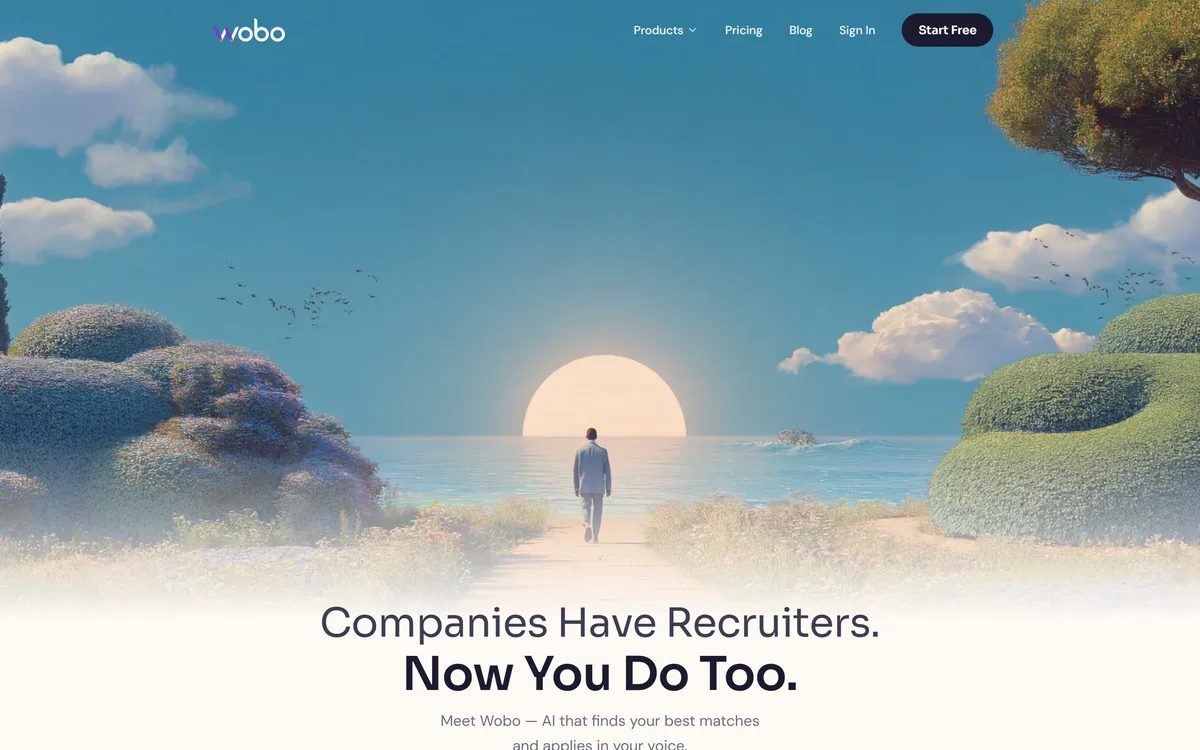
Wobo: An AI Recruiter On Your Side
- Pre-vetting is the standout — the site states company signals are verified before a job reaches your feed, with no ghost listings.
- It scans daily across 50+ sources, with a stated 3M+ jobs scanned.
- Auto-apply with personalised resumes and cover letters, plus a swipe interface showing match score, salary range and company rating.
- An ATS Resume Checker scoring your CV against 24+ criteria, which is useful independently of the rest.
- Free to start with no card required, and a stated 4.7 out of 5 from 282 reviews on Reviews.io.
Should An AI Apply To Jobs For You?
Wobo's headline capability is auto-applying with personalised resumes and cover letters, and it deserves a genuinely mixed answer rather than either enthusiasm or dismissal.
The case for it is that the current system rewards volume. Application-to-interview rates are low enough that fifty applications is a reasonable strategy, and producing fifty tailored applications by hand is a full-time job that most people looking for work do not have time for.
The case against is that everyone reasoning this way is the reason the system is broken. Volume applying is what buried recruiters, which produced automated screening, which made volume necessary — and each candidate joining that loop makes it slightly worse for everyone including themselves.
There is also a specific personal risk that people underestimate. An application you did not read is one you cannot discuss, and being invited to interview for a role you do not remember applying to — with a cover letter you did not write — is a bad position to be in.
The version that works is auto-apply as a first pass on roles you are genuinely open to, with a rule that you read anything before it is sent and anything you would be embarrassed to be asked about. That is slower than the tool permits and it is the only version that survives contact with an interview.
The opposite discipline is to improve one application properly, which is what a tool like ApplyArc is for — reading a single CV against a single posting rather than sending fifty.
An application you did not read is one you cannot discuss. Being interviewed on a cover letter you never saw is a bad position to be in.
Pre-Vetting Is The Half That Helps
Wobo states that every job is pre-vetted, that company signals are verified before a listing reaches your feed, and that there are no ghost listings.
This addresses something candidates genuinely cannot check. A substantial share of posted jobs are not real vacancies — roles already filled internally, listings kept open to collect a pipeline, agency postings for positions that do not exist, and duplicates across five boards.
From the candidate's side all of them look identical to a genuine opening, and the time spent applying is indistinguishable until nothing happens. That is the single most demoralising part of job searching and the part no amount of application polish fixes.
Filtering on company signals — hiring activity, funding, growth indicators — is a reasonable proxy for whether an organisation is actually hiring, and it is exactly the kind of aggregation a person cannot do alone.
The honest caveat is that pre-vetting is a heuristic rather than verification. A company can be hiring and still have filled this particular role, and no external signal reveals that. It narrows a large problem rather than solving it.
ATS Scoring And What It Really Measures
Wobo includes an ATS Resume Checker scoring a CV across 24+ criteria, and this is the most useful thing in the product for someone not using anything else.
An applicant tracking system is the software that receives applications, parses them into fields and lets a recruiter search. Most large employers use one, and a CV it parses badly is a CV a recruiter never sees regardless of how good the candidate is.
The failures are mechanical and fixable: a two-column layout the parser reads out of order, a header block the system ignores, a graphic where your contact details should be, a PDF exported as an image. None of these are about the writing.
Scoring against those criteria is genuinely valuable, and it is a one-time fix rather than a subscription-shaped problem — which makes it the thing to use even if you use nothing else here.
What it cannot tell you is whether a human will like your CV, and it is worth not over-optimising. A document tuned entirely for keyword matching reads as a document tuned for keyword matching, and the person who eventually opens it notices.
None of it helps if the document itself parses badly, which is a separate and mechanical problem that a formatter such as CVUniform addresses directly.
- Fix the ATS parsing problems first — they are mechanical and one-time.
- Read every application before it is sent, however slow that makes the tool.
- Treat pre-vetting as a strong filter, not a guarantee the role is open.
- Judge the search on interviews reached, not on applications submitted.
- Keep a record of what was sent where, so an unexpected call is not a surprise.
What Wobo's Own Numbers Show
Wobo displays a 4.7 out of 5 from 282 reviews on Reviews.io, 3M+ jobs scanned, 100% pre-vetted, scanning across 50+ sources, and a Product Hunt Product of the Day badge.
The review score is the most useful of these, because it sits on a third-party platform the vendor does not control. 282 reviews is a real sample rather than a handful, though consumer review scores skew high for the usual reason: dissatisfied users cancel silently rather than write.
The jobs-scanned figure describes effort rather than outcome. Three million listings scanned is a statement about coverage, and the number a job seeker actually cares about — how many people got interviews — is not published by anyone in this category.
The company logos shown alongside — Spotify, OpenAI, Stripe, Netflix, Anthropic and others — appear in the context of jobs scanned rather than as customers or employers who hired through the platform, and no relationship is described.
The Product Hunt badge is a launch-day popularity award. It signals that the launch went well, which is genuinely something, and it says nothing about whether the product works six months later.
Running An AI Job Search Honestly
A search run entirely on automation produces a lot of activity and very little signal, which is exhausting in a different way from doing it by hand.
The sequence below uses the tool for the parts that are genuinely mechanical and keeps you in the parts that are not.
For the roles that are never advertised, the honest route is approaching companies directly — enrichment data from Clay and outbound tooling like Instantly are the same machinery pointed the other way.
- Fix your CV against the ATS checker first, since parsing failures make everything downstream pointless.
- Set your criteria narrowly at the start — a wide net produces matches you do not want and applications you cannot defend.
- Read every generated application before it is sent, at least for the first fortnight, to see what it says in your name.
- Keep a record of which roles were applied to and when, so an unexpected call is never a surprise.
- Reserve genuine effort for the five roles you actually want, and write those yourself.
- Judge after a month on interviews reached rather than applications sent, which is the only number that matters.
Wobo: Products And Numbers
| Product type | AI job search and application platform |
|---|---|
| Positioning | AI that finds your best matches and applies in your voice |
| AI Job Application | Auto-apply with personalised resumes and cover letters |
| AI Resume Builder | ATS-optimised resumes tailored per job |
| AI Cover Letter Generator | Job-specific cover letters |
| ATS Resume Checker | Scores a CV across 24+ ATS criteria |
| Pre-vetting | Company signals verified before a job reaches your feed, stated as 100% pre-vetted |
| Scanning | 50+ sources scanned daily, with 3M+ jobs scanned stated |
| Matching interface | Swipe to apply, with match score, salary range and company rating shown |
| Company scoring | A Wobo Score shown per company alongside size, location and founding year |
| Entry | Free to start, no credit card required |
| Stated rating | 4.7 out of 5 from 282 reviews on Reviews.io |
| Recognition | Product Hunt Product of the Day badge displayed |
Is Wobo Right For Your Search?
A genuine help when
- You are searching at volume and losing days to listings that were never real.
- Your CV has never been checked against how an ATS parses it.
- You want jobs filtered before you see them rather than after you apply.
- You will read every application before it goes out.
- You are open to a range of roles rather than targeting three companies.
Apply yourself when
- You are targeting a small number of specific employers, where personal effort wins.
- You would send applications you have not read, which you cannot then defend.
- You are in a field where applications go through named contacts rather than boards.
- You would measure success by applications sent rather than interviews reached.
- You are senior enough that roles reach you through network rather than listings.
Key features of Wobo
Daily scanning across 50+ job sources
Pre-vetting against company signals before a listing reaches your feed
Auto-apply with personalised resumes and cover letters
A swipe interface showing match score, salary range and company details
ATS Resume Checker scoring against 24+ criteria
AI Resume Builder producing ATS-optimised documents per job
AI Cover Letter Generator for job-specific letters
A Wobo Score summarising each company
Pros & cons
Pros
6- Pre-vetting addresses something candidates genuinely cannot check themselves
- Ghost listings are the most demoralising part of a search and the hardest to detect
- The ATS checker fixes mechanical parsing failures that make good CVs invisible
- Match score, salary and company detail in one card is a real time saving
- A third-party review score with a real sample size rather than on-site testimonials
- Free to start with no card, which makes the ATS check available to anyone
Cons
6- Auto-applying contributes to the volume problem that broke job boards
- An application you did not read is one you cannot defend in an interview
- Pre-vetting is a heuristic — a hiring company can still have filled this role
- Displayed company names describe no stated relationship to the product
- Over-optimising for ATS produces a CV that reads as optimised for ATS
- No operating company, location or model disclosure published
Best For
- Candidates searching at volume across many listings
- Anyone who has lost weeks to roles that were never really open
- People whose CV has never been checked against ATS parsing
- Job seekers open to a range of roles rather than three companies
- Anyone who will read applications before they are sent
Wobo Against Other Career Tools
Career tools split by whether they improve the application, find the role, or send it for you.
| Tool | What it does | Human involvement | Best for |
|---|---|---|---|
| Wobo | Finds, vets, matches and applies | Approve by swipe | Volume searching with the listings filtered first |
| ApplyArc | Analyses a CV against a posting | You apply | Improving one application at a time |
| CVUniform | CV formatting and structure | You apply | Fixing the document itself |
| Clay | Company and contact data | You act on it | Researching employers directly |
| Instantly | Outbound email at volume | You write the sequence | Approaching companies that are not advertising |
Other Career And Job Tools
Improving the document, finding the role and reaching the employer are three separate problems.
- ApplyArc — analysing one CV against one posting properly
- CVUniform — fixing the document's structure and formatting
- Clay — researching employers directly rather than through listings
- Instantly — approaching companies that are not advertising at all
- Willow Voice — for writing the applications you do want to write yourself
Wobo: Reading The Homepage Claims
Last checked . Read from wobo.ai in a browser session, with the screenshot above captured alongside.
- Positioned on the site as AI that finds your best matches and applies in your voice
- AI Job Application confirmed as auto-applying with personalised resumes and cover letters
- AI Resume Builder confirmed as producing ATS-optimised resumes tailored to each job
- AI Cover Letter Generator confirmed
- ATS Resume Checker confirmed as scoring a resume across 24+ ATS criteria
- Pre-vetting stated on the site, with company signals verified before a job reaches the feed and a claim of no ghost listings
- Daily scanning across 50+ sources stated, with 3M+ jobs scanned and 100% pre-vetted displayed
- A swipe interface confirmed, showing match score, salary range, requirements and company details
- A Wobo Score shown per company alongside size, location and founding year
- Free entry confirmed with no credit card required
- A 4.7 out of 5 rating from 282 reviews on Reviews.io displayed on the site
- A Product Hunt Product of the Day badge displayed
- Company names shown on the homepage including Spotify, OpenAI, Airbnb, Stripe, Reddit, Netflix, Anthropic, Figma, Cisco, SpaceX, Notion and others, in the context of jobs scanned
What we could not confirm: the operating company's legal name or location; pricing beyond the free entry point; which company signals are used for pre-vetting, or how they are weighted; whether the displayed company names indicate any relationship beyond listings appearing in the index; how many users have found roles through the platform, which nobody in this category publishes; which underlying models write the applications; and how CV and personal data are stored or retained. We did not use the product, so nothing here reflects tested results.
Editor's Verdict
3.6/5Wobo's genuinely useful half is the pre-vetting. Job boards are full of listings that are stale, duplicated, or posted by companies not actually hiring, and a candidate cannot tell which from the outside — so time goes into applications nobody will read. Verifying company signals before a job reaches your feed addresses a real and specific waste. The auto-apply half is where the caution belongs: volume applying is what made job boards unusable in the first place, and a candidate contributing to that is competing against the noise they helped create. Applications you did not read are applications you cannot defend in an interview. AInexfinder Editor Score: 3.6/5.
Wobo pricing
AInexfinder does not list plan prices or billing details. For current pricing, plans, and trials, visit the official Wobo website.
Visit official website for pricingVendor pricing, credits, and billing policies change over time. Always confirm on the official site before you buy.
Frequently asked questions
What is Wobo?
Wobo is an AI job search platform that scans 50+ sources daily, pre-vets listings against company signals, matches roles to your background and can auto-apply with personalised resumes and cover letters. It also includes an ATS Resume Checker scoring a CV across 24+ criteria, and is free to start.
Should I let AI apply to jobs for me?
Partially, with a rule. The system rewards volume, and producing fifty tailored applications by hand is a full-time job. But an application you did not read is one you cannot discuss — being interviewed on a cover letter you never saw is a bad position. Read anything before it is sent.
What does pre-vetting actually do?
It filters out listings that are not real openings — roles filled internally, postings kept open to collect a pipeline, agency listings for positions that do not exist, duplicates across boards. Candidates cannot tell any of these apart from a genuine vacancy, and the wasted time is the most demoralising part of searching.
Is pre-vetting reliable?
It is a heuristic rather than verification. Company signals — hiring activity, funding, growth — are a reasonable proxy for whether an organisation is actually hiring, and no external signal can tell you whether this particular role has already been filled. It narrows a large problem rather than solving it.
What is the ATS Resume Checker for?
Catching mechanical failures that make a good CV invisible: a two-column layout the parser reads out of order, a header block the system ignores, contact details inside a graphic, a PDF exported as an image. None of these are about your writing, all of them stop a recruiter ever seeing you, and all are one-time fixes.
Can I over-optimise for an ATS?
Yes, and it is worth avoiding. A document tuned entirely for keyword matching reads as a document tuned for keyword matching, and the person who eventually opens it notices. Fix the parsing problems, include the relevant terms, and then write for the human who decides.
Are Spotify and Netflix Wobo customers?
The homepage displays those names in the context of jobs scanned rather than as customers or as employers who hired through the platform, and no relationship is described. Treat them as an indication of which companies appear in the index, not as endorsement of any kind.
How reliable is the 4.7 rating?
It sits on Reviews.io, a third-party platform the vendor does not control, with 282 reviews — a real sample rather than a handful. Consumer review scores skew high for the usual structural reason: dissatisfied users cancel silently rather than write. It is meaningful evidence, read with that caveat.
How should I measure whether my search is working?
Interviews reached, not applications sent. Applications submitted is the number every tool in this category shows you and the one that tells you least — it measures activity rather than progress. If a month of automated applying produces no more interviews than a fortnight of careful ones did, that is your answer.
When should I apply manually instead?
For the five roles you actually want. Targeting a specific employer rewards personal effort in a way volume never does — a message to a named person, a reference to something specific about the company, an application that could only have been written for that role. Reserve real effort for those.
Reviews
Log in to write a review.
User Reviews
No reviews yet. Be the first to share your experience with Wobo.
Reviewed by Daniel Reed
Assigned reviewer
Daniel ReedSenior AI Tools Reviewer
Daniel reviews AI tools the slow way — by actually using them on real projects. His reviews cover what works, what breaks, and who each tool is genuinely a good fit for.
Hands-on reviewsProduct testingAI software
Daniel and the AInexfinder editorial team research Wobo using public product information, listing evidence, and (when available) hands-on checks. Scores reflect listing completeness and transparency — not paid placement.
- Last verified
- Methodology
- How we review AI tools
- Sources used
- wobo.ai
- AInexfinder listing fields (features, pros/cons, description)
- Public vendor pages when available
- Editorial policy
- Listings may include affiliate or sponsored placements, which are labeled when present. Editorial scores and cons are not sold. See our affiliate disclosure and review methodology.
Related tools
ApplyArc pairs a Kanban job tracker with eighteen AI tools built around one loop: paste a job posting, paste your CV, read the gap analysis, fix the gaps, then apply. It runs on Azure OpenAI, is operated by a registered UK company, and states that your data is never used for training.
FreemiumWriting & Content
Jobsuit AI is a resume builder from Jobsuit AI PTE. LTD. that analyses a CV against a job description, flags missing keywords and content gaps, tailors the document to the role, writes matching cover letters and tracks applications.
FreemiumWriting & Content
Cover Letter Copilot generates a tailored cover letter from your resume and a job description in under 60 seconds, with tone controls, paragraph-level regeneration and a built-in editor. It claims 1.2M+ users, 2M+ letters generated across 150+ countries, and is contactable at ben@coverlettercopilot.ai.
FreemiumWriting & Content
Kickresume builds resumes and cover letters from typographer-designed templates, scores them against an applicant tracking system checker, tailors each one to a specific job description, and adds interview practice, career mapping, a job board and application tracking around them.
FreemiumWriting & Content

Copy.ai has become an AI-native go-to-market platform: workflows and agents that run prospecting, lead processing, deal coaching, ABM, and CRM enrichment across Salesforce, HubSpot, Gong, Outreach, and 2,000+ integrations.
FreemiumWriting & Content
Explore More
Embed this listing on your site
Featured on AInexfinder