Willow Voice is AI dictation that works in any application on Mac and iOS. You place a cursor, hold a hotkey and speak; formatted text appears in place. Willow Scribe extends it, turning rough spoken intent into polished writing, and the site states 100,000+ professionals.
willowvoice.com6 viewsAdded September 18, 20255K visitors
Dictation has been almost good enough for about thirty years, and the reason it never stuck is not the transcription.
It is that the text always appeared somewhere else. You spoke into an application, corrected the punctuation, then copied the result into the place you actually needed it — and a three-step process loses to typing, every time, no matter how fast the middle step gets.
Willow Voice's answer removes the steps rather than speeding them up. Put your cursor where you want the words, hold a key, speak, and the formatted text is already there.
Willow Voice: Dictation That Sticks
It works in any text field — Slack, Gmail, Cursor, Notion, iMessage — rather than in an application you copy from.
Hold a hotkey and speak; formatted text appears where the cursor already was, with no switching or cleanup.
Punctuation and filler words are handled for you, because nobody speaks in punctuation.
Willow Scribe turns rough spoken intent into polished writing rather than only transcribing it.
Mac and iOS, with the site stating 100,000+ professionals and a dedicated security page.
Why Has Dictation Never Worked Before?
Willow describes a three-step interaction: place your cursor in any text field, press a hotkey and speak naturally, and perfectly formatted text appears where the cursor is.
The important word is *any*. Slack, Gmail, Cursor, Notion, iMessage — anywhere you would normally type, which means dictation stops being a destination and becomes an input method.
That is the difference from every previous generation. A dictation application is somewhere you go; an input method is something you use without thinking about it, and only the second becomes a habit.
The second half is the formatting. Speaking naturally means speaking without punctuation, with restarts and hesitations and the occasional abandoned sentence, and older dictation faithfully transcribed all of it — leaving you to clean up text you could have typed correctly in the first place.
Handling that automatically is what makes the output usable without editing, and it is the claim to test hardest. The gap between raw transcription and something you would actually send is where every previous attempt at this failed.
The contrast with a meeting notetaker is worth drawing. Wave captures what other people said; this produces what you meant to write, which is a different product entirely.
Dictation applications are somewhere you go. An input method is something you use without thinking. Only the second ever becomes a habit.
Willow Scribe Turns Intent Into Writing
Willow Scribe is described as AI writing from your intent: describe roughly what you want to say, and it produces polished writing in your voice, in place.
That is a meaningfully different product from dictation, and worth separating. Dictation writes down what you said; Scribe writes what you meant, which is a much larger claim and a much larger risk.
The case for it is real. Most people know what they want a message to convey and lose ten minutes constructing sentences, and the constructing is not where the value is. Describing the intent in twenty rough seconds and getting a draft is a genuine reallocation of effort.
The risk is equally real and specific: the output is your writing with your name on it, sent to someone who will hold you to it. A dictated message you spoke is yours by definition; a generated one from a rough description is yours only if you read it.
The practical rule follows. Use Scribe for the messages where the words do not matter much and read every one before sending, and dictate the messages where the words do. That division is easy to make in the moment and easy to forget.
Working In Every App Is The Whole Point
Willow states it works in every app on Mac and iOS, and the practical significance of that is worth spelling out with examples.
The applications listed are a fair sample of a working day: Slack for internal conversation, Gmail for external, Cursor for code, Notion for documents, iMessage for personal. A dictation tool that covered three of those and not the others would be useless, because the habit never forms if it sometimes does not work.
Cursor is the interesting inclusion, because prompting an AI is a category the site names specifically. Prompts are long, conversational and awkward to type — you are describing what you want in prose — which makes them close to an ideal case for speaking.
That is arguably the strongest use of the tool and one nobody predicted three years ago. The volume of prose people now type into AI tools is enormous, and it is exactly the shape of writing that speaking suits.
The constraint is physical rather than technical. Dictation requires a room where you can speak, which rules out open-plan offices, shared spaces, trains and anywhere a colleague is on a call — and that is a substantial fraction of where work happens.
It is also the exact inverse of a narration tool. Narakeet turns your text into speech; this turns your speech into text, and only one of them removes work from a working day.
Use it for prompts and messages first, where speaking suits the writing.
Read anything Scribe produces before sending it, since it is your words legally.
Give it a week — the habit forms around day four or not at all.
Check accuracy on your own product names and jargon before relying on it.
Accept that it needs a room where you can talk, which excludes a lot of offices.
Building A Dictation Habit In A Week
Willow's own framing is three seconds to start, a habit in a week, and the second half is the harder claim.
New input methods fail on muscle memory rather than on capability. Typing is automatic; reaching for a hotkey is a decision, and decisions lose to habits until they become one.
Pick one context to start with — AI prompts are the easiest, since they are long and nobody reads them but the model.
Use it there exclusively for three days, even when typing would be faster, to build the reflex.
Note what it gets wrong on your own vocabulary, and check whether product names and jargon come out correctly.
Add a second context in week two — Slack messages are the natural next step.
Keep Scribe separate from dictation in your head, and read everything it writes before it goes out.
Judge after two weeks by whether you reach for it without deciding to, which is the only test that matters.
Where Speaking Beats Typing, And Where It Does Not
Being specific about this saves a fortnight of finding out, because the answer is not uniform across kinds of writing.
Speaking wins for anything conversational and long: messages, emails, AI prompts, first drafts, anything where you already know what you want to say and the typing is pure transcription of your own thoughts.
It also wins on volume. Speech runs at roughly three times typing speed for most people, which is why the four-times-faster claim on the site is plausible for the right kind of writing rather than obviously inflated.
Typing wins for anything structured or precise. Code, formulas, anything with symbols, anything where you are thinking as you write rather than transcribing a finished thought. Writing is also a thinking process, and speaking a paragraph you have not worked out produces a paragraph nobody has worked out.
The honest summary is that dictation is excellent at getting known thoughts out of your head and poor at helping you have them. Which is fine — most of what anyone types in a day is the first kind.
For messages where you would rather generate than dictate, a purpose-built writer such as WriteMail.ai sits in the same gap from the other side.
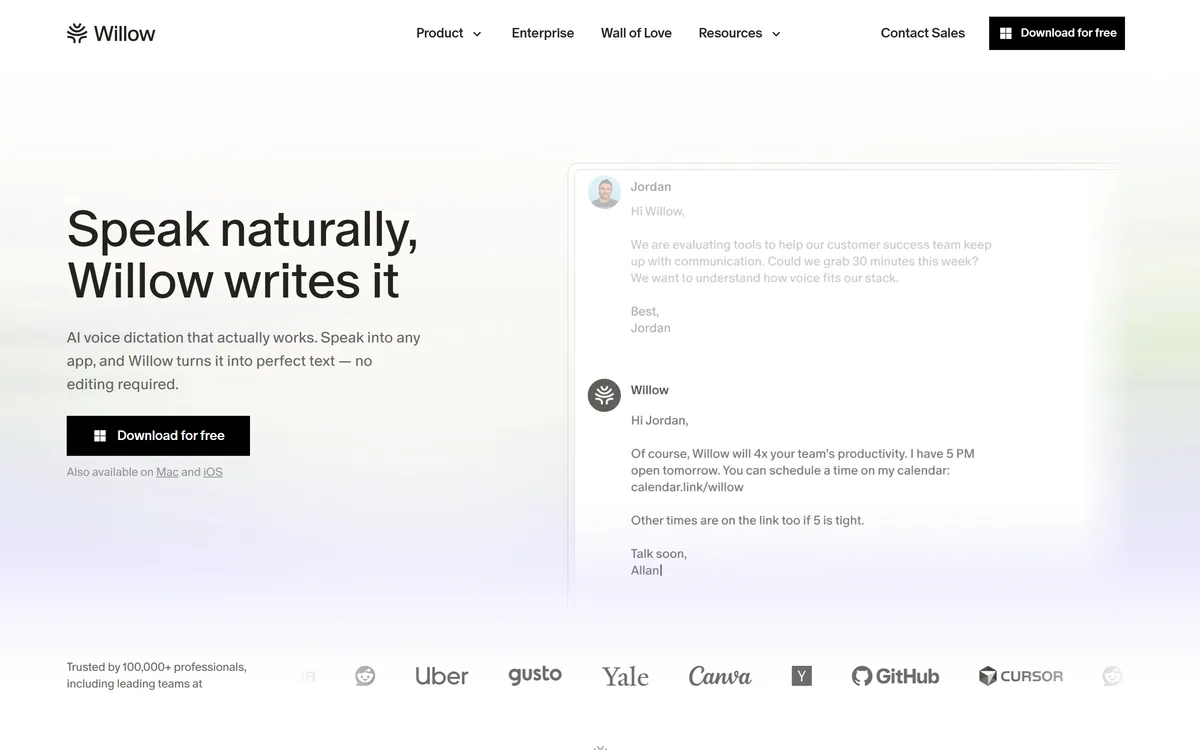
Willow Voice's homepage, captured 9 September 2026, showing the dictation positioning across applications.
Willow Voice: Platforms And Reach
Product type
AI voice dictation
Core interaction
Place cursor, hold hotkey, speak, formatted text appears in place
Coverage
Works in any app you would normally type in
Named applications
Slack, Gmail, Cursor, Notion, iMessage
Formatting
Punctuation, formatting and filler words handled automatically
Willow Scribe
AI writing from rough spoken intent, in your voice
Willow for iPhone
Voice typing on mobile
Platforms
Mac and iOS
Stated reach
100,000+ professionals
Stated results
4x faster writing across every app, 5 hours of productivity reclaimed weekly
Named endorsements
Alexis Ohanian, founder of Reddit; Kipp Bodnar, CMO at HubSpot
Site sections
Product, Solutions by role, Wall of Love, Pricing, Case studies, Use cases, Security
Key features of Willow Voice
Dictation into any text field in any application
Hotkey-triggered capture with text appearing at the cursor
Automatic punctuation, formatting and filler word removal
Willow Scribe for turning rough spoken intent into polished writing
Willow for iPhone for voice typing on mobile
Role-specific guidance for developers, sales, support, lawyers and healthcare
A dedicated Security page
Pros & cons
Pros
6
Removing the copy-paste step is the actual reason dictation never stuck before
Working in every app is what turns it from a destination into an input method
Automatic punctuation handling means output is usable without editing
AI prompting is an ideal use case — long, conversational, awkward to type
Speech runs roughly three times typing speed, so the speed claim is plausible
Named endorsements from identifiable people rather than anonymous testimonials
Cons
6
Requires a room where you can speak, which excludes many working environments
Poor for code, formulas and anything symbol-heavy
Scribe output is your writing legally, and needs reading before it is sent
Mac and iOS only — no Windows, Linux or Android
No language support is stated at all
Whether audio is processed on-device or in the cloud is unpublished
Best For
People who write long prose they have already thought through
Anyone typing extensive prompts into AI tools
Roles with high message volume — sales, support, leadership
Users for whom previous dictation failed on workflow rather than accuracy
Mac and iPhone users with a private working space
Willow Voice Beside Other Speech Tools
Speech tools split by what they produce: text where you are, a transcript elsewhere, or a synthetic voice.
Speech in, speech out and speech about other people are three different products.
Wave — capturing what other people say rather than what you dictate
Otter.ai — meeting transcription as a separate discipline
Narakeet — the opposite direction — text into synthetic speech
Deepgram — the recognition layer, for building rather than using
WriteMail.ai — generating email text rather than speaking it
Should You Dictate Instead Of Type?
Worth the hotkey when
You write a lot of prose you have already worked out in your head.
You type long prompts into AI tools, which is close to an ideal dictation case.
You have a room where speaking aloud is normal rather than disruptive.
Previous dictation failed for you because of the copy-paste step rather than accuracy.
You are on Mac or iOS, which are the platforms supported.
Keep typing when
You work in an open-plan office where speaking is not an option.
Most of your typing is code, formulas or anything symbol-heavy.
You think by writing rather than transcribing a finished thought.
You are on Windows, Linux or Android, none of which are listed.
You would send Scribe output without reading it, which is your writing legally.
Willow Voice: The Facts We Checked
Last checked . Read from willowvoice.com in a browser session, since the site returns 403 to automated fetchers. The screenshot above was captured alongside.
Positioned as AI voice dictation that turns speech into text in any app
Three-step interaction confirmed: place cursor in any text field, hold hotkey and speak, formatted text appears in place
Named applications confirmed as Slack, Gmail, Cursor, Notion and iMessage
Automatic handling of punctuation, formatting and filler words confirmed
Willow Scribe confirmed as AI writing from your intent
Willow for iPhone confirmed as voice typing on mobile
Platforms confirmed as Mac and iOS
100,000+ professionals stated on the site
Stated results confirmed as 4x faster writing across every app and 5 hours of productivity reclaimed weekly
Named endorsements confirmed from Alexis Ohanian, founder of Reddit, and Kipp Bodnar, CMO at HubSpot
Site sections confirmed for Product, Solutions by role including Leaders, Developers, Sales, Customer support, Lawyers, Healthcare, Students and Enterprise, plus Wall of Love, Pricing, Case studies, Use cases and Security
Prompting AI confirmed as a named use case on the site
What we could not confirm: the operating company's legal name or location; pricing and plan structure; which underlying speech models are used; how many languages are supported, since none are stated; whether audio is processed on the device or in the cloud; retention and deletion policy for dictated audio; what the Security page commits to specifically; and the basis for the 4x and 5-hours figures. We did not use the product, so nothing here reflects tested accuracy.
Editor's Verdict
4.1/5
Willow Voice's design decision is the right one: work in every application rather than being one. Dictation has failed for decades not because transcription was bad but because it lived somewhere you then had to copy from, and a two-step process loses to typing every time. Placing formatted text at the cursor removes the step entirely. Handling punctuation and filler words automatically is the second half of the same insight — nobody speaks in punctuation. It sits below the top because dictation only suits some kinds of writing, and speaking your thoughts aloud is not always available in the room you are in. AInexfinder Editor Score: 4.1/5.
Willow Voice pricing
AInexfinder does not list plan prices or billing details. For current pricing, plans, and trials, visit the official Willow Voice website.
Vendor pricing, credits, and billing policies change over time. Always confirm on the official site before you buy.
Frequently asked questions
What is Willow Voice?
Willow Voice is AI dictation that works in any application on Mac and iOS. You place your cursor in a text field, hold a hotkey, speak naturally, and formatted text appears in place. Willow Scribe extends it by turning rough spoken intent into polished writing, and Willow for iPhone covers mobile.
Why has dictation never stuck before?
Not because transcription was bad. Because the text appeared somewhere else — you spoke into an application, fixed the punctuation and copied the result to where you needed it. A three-step process loses to typing every time, however fast the middle step becomes. Removing the steps is the fix, not speeding them up.
What is the difference between Willow and Willow Scribe?
Dictation writes down what you said; Scribe writes what you meant, from a rough description. That is a much larger claim and a larger risk — the output is your writing with your name on it. Use Scribe where the exact words matter less, and read every one before sending.
Which applications does it work in?
The site states any app you would normally type in, naming Slack, Gmail, Cursor, Notion and iMessage. That breadth is the point: a dictation tool that worked in three applications and not the others would never become a habit, because the habit dies the first time it does not work.
Is dictation good for writing AI prompts?
It is arguably the best use, and the site names it. Prompts are long, conversational and awkward to type — you are describing what you want in prose, which is exactly the shape of writing speech suits. The volume of prose people now type into AI tools makes this a larger use case than anyone predicted.
When is typing still better?
Anything structured or symbol-heavy — code, formulas, precise formatting. And anything where you are thinking as you write rather than transcribing a finished thought, because writing is a thinking process. Speaking a paragraph you have not worked out produces a paragraph nobody has worked out.
How fast is dictation really?
Speech runs at roughly three times typing speed for most people, which makes the site's 4x claim plausible for the right kind of writing rather than obviously inflated. The gain evaporates entirely for anything that needs editing afterwards, which is why automatic punctuation and filler removal matter so much.
What is the biggest practical obstacle?
The room. Dictation requires somewhere you can speak aloud, which rules out open-plan offices, shared desks, trains and anywhere a colleague is on a call — a substantial fraction of where work happens. That constraint is physical rather than technical, and no amount of accuracy fixes it.
Does Willow Voice work on Windows or Android?
Not from what the site states. Platforms are listed as Mac and iOS, with Willow for iPhone as the mobile product. Anyone on Windows, Linux or Android is outside the supported set, and no roadmap for them is mentioned on the pages we read.
How long before it becomes a habit?
The site says three seconds to start and a habit in a week, and the second half is the harder claim. New input methods fail on muscle memory, not capability — typing is automatic and reaching for a hotkey is a decision. Use it exclusively in one context for three days, even when typing would be faster.
Daniel reviews AI tools the slow way — by actually using them on real projects. His reviews cover what works, what breaks, and who each tool is genuinely a good fit for.
Daniel and the AInexfinder editorial team research Willow Voice using public product information, listing evidence, and (when available) hands-on checks. Scores reflect listing completeness and transparency — not paid placement.
Listings may include affiliate or sponsored placements, which are labeled when present. Editorial scores and cons are not sold. See our affiliate disclosure and review methodology.
Rev has repositioned from transcription into an investigative intelligence platform for legal teams, combining AI evidence analysis with human-verified transcription guaranteed 99%+ accurate in 12 hours, plus court reporting, deposition summaries and a speech-to-text API.
Cockatoo transcribes audio and video across 100+ languages with a stated accuracy of up to 99.8%, exports to SRT, DOCX, PDF and TXT, imports from Dropbox and YouTube, and offers three free transcripts daily with no card required.
AssemblyAI sells voice AI infrastructure: production APIs for pre-recorded and real-time speech-to-text on its Universal models, a Speech Understanding API that turns transcripts into structured insight, a Voice Agent API over a single WebSocket, and guardrails including PII redaction and content moderation.
Deepgram provides speech-to-text and text-to-speech through its Flux models, plus a Voice Agent API that combines transcription, speech synthesis and LLM orchestration into a single interface. Everything runs in real time or batch, in the cloud or self-hosted, with text-to-speech latency stated as low as 80ms.
The workspace at www-flux3.com generates 5–20 second AI videos with native audio from text or a starting image, routing across FLUX 3, MiniMax H3, Seedance, Wan 3.0 and Kling 3.0 Pro, at 720p or 1080p with video extension.