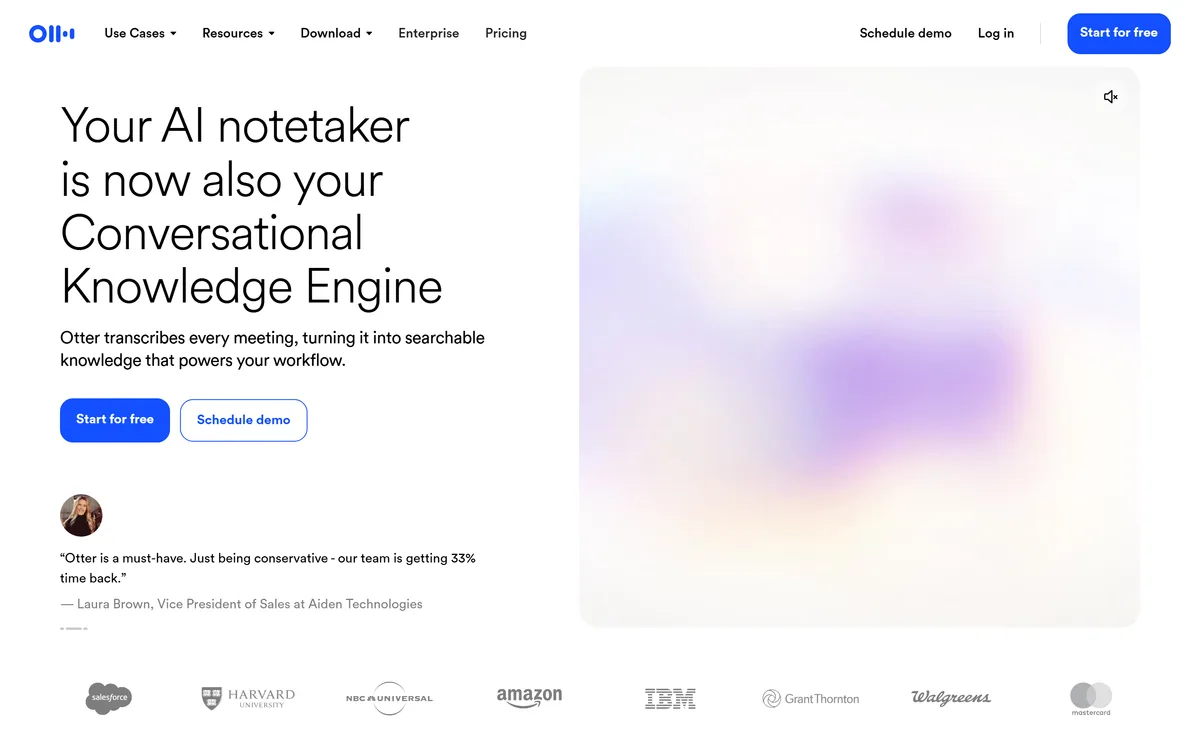
Otter.ai transcribes meetings live, writes summaries and action items, and organises everything into searchable Channels — with OtterPilot joining Zoom, Teams, and Google Meet, plus role-specific agents for sales, recruiting, and SDR work.
AISense Incotter.ai76,043 viewsAdded June 8, 20254M+ visitors
Otter.ai records meetings, transcribes them live, and turns them into notes with summaries and action items. It is the category-defining product for that job and the one most people have heard of.
The ambition has grown past transcription. Otter now organises meetings into Channels, lets you query your entire meeting history through AI Chat, and ships role-specific agents for sales, recruiting, and SDR work.
This review covers how the capture actually works, what the agents add, where accuracy genuinely limits it, and the etiquette problem that no feature solves.
Otter positions itself as a knowledge layer over meetings rather than a transcription tool.
Otter.ai Product Facts
Maker
Otter.ai Inc
Category
AI meeting notetaker and transcription assistant
Meeting assistant
OtterPilot and the Otter Meeting Agent
Role agents
Sales Agent, Recruiting Agent, SDR Agent
Organisation
Channels, grouping meetings by team, project, or topic
Query layer
Otter AI Chat across your meeting history
Meeting platforms
Zoom, Microsoft Teams, Google Meet
Integrations
Slack, Salesforce, HubSpot, Jira, Notion, Asana, Google Calendar, Google Docs, Dropbox
Apps
Mac and Windows desktop with bot-free recording, plus a Chrome extension
Free plan
Yes
How OtterPilot Gets Into Your Meetings
OtterPilot connects to your calendar and joins scheduled meetings on Zoom, Microsoft Teams, and Google Meet, capturing and transcribing without anyone having to remember to start it.
There is also a desktop app for Mac and Windows that records without sending a bot into the call. That distinction matters more than it sounds — a visible bot participant changes how people behave in a meeting, and some organisations forbid them outright.
A Chrome extension covers browser-based calls. Between the three routes, most meeting setups are handled.
From Transcript To Something Useful
A raw transcript is nearly useless — nobody reads forty minutes of speech. Otter's real work is the layer above it.
Summaries And Action Items
Otter produces automatic summaries that pull out decisions and action items rather than compressing the conversation evenly. Decisions and commitments are what people actually go back for.
Accuracy on action items is good but not perfect, so they are best treated as a first pass to confirm rather than a task list to trust blindly.
Channels
Channels group meetings by team, project, or topic, which converts a growing pile of recordings into something with structure. Without this, a year of meetings becomes an archive nobody searches.
Otter AI Chat
AI Chat lets you question your meeting history directly — what was agreed, when a topic last came up, what a client said about a requirement. This is where the accumulated recordings finally pay off.
It is also the feature that justifies capturing everything. One meeting's notes are convenient; a queryable year of them is genuinely different.
The Role-Specific Agents
Otter has moved beyond one general assistant into agents shaped around particular jobs — a Sales Agent, a Recruiting Agent, and an SDR Agent.
The logic is that what matters in a meeting depends entirely on why you were in it. A sales call needs objections, next steps, and pipeline signals surfaced; a screening interview needs candidate responses against requirements.
Paired with the Salesforce and HubSpot integrations, this is what turns Otter from a note-taker into part of a revenue workflow rather than a personal convenience.
Where The Notes End Up
Otter's integration list is broad, and it determines whether the notes reach the place work actually happens.
Notes flowing into the tools a team already uses is the difference between a meeting archive and a working record.
Slack, for sharing summaries where discussion continues
Salesforce and HubSpot, for pushing call context into CRM records
Jira and Asana, for turning action items into tracked work
Notion and Google Docs, for written knowledge bases
Google Calendar, which drives automatic meeting joining
Accuracy, And What Actually Degrades It
Otter's transcription is strong on clear audio with distinct speakers, and speaker recognition holds up well in ordinary meetings.
It degrades in predictable ways: overlapping speech, strong accents, poor microphones, and technical or industry vocabulary. Product names and acronyms are routinely mangled, which then propagates into summaries.
Live transcription supports multiple languages, but coverage and quality vary by language, so verify yours before relying on it for anything consequential.
The practical consequence is that Otter is excellent for recall and terrible as a verbatim record. Do not treat its output as a transcript of what someone legally said.
The Consent Problem Nobody Solves
An assistant that silently joins meetings raises a question no feature addresses: does everyone in the room know it is there and agree to it.
Recording laws vary by jurisdiction, and some require all parties to consent rather than just one. The bot-free desktop recording that avoids an awkward participant in the list also removes the most obvious signal that recording is happening.
Handle this with policy rather than settings. Say at the start that notes are being taken, and decide as an organisation which meeting types are recorded — sensitive HR, legal, and personnel conversations usually should not be.
What Recording Everything Does To Meetings
There is a second-order effect worth anticipating. When people know a meeting is captured and searchable, some become more careful and less candid, particularly about half-formed ideas and disagreements.
That cuts both ways. Better-documented decisions are a real gain, and fewer meetings held purely to relay information is another. But the conversation where someone thinks aloud and changes their mind is valuable too, and it is the first thing to disappear.
The teams that handle this well are explicit about which meetings are recorded and which are deliberately not. Treating capture as universal by default tends to flatten exactly the discussions worth having.
Getting Real Value From It
Set Channels up before the archive grows. Retrofitting structure onto six months of unsorted meetings is far more work than sorting them as they arrive.
Correct names and product terms early. Otter learns from your corrections, and the vocabulary specific to your business is exactly where it makes the most errors.
Use AI Chat deliberately rather than reading summaries. The value of recording everything is being able to ask across it, and most users never make that shift.
Is Otter Worth Adopting?
Otter.ai is the most complete meeting notetaker available, and the move from transcription into Channels, AI Chat, and role agents has made it genuinely more useful than a recording tool.
Choose it if meetings carry your organisation's decisions, if sales or recruiting conversations need to reach a CRM, or if you want to query months of discussion rather than reread it. Be more careful where audio quality is poor, where your vocabulary is heavily technical, or where recording consent is legally sensitive.
There is a free plan, which is enough to judge the capture quality on your own meetings. Check otter.ai for current limits before rolling it out.
Key features of Otter.ai
OtterPilot auto-joins Zoom, Teams, and Google Meet from your calendar
Bot-free desktop recording on Mac and Windows
Live transcription with speaker recognition in multiple languages
Automatic summaries capturing decisions and action items
Channels for grouping meetings by team, project, or topic
Otter AI Chat for querying your entire meeting history
Sales, Recruiting, and SDR agents for role-specific output
Integrations with Slack, Salesforce, HubSpot, Jira, Notion, and Asana
Pros & cons
Pros
5
Captures meetings automatically without anyone remembering to start it
Bot-free desktop recording avoids an intrusive participant in the call
AI Chat across months of meetings is genuinely more useful than notes
Role agents surface what matters for sales and recruiting specifically
Broad integrations push notes into the tools where work continues
Cons
5
Accuracy drops on overlapping speech, strong accents, and poor microphones
Product names, acronyms, and technical vocabulary are frequently mangled
Not reliable as a verbatim record — errors propagate into summaries
Language quality varies, so non-English coverage needs testing first
Silent recording raises consent issues that no product setting resolves
Best For
Sales teams pushing call context into Salesforce or HubSpot
Recruiters running high volumes of screening interviews
Teams whose decisions get made in meetings and then lost
Anyone who needs to search months of discussion rather than reread it
Remote organisations where meeting notes are the written record
Editor's Verdict
4.4/5
Otter.ai has an AInexfinder Editor Score of 4.4/5.
Otter.ai pricing
AInexfinder does not list plan prices or billing details. For current pricing, plans, and trials, visit the official Otter.ai website.
Vendor pricing, credits, and billing policies change over time. Always confirm on the official site before you buy.
Frequently asked questions
Which meeting platforms does Otter.ai support?
OtterPilot joins Zoom, Microsoft Teams, and Google Meet automatically from your calendar. There is also a Mac and Windows desktop app that records without sending a bot into the call, plus a Chrome extension.
Can Otter record without a bot joining the meeting?
Yes, through the desktop app for Mac and Windows. That matters where a visible bot participant changes how people speak, or where an organisation forbids meeting bots outright.
How accurate is Otter.ai?
Strong on clear audio with distinct speakers, and weaker on overlapping speech, strong accents, poor microphones, and technical vocabulary. Product names and acronyms are commonly mangled, so it is good for recall but not reliable as a verbatim record.
What are Otter Channels?
Channels group meetings by team, project, or topic. They turn a growing pile of recordings into a structured archive — worth setting up before the volume builds, since retrofitting structure later is much harder.
What do Otter's sales and recruiting agents do?
They shape the output around the job. A Sales Agent surfaces objections, next steps, and pipeline signals; a Recruiting Agent focuses on candidate responses. Combined with the Salesforce and HubSpot integrations, this pushes meeting context into CRM records.
Do I need consent to record meetings with Otter?
Often, yes. Recording laws vary and some jurisdictions require all parties to consent. Bot-free recording removes the most obvious signal that a meeting is being captured, so handle this with a stated policy rather than a setting.
Is Otter.ai free?
There is a free plan, and it is enough to judge transcription quality on your own meetings and audio setup. Check otter.ai for current limits before rolling it out across a team.
Daniel reviews AI tools the slow way — by actually using them on real projects. His reviews cover what works, what breaks, and who each tool is genuinely a good fit for.
Daniel and the AInexfinder editorial team research Otter.ai using public product information, listing evidence, and (when available) hands-on checks. Scores reflect listing completeness and transparency — not paid placement.
Listings may include affiliate or sponsored placements, which are labeled when present. Editorial scores and cons are not sold. See our affiliate disclosure and review methodology.
Wave records, transcribes and summarises meetings, calls and lectures across iPhone, Android, web, desktop, Apple Watch and Wear OS. It covers 76 languages, identifies speakers with Voice ID, and states that it never trains AI models on customer data.
axess is a free AI job-search tool that scans LinkedIn, Indeed and Glassdoor daily, scores each role against your profile on both relevance and likelihood, researches the employer, and prepares a tailored CV and cover letter for the matches worth pursuing.
MiroFish is a multi-agent simulation platform for scenario prediction. You ask a plain-language question, attach supporting files, and it returns a structured report covering likely reactions, narrative paths, risk signals and follow-up questions.
CrewAI is an enterprise platform to build and run AI agents: a Discovery layer that finds automation opportunities, a no-code canvas and code-first Python API for building role-based multi-agent workflows, and a control plane that adds tracing, RBAC, audit and human-in-the-loop approvals.
AudioNotes is an AI note-taker that turns voice, audio, video and text into structured notes, transcripts and summaries in 99+ languages, with custom templates, chat-with-your-notes, integrations, and a clear no-AI-training privacy stance.
Goodnotes is a handwriting-first note-taking app spanning iPad, iPhone, Mac, Windows, Android and web. It converts handwriting to text, searches across typed text, handwriting and sketches, annotates PDFs, records and transcribes audio, and turns notes into mind maps and project plans.