Wave records, transcribes and summarises meetings, calls and lectures across iPhone, Android, web, desktop, Apple Watch and Wear OS. It covers 76 languages, identifies speakers with Voice ID, and states that it never trains AI models on customer data.
Meeting notetakers have a blind spot they rarely admit to: they assume the meeting is a video call.
A great deal of what is worth capturing is not. The conversation after the meeting ends, the corridor discussion where the real decision happens, the client call taken in a car, the lecture in a hall, the interview across a table.
Wave's answer is to run on everything — including a watch — which sounds like a feature-list detail and is actually the whole product. A recorder that is already on your wrist captures conversations a Zoom bot never hears.
Wave: A Notetaker On Every Device
It runs on almost everything — iPhone, iPad, Android, web, macOS, Windows, Chrome, Apple Watch and Wear OS.
76 languages for transcription and summarisation, with translation between any of them.
Voice ID identifies speakers automatically, rather than labelling them Speaker 1 and Speaker 2.
Never trains AI models on customer data, with recordings and transcripts stated as belonging to you.
A developer API and MCP server, so notes are reachable from Claude, ChatGPT, Zapier and your own code.
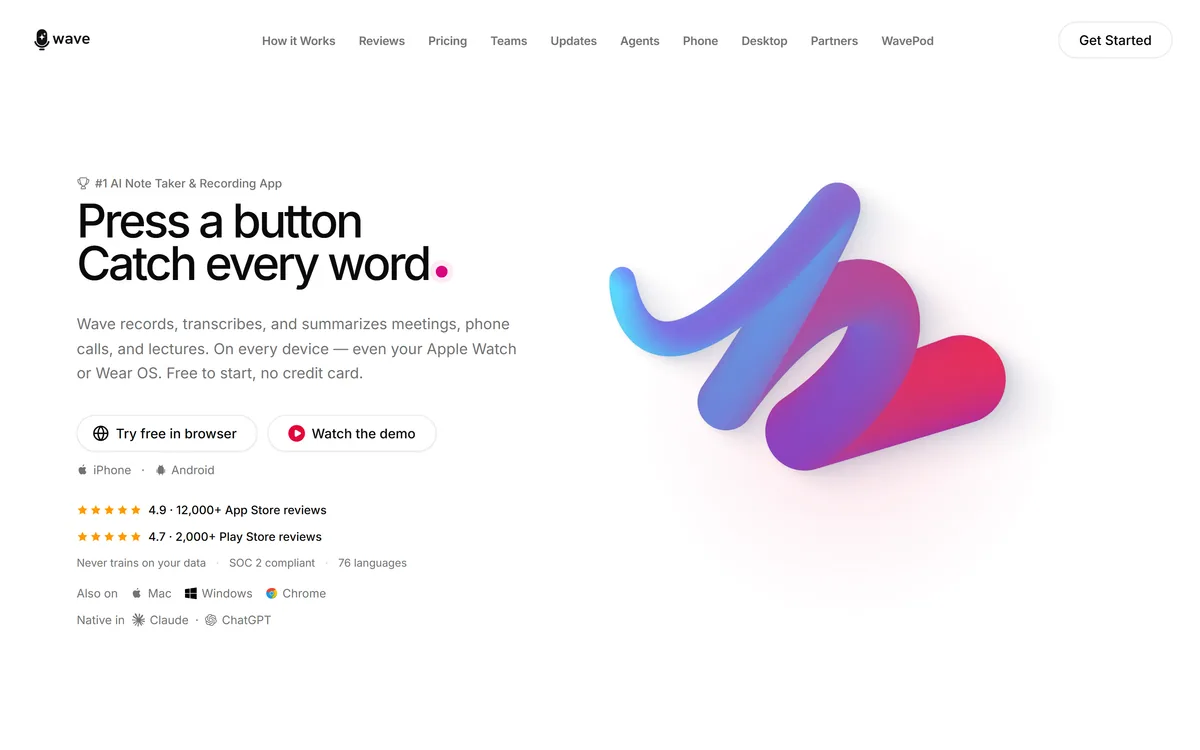
Wave's homepage, captured 9 September 2026, showing the notetaker's cross-device positioning.
Why Does Device Coverage Decide A Notetaker?
Wave runs on iPhone, iPad, Android, the web, macOS and Windows desktops, a Chrome extension, Apple Watch and Wear OS smartwatches, and it integrates with Zoom, Google Meet and Microsoft Teams.
That list is doing more work than a feature comparison suggests. Most notetakers are meeting bots: they join a scheduled call, record it, and produce notes. That covers a specific and increasingly small proportion of the conversations that matter.
The rest happen without a calendar invitation. Someone catches you after a meeting and tells you the actual constraint. A supplier calls your mobile. A customer says something important in a corridor at a conference.
A recorder you can start in two seconds from a watch captures those, and one that requires a laptop, an application and a meeting link does not — because by the time you have opened anything, the moment has passed.
The trade is that ubiquity is worthless without discipline. A tool this easy to start is a tool you will accumulate hundreds of recordings in, and a pile of unreviewed transcripts is the note-taking equivalent of a read-later app.
The established comparison is Otter.ai, which does meeting transcription well and assumes a meeting. Where the two diverge is everything that happens outside one.
Most notetakers are meeting bots. The conversation where the real constraint gets mentioned usually happens after the meeting, without a calendar invitation.
Voice ID And The Speaker Problem
Wave lists Voice ID for automatic speaker identification, which is a step beyond the speaker labelling most transcription offers.
The distinction matters more than it sounds. Diarisation — separating who spoke when — is a solved-ish problem, and it gives you Speaker 1 and Speaker 2. Knowing that Speaker 2 is your client's head of procurement requires recognising the voice.
For a summary, that difference is everything. "Someone said they need it by March" is not actionable; "the finance director said they need it by March" is a fact you can act on and quote.
It also determines whether action items are usable. A list of commitments with no owner attached is a list of things nobody will do, and attaching the right name automatically is the difference between a summary and a record.
Voice recognition also carries an obligation the marketing does not raise. A system building voiceprints of people in your meetings is holding biometric identifiers, and those are treated as a special category of personal data in several jurisdictions. Worth understanding before enabling it across a team.
Never Training On Customer Data Is The Claim That Matters
Wave states that it never trains AI models on customer data, that recordings and transcripts belong to the user, that everything is encrypted in transit and at rest, and that it is SOC 2 Type 1 and GDPR compliant.
The training clause is the one worth reading twice. Meeting recordings are among the most sensitive material a company produces — pricing discussions, personnel matters, unreleased plans, and candid opinions about customers who are not in the room.
A vendor training models on that is not doing anything sinister, and it does mean your commercial conversations become part of a system other people query. A clear commitment not to is the single most valuable sentence a notetaker can publish.
Ownership of recordings and transcripts is the second clause, and it decides what happens when you leave. A tool that owns your archive can make export difficult; one that states the material is yours has, at minimum, made a commitment you can point at.
SOC 2 Type 1 is where the position weakens slightly, and the distinction is worth knowing. Type 1 attests that controls were designed appropriately at a point in time; Type 2 attests that they operated effectively over a period. Type 1 is a genuine step and it is the weaker of the two.
The strictest version of this argument is a clinical one. Nabla Copilot holds SOC 2 Type 2, ISO 27001 and HIPAA because a consultation recording is regulated material, not merely sensitive.
Get consent before recording — in several jurisdictions it is a legal requirement, not a courtesy.
Understand that Voice ID means storing voiceprints, which are biometric data.
Review recordings weekly, or the archive becomes a read-later pile.
Check whether SOC 2 has moved from Type 1 to Type 2 if that matters to procurement.
Use the MCP server to query notes rather than re-reading them.
An API And MCP Server Change What Notes Are For
Wave lists a developer API, an MCP server usable from Claude and ChatGPT, Zapier, and exports to Notion, Google Docs, OneNote, Evernote, PDF, Slack and email.
The MCP server is the interesting one, because it inverts the relationship. Ordinarily you open a notetaker to read a note; an MCP server means an assistant you are already talking to can query your entire meeting history without you opening anything.
That turns an archive into a resource. "What did we agree with this supplier about lead times?" becomes a question you ask in the middle of drafting an email, rather than a search you go and perform in another application.
It is also what makes accumulating hundreds of recordings defensible rather than wasteful. An archive nobody reads is dead weight; an archive an assistant can search is a memory, and the difference is entirely about access.
The export list matters for a simpler reason: nothing is trapped. A notetaker whose output only lives in its own interface creates a second place to look, and the tools people actually use — Notion, Docs, Slack — are where notes need to arrive.
Once transcripts exist, interrogating them is a separate job — a grounded notebook such as Gemini Notebook cites back into the source, which a summary does not.
Recording Meetings Without Annoying Anyone
The social problem with a notetaker is larger than the technical one, and getting it wrong costs more than a bad transcript.
The rules below are partly legal and mostly about not being the person who recorded a conversation without saying so.
Establish the consent position for your jurisdiction before recording anything — several require all parties to agree.
Say you are recording at the start, every time, including for informal conversations.
Decide who has access to a recording before you make it, especially for sensitive discussions.
Review and act on notes weekly rather than accumulating an archive nobody opens.
Delete recordings you no longer need, since a permanent archive of candid conversations is a liability.
Test transcription accuracy on your own product names before relying on any summary.
Wave: Platforms And Privacy
Product type
AI notetaker for meetings, calls and lectures
Recording
One-button recording, including in the background
Transcription
AI transcription with speaker labels
Summaries
Structured summaries with action items and customisable templates
Voice ID
Automatic speaker identification
Wave Assistant
Search and chat across recordings
Languages
76 for transcription and summarisation, with translation between any of them
Mobile
iPhone, iPad, Android
Desktop
macOS and Windows applications, plus web at app.wave.co
Wearables
Apple Watch and Wear OS
Browser
Chrome extension
Meeting integrations
Zoom, Google Meet, Microsoft Teams
Export targets
Notion, Google Docs, OneNote, Evernote, PDF, Slack, email, public share links
Developer
API, MCP server usable from Claude and ChatGPT, Zapier, CLI
Data handling
Never trains AI models on customer data; recordings and transcripts belong to users; encrypted at rest and in transit
Compliance
SOC 2 Type 1 and GDPR
Key features of Wave
One-button recording across phone, desktop, web and smartwatch
AI transcription with speaker labels and Voice ID identification
Structured summaries with action items and customisable templates
Wave Assistant for search and chat across your whole recording history
76 languages with translation between any supported pair
Meeting integrations with Zoom, Google Meet and Microsoft Teams
Exports to Notion, Google Docs, OneNote, Evernote, PDF, Slack and email
Developer API, MCP server, Zapier and CLI
Pros & cons
Pros
7
Runs on a watch, which captures the conversations a meeting bot never hears
Voice ID attaches names to commitments, which is what makes action items usable
A clear commitment not to train models on customer data
Recordings and transcripts stated as belonging to the user
An MCP server turns an archive into something an assistant can query
Very wide export list, so notes reach the tools people actually use
76 languages with translation between any of them
Cons
6
SOC 2 Type 1 attests design at a point in time, not operation over a period
Voice ID means storing biometric identifiers, and retention is unstated
Ease of recording produces an archive that goes unreviewed without discipline
No operating company, location or pricing published on the pages we read
The underlying models are not disclosed
Recording consent is a legal question the marketing does not raise
Best For
People whose important conversations are not scheduled calls
Consultants and salespeople recording on the move
Teams needing action items attributed to named speakers
Anyone wanting meeting history queryable from an AI assistant
Organisations requiring a no-training commitment on meeting content
Wave Beside Other Meeting Notetakers
Notetakers differ on where they can record, which decides how much of your working life they capture.
The conversations you most need captured are not scheduled video calls.
You want to start recording from a watch or a phone in two seconds.
Speaker identity matters, because action items without owners do not happen.
You need notes queryable from an assistant rather than only readable in an app.
A no-training commitment on meeting content is a requirement for you.
Use something narrower when
Your procurement requires SOC 2 Type 2, which is stronger than Type 1.
You record clinical consultations, where a specialist with EHR integration belongs.
Your recordings are lectures and coursework, where a study tool fits better.
You cannot establish a workable consent practice for recording.
Nobody will review the archive, in which case it becomes a read-later pile.
Other Meeting And Note Tools
Capturing conversations, capturing lectures and capturing reading are three different jobs.
Otter.ai — the established default for meeting transcription
Coconote — the same idea aimed at students and lectures
Recall — retention for what you read rather than what you hear
Nabla Copilot — clinical documentation, where the requirements are entirely different
Gemini Notebook — for interrogating transcripts with citations once you have them
Wave: Checking The Integration List
Last checked . Read from wave.co and its footer navigation, with the screenshot above captured in the same session.
Described as recording, transcribing and summarising meetings, phone calls and lectures
One-button recording and background recording confirmed
AI transcription with speaker labels confirmed
Structured summaries with action items and customisable templates confirmed
Voice ID confirmed as automatic speaker identification
Wave Assistant confirmed for cross-recording search and chat
76 languages confirmed for transcription and summarisation, with translation between supported languages
Platforms confirmed as iPhone, iPad, Android, web at app.wave.co, macOS and Windows desktop applications, Chrome extension, Apple Watch and Wear OS
Meeting integrations confirmed for Zoom, Google Meet and Microsoft Teams
Export targets confirmed including Notion, Google Docs, OneNote, Evernote, PDF, Slack, email and public share links
Developer surface confirmed including an API, an MCP server usable from Claude and ChatGPT, Zapier and a CLI
Data handling stated as never training AI models on customer data, with recordings and transcripts belonging to users and encryption at rest and in transit
Compliance stated as SOC 2 Type 1 and GDPR compliant
Footer confirmed with developer resources including API, MCP manifest and CLI, plus a documentation portal, sitemap and contact information
What we could not confirm: the operating company's legal name or location, neither of which appears on the pages we read; pricing and plan structure; which underlying models perform transcription and summarisation; how Voice ID voiceprints are stored, retained or deleted, which matters because they are biometric identifiers; recording retention and deletion policy; whether SOC 2 Type 2 is in progress; and transcription accuracy in any language. We did not use the product, so nothing here reflects tested output.
Editor's Verdict
4.2/5
Wave's distinguishing feature is unglamorous and decisive: it runs everywhere, including on a watch. Meeting notetakers almost all assume the conversation happens in a video call, and a great deal of the conversation worth capturing does not — it happens in a corridor, in a car, at a conference, in a room. A recorder you can start from your wrist captures those; one that needs a Zoom link does not. The privacy position is stated clearly and includes the sentence that matters most: never training on customer data. It sits just below the top because SOC 2 Type 1 is a weaker attestation than Type 2. AInexfinder Editor Score: 4.2/5.
Wave pricing
AInexfinder does not list plan prices or billing details. For current pricing, plans, and trials, visit the official Wave website.
Vendor pricing, credits, and billing policies change over time. Always confirm on the official site before you buy.
Frequently asked questions
What is Wave?
Wave records, transcribes and summarises meetings, phone calls and lectures across iPhone, iPad, Android, web, macOS, Windows, a Chrome extension, Apple Watch and Wear OS. It supports 76 languages, identifies speakers with Voice ID, and states that it never trains AI models on customer data.
Why does running on a watch matter?
Because most notetakers are meeting bots that join a scheduled call, and a great deal of what is worth capturing happens without a calendar invitation — after the meeting, in a corridor, on a mobile in a car. A recorder you can start in two seconds from your wrist catches those; a laptop application does not.
What is Voice ID and why is it better than speaker labels?
Speaker labels give you Speaker 1 and Speaker 2; Voice ID recognises who they are. That difference is everything in a summary — "someone said they need it by March" is not actionable, while "the finance director said it" is a fact you can quote. It also attaches owners to action items.
Is Voice ID a privacy concern?
It is worth thinking about. A system recognising voices is building voiceprints, which are biometric identifiers and are treated as a special category of personal data in several jurisdictions. The site does not state how they are stored or deleted, and that is worth resolving before enabling it across a team.
Does Wave train AI on my meetings?
The site states it never trains AI models on customer data, and that recordings and transcripts belong to users. That is the single most valuable sentence a notetaker can publish, because meeting recordings contain pricing discussions, personnel matters and candid opinions about people who were not in the room.
How strong is SOC 2 Type 1?
It is a genuine step and the weaker of the two types. Type 1 attests that controls were appropriately designed at a point in time; Type 2 attests that they operated effectively over a period. If your procurement specifies Type 2, confirm whether one is in progress before assuming.
What does the MCP server do?
It lets an assistant you are already talking to query your meeting history without you opening Wave. "What did we agree with this supplier about lead times?" becomes a question you ask while drafting an email, rather than a search performed in another application. That turns an archive into a usable memory.
Do I need permission to record?
Frequently yes, and it varies by jurisdiction — several require all parties to consent. Beyond the legal position there is a practical one: being the person who recorded a conversation without saying so costs more than any transcript is worth. Say it at the start, every time, including for informal conversations.
How many languages does Wave support?
76 for both transcription and summarisation, with translation between any supported pair. The translation capability is the more unusual part — most notetakers transcribe in several languages and summarise in one, which leaves a multilingual team reading notes in a language half of them do not use.
Will I actually review all these recordings?
Probably not, and that is the risk with a tool this easy to start. A pile of unreviewed transcripts is the note-taking equivalent of a read-later app. Review weekly, delete what you no longer need, and rely on the assistant to search the rest rather than intending to read it.
Daniel reviews AI tools the slow way — by actually using them on real projects. His reviews cover what works, what breaks, and who each tool is genuinely a good fit for.
Daniel and the AInexfinder editorial team research Wave using public product information, listing evidence, and (when available) hands-on checks. Scores reflect listing completeness and transparency — not paid placement.
Listings may include affiliate or sponsored placements, which are labeled when present. Editorial scores and cons are not sold. See our affiliate disclosure and review methodology.
Otter.ai transcribes meetings live, writes summaries and action items, and organises everything into searchable Channels — with OtterPilot joining Zoom, Teams, and Google Meet, plus role-specific agents for sales, recruiting, and SDR work.
Jamie is an on-device AI meeting assistant that captures and summarizes meetings, online and in person, without a bot joining the call, then powers prep, search, chat and post-meeting workflows, aimed at regulated fields with an EU-data-residency, privacy-first posture.
axess is a free AI job-search tool that scans LinkedIn, Indeed and Glassdoor daily, scores each role against your profile on both relevance and likelihood, researches the employer, and prepares a tailored CV and cover letter for the matches worth pursuing.
MiroFish is a multi-agent simulation platform for scenario prediction. You ask a plain-language question, attach supporting files, and it returns a structured report covering likely reactions, narrative paths, risk signals and follow-up questions.