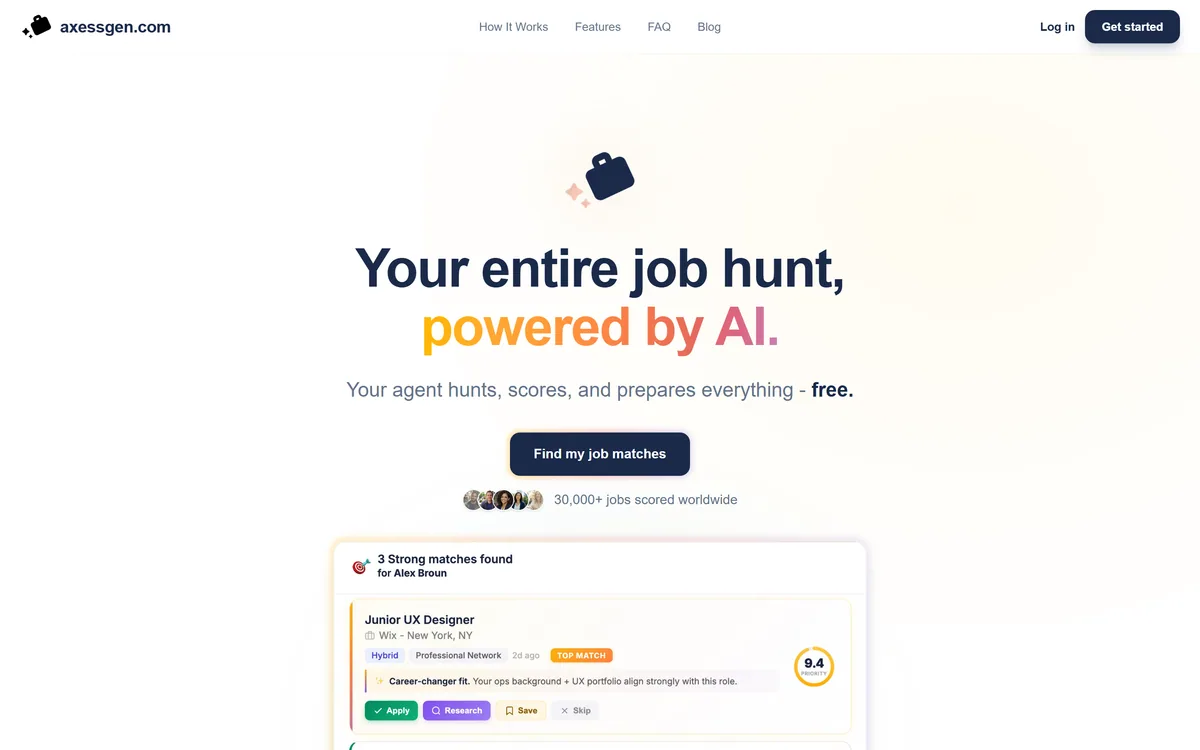
axess is a free AI job-search tool that scans LinkedIn, Indeed and Glassdoor daily, scores each role against your profile on both relevance and likelihood, researches the employer, and prepares a tailored CV and cover letter for the matches worth pursuing.
Job searching is a scheduling problem disguised as a skills problem. The good roles are posted continuously and filled quickly, and you can only look in the evenings — so the search becomes a race you are structurally losing while also being told your CV is the issue.
axess inverts the timing. You set up a profile once, and it searches while you are doing something else, scoring what it finds and preparing materials for the matches worth a real application.
This review covers why the two-score approach is a genuinely better idea than a single match percentage, what continuous scanning does and does not fix, where the tailored materials help, and the one thing about this category that nobody advertises.
Two scores, not one: how well a job fits you, and how likely you are to get it.
The Dual Score Is The Idea
Relevance and likelihood are scored separately — a job can be perfect for you and still a long shot, and knowing which is which is the whole point.
It searches continuously, scanning a stated 33,000+ jobs daily across LinkedIn, Indeed and Glassdoor rather than waiting for you to look.
Tailored materials in under a minute: a CV and cover letter adapted per role, plus a company research summary.
You approve everything. It does not mass-apply on your behalf, which is the line that separates this from auto-apply tools.
Free, with no payment required per the site — worth knowing what the business model is before committing your CV.
Why Two Scores Beat One
Almost every matching tool gives you a single number: how well this job matches your profile. That number is close to useless on its own, because it answers only half the question a job seeker actually has.
Relevance asks whether the role suits you — the work, the level, the domain, what you want next. Likelihood asks whether you would realistically get it given the stated requirements and your actual background. They come apart constantly, and the interesting cases are exactly where they disagree.
High relevance with low likelihood is the stretch application: worth doing occasionally, with a genuinely tailored effort, and worth knowing that is what you are doing. Low relevance with high likelihood is the job you could walk into and would resent in four months — the trap that a single match score actively hides.
The practical value is triage. Twenty matches split into 'apply properly', 'apply if you have time' and 'do not bother' is a plan. Twenty matches with a percentage next to each is a list.
A single match score tells you a job is a 78% fit. It never tells you whether that 78% is your ceiling or your floor.
Continuous Scanning, And What It Actually Fixes
The stated coverage is 33,000+ jobs daily across LinkedIn, Indeed and Glassdoor. That number is the vendor's own and this page does not treat it as verified — but the mechanism behind it is worth understanding regardless.
The real advantage is not volume, it is timing. Applications submitted in the first day or two of a posting are read by a human with an empty pile; applications submitted on day nine arrive after the shortlist has taken shape. A search running continuously catches postings while that still matters, which is the single thing an evenings-and-weekends search cannot do.
The second advantage is breadth of source. Most people search one board out of habit and never see the roles posted only to the others.
What it does not fix is competition. Faster and better-targeted applications improve your odds; they do not change the fact that a good role attracts hundreds of candidates. Anyone selling job-search automation as a solution to the market rather than to your admin is overselling.
Tailored Materials Without Losing The Thread
The materials side covers a tailored CV, a cover letter matched to the role and a company research summary, generated in under a minute per the site.
Company research is the underrated one. The gap between a generic application and a good one is almost always specificity — knowing what the company actually does, what changed recently, why this role exists now. That research takes twenty minutes per application by hand, which is why almost nobody does it for more than three.
The discipline that matters is the same as with any tailoring tool: read every version before it goes out. Generated tailoring drifts. A phrase that reads as reasonable emphasis in draft four has become a claim you cannot defend by draft twelve, and you will be interviewed on it.
The other habit worth building early is keeping track of which version went where. Twenty tailored CVs means twenty documents, and a recruiter calling about a role you half remember is a bad moment to discover you cannot find the one they read.
Read every tailored version as if the interview starts tomorrow — because it might
Keep the company research; it is the raw material for your interview prep too
Watch for emphasis drifting into claims across successive tailorings
Record which document went to which employer, on the day you send it
Treat the generated cover letter as a first draft with your specifics added, not a finished artefact
The Thing This Category Does Not Advertise
Handing a job-search tool your CV, your work history and your salary expectations is handing over a detailed professional profile, and it is worth a moment's thought about where that sits.
axess states it is free with no payment required. Free is genuinely good for a job seeker — the people who most need help searching are frequently between salaries — but 'free' always has a model behind it, and knowing whether it is future paid tiers, recruiter-side products or something else is a reasonable thing to establish from the privacy policy rather than assume.
This is not a criticism of axess, whose privacy policy and terms are published in the usual place. It is a habit worth having across the whole category, because a CV is one of the more revealing documents most people own.
The related point in the product's favour: it does not mass-apply for you. Tools that submit applications automatically put your name on things you have not read, and the first you know is a rejection from a company you would never have approached. Keeping the human at the send button is the right design.
Getting A Real Return From It
The setup determines everything downstream, and rushing it produces a stream of confidently mismatched roles.
Fill in the profile honestly, including what you want next rather than only what you have done. Relevance scoring has nothing to work with otherwise.
Set your constraints explicitly — location, remote, salary floor, sector — so the likelihood score has real boundaries.
Look at where the two scores disagree first. That is where the useful decisions are.
Apply properly to a small number of high-relevance roles rather than lightly to everything the dashboard surfaces.
Read the company research before the interview as well as before applying; it was written once and is useful twice.
Check every tailored CV against your own memory of the job, not against the score.
Review after two weeks: if the matches are consistently wrong, the profile is wrong, not the tool.
Coverage, Scoring And Output
Site
axessgen.com
Category
AI job search, matching and application materials
Named features
Smart Notifications, Tailored Materials, AI Dual Scoring, Company Research, Dashboard
Scoring model
Relevance and likelihood, scored separately
Job sources
LinkedIn, Indeed, Glassdoor
Stated coverage
33,000+ jobs scanned daily (the site's own figure)
Inputs
CV or resume upload, plus a profile questionnaire
Outputs
Ranked matches, tailored CVs, cover letters, company research summaries
Stated speed
Customised materials in under 60 seconds
Applying
You review and apply — it does not submit on your behalf
Cost
Stated as free, no payment required
Site sections
Get started, blog, help centre, contact, privacy policy, terms of service
Will This Change Your Search?
Genuinely Helpful If
You are searching while employed and can only look in the evenings
You keep missing roles because they were filled before you saw them
You default to one job board and suspect you are missing the others
You know tailoring works but cannot spend twenty minutes researching per application
You want to understand which applications are realistic and which are stretches
Less Use When
You are targeting a handful of specific companies rather than searching broadly
Your field hires through networks and referrals rather than public postings
You want something to apply on your behalf — this deliberately does not
You are senior enough that roles come to you
You would send tailored materials without reading them
Where axess Sits Among Job Tools
These divide by how much they do for you, and how much you still decide.
Finding roles, writing documents and tracking applications are three jobs people usually solve with three tools.
Jobsuit AI — deeper per-role CV tailoring against a specific job description
ApplyArc — workflow and tracking across a long search
Careered — career guidance alongside the document work
Kickresume — building the master CV everything else is derived from
Gappeo — the employer side — what is screening your application once it lands
Read From axessgen.com
Last checked . Checked against the product site during this review, with the screenshot above captured at the same time.
Named features listed on the site as Smart Notifications, Tailored Materials, AI Dual Scoring, Company Research and Dashboard
Dual scoring described on the site as relevance plus likelihood
Job sources given as LinkedIn, Indeed and Glassdoor
The figure of 33,000+ jobs scanned daily is the site's own claim and is described as such here
Inputs described as CV upload and a profile questionnaire; outputs as ranked matches, tailored CVs, cover letters and company research
Stated generation speed of under 60 seconds for customised materials
The four-step workflow presented on the site: tell us about you, your AI does the searching, your top matches delivered, see the full picture
Free with no payment required, as stated on the site
Blog, help centre, contact, privacy policy and terms of service present in the site footer
No plan prices published here, in line with this site's pricing policy
The daily job-scan figure and the speed claim are the vendor's own and have not been independently verified. The note about data and free products is a general point about the category, not a finding about this company — its privacy policy and terms are published in the usual place.
Best For
People job-hunting while employed, with only evenings to search
Anyone who keeps finding good roles after they have been filled
Candidates who default to one board and miss the others
Job seekers who know tailoring works but cannot sustain it manually
Anyone wanting to tell a realistic application from a stretch before spending the effort
Key features of axess
Continuous job scanning across LinkedIn, Indeed and Glassdoor
AI dual scoring — relevance and likelihood assessed separately
Tailored CVs adapted per role
Cover letters matched to the specific posting
Company and role research summaries
Smart notifications when strong matches appear
Dashboard tracking the state of the search
CV upload plus a profile questionnaire as setup
Pros & cons
Pros
5
Two scores answer the question a single match percentage cannot
Continuous scanning catches postings while early applications still count
Company research is the part that separates a good application from a generic one
Does not apply on your behalf, so your name never lands on something you have not read
Free at the point of use, which matters for people between salaries
Cons
5
The 33,000-jobs figure is the vendor's own and unverified
Faster, better-targeted applications improve odds but do not change a competitive market
Match quality depends entirely on how honestly the profile is filled in
Repeated tailoring can drift emphasis into claims you cannot defend
Little use in fields that hire through networks rather than public postings
axess pricing
AInexfinder does not list plan prices or billing details. For current pricing, plans, and trials, visit the official axess website.
Vendor pricing, credits, and billing policies change over time. Always confirm on the official site before you buy.
Frequently asked questions
What does dual scoring actually mean?
Relevance and likelihood are scored separately. Relevance asks whether the role suits you; likelihood asks whether you would realistically get it. They come apart constantly, and the cases where they disagree are the ones worth your attention — a single match percentage hides exactly that.
Does it apply to jobs for me?
No, and that is deliberate. It finds, scores and prepares materials; you review and send. Tools that auto-apply put your name on applications you have not read, and the first you hear is a rejection from a company you would never have approached.
Is the 33,000 jobs a day figure real?
It is the site's own claim and we have not verified it. The number matters less than the mechanism anyway — the advantage of continuous scanning is timing, not volume. Applications in the first day or two land before a shortlist has formed.
Will it get me a job?
It will get you better-targeted applications submitted sooner, which improves your odds. It does not change the fact that a good role attracts hundreds of candidates. Anyone selling job-search automation as a fix for the market rather than for your admin is overselling it.
How much does the profile setup matter?
It determines everything. Relevance scoring needs to know what you want next, not only what you have done, and likelihood needs your real constraints — location, salary floor, sector. If the matches are consistently wrong after two weeks, the profile is wrong rather than the tool.
It is free — what is the catch?
The site states free with no payment required, and its privacy policy and terms are published. Free always has a model behind it, so it is worth reading how your data is used before uploading a CV. That is a habit for the whole category rather than a concern specific to this product.
Do I still need to check the tailored CV?
Every time. Generated tailoring drifts — a phrase that was reasonable emphasis in the fourth version has become a claim you cannot defend by the twelfth, and you will be interviewed on it. Also record which version went where, because a recruiter will eventually call about one.
Daniel reviews AI tools the slow way — by actually using them on real projects. His reviews cover what works, what breaks, and who each tool is genuinely a good fit for.
Daniel and the AInexfinder editorial team research axess using public product information, listing evidence, and (when available) hands-on checks. Scores reflect listing completeness and transparency — not paid placement.
Listings may include affiliate or sponsored placements, which are labeled when present. Editorial scores and cons are not sold. See our affiliate disclosure and review methodology.
CVUniform standardises CVs for recruitment agencies — upload a PDF or DOCX, inspect the extracted candidate fields, and export a consistent profile, with a no-signup preview and recruiter review kept in the loop before export.