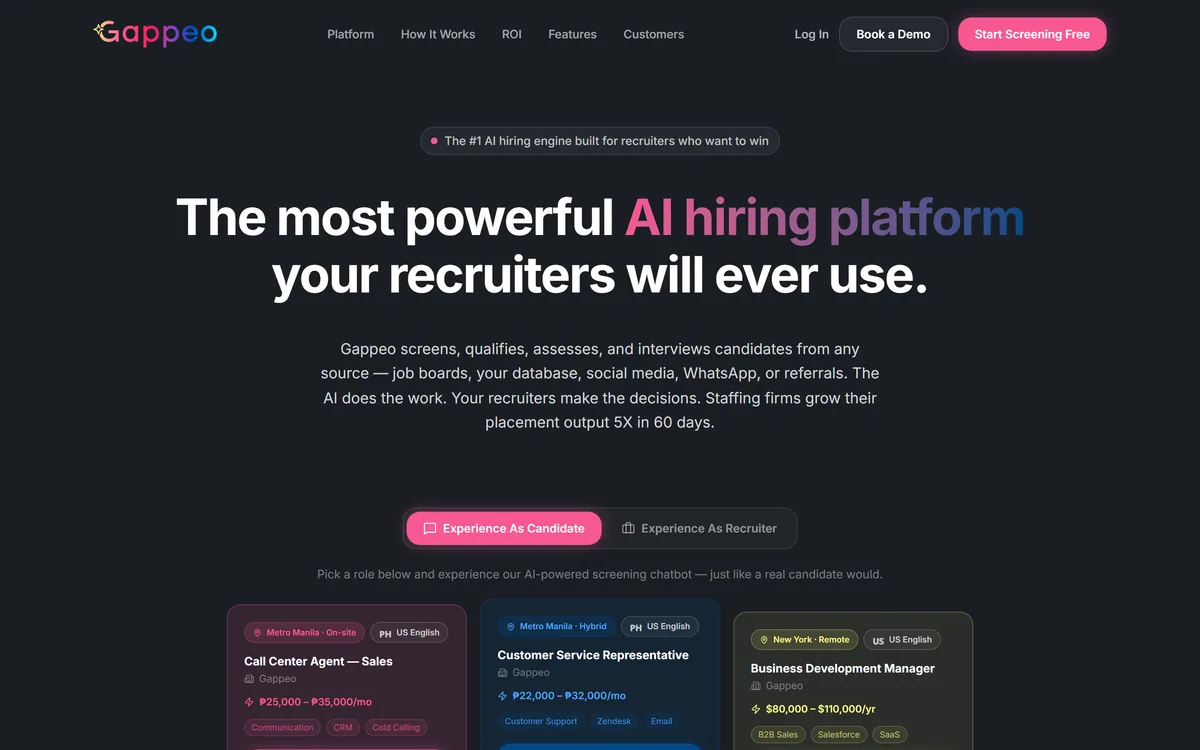
Gappeo automates hiring from sourcing to onboarding: chatbot pre-screening, AI phone screening, skills and language assessments, live AI video interviews, and WhatsApp document verification. It integrates natively with Greenhouse, Workday, Lever, BambooHR, SmartRecruiters and SAP SuccessFactors.
High-volume hiring has a brutal arithmetic problem. Four hundred applications for one role means a recruiter can give each about ninety seconds, and ninety seconds is not enough to assess anyone — so the screen becomes a proxy hunt for the right keywords and the right university, which is both unfair and a poor predictor.
Gappeo attacks that with automation across six stages: a chatbot engages applicants, an AI conducts phone screening, assessments test actual skills, video interviews are scored against structure, and verification happens over WhatsApp. What arrives at the recruiter is a ranked shortlist.
This review covers what that genuinely improves, why structured assessment can be fairer than a rushed human skim, the integration list that decides whether it fits your stack — and the compliance work that anyone deploying automated interviewing now has to do.
Six stages automated. The one that stays human is the decision — and the accountability.
Gappeo, Stage By Stage
It automates six stages, not one: sourcing, phone screening, skills assessment, video interview, workflow, and onboarding verification.
Output is a ranked shortlist, with the hiring decision left to a recruiter — which is the right division and also the legally significant one.
Native ATS integrations with Greenhouse, Workday, Lever, BambooHR, SmartRecruiters and SAP SuccessFactors, plus Zapier and a REST API.
WhatsApp onboarding for document collection, which tells you the markets it is built for.
Automated interviewing is regulated in a growing number of jurisdictions. Audit and disclosure obligations are a procurement question, not an afterthought.
Stages, Integrations And Reach
Company
Gappeo
Category
AI hiring automation and candidate screening
Automated stages
Sourcing and pre-screening, AI phone screening, skills and language assessments, live AI video interviews, hiring workflows, onboarding and verification
Candidate engagement
Chatbot across multiple sources
Assessment types
Role-specific skills and language competency
Interview format
Live AI video interviews with structured scoring
Onboarding
Document collection and credential verification via WhatsApp
Native ATS integrations
SmartRecruiters, BambooHR, Greenhouse, Workday, Lever, SAP SuccessFactors
Other integration
Zapier to 5,000+ apps; REST API with OAuth 2.0 and webhooks
Named audiences
Staffing and recruitment firms, enterprise talent acquisition, businesses of 50–500 employees
Output
Ranked candidate shortlists for recruiter decision
Site sections
Platform, company, careers, blog, help centre, API docs, changelog, security
Where Automation Genuinely Improves Hiring
It is easy to be reflexively sceptical about AI in recruitment, and the sceptical case is often right. But there is a real argument on the other side that deserves stating properly.
A human screening four hundred CVs in a day is not doing careful work. They are pattern-matching on university, employer names, formatting and keywords — proxies that correlate with background far more than with capability, and that quietly filter out career changers, people from less prestigious institutions and anyone whose CV does not follow the expected shape.
A structured skills assessment given to every applicant is, by comparison, a better instrument. Everyone answers the same questions, scoring is consistent, and it measures something closer to whether the person can do the job. That is not a small improvement — it is the difference between assessing capability and assessing pedigree.
The same argument applies to phone screening. A consistent set of questions asked identically of everyone removes the variance of whether the recruiter was having a good morning, and the rapport bias that favours candidates who resemble the interviewer.
The honest comparison is not against careful human judgement. It is against ninety seconds per CV — and structure wins that comparison easily.
And Where It Introduces New Problems
The same automation that removes one set of biases can encode another, at greater scale and with less visibility.
A model trained or tuned on who succeeded before will reproduce whatever patterns existed in those decisions. If a company historically hired one kind of person, a system learning from that history learns to prefer them — and does so consistently, invisibly, across every applicant, which is worse than an inconsistent human bias because it never has an off day.
Video interview scoring carries its own specific concerns. Assessment influenced by speech patterns, accent, fluency or visual presentation disadvantages non-native speakers, some disabled candidates and anyone whose communication style differs from the norm the system was tuned against.
None of this is a reason to reject the category, and none of it is a claim about Gappeo specifically — it is the well-documented risk profile of automated assessment generally. It is a reason to insist on the audit and transparency work described below rather than treating scores as neutral.
The Compliance Work That Is Now Part Of Buying This
Automated employment decision tools have moved from unregulated to regulated in several major markets, and the obligations sit with the employer rather than the vendor.
Depending on where you hire, you may face requirements around bias auditing of automated hiring tools, notifying candidates that AI is being used in the assessment, providing an alternative process on request, retaining records of how decisions were reached, and treating employment-related AI as a high-risk category with documentation duties attached.
The specifics differ by jurisdiction and are changing, so this page will not pretend to state your obligations. What it will say is that these are procurement questions with answers you should get in writing.
The structural point in Gappeo's favour is that it produces a ranked shortlist for a recruiter rather than making the rejection itself. Keeping a human as the decision-maker is both better practice and materially relevant to how these rules apply — provided the human is genuinely deciding rather than rubber-stamping a ranking.
Ask the vendor for bias audit results and how often the audit is repeated
Establish what candidates are told, and when, about AI involvement in their assessment
Confirm there is an accessible alternative route for candidates who request one
Check what record of the scoring rationale you can retain and produce later
Verify that a human is genuinely making the reject decision, not confirming a rank
Get your own legal advice for the markets you hire in — these rules differ and are moving
The Integration List Is A Buying Signal
Native connections to SmartRecruiters, BambooHR, Greenhouse, Workday, Lever and SAP SuccessFactors is a serious list, and it tells you something a feature page cannot.
Building and maintaining native integrations with six enterprise ATS platforms is expensive and slow. A vendor that has done it is selling to organisations that already run one — which means enterprise procurement, security review and the rest. That is a signal about maturity rather than a feature in itself.
It also removes the failure mode that kills most hiring tools: a system that does not write back to your ATS creates a second source of truth, and within a quarter nobody knows which one is current.
The Zapier connection and the REST API with OAuth 2.0 and webhooks cover the rest. Webhooks in particular matter for hiring, where the events — candidate completed assessment, interview scored, offer accepted — need to trigger things elsewhere in real time.
The WhatsApp onboarding is the detail that reveals the intended market. Document collection over WhatsApp is a natural fit where WhatsApp is the default business channel, notably South Asia, parts of Africa and Latin America — and would be an odd choice for a purely North American product.
Deploying It Without Creating A Problem
The sequence below front-loads the parts that are painful to retrofit.
Settle the compliance questions before the pilot, not after — disclosure and audit requirements shape how you configure it.
Start with assessments rather than video interviews. Skills tests are the least contested part of the stack and deliver most of the fairness benefit.
Run the AI screen in parallel with your existing process for one role, without acting on it, and compare the shortlists.
Look specifically at who the AI screened out that a human advanced, and understand why. That comparison is the whole point of a pilot.
Connect your ATS before scaling, so you never operate two candidate records.
Write down what a recruiter must do before rejecting — if the answer is 'agree with the ranking', you have automated the decision whatever the diagram says.
Re-audit after every material change to the role mix or the scoring configuration, not just at purchase.
Key features of Gappeo AI
AI chatbot sourcing and pre-screening across candidate sources
Automated phone screening with candidate scoring
Role-specific skills and language assessments
Live AI video interviews with structured scoring
End-to-end hiring workflow automation
Onboarding document collection and credential verification over WhatsApp
Native integrations with six major ATS platforms
Zapier connectivity and a REST API with OAuth 2.0 and webhooks
Ranked candidate shortlists for recruiter review
Pros & cons
Pros
5
Structured assessment is a fairer instrument than ninety seconds per CV
Consistent questions remove rapport bias and recruiter-mood variance
Six native enterprise ATS integrations signal genuine maturity, not just a feature list
Writing back to the ATS avoids the two-sources-of-truth problem that kills hiring tools
Keeps the recruiter as decision-maker rather than automating the rejection itself
Cons
5
Automated assessment can encode historic hiring bias consistently and invisibly
Video interview scoring raises specific concerns for non-native speakers and some disabled candidates
Audit, disclosure and record-keeping obligations now sit with you as the employer
Structured screening measures the wrong things for senior or bespoke roles
Only worth the setup at genuine volume
Best For
Staffing and recruitment firms where placement throughput is the business
Enterprise talent teams drowning in applications per role
Companies hiring repeatedly for similar positions
Organisations already running Greenhouse, Workday, Lever, BambooHR, SmartRecruiters or SAP SuccessFactors
Employers operating where WhatsApp is a standard business channel
Both Sides Of The Hiring Desk
Worth seeing what the candidates are using, since the same automation is now running on both sides.
You receive far more applications than anyone can genuinely read
You already run one of the six natively integrated ATS platforms
You hire repeatedly for similar roles, where structured assessment pays off
You are a staffing firm where placement throughput is the business
You operate in markets where WhatsApp is a normal business channel
Wrong Scale If
You hire a handful of people a year, where the setup exceeds the saving
Roles are senior or bespoke, where structured screening measures the wrong things
You cannot commit to the audit and disclosure work the category now requires
Your ATS is not supported and you would end up with two candidate records
Nobody will genuinely review the shortlist rather than accepting the ranking
Around The Hiring Process
The same automation now runs on both sides of the desk, which is worth understanding as an employer.
Jobsuit AI — what candidates use to tailor CVs against your job descriptions
ApplyArc — application workflow from the candidate's side
Hyperbound — AI roleplay for assessing sales capability specifically
Careered — broader career and application support for candidates
Kickresume — the CV builder producing many of the documents you screen
Platform Details, Checked
Last checked . Read from gappeo.ai during this check, with the screenshot above captured at the same time.
The six automated stages — sourcing and pre-screening, AI phone screening, skills and language assessments, live AI video interviews, hiring automation workflows, and onboarding and verification — named on the site
Onboarding document collection and credential verification described as running via WhatsApp
Native integrations listed as SmartRecruiters, BambooHR, Greenhouse, Workday, Lever and SAP SuccessFactors
Zapier connectivity to 5,000+ applications and a REST API with OAuth 2.0 and webhooks
Stated audiences of staffing and recruitment firms, enterprise talent acquisition teams, and businesses of 50–500 employees
Output described as ranked candidate shortlists with recruiters making the final decision
Platform, company, careers, blog, help centre, API documentation, changelog, security and legal pages present in the site footer
No plan prices published here, in line with this site's pricing policy
The sections on bias and regulation describe the documented risk profile and regulatory direction of automated hiring tools generally. They are not findings about Gappeo, which we have not audited, and they are not legal advice — obligations differ by jurisdiction and are changing, so take advice for the markets you hire in.
Editor's Verdict
4.0/5
Gappeo AI has an AInexfinder Editor Score of 4.0/5.
Gappeo AI pricing
AInexfinder does not list plan prices or billing details. For current pricing, plans, and trials, visit the official Gappeo AI website.
Vendor pricing, credits, and billing policies change over time. Always confirm on the official site before you buy.
Frequently asked questions
Does the AI reject candidates on its own?
The stated design is that it produces a ranked shortlist and recruiters make the decision. That division matters both ethically and legally — but only if the human is genuinely deciding. Write down what a recruiter must do before a rejection; if the answer is 'agree with the ranking', the decision has been automated whatever the diagram shows.
Is automated screening fairer or less fair than a human?
It depends what you compare it against. Against careful human judgement, structured assessment is not obviously better. Against a recruiter giving ninety seconds per CV and pattern-matching on university and employer names, structure is a real improvement — everyone answers the same questions and scoring is consistent.
What are the legal obligations?
They differ by market and are changing fast. Depending on where you hire, expect requirements around bias auditing, telling candidates AI is involved, offering an alternative process, and keeping records of how decisions were reached. Get these answers in writing during procurement and take your own advice — this page cannot state your obligations.
What should I ask the vendor before buying?
For bias audit results and how often they are repeated; what candidates are told and when; whether an accessible alternative route exists; and what record of the scoring rationale you can retain and produce later. Those four cover most of what a regulator or a candidate would ask.
Which ATS platforms does it connect to?
Native integrations with SmartRecruiters, BambooHR, Greenhouse, Workday, Lever and SAP SuccessFactors, plus Zapier and a REST API with webhooks. Connect before scaling — a hiring tool that does not write back to your ATS creates a second candidate record, and within a quarter nobody knows which is current.
Why does it use WhatsApp for onboarding?
Because of where it expects to be used. Document collection over WhatsApp is natural where WhatsApp is the default business channel — South Asia, parts of Africa and Latin America — and would be an unusual choice for a purely North American product.
Where should I start if we pilot it?
With skills assessments rather than video interviews. They are the least contested part of the stack and deliver most of the fairness benefit. Run the AI screen alongside your existing process for one role without acting on it, then look hard at who it screened out that a human advanced.
Daniel reviews AI tools the slow way — by actually using them on real projects. His reviews cover what works, what breaks, and who each tool is genuinely a good fit for.
Daniel and the AInexfinder editorial team research Gappeo AI using public product information, listing evidence, and (when available) hands-on checks. Scores reflect listing completeness and transparency — not paid placement.
Listings may include affiliate or sponsored placements, which are labeled when present. Editorial scores and cons are not sold. See our affiliate disclosure and review methodology.
Listomize is an Etsy SEO platform that generates titles, tags, and descriptions within Etsy's own limits, scores listings, optimises 100+ listings from a CSV, tracks competitors and trends, and auto-generates Pinterest pins.
Lahjty (لهجتي) is an Arabic-first marketing platform for MENA campaigns. From one brief it produces dialect-aware ad copy, headlines, campaign images with Arabic text rendered in, dialect-aware voice, and SEO articles grounded in your own brand sources — with a Partner API and an MCP server for teams that want it inside their own workflow.
MaxAEO is an answer engine optimisation platform from HIII PTE. LTD. It tracks how ChatGPT, Gemini, Claude, Perplexity, Copilot, Grok and Google's AI surfaces mention a brand, with sentiment, competitor benchmarking and citation tracing.
Mailjet is a Sinch-owned email platform handling both marketing campaigns and transactional sending from one account. It offers a collaborative drag-and-drop editor, an email API with SMTP relay, AI generation and segmentation, and EU-based data centres.
Outranking is an AI SEO content platform that writes briefs and first drafts and optimises them with real-time scoring, grounding content in live SERP data through its Concepts feature, with keyword clustering, internal linking and content workflows.
PitchBud is a press outreach tool that drafts a release with Claude Sonnet, publishes it to a newsroom URL with NewsArticle schema and RSS, matches relevant journalists by their recent work, and drafts personal pitches you review and send yourself.