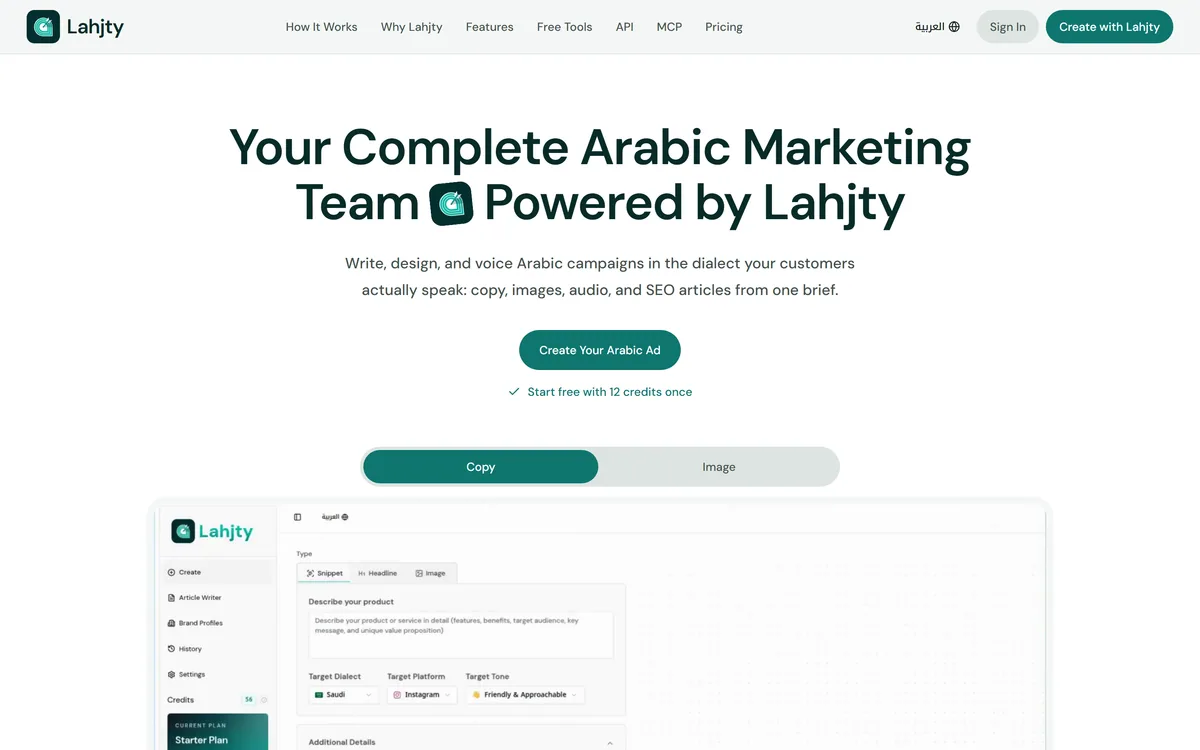
Lahjty (لهجتي) is an Arabic-first marketing platform for MENA campaigns. From one brief it produces dialect-aware ad copy, headlines, campaign images with Arabic text rendered in, dialect-aware voice, and SEO articles grounded in your own brand sources — with a Partner API and an MCP server for teams that want it inside their own workflow.
Arabic breaks most multilingual marketing tools in a way their feature lists never admit. Ask a general-purpose model for Arabic ad copy and you get Modern Standard Arabic — correct, formal, and instantly recognisable to a Gulf reader as something written by an institution rather than by a brand that knows them.
Lahjty is built on that gap. You pick a market before you write anything, and the output comes back in the dialect that market actually speaks: Saudi, Emirati or Egyptian, with the same source idea rendered three different ways rather than translated once.
Around that sits more than a copy generator. The same brief drives campaign images with Arabic text rendered into them, dialect-aware voice, and long-form SEO articles grounded in your own brand sources — a combination that tools like Jasper AI cover in English and largely leave to translation everywhere else.
Five Things Lahjty Puts In One Place
Dialect-aware copy: one source idea rewritten as Saudi, Emirati or Egyptian campaign copy, not translated into formal Arabic and left there.
Images with real Arabic text: campaign visuals generated with the Arabic wording built into the workflow, which is where most image generators quietly fail.
Voice in dialect: approved copy turned into audio with dialect-aware voice profiles, with playback, regeneration and download.
Articles grounded in your sources: long-form Arabic SEO pieces built from brand URLs, PDFs and notes you supply, rather than from the model's general knowledge.
A developer surface: a Partner API, an MCP server, OpenAPI docs and an llms.txt — unusually complete for a product this size.
Why Does Arabic Marketing Need Dialect Awareness?
Because the written standard and the spoken language are genuinely different things. Modern Standard Arabic is the language of news bulletins, government notices and school textbooks. It is understood everywhere and spoken natively nowhere, and a brand that advertises in it sounds like an announcement rather than a conversation.
The gap is not decorative. Vocabulary, sentence rhythm and the words that carry warmth or urgency all shift between Gulf, Levantine and Egyptian speech. A weekend offer written for Riyadh and the same offer written for Dubai differ in wording a translator would not change and a local reader would notice immediately.
Lahjty's own demonstration makes the point better than its marketing does: one English brief, rendered as Saudi, Emirati and Egyptian copy side by side, with visibly different phrasing in each. That is the product in a sentence.
Turn one source idea into Saudi, Emirati, and Egyptian campaign copy that sounds written for the market, not translated into it. — Lahjty, September 2026
What Can You Produce From A Single Brief?
Four output types, all driven from the same brand context rather than from four separate prompts. This is the structural idea worth understanding, because it is what separates Lahjty from running the same request through a chatbot four times.
You describe the product, pick a target dialect, a platform and a tone, and the workspace produces:
Ad copy and headlines shaped for the platform you chose — the length and register that suit Instagram are not the ones that suit WhatsApp or X.
Dialect conversion of copy you already have, so approved messaging can move between Gulf markets without a rewrite from scratch.
Campaign images generated for the chosen platform, with the Arabic wording optionally rendered into the artwork rather than added afterwards.
Dialect-aware speech from approved copy, with named voice profiles per market and regeneration until the read is right.
SEO articles built in stages — setup, outline, writing — from brand sources you attach, with a target keyword and market set at the start.
How Brand Context Travels Between Generations
You save a brand profile once: the offer, the audience, the voice, plus URLs, PDFs and free notes. Every later generation pulls that context in automatically, which is the difference between a tool that knows your business and a chat window you re-brief every morning.
It also underpins the article writer. Long-form Arabic generated from a model's general knowledge is where factual drift shows up fastest; generating from sources you attached is a meaningfully different proposition, and the workspace shows which sources fed a given piece.
Brand profile counts are what the paid tiers actually ration, alongside credits — one profile on the free tier, more as you move up. For an agency running several clients, that is the number to check before anything else.
The Free Arabic Tools Around The Paid Product
Lahjty publishes a large set of free Arabic utilities that need no credits and, for many visitors, are the reason to arrive at all: tashkeel (adding or stripping diacritics), a dialect detector, hashtag and hook generators, an Instagram RTL fixer, a readability checker, an Arabic font pairer, a Hijri content calendar, and MENA ad-budget and influencer-rate calculators.
Treat them as a genuine resource rather than a funnel. Several — the RTL fixer and the tashkeel tool in particular — solve small, real problems that have nothing to do with generative AI and are awkward to do by hand.
They are also the cheapest way to judge whether the product understands Arabic properly before you spend a credit on anything.
A First Session On The Free Credits
The free tier grants a small one-off credit allowance — enough, by Lahjty's own reckoning, for roughly one complete campaign across copy, image and voice. Spend it deliberately, because it does not refresh.
Start in the free tools, not the composer. Run some of your existing Arabic copy through the dialect detector and the readability checker — if its reading of your own material is wrong, nothing downstream will be right.
Build one real brand profile before generating anything. Attach a live URL and a PDF you actually use, not placeholder text; the grounding is the part being tested.
Generate ad copy for your true target market, with the platform and tone set to the ones you really publish on.
Now the part that matters: put the output in front of a native speaker from that specific market. Not an Arabic speaker generally — a Saudi reader for Saudi copy.
Pass/fail step: ask them one question — does this read as written for them, or as translated into Arabic? If the answer is 'translated', the core promise has failed for your use case and no amount of credits will change it.
If it passes, generate one image with Arabic text rendered in and inspect the lettering character by character. Arabic script joins, and generators that handle Latin text cleanly often mangle the joins.
Finish with one voice generation from the approved copy, and listen for the accent rather than the audio quality.
How Lahjty Charges, And What Refreshes Monthly
Credits, on a subscription, with two properties that behave differently. Plan credits refresh every month and do not accumulate; separately purchased top-ups persist while the account remains active. Mixing the two is how most credit products confuse people, and Lahjty at least states the distinction plainly on the pricing page.
The tiers ration two things at once — monthly credits and brand profiles — and for agencies the profile count usually binds first. A free tier grants a one-off credit allowance, one brand profile and a single article a month, with no API access and no top-ups. Paid tiers scale credits and profiles together, adding Partner API access partway up and priority support at the top, with a custom Enterprise arrangement above that. Billing is monthly or annual, with the annual option discounted.
AInexfinder does not publish plan amounts because vendor pricing changes without notice — the pricing page is the only current source. What is worth noting structurally is that the free tier is a genuine trial rather than a permanent free product: the credits arrive once.
Partner API, MCP And The Developer Surface
This is where Lahjty is unexpectedly ahead of its size. Beyond a Partner API on the higher tiers, it publishes an MCP server — the protocol that lets an AI assistant call a tool directly — plus OpenAPI documentation and an llms.txt describing the product to crawling models.
For an agency, the API is what turns this from a workspace someone logs into a step inside an existing content pipeline. For a product team, the MCP server means Arabic generation can be handed to an assistant already running in a developer's editor.
It is also a signal about the roadmap. A team publishing OpenAPI docs and an MCP server this early is building for integration rather than for sign-ups alone.
Lahjty's composer, with target dialect, platform and tone chosen before a single line is written. Captured September 2026.
Arabic Marketing Terms Used On This Page
Five terms this product assumes you know, and that decide whether its output is any good.
MSA (Modern Standard Arabic)
The formal written standard used in news, government and education. Universally understood, natively spoken nowhere. It is the default output of most general-purpose models, and the reason translated Arabic advertising so often lands flat.
Dialect (لهجة)
The spoken varieties — Saudi, Emirati, Egyptian and many more — that differ from MSA and from each other in vocabulary, rhythm and idiom. Lahjty's name is the Arabic word for 'my dialect', which is the whole positioning in one word.
Tashkeel
The diacritical marks that indicate short vowels in Arabic script. Usually omitted in everyday writing, but needed for disambiguation, for correct text-to-speech pronunciation, and in religious or educational material. Lahjty offers adding and stripping them as a free tool.
RTL
Right-to-left text direction. Arabic runs right to left, which breaks layouts, truncates captions and scrambles mixed Arabic-and-Latin strings on platforms built left-to-right — a recurring practical problem that has nothing to do with the quality of the writing.
MCP server
Model Context Protocol — a standard that lets an AI assistant call an external tool directly rather than through a browser. Lahjty publishing one means its generation can be driven from inside an assistant, in the same way a coding agent calls tools in Warp or a similar environment.
Lahjty Coverage, Outputs And Limits
Primary language
Arabic, with an English interface option
Dialects handled
Saudi, Emirati and Egyptian, plus dialect detection on existing text
Copy outputs
Ad copy, headlines, dialect conversion, platform-shaped snippets
Visual outputs
Campaign images with Arabic text optionally rendered in
Audio outputs
Dialect-aware speech with per-market voice profiles
Long-form
Staged SEO articles grounded in attached brand sources
Grounding inputs
Brand profile plus URLs, PDFs and free notes
Free utilities
A large set of Arabic tools requiring no credits
Developer access
Partner API on higher tiers, MCP server, OpenAPI docs, llms.txt
Charging model
Monthly or annual subscription credits, plus persistent paid top-ups
Free tier
A one-off credit grant, one brand profile, one article a month, no API
Published contact
Email and a UAE telephone number, alongside privacy and terms pages
Key features of Lahjty
Dialect-aware Arabic campaign copy in Saudi, Emirati and Egyptian, generated from one source brief
Dialect conversion of existing approved copy, so messaging moves between markets without a rewrite
Campaign image generation with Arabic text rendered into the artwork rather than overlaid afterwards
Dialect-aware Arabic speech with per-market voice profiles, playback, regeneration and download
Staged SEO article writing grounded in brand URLs, PDFs and notes you attach
Reusable brand profiles carrying offer, audience, voice and sources into every later generation
A large library of free Arabic utilities — tashkeel, dialect detection, hashtags, RTL fixing, readability and more
Partner API, an MCP server, OpenAPI documentation and an llms.txt for integration into existing pipelines
Pros & cons
Pros
6
Treats dialect as the core problem rather than as a translation setting, which is the right diagnosis for MENA marketing
Copy, image, voice and long-form article in one workspace, all driven from the same saved brand context
Articles are grounded in sources you supply rather than generated from the model's general knowledge
An unusually complete developer surface for a product this size — Partner API, MCP server and OpenAPI docs
A substantial set of genuinely free Arabic utilities that work without credits or a paid plan
Publishes an email address, a telephone number and a named maker alongside its privacy and terms pages
Cons
6
Dialect coverage demonstrated for three markets only — Levantine, Iraqi and North African varieties are not shown
The free tier's credits arrive once and do not refresh, so it is a trial rather than a free product
Paid tiers ration brand profiles as well as credits, which binds agencies sooner than the credit count does
Output quality in dialect is not independently verified, and needs a native speaker from the specific market to judge
Arabic lettering inside generated images is a hard problem industry-wide, and no accuracy measurement is published
A small operation, so roadmap and support depth carry the risk that comes with that
Best For
Marketers running campaigns in Saudi Arabia, the UAE or Egypt who need copy that reads as locally written
Agencies handling several MENA clients who want per-client brand context saved and reused
Founders launching into Gulf markets without an in-house Arabic copywriter
Content teams producing Arabic SEO articles that must stay grounded in the brand's own material
Product and engineering teams wanting Arabic generation inside a pipeline via Partner API or MCP
Lahjty Beside General-Purpose AI Writers
The question is not which model writes better, but which one knows a Saudi reader is not an Egyptian reader.
Tool
Arabic handling
What else it covers
Best when
Lahjty
Dialect-first — market chosen before generation, conversion between dialects built in
Copy, images with Arabic text, dialect voice, grounded articles
Arabic speech synthesis with strong general voice quality
Voice only — no copy, images or articles
You already have approved Arabic script and need the audio to be excellent
Is Lahjty Built For Your Market?
A Strong Match If
You run campaigns in Saudi Arabia, the UAE or Egypt and have watched translated copy underperform against locally written copy.
You are an agency handling several MENA clients and want brand context saved per client rather than re-briefed every session.
Your Arabic visuals keep coming back with broken lettering because your image generator treats Arabic as decoration.
You want a Partner API or an MCP server so Arabic generation sits inside a pipeline rather than in another browser tab.
You need Arabic voice in a specific market accent rather than a generic Arabic read, as a companion to tools like HeyGen for the visual side.
Look Past Lahjty If
Your Arabic requirement is Levantine, Iraqi, Moroccan or another variety outside the three dialects covered.
You market primarily in English and need Arabic occasionally — a general suite with translation will cost less and serve you adequately.
You need a permanently free tool. The free credits arrive once and do not refresh, so ongoing use is a paid product.
You have no native speaker available to review output. Dialect copy you cannot evaluate is a risk, not a shortcut.
Formal Modern Standard Arabic is genuinely what you want — for legal, governmental or institutional communication, the dialect advantage works against you.
What We Verified On lahjty.com
Last checked . Read from the product's own English-language site, rendered in a real browser including the footer.
The home page, feature walkthroughs, free-tools index, pricing table and FAQ, captured in Chromium in September 2026.
Dialect coverage, output types and the brand-context model taken from the product's own demonstrations rather than from its summary copy.
Credit behaviour — plan credits refreshing monthly, purchased top-ups persisting while the account is active — read from the pricing page wording.
Tier structure confirmed as rationing both monthly credits and brand profile counts, with API access appearing partway up the range.
Footer checked: privacy policy, terms of service, a contact email, a UAE telephone number and a named individual credited as the maker are all published.
The hero screenshot on this page captured from lahjty.com in September 2026, unedited.
What we could not confirm: we have not had the Arabic output assessed by native speakers of each dialect, so nothing here judges how the copy actually reads in Riyadh, Dubai or Cairo — that is the one test that matters and the one we cannot run for you, which is why the walkthrough above puts it in your hands. Dialect coverage beyond the three demonstrated markets is not stated on the site. We also have no independent measurement of how reliably Arabic lettering renders inside generated images, which is a known weak point across the whole image-generation category rather than a claim against this product.
Other Tools For Multilingual Campaign Work
What sits either side of this, depending on which part of the job is the hard part.
Jasper AI — a mature English-first marketing suite, when Arabic is one channel rather than the main market.
Writesonic — high-volume SEO content across many languages, where formal register is acceptable.
ElevenLabs — voice synthesis on its own, if you already have approved Arabic script.
Canva AI — design-side production, for laying out campaign artwork once the wording is settled.
Surfer SEO — search-side planning to sit in front of the article writer.
Editor's Verdict
4.0/5
Lahjty is built around a distinction most multilingual tools flatten: Modern Standard Arabic is not what people speak, and a Saudi reader can tell a translation from a campaign written for them. Dialect conversion, Arabic text rendered correctly into images, dialect-aware voice and brand-grounded articles is a coherent set rather than a feature list, and the MCP server and Partner API are unusually mature for a product this size. It falls short of higher marks on reach rather than quality — three dialects deep, MENA only, and no independent verification of how the dialect output reads to native speakers. AInexfinder Editor Score: 4.0/5.
Lahjty pricing
AInexfinder does not list plan prices or billing details. For current pricing, plans, and trials, visit the official Lahjty website.
Vendor pricing, credits, and billing policies change over time. Always confirm on the official site before you buy.
Frequently asked questions
What is Lahjty?
Lahjty (لهجتي) is an Arabic-first marketing platform. From a single brief it produces dialect-aware ad copy and headlines, campaign images with Arabic text rendered in, dialect-aware voice, and SEO articles grounded in brand sources you attach. The name is Arabic for 'my dialect', which is the positioning in one word.
Which Arabic dialects does Lahjty support?
Saudi, Emirati and Egyptian are the three demonstrated across the product, together with dialect detection on text you already have. Other varieties — Levantine, Iraqi, North African — are not shown on the site, so if your market is outside those three, confirm coverage before committing.
How is Lahjty different from translating English copy?
Translation produces Modern Standard Arabic: correct, formal, and recognisable to a Gulf reader as institutional rather than conversational. Lahjty generates into a chosen dialect from the start, so vocabulary, rhythm and idiom are the market's own. The same source idea comes back worded differently for Riyadh, Dubai and Cairo.
Can Lahjty generate images with Arabic text in them?
Yes, and it is one of the more distinctive parts. Campaign images are generated for a chosen platform with the Arabic wording built into the workflow rather than added over the top afterwards. Inspect the lettering closely on any result — Arabic script joins, and rendering those joins correctly is a known weak point across all image generators.
Does Lahjty have a free plan?
There is a free tier, but the credits arrive once rather than refreshing monthly, so it functions as a trial. It includes one brand profile and one article a month, with no API access and no top-ups. Separately, Lahjty publishes a large set of free Arabic utilities that need no credits at all.
How do Lahjty credits work?
Two kinds behave differently. Subscription credits refresh every month and do not carry over. Separately purchased top-ups persist while your account stays active. By the vendor's own example, a complete campaign across copy, image and voice consumes roughly a dozen credits. Check the pricing page for current amounts.
Does Lahjty offer an API?
Yes — a Partner API on the higher tiers, plus an MCP server, OpenAPI documentation and an llms.txt. That combination is unusually complete for a product this size, and it means Arabic generation can run inside an existing content pipeline or be called directly by an AI assistant rather than used through the browser.
What free Arabic tools does Lahjty offer?
A large library that needs no credits: tashkeel for adding or stripping diacritics, a dialect detector, hashtag and hook generators, an Instagram RTL fixer, an Arabic readability checker, a font pairer, a Hijri content calendar, and MENA ad-budget and influencer-rate calculators, among others. They are also the cheapest way to judge whether the product handles Arabic properly.
Can Lahjty write long-form Arabic articles?
Yes, in stages — setup, outline, writing — with a target keyword and market set at the start. What distinguishes it is grounding: the article is built from brand URLs, PDFs and notes you attach rather than from the model's general knowledge, which is where factual drift in long-form Arabic usually appears.
Who is Lahjty built for?
Marketers, founders and agencies working in MENA markets. Agencies are the clearest fit because brand profiles are saved per client and reused, though profile counts are rationed by tier — for an agency that limit usually binds before the credit allowance does.
Is Lahjty better than ChatGPT for Arabic marketing?
For dialect work, it is built for a job a general assistant is not. A general model will produce fluent Arabic, but you have to specify dialect, audience, platform and length in every prompt, and it defaults to the formal register. Lahjty makes market selection the first step and carries brand context between generations. For general writing, a general assistant remains more flexible.
How should I test whether Lahjty's Arabic is good?
Put the output in front of a native speaker from the specific market — a Saudi reader for Saudi copy, not an Arabic speaker generally — and ask one question: does this read as written for them, or as translated into Arabic? No feature list answers that, and it is the test the whole product stands or falls on.
Daniel reviews AI tools the slow way — by actually using them on real projects. His reviews cover what works, what breaks, and who each tool is genuinely a good fit for.
Daniel and the AInexfinder editorial team research Lahjty using public product information, listing evidence, and (when available) hands-on checks. Scores reflect listing completeness and transparency — not paid placement.
Listings may include affiliate or sponsored placements, which are labeled when present. Editorial scores and cons are not sold. See our affiliate disclosure and review methodology.
Listomize is an Etsy SEO platform that generates titles, tags, and descriptions within Etsy's own limits, scores listings, optimises 100+ listings from a CSV, tracks competitors and trends, and auto-generates Pinterest pins.
MaxAEO is an answer engine optimisation platform from HIII PTE. LTD. It tracks how ChatGPT, Gemini, Claude, Perplexity, Copilot, Grok and Google's AI surfaces mention a brand, with sentiment, competitor benchmarking and citation tracing.
Mailjet is a Sinch-owned email platform handling both marketing campaigns and transactional sending from one account. It offers a collaborative drag-and-drop editor, an email API with SMTP relay, AI generation and segmentation, and EU-based data centres.
Outranking is an AI SEO content platform that writes briefs and first drafts and optimises them with real-time scoring, grounding content in live SERP data through its Concepts feature, with keyword clustering, internal linking and content workflows.
PitchBud is a press outreach tool that drafts a release with Claude Sonnet, publishes it to a newsroom URL with NewsArticle schema and RSS, matches relevant journalists by their recent work, and drafts personal pitches you review and send yourself.
Helium 10 is an all-in-one platform for Amazon, Walmart and TikTok Shop sellers, covering product research, keywords, listing optimisation, advertising, operations and analytics — now fronted by an AI agent and an MCP connector.