
Outset runs AI-moderated research interviews in video, voice or text, probing dynamically like a human moderator, then synthesises and tags the results automatically. It draws participants from a very large pool across 85+ countries and offers simulated respondents grounded in real human data.
PitchBud
Verified
PitchBud is a press outreach tool that drafts a release with Claude Sonnet, publishes it to a newsroom URL with NewsArticle schema and RSS, matches relevant journalists by their recent work, and drafts personal pitches you review and send yourself.
4.0Editor Score
pitchbud.io8 viewsAdded December 28, 20251K visitors
The press release industry has an uncomfortable open secret, and PitchBud's site states it more plainly than most vendors would dare.
Wire distribution mostly syndicates to the same set of automated endpoints — finance portals, mirror feeds, regional station sites that republish algorithmically — and almost none of those pickups are read by a human, let alone a journalist. The report you receive counts them anyway.
Meanwhile the reporters who actually cover your beat work from source-request lists, their own contacts and direct pitches. PitchBud is built around that gap, and the design follows from it.
PitchBud, Point By Point
- Five stages: Assess, Draft, Publish, Pitch, Track — starting with scoring whether the announcement is worth spending on at all.
- Claude Sonnet drafts the release, named explicitly on the site, producing a roughly 1,200-word newsroom-ready draft you can edit.
- A real newsroom URL with NewsArticle markup, RSS and a news sitemap, plus IndexNow and WebSub notifications and an Internet Archive snapshot request.
- You send the pitches yourself, from your own inbox, after reviewing byline-aware drafts — which is the whole design decision.
- Source-request matching scores incoming journalist queries against your expertise and drafts responses you approve.
Do Press Release Wires Still Reach Anyone?
PitchBud's own framing is that wires distribute broadly and that broad distribution turns into automated pickup pages rather than real reporting.
That description matches what most people discover after buying one. The delivery report arrives full of impressive-sounding numbers — potential reach, pickups, syndication partners — and none of those quantities correspond to a person reading anything.
The distinction that matters is between distribution and coverage. Distribution means your text appeared somewhere; coverage means a journalist decided your announcement was worth writing about. Only the second does anything for you, and only the first is what a wire sells.
PitchBud keeps the parts of a wire that are genuinely useful — a public newsroom URL, structured data, RSS, discovery signals, a citable release — and drops the syndication receipt.
The site is also careful about what it promises, which is worth crediting. It describes IndexNow, WebSub and Internet Archive requests as *discovery signals* rather than as promised syndication or coverage. That is a more honest claim than the category norm, and it is the sentence to read closely when comparing vendors.
The parallel in sales outreach is exact. Platforms like Instantly exist because volume sending works differently from personal sending, and press is the extreme end of that distinction.
Distribution means your text appeared somewhere. Coverage means a journalist decided it was worth writing about. Only the second does anything for you.
What A Newsroom URL With Schema Actually Does
PitchBud publishes a clean newsroom page with NewsArticle markup, RSS and a news sitemap, then sends IndexNow and WebSub notifications and requests an Internet Archive snapshot.
Each of those has a specific job, and none of them is the same as being reported on. A canonical URL gives a journalist something to link to and cite, which matters because a release that exists only in an email attachment is harder to reference than one with an address.
NewsArticle structured data tells machines what the page is — headline, date, publisher, body — which is how search engines and, increasingly, answer engines decide whether to surface something as news rather than as marketing.
IndexNow and WebSub are notification protocols: they tell search engines and subscribers that a page exists, immediately, rather than waiting for a crawl. That shortens the gap between publishing and being findable.
The Internet Archive snapshot is the most interesting inclusion, because it is about permanence rather than discovery. A dated, archived copy of what you announced and when is genuinely useful later, and almost nobody thinks to create one.
Sending From Your Own Inbox Changes The Odds
PitchBud drafts byline-aware pitches and hands them to you to review and send from your own inbox — described on the site as a MAILTO-first model. This is the design decision the whole product turns on.
The first reason is deliverability. Bulk email sent from a platform's infrastructure carries that platform's reputation, and journalists' inboxes filter aggressively against exactly that pattern. A message from your own domain, sent individually, arrives.
The second is reply-ability. A journalist who wants to follow up on a platform-sent pitch is replying to a system; one replying to your address is replying to you. That difference decides whether an interested reporter reaches you at all.
The third is accountability, and it is the one that improves the writing. A pitch you have to press send on yourself is a pitch you will read first, and reading it first is what stops the obviously irrelevant ones going out.
The trade is honest and worth stating: this does not scale. Reviewing and sending twenty-five personal pitches takes real time, which is precisely why the wire model exists. PitchBud is betting that twenty-five considered emails beat a syndication report, which is a defensible bet and not a free one.
Contact quality is the same problem enrichment tools such as Clay were built for: a well-written message to the wrong person performs exactly as badly as a bad one.
- Read every drafted pitch before sending — the review step is the quality control.
- Check the journalist actually covers your beat now, not two years ago.
- Treat discovery signals as findability, never as promised coverage.
- Use the Assess stage honestly; a weak angle does not improve with distribution.
- Keep the archived snapshot, since a dated record of what you announced is useful later.
The Assess Stage Is The Underrated One
PitchBud's first stage scores the angle, proof, audience and outreach plan before you commit any budget, and this is the most valuable thing in the product.
The reason is that most PR failure is upstream of execution. The announcement was not newsworthy, and no amount of distribution, targeting or drafting fixes that. A funding round nobody cares about, a feature release that is not a story, a rebrand that matters only internally — these fail because they were never stories.
A tool willing to tell you that before taking money is doing something unusual. The commercial incentive in PR runs entirely the other way, because a vendor paid per release has no reason to talk you out of one.
The four things it scores are the right four. An angle is what makes this interesting to someone outside your company. Proof is what makes it credible. Audience is who would care. An outreach plan is who specifically to tell.
The practical use is as a filter rather than a gate. If the assessment comes back weak, the useful response is usually to find the actual story inside your announcement — the customer outcome, the industry shift, the number nobody expected — rather than to send it anyway.
If the assessment says there is no story, the honest alternatives are your own channels — a scheduler like Vista Social — or search visibility, which is what a platform such as SEO.AI chases instead.
Running One Announcement Properly
The most common mistake in outreach is volume: sending a mediocre pitch to a hundred journalists rather than a good one to ten.
The sequence below inverts that, and it takes about two hours.
- Run the Assess stage before writing anything, and take a weak score seriously rather than proceeding anyway.
- Find the story inside the announcement — what changed for someone who is not you — and lead the draft with it.
- Edit the generated release properly. A 1,200-word draft in twenty seconds is a starting point, not a finished document you stand behind.
- Check each matched journalist's recent work yourself, and remove anyone whose beat has moved.
- Read every drafted pitch before sending, and cut any that reads as a template with a name inserted.
- Track replies and actual coverage, not potential reach, and judge the campaign on the first only.
PitchBud: Product And Process
| Product type | Press release drafting, publishing and journalist outreach |
|---|---|
| Positioning | A modern alternative to traditional newswire services |
| Five stages | Assess, Draft, Publish, Pitch, Track |
| Drafting model | Claude Sonnet, named on the site |
| Draft length | Around 1,200 words, newsroom-ready and editable |
| Publishing | Public newsroom URL with NewsArticle markup, RSS and a news sitemap |
| Discovery signals | IndexNow and WebSub notifications, plus an Internet Archive snapshot request |
| Outreach model | Byline-aware pitches you review and send from your own inbox |
| Journalist matches | 3 previewed free; a Campaign Pack unlocks up to 25 |
| Source requests | Scores incoming source-request digests against your expertise and drafts responses |
| Support | 24/7 sales and support phone line listed |
| Site sections | Home, Pricing, Resources, How It Works, PR Readiness, Newsroom, Affiliates, Contact |
Is PitchBud The Right PR Route?
A sensible route when
- You have an announcement with a genuine story inside it.
- You would rather have three real replies than a syndication report.
- You can spend the time reviewing and sending pitches yourself.
- You want a citable newsroom URL with proper structured data.
- You already receive source-request digests and never get round to answering them.
Use a wire when
- You need a wire specifically for a regulatory or disclosure requirement.
- Your announcement is a compliance obligation rather than a story.
- Nobody will do the review step, which is where the quality lives.
- You are measuring success by reach numbers rather than replies.
- You need guaranteed placement, which no honest vendor offers.
Key features of PitchBud
A PR readiness assessment scoring angle, proof, audience and outreach plan
Release drafting by Claude Sonnet, producing an editable newsroom-ready document
A public newsroom URL carrying NewsArticle markup, RSS and a news sitemap
IndexNow and WebSub notifications plus an Internet Archive snapshot request
Journalist matching based on their recent published work
Byline-aware pitch drafts you review and send from your own inbox
Source-request scoring and response drafting for inbound queries
Tracking focused on replies and coverage rather than potential reach
Pros & cons
Pros
7- States the newswire problem honestly, including that pickups are largely automated
- Sending from your own inbox solves deliverability and reply-ability together
- The review step is quality control, not friction — you read what goes out
- Names its drafting model, which almost no competitor does
- Describes discovery signals as signals rather than as promised coverage
- The Assess stage can talk you out of a campaign, against its own commercial interest
- An archived, dated snapshot of what you announced is genuinely useful later
Cons
6- Personal outreach does not scale, which is the trade the whole model makes
- Journalist matching is only as good as its underlying contact data, which is undisclosed
- No published reply or coverage rate to judge effectiveness against
- A wire is still required where distribution is a regulatory obligation
- No operating company, registration or location is published
- Whether the newsroom URL sits on your domain or a shared one is unclear
Best For
- Startups with a genuine story and no PR agency
- Founders who would rather have three replies than a reach number
- Teams already receiving source-request digests they never answer
- Announcements that need a citable, structured newsroom page
- Anyone who has bought a wire release and seen what the report actually contained
PitchBud Against Traditional Wires
The category divides on whether you are buying distribution or buying an attempt at coverage.
| Tool | What you buy | Who sends | Best for |
|---|---|---|---|
| PitchBud | A release, a newsroom URL and personal pitches | You, from your own inbox | Launches where coverage matters more than a receipt |
| Instantly | Outbound email infrastructure at volume | The platform, at scale | Sales outreach rather than press |
| Clay | Contact data and enrichment | You decide | Building the list rather than writing the pitch |
| Vista Social | Owned-channel publishing and listening | You, on your own accounts | Reaching your audience without a journalist |
| SEO.AI | Search visibility through published content | Automated publishing | Discovery that does not depend on coverage at all |
Checking PitchBud Against Its Own Pages
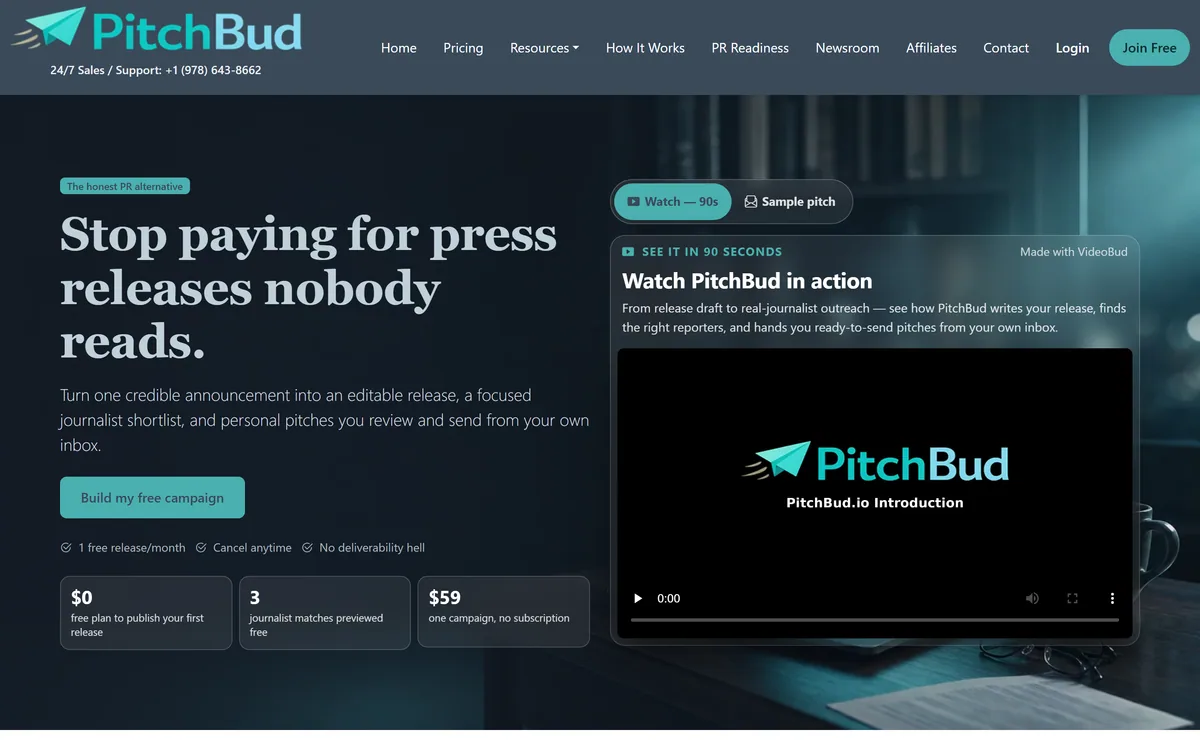
Last checked . Read from pitchbud.io in a browser session, with the screenshot above captured alongside.
- Positioned on the site as a modern alternative to traditional newswire services
- Five-stage flow confirmed as Assess, Draft, Publish, Pitch, Track
- Claude Sonnet named on the site as the model that writes the release
- Release length stated as around 1,200 words, newsroom-ready and editable
- Publishing confirmed as a clean newsroom URL with NewsArticle markup, RSS and a news sitemap
- IndexNow and WebSub notifications confirmed, plus an Internet Archive snapshot request
- Site explicitly describes these as discovery signals rather than promised syndication or coverage
- Outreach model confirmed as byline-aware pitches reviewed and sent from your own inbox
- 3 journalist matches previewed free confirmed, with a Campaign Pack unlocking up to 25
- Source-request matching confirmed, scoring digests against your expertise and drafting responses you review
- Site navigation confirmed for Home, Pricing, Resources, How It Works, PR Readiness, Newsroom, Affiliates and Contact
- A 24/7 sales and support phone number is displayed on the site
What we could not confirm: the operating company's legal name, registration or location; where journalist contact data comes from and how it is kept current; how matches are scored; any published reply or coverage rate; how the Assess stage scores an angle; whether the newsroom URL is on a shared domain or your own; and data handling for the announcements you upload. We did not run a campaign, so nothing here reflects tested results.
Other Marketing And Outreach Tools
Reaching people splits three ways — through journalists, through your own channels, or through search.
- Instantly — the outbound side, for sales rather than press
- Clay — for building and enriching the list itself
- Vista Social — reaching your audience directly on owned channels
- SEO.AI — visibility through search rather than through coverage
- MarketMuse — deciding what is worth publishing in the first place
Editor's Verdict
4.0/5PitchBud's central argument is correct and unusually well stated: newswire distribution mostly produces automated pickup pages rather than reporting, and the journalists who cover your beat are not reading the firehose. Building the product around personal pitches sent from your own inbox rather than blasted from a platform is the right structural choice, because deliverability and reply rates both follow from the sender. Naming Claude Sonnet as the drafting model is more transparency than almost any competitor offers. It scores where it does because journalist matching is only as good as its data, and a personal pitch to the wrong reporter is still a cold email. AInexfinder Editor Score: 4.0/5.
PitchBud pricing
AInexfinder does not list plan prices or billing details. For current pricing, plans, and trials, visit the official PitchBud website.
Visit official website for pricingVendor pricing, credits, and billing policies change over time. Always confirm on the official site before you buy.
Frequently asked questions
What is PitchBud?
PitchBud drafts a press release with Claude Sonnet, publishes it to a newsroom URL carrying NewsArticle markup, RSS and a news sitemap, matches relevant journalists based on their recent work, and drafts personal pitches you review and send from your own inbox. It runs in five stages: Assess, Draft, Publish, Pitch, Track.
Do newswire services still work?
For distribution, yes; for coverage, largely not. Wires syndicate to the same automated endpoints — finance portals, mirror feeds, regional station sites that republish algorithmically — and almost none of those pickups are read by a human. The report counts them anyway, which is why the numbers look better than the outcome.
Why does sending from my own inbox matter?
Three reasons. Deliverability, because journalists' inboxes filter aggressively against platform-sent bulk mail. Reply-ability, because a reporter replying to your address reaches you rather than a system. And accountability — a pitch you press send on yourself is one you read first, which stops the irrelevant ones going out.
What does the newsroom URL actually give me?
A citable address a journalist can link to, structured data telling machines this is news rather than marketing, and immediate notification to search engines through IndexNow and WebSub rather than waiting for a crawl. The Internet Archive snapshot adds permanence — a dated record of what you announced and when.
Does PitchBud guarantee coverage?
No, and it is careful not to claim it. The site describes IndexNow, WebSub and Archive requests as discovery signals rather than as promised syndication or coverage. That is a more honest position than the category norm, and the wording is worth reading closely when comparing any PR vendor.
What is the Assess stage for?
Scoring the angle, proof, audience and outreach plan before you commit budget. It is the most valuable part, because most PR failure is upstream of execution — the announcement was never a story, and no amount of distribution fixes that. A tool willing to say so before taking money is going against its own incentive.
How many journalists does it find?
Three matches are previewed free, and a Campaign Pack unlocks up to 25. What is not published is where the contact data comes from or how current it is kept, which matters — a personal pitch to a reporter who moved beats two years ago is still a cold email, however well written.
What is source-request matching?
If you already receive journalist source-request digests, PitchBud scores them against your expertise and drafts responses for strong matches, which you review and send. That addresses a real failure: most people who sign up for these digests never answer any of them, because sorting the relevant ones takes time nobody has.
Does this replace a PR agency?
For a single announcement with a clear story, plausibly. For ongoing relationship-building with journalists, no — an agency's actual asset is that reporters already take their calls, which no tool supplies. PitchBud is closer to replacing a wire subscription than to replacing a retained agency.
How should I judge whether a campaign worked?
By replies and actual coverage, not by reach. The site itself frames tracking that way, which is the right instinct. One reporter replying with a question is worth more than any number of syndicated pickups, and measuring the second is how people convince themselves a wire release did something.
Reviews
Log in to write a review.
User Reviews
No reviews yet. Be the first to share your experience with PitchBud.
Reviewed by Daniel Reed
Assigned reviewer
Daniel ReedSenior AI Tools Reviewer
Daniel reviews AI tools the slow way — by actually using them on real projects. His reviews cover what works, what breaks, and who each tool is genuinely a good fit for.
Hands-on reviewsProduct testingAI software
Daniel and the AInexfinder editorial team research PitchBud using public product information, listing evidence, and (when available) hands-on checks. Scores reflect listing completeness and transparency — not paid placement.
- Last verified
- Methodology
- How we review AI tools
- Sources used
- pitchbud.io
- AInexfinder listing fields (features, pros/cons, description)
- Public vendor pages when available
- Editorial policy
- Listings may include affiliate or sponsored placements, which are labeled when present. Editorial scores and cons are not sold. See our affiliate disclosure and review methodology.
Related tools
Brandwatch is a Cision-owned enterprise suite covering consumer intelligence, social media management, influencer marketing and media intelligence. It monitors over 100 million sources, applies its Iris AI layer to the results, and is bought by large brands as a single platform rather than as point tools.
Lakmoos AI builds a private reasoning model from a client's existing survey data, then answers new questions as a simulated panel — reporting a similarity score above 98 percent across 20 benchmarking studies, and handling what it says is 20 million questions a week for 50-plus enterprise teams.
Klue is an AI platform that unites competitive intelligence and win-loss programs: a Compete Agent that collects intel and answers sellers in real time, living battlecards, and a Win-Loss Suite of verified buyer interviews, so revenue teams know why they win and lose and what to do about it.
Synthetic Users is an AI user-research platform that simulates research participants, from procurement officers to clinicians, so teams can run fast, cheap interviews to explore problems and refine questions. The vendor positions it as a discovery co-pilot, not a replacement for research with real people.

Listomize is an Etsy SEO platform that generates titles, tags, and descriptions within Etsy's own limits, scores listings, optimises 100+ listings from a CSV, tracks competitors and trends, and auto-generates Pinterest pins.
FreemiumBusiness & Marketing
Explore More
Embed this listing on your site
Featured on AInexfinder