Synthetic Users is an AI user-research platform that simulates research participants, from procurement officers to clinicians, so teams can run fast, cheap interviews to explore problems and refine questions. The vendor positions it as a discovery co-pilot, not a replacement for research with real people.
syntheticusers.com7 viewsAdded May 27, 202510K visitors
User research is slow and expensive: recruiting the right participants, scheduling interviews and synthesising findings can take weeks. Synthetic Users offers a radical shortcut, interviewing AI-simulated participants instead of people.
You define who you want to hear from, such as a procurement officer, a clinician or a retail manager, and run interviews with synthetic respondents in minutes. It sits among research and go-to-market tools like Clay, but it addresses a different question: what might these people think, before you ask them for real.
This review covers what Synthetic Users actually does, the evidence it cites, who it fits, and why the validity line matters.
Synthetic Users offers AI-simulated participants for early-stage user research.
Synthetic Users Simulated-Research Facts
What it is
An AI platform for simulated user research
Respondents
AI personas across roles and industries
Method
Fast synthetic interviews and analysis
Positioning
A discovery co-pilot, not a replacement (vendor)
Evidence cited
Parity studies and published papers (vendor-cited)
Pricing model
Per-interview pricing (vendor-stated)
Security
SOC 2 (vendor-stated)
Access
Demo-led, with self-serve options
AI 'Participants' For Research, With A Validity Line
Synthetic Users replaces recruited participants with AI respondents built to represent specific roles and contexts, so a product team can 'interview' a paediatric oncologist or a port logistics planner in minutes. For early exploration, that speed and low cost are genuinely appealing.
The idea is not as far-fetched as it sounds. Large language models encode a great deal about how different professions talk and what they worry about, so simulated interviews can surface plausible themes, objections and vocabulary quickly.
But there is a hard validity line. A synthetic respondent is a model's prediction of what such a person might say, not a person with real experiences, constraints and contradictions. It can echo stereotypes, sound more articulate and agreeable than real people, and miss the unexpected behaviour that makes real research valuable.
To its credit, Synthetic Users itself says it is a discovery co-pilot, not a replacement for real research, designed to front-load the problem space and help you spend your real research budget more wisely. That is exactly how it should be used, and how we score it.
A synthetic respondent is a model's prediction of what a person might say, not a person; use it to prepare for real research, not to replace it.
What Does Synthetic Users Simulate, Exactly?
The platform produces simulated interviews and points to evidence that they resemble real ones.
Simulated Respondents And Fast Interviews
You describe the audience and research goals, and Synthetic Users generates respondents and runs interviews, returning transcripts and synthesis without recruitment fees or scheduling. That makes it fast to test several audiences, compare segments or pressure-test an interview guide.
For grounding in what real customers already say in public, a monitoring tool like BrandMentions surfaces genuine conversations, a useful real-world check against simulated opinions.
The Evidence, And Why It Is A Co-Pilot Not A Replacement
Synthetic Users cites comparison studies reporting substantial overlap between synthetic and real interview themes, a quote that AI feedback matched human feedback most of the time, and a list of published work supporting the approach. These are vendor-cited, and 'thematic overlap' is not the same as predicting what real people will actually do or buy.
If you want to read the underlying research yourself, a literature search tool like Consensus can help you find independent studies on synthetic respondents and LLM-simulated surveys, including their known biases.
Who Synthetic Users Fits, And Who It Does Not
Synthetic Users fits product managers, UX researchers, founders and strategists who want to explore a problem space fast, draft and refine interview guides, generate hypotheses, or prepare before talking to hard-to-reach professionals.
It suits teams with limited research budgets who want to spend real interviews more wisely, and researchers who use synthetic runs to spot gaps in their questions before fieldwork.
It does not fit decisions that must rest on real user evidence, such as launches, pricing, regulated or high-stakes products, or research on under-represented groups where models may encode bias. Treat its parity figures and testimonials as vendor-cited claims.
What Synthetic Users Costs Per Interview
Synthetic Users describes per-interview pricing far below traditional agency research, with demos and self-serve options. We do not publish prices, which change; check the site.
The value question is not just cost per interview but what the interviews are worth: cheap synthetic answers are valuable for exploration and preparation, and misleading if treated as evidence.
The sensible approach is to budget it as a pre-research tool, use synthetic runs to sharpen questions and hypotheses, then spend real money on real participants to validate what matters.
A Sceptical First Study With Synthetic Users
Because the risk is mistaking simulation for evidence, trial Synthetic Users against research you have already done with real people.
Pick a study you already ran with real participants.
Recreate the audience and questions in Synthetic Users.
Compare themes, objections and surprises with your real findings.
Note what the synthetic run missed or made more agreeable.
Use it to refine your next interview guide, not to replace the interviews.
Pass/fail: it is worth it if it sharpens real research, not if it replaces it.
Treat parity figures and quotes as vendor-cited claims.
Synthetic Users, The Honest Brief
Synthetic Users simulates research participants: AI personas you can interview in minutes instead of recruiting people.
It is fast and cheap for early discovery: map a problem space and sharpen questions before real research.
Simulated is not real: AI respondents can reflect stereotypes and miss the surprises real users bring.
The vendor agrees: it calls itself a discovery co-pilot, not a replacement, which is the right way to use it.
Terms For Judging Synthetic Research
Synthetic respondent
An AI-simulated research participant designed to represent a role or audience, rather than a real person.
Organic research
Research with real human participants, such as interviews, surveys or usability tests.
Synthetic-organic parity
How closely synthetic interview results match real ones, usually measured on themes rather than actual behaviour.
Discovery
The early research stage of exploring a problem space and forming hypotheses before validating them.
Is Synthetic Users Right For Your Discovery?
Product Teams Synthetic Users Can Help
Product teams exploring a new problem space
Researchers refining interview guides
Founders forming early hypotheses
Teams preparing for hard-to-reach professionals
Budget-limited teams planning real research
When Synthetic Users Misleads You
Launch, pricing or go/no-go decisions
Regulated or high-stakes product research
Research on under-represented groups
Anyone treating synthetic answers as evidence
Teams skipping real research to save money
Key features of Synthetic Users
AI-simulated research participants
Custom audience definitions
Synthetic interviews
Transcripts and synthesis
Multiple personas and segments
Interview-guide testing
SOC 2 security (vendor-stated)
Per-interview pricing
Pros & cons
Pros
5
Very fast early exploration
Low cost per interview
Good for refining research questions
Reaches hard-to-recruit roles in simulation
Vendor is candid about its limits
Cons
5
Simulated answers are not real evidence
Can reflect stereotypes and bias
Tends to miss real-world surprises
Parity claims are vendor-cited
Risky if used to skip real research
Best For
Early discovery
Interview-guide design
Hypothesis generation
Research preparation
Budget-limited teams
Synthetic Users Beside Real Research
The useful comparison is with the ways teams learn from real people.
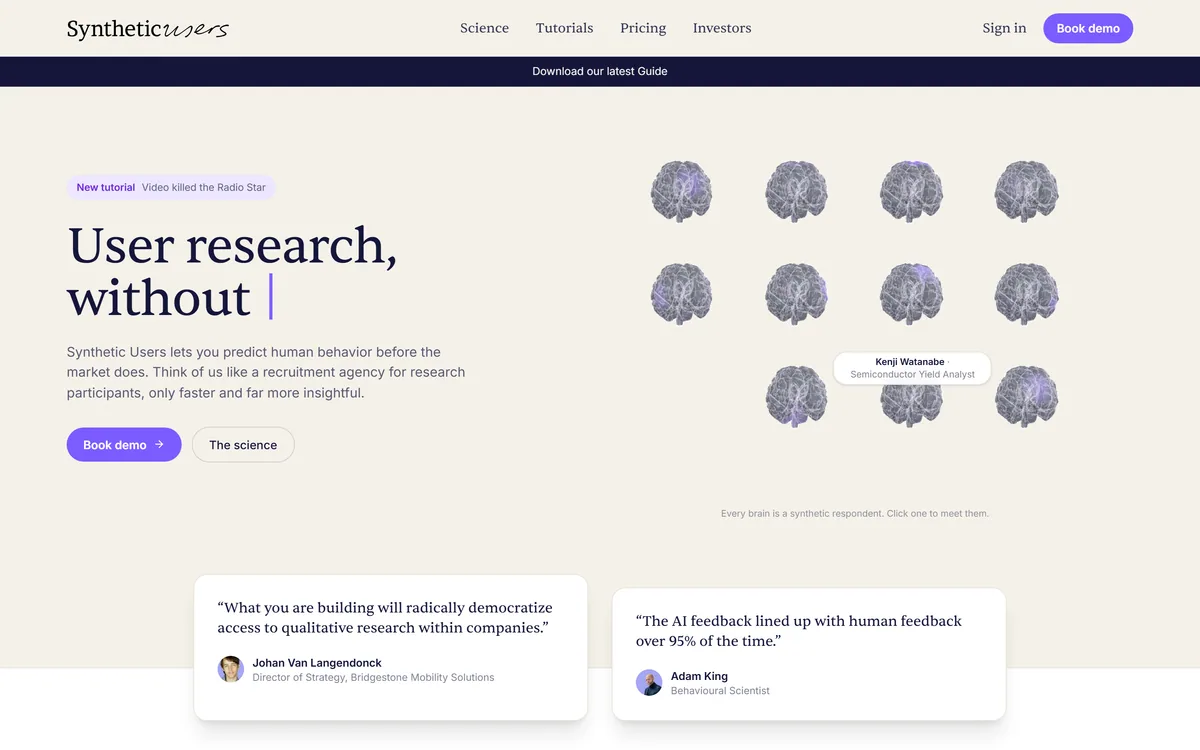
Last checked . Read from syntheticusers.com during this check, with the screenshot above captured at the same time.
An AI platform for simulated user research
Synthetic respondents across many roles and industries
Positioned by the vendor as a discovery co-pilot, not a replacement
Vendor-cited parity studies measured on themes and alignment
A vendor-presented quote on AI and human feedback agreement
A vendor-cited list of supporting publications
Per-interview pricing described against agency research
A SOC 2 claim and demo-led sales
No prices reproduced here, in line with this site's pricing policy
Synthetic respondents are model predictions, not people; they can reflect stereotypes and miss real surprises. Parity figures are vendor-cited and measure thematic overlap, not real behaviour. Use the tool to prepare for real research, never to replace it.
Other Research And GTM Tools
A GTM data tool, a literature-search tool and a brand monitor to weigh alongside Synthetic Users.
Synthetic Users earns 3.6 as a useful but easily misused tool: AI-simulated participants let product teams explore a problem space, generate hypotheses and refine interview guides in minutes, at a fraction of the cost of recruiting people. The validity line is the whole story, though: synthetic respondents are model predictions that can echo stereotypes and miss real surprises, and its parity figures are vendor-cited measures of thematic overlap. Commendably, the vendor itself calls it a co-pilot, not a replacement, so use it to prepare for real research, never to substitute for it. AInexfinder Editor Score: 3.6/5.
Synthetic Users pricing
AInexfinder does not list plan prices or billing details. For current pricing, plans, and trials, visit the official Synthetic Users website.
Vendor pricing, credits, and billing policies change over time. Always confirm on the official site before you buy.
Frequently asked questions
What is Synthetic Users?
Synthetic Users is an AI user-research platform that simulates research participants, letting teams run fast interviews with AI personas representing specific roles and audiences instead of recruiting real people.
Can synthetic users replace real user research?
No, and the vendor says so: it positions itself as a discovery co-pilot, not a replacement. Synthetic respondents are model predictions that can miss real behaviour and surprises, so decisions should rest on research with real people.
How accurate are synthetic respondents?
Synthetic Users cites studies showing substantial overlap with real interview themes. Those figures are vendor-cited and measure thematic similarity, which is not the same as predicting what real people will actually do or buy.
What are the risks of synthetic user research?
AI respondents can reflect stereotypes from training data, sound more articulate and agreeable than real people, and miss unexpected behaviour. The biggest risk is treating simulated answers as evidence for decisions.
When should I use Synthetic Users?
For early discovery: exploring a problem space, generating hypotheses, testing and refining interview guides, and preparing for interviews with hard-to-reach professionals, before validating with real participants.
How much does Synthetic Users cost?
It describes per-interview pricing far below traditional agency research, with demos and self-serve options. We do not publish prices, which change; check the site.
Who is Synthetic Users best for?
Product managers, UX researchers, founders and strategists doing early exploration, especially with limited research budgets. It is not suited to launch, pricing or high-stakes decisions that need real evidence.
Is synthetic research biased?
It can be. Models may encode stereotypes or under-represent some groups, so research on under-represented or vulnerable populations especially needs real participants. Comparing synthetic runs with real findings helps reveal bias.
Is Synthetic Users secure?
The vendor states it is SOC 2 compliant and that your data belongs to you. Confirm current security documentation if you plan to share confidential product or customer information.
How should I test Synthetic Users?
Recreate a study you already ran with real people and compare the synthetic themes, objections and surprises with your real findings. That shows you where it helps and where it misleads before you rely on it.
Daniel reviews AI tools the slow way — by actually using them on real projects. His reviews cover what works, what breaks, and who each tool is genuinely a good fit for.
Daniel and the AInexfinder editorial team research Synthetic Users using public product information, listing evidence, and (when available) hands-on checks. Scores reflect listing completeness and transparency — not paid placement.
Listings may include affiliate or sponsored placements, which are labeled when present. Editorial scores and cons are not sold. See our affiliate disclosure and review methodology.
PitchBud is a press outreach tool that drafts a release with Claude Sonnet, publishes it to a newsroom URL with NewsArticle schema and RSS, matches relevant journalists by their recent work, and drafts personal pitches you review and send yourself.
Brandwatch is a Cision-owned enterprise suite covering consumer intelligence, social media management, influencer marketing and media intelligence. It monitors over 100 million sources, applies its Iris AI layer to the results, and is bought by large brands as a single platform rather than as point tools.
Outset runs AI-moderated research interviews in video, voice or text, probing dynamically like a human moderator, then synthesises and tags the results automatically. It draws participants from a very large pool across 85+ countries and offers simulated respondents grounded in real human data.
Lakmoos AI builds a private reasoning model from a client's existing survey data, then answers new questions as a simulated panel — reporting a similarity score above 98 percent across 20 benchmarking studies, and handling what it says is 20 million questions a week for 50-plus enterprise teams.
Listomize is an Etsy SEO platform that generates titles, tags, and descriptions within Etsy's own limits, scores listings, optimises 100+ listings from a CSV, tracks competitors and trends, and auto-generates Pinterest pins.
Lahjty (لهجتي) is an Arabic-first marketing platform for MENA campaigns. From one brief it produces dialect-aware ad copy, headlines, campaign images with Arabic text rendered in, dialect-aware voice, and SEO articles grounded in your own brand sources — with a Partner API and an MCP server for teams that want it inside their own workflow.