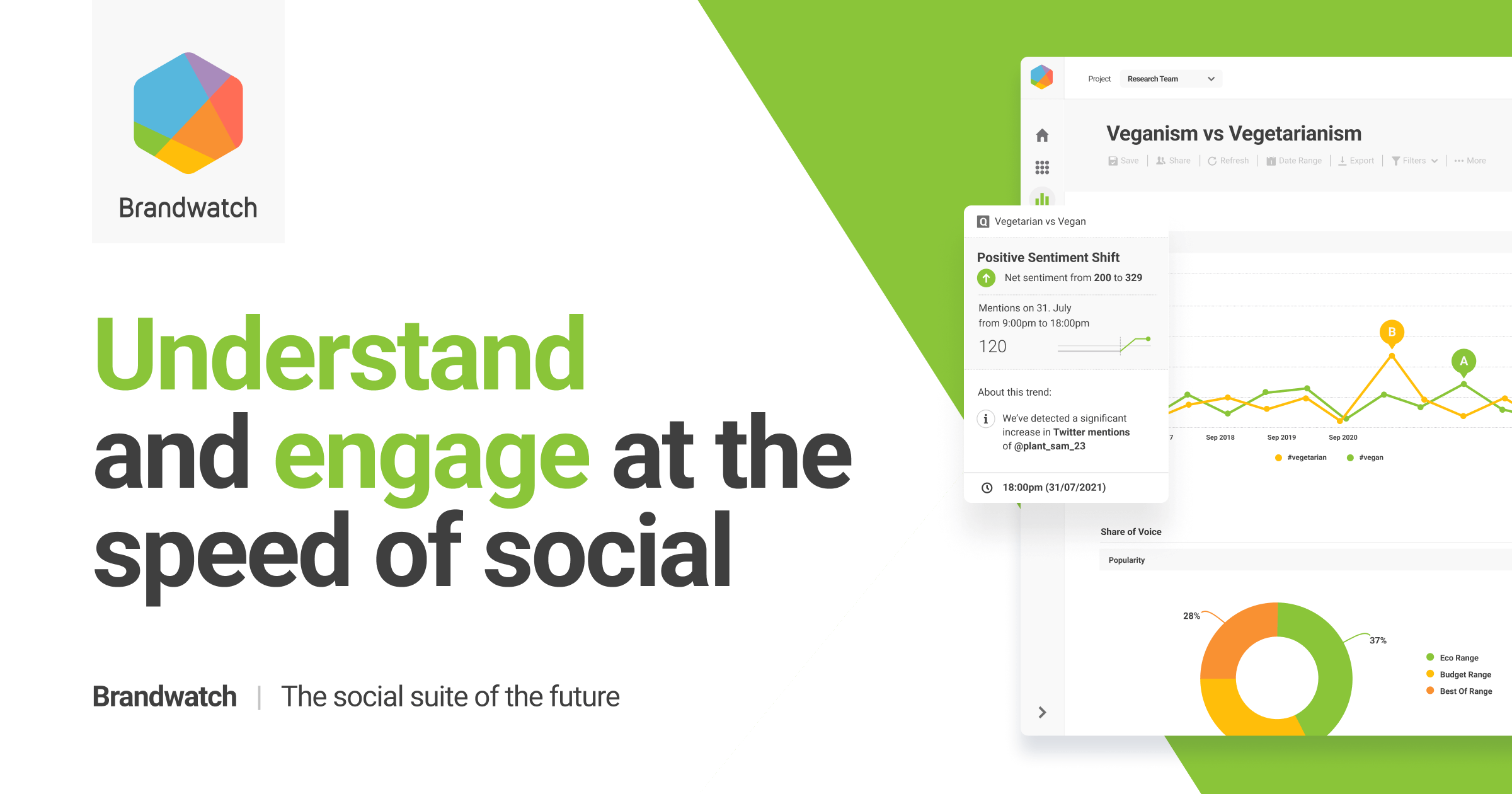
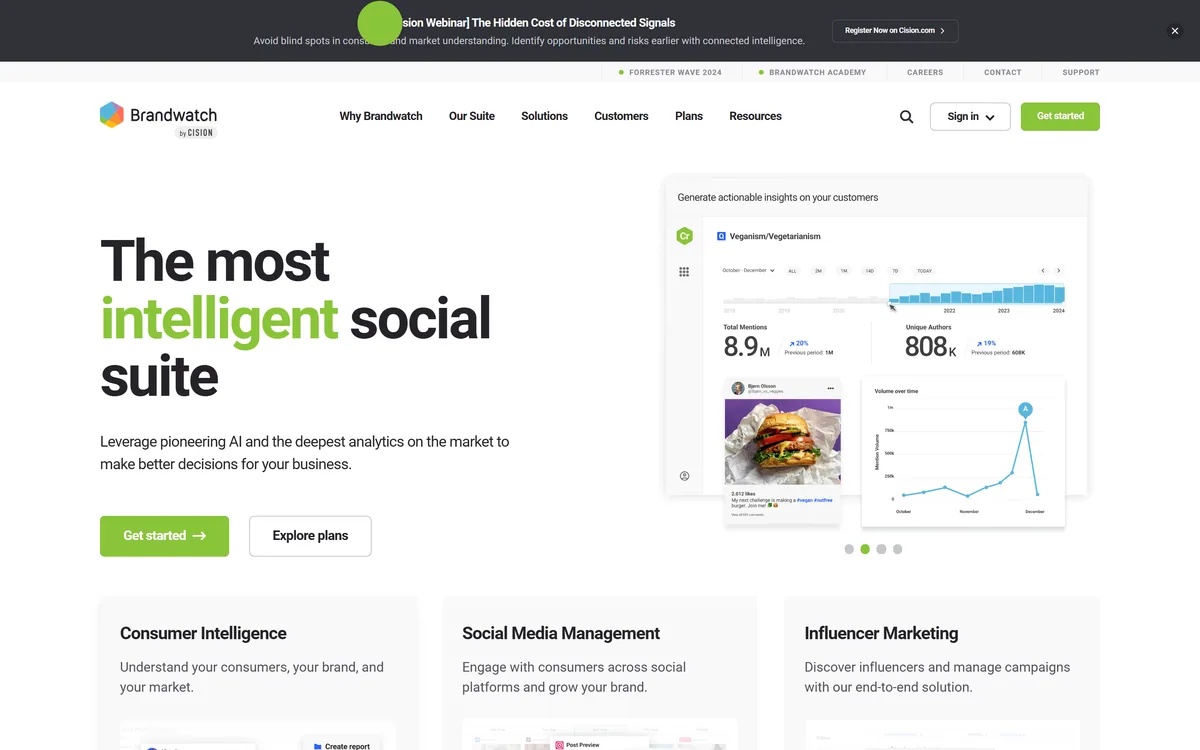
Brandwatch is a Cision-owned enterprise suite covering consumer intelligence, social media management, influencer marketing and media intelligence. It monitors over 100 million sources, applies its Iris AI layer to the results, and is bought by large brands as a single platform rather than as point tools.
brandwatch.com11 viewsAdded May 10, 202575K visitors
The archive is the moat. Everything else on the platform can be bought elsewhere.
Modules, Coverage And Ownership
Owner
Cision
Category
Enterprise social listening, consumer intelligence and social media management
Core modules
Consumer Intelligence, Social Media Management, Influencer Marketing, Media Intelligence and Insights
Additional offerings
Search Intelligence and APIs
Module heritage
Social Media Management descends from Falcon; Influencer Marketing from Paladin
Stated coverage
More than 100 million sources
Archive claim
Vendor describes it as the world's largest archive of consumer opinion
AI layer
Iris, applied across analysis, using both proprietary and generative models
Management features
Unified social inbox, community management, content calendars, approval workflows, channel management, real-time brand alerting
Named customers
Virgin Holidays, OnePlus, Metia, BBC
Recognition
Social Listening Solution of the Year at the 2026 MarTech Breakthrough Awards; named in the Forrester Wave for social suites in 2024
Charging model
Modular, contact-sales, with annual contracts standard; no prices published here
The Suite, Condensed
Brandwatch is an enterprise social listening and social media management platform — it monitors what people say about a brand across the public web and social platforms, and also publishes and manages that brand's own channels.
Four modules make up the suite: Consumer Intelligence, Social Media Management, Influencer Marketing and Media Intelligence, plus Search Intelligence and APIs.
Coverage is stated at more than 100 million sources with what the vendor calls the world's largest archive of consumer opinion — the historical depth is the genuine differentiator.
Iris is the AI layer, applied across analysis rather than sold as a separate product.
It is owned by Cision and priced by contact-sales on annual contracts, which tells you plainly who it is built for.
The Archive Is The Thing You Cannot Buy Elsewhere
Every social listening vendor — Meltwater included — claims broad coverage, and coverage of the present is genuinely commoditised — the platforms expose APIs and firehoses that any funded competitor can consume.
Historical depth is different, and it is the one thing a new entrant cannot simply purchase. You either collected the data as it happened or you did not.
That matters for a specific class of question, and those questions are the expensive ones. How did sentiment about this brand move across the last five years? Was the reaction to our last three product launches getting better or worse? Is this crisis unusual by our own standards, or does it look like the one in 2022?
A tool that started collecting last month can tell you what is happening. It cannot tell you whether what is happening is normal, and that comparison is usually what a decision actually turns on.
This is also why the acquisition history is relevant rather than trivia. Brandwatch merged with Crimson Hexagon in 2018, which combined two of the longest-running archives in the category, and was later acquired by Cision. Each step consolidated more history into one dataset.
If you are evaluating this against a cheaper competitor, the honest test is whether your questions are about now or about trend. If they are about now, you can save a great deal of money.
Coverage of today is a commodity. Coverage of 2019 is not, because nobody can go back and start collecting it.
Listening And Publishing In One Platform
The suite does two jobs that were historically bought separately, and the combination is either the point or the compromise depending on your team.
Listening is research: what are people saying about us, our competitors and our category, across the open web and social platforms.
Social media management is operations: scheduling posts, running the content calendar, routing incoming messages to the right person, and handling approvals.
In most organisations these belong to different people. Insights and brand teams do listening; social and community teams do management. They have different rhythms, different skills and, frequently, different budgets.
Where the combination genuinely pays is the handoff between them. A brand threat detected by listening should reach whoever answers the inbox within minutes, not through a weekly report. Real-time alerting into the same system that holds the inbox closes that loop properly.
Where it does not pay is when you only need one half. A team that only needs scheduling would be better served by eclincher or Sprout; buying a research platform it will not open, and paying enterprise rates for the privilege. That is the most common way money gets wasted on this category.
What To Actually Test In A Demo
Social listening platforms demo beautifully and disappoint specifically. The gap is almost always in the same three places, and they are worth insisting on rather than accepting a walkthrough.
Query precision on your own brand name. Ambiguous brand names are the classic failure — a company called Orange, Apple or Shell drowns in irrelevant mentions, and cleaning that up is genuinely difficult query work. Ask them to build it live on your name, not on a sanitised example.
Sentiment accuracy on your own category. Automated sentiment is much weaker than vendors imply, particularly with sarcasm, industry jargon and negation. Ask to see a hundred classified mentions from your sector and check them by hand. Expect to find errors; the question is how many and in which direction.
Coverage of the sources you actually care about. The 100 million figure includes a very long tail. If your customers argue about you in a specific subreddit, a regional forum or a non-English platform, confirm those are covered rather than assuming the total implies it.
The generative AI layer deserves the same scrutiny as anywhere else. Summarising thousands of mentions into a paragraph is genuinely useful and it also produces confident narrative from noisy input. Check summaries against the underlying mentions before anyone quotes them in a board deck.
Have them build a live query on your real brand name, including its ambiguous uses.
Export a hundred classified mentions from your own category and hand-check the sentiment.
Name the three specific sources that matter most to you and confirm coverage.
Ask how far back the historical data goes for your brand specifically.
Compare an AI-generated summary against the mentions underneath it before trusting the feature.
Why There Is No Price On The Page
This site does not publish plan prices, and in Brandwatch's case neither does Brandwatch. That absence is itself informative.
The model is modular and contact-sales, with annual contracts standard. You buy the modules you need — Consumer Intelligence, Social Media Management, Influencer Marketing, Media Intelligence — rather than a single flat product.
Contact-sales pricing in enterprise software usually means the same thing everywhere: cost varies with scale, and the vendor wants to understand your scale before quoting. Here the variables are typically mention volume, number of tracked queries, seats, historical data depth and which modules are switched on.
The practical consequences are worth planning for. Expect a procurement cycle measured in weeks rather than an afternoon, expect an annual commitment rather than a monthly one, and expect the quote to move substantially depending on how many modules you take.
That last point is the one to use. Because it is modular, the biggest saving available is not negotiating the rate — it is being honest about which modules your team will actually open. Buying the full suite and using one module is the standard failure in this category.
If a procurement cycle and an annual commitment are not workable for you, that is a clear signal the product is not aimed at you, and there are capable mid-market alternatives that publish their prices.
The Real Limits Of Social Listening
Three, and none are specific to Brandwatch. They apply to the whole category and rarely appear in vendor material.
You are watching the people who post. Social data is not a representative sample of your customers, it is a sample of your customers who publish opinions in public. Those groups differ systematically by age, platform and temperament, and treating listening data as market research quietly imports that bias into decisions.
Access is at the platforms' discretion. Every listening vendor depends on data access that platform owners control and have restricted repeatedly. Coverage that exists today can narrow because of a decision made somewhere else, and no vendor can promise otherwise.
Private conversation is invisible. A growing share of real discussion happens in group chats, Discord servers and closed communities that no listening tool sees. The public web is an increasingly partial view of what people actually think.
None of this makes the category useless — it makes it one input among several. The teams that get value from listening treat it as a tripwire and a trend line, not as a substitute for talking to customers.
The sample is people who post publicly, not your customer base
Platform data access can narrow without warning, for anyone
Private and closed-community conversation is entirely invisible
Automated sentiment struggles with sarcasm, jargon and negation
Generated summaries narrate noise as confidently as signal
The Terms Vendors Use Loosely Here
Four phrases recur across every platform in this category and mean different things to different vendors.
Social listening
Monitoring public mentions of a brand, competitor or topic across social platforms and the open web, then analysing them at aggregate level.
Share of voice
Your proportion of category conversation against competitors. Useful as a trend, misleading as an absolute, since it depends entirely on how the queries were built.
Sentiment analysis
Automated classification of a mention as positive, negative or neutral. Consistently weaker than marketing implies, especially on sarcasm and industry language.
Consumer intelligence
The research-side use of listening data — understanding a market or audience — as distinct from the operational use of managing your own channels.
Key features of Brandwatch
Social listening across more than 100 million sources
Historical archive of consumer opinion for trend analysis
Iris AI layer applied across analysis and summarisation
Consumer Intelligence research module
Unified social inbox across networks
Content calendars with collaborative approval workflows
Community management and customer support workflows
Real-time alerting on emerging brand threats
Influencer discovery and campaign management
Media intelligence and press coverage analysis
Search Intelligence
APIs for pulling data into your own systems
Pros & cons
Pros
6
Historical archive depth is the one advantage a newer competitor cannot buy
Listening and channel management in one platform closes the detection-to-response gap
Modular structure means you can take only the parts your team will use
Iris is applied throughout rather than sold as a separate AI upsell
Cision ownership adds press and media monitoring reach to social data
Independent analyst recognition supports the enterprise positioning
Cons
6
Contact-sales pricing and annual contracts rule it out for small teams
Buying the full suite and using one module is an easy and expensive mistake
Automated sentiment accuracy needs hand-checking on your own category
The data samples public posters, not your customers, and that bias is easy to forget
Platform access restrictions can narrow coverage outside any vendor's control
Private communities and group chats remain entirely invisible
Best For
Enterprise brand and insights teams tracking multi-year sentiment
Communications teams managing reputation risk in real time
Agencies running listening and social operations for multiple clients
Multi-brand or multi-region organisations needing one platform
Research teams using social data as a continuous market input
Brandwatch Against The Alternatives
The meaningful axes are historical depth and whether you need the operational half at all.
Tool
Shape
Historical depth
Buyer
Brandwatch
Full suite: listening plus management plus influencer
eclincher — mid-market publishing and engagement at a published price
Verified Against Brandwatch's Own Pages
Last checked . Read from brandwatch.com during this check, with the screenshot above captured at the same time.
Four core modules confirmed on site: Consumer Intelligence, Social Media Management, Influencer Marketing, and Media Intelligence and Insights
Search Intelligence and APIs offered alongside the core modules
Coverage stated as more than 100 million sources
Vendor describes access to the world's largest archive of consumer opinion
Iris named on site as the platform's AI layer, using proprietary and generative models
Social management features confirmed: unified inbox, community management, content calendars, approval workflows, channel management and real-time alerting
Cision ownership referenced on site, including a combined enterprise offering
Named customers on site: Virgin Holidays, OnePlus, Metia and BBC
Awards cited: Social Listening Solution of the Year at the 2026 MarTech Breakthrough Awards, and recognition in the 2024 Forrester Wave for social suites
Pricing directed to contact sales and plan enquiry pages, with annual contracts standard for enterprise; no prices published here, in line with this site's pricing policy
Source counts and archive claims are the vendor's own and were not independently verified. Social listening samples people who post publicly rather than your customer base, automated sentiment is materially less accurate than vendor material implies, and platform data access can narrow at the platform owners' discretion — test query precision and sentiment accuracy on your own brand before signing anything.
Editor's Verdict
4.3/5
Brandwatch has an AInexfinder Editor Score of 4.3/5.
Brandwatch pricing
AInexfinder does not list plan prices or billing details. For current pricing, plans, and trials, visit the official Brandwatch website.
Vendor pricing, credits, and billing policies change over time. Always confirm on the official site before you buy.
Frequently asked questions
What does Brandwatch actually do?
Two things. It monitors what people say publicly about your brand, competitors and category across social platforms and the open web, and it manages your own channels — scheduling, inbox, approvals and community management — from the same platform.
How much does Brandwatch cost?
It is not published. The model is modular and contact-sales with annual contracts standard, and the quote varies with mention volume, tracked queries, seats, historical depth and which modules you take. Expect a procurement cycle of weeks, not an afternoon.
Who owns Brandwatch?
Cision. That matters practically rather than as trivia — it brings press and media monitoring alongside social data, and the two are sold together for enterprise buyers.
Is Brandwatch worth it for a small business?
Usually not. If you only need to schedule posts, or your mention volume is low enough for a person to read, you are buying a research platform you will not open at enterprise rates. Mid-market tools that publish their pricing are the better starting point.
How accurate is automated sentiment analysis?
Less accurate than vendor material implies, across every platform in this category. Sarcasm, industry jargon and negation are the common failure points. Export a hundred classified mentions from your own sector during a trial and check them by hand before relying on the metric.
What is Iris in Brandwatch?
Iris is Brandwatch's AI layer, applied across the platform's analysis and summarisation rather than sold separately. As with any generative summarisation over noisy data, check its summaries against the underlying mentions before quoting them.
Does social listening show what all my customers think?
No, and this is the limit worth internalising. It shows what the subset of people who post publicly think, which differs systematically by age, platform and temperament. Increasingly, real discussion happens in private groups no listening tool can see.
Daniel reviews AI tools the slow way — by actually using them on real projects. His reviews cover what works, what breaks, and who each tool is genuinely a good fit for.
Daniel and the AInexfinder editorial team research Brandwatch using public product information, listing evidence, and (when available) hands-on checks. Scores reflect listing completeness and transparency — not paid placement.
Listings may include affiliate or sponsored placements, which are labeled when present. Editorial scores and cons are not sold. See our affiliate disclosure and review methodology.
PitchBud is a press outreach tool that drafts a release with Claude Sonnet, publishes it to a newsroom URL with NewsArticle schema and RSS, matches relevant journalists by their recent work, and drafts personal pitches you review and send yourself.
Outset runs AI-moderated research interviews in video, voice or text, probing dynamically like a human moderator, then synthesises and tags the results automatically. It draws participants from a very large pool across 85+ countries and offers simulated respondents grounded in real human data.
Lakmoos AI builds a private reasoning model from a client's existing survey data, then answers new questions as a simulated panel — reporting a similarity score above 98 percent across 20 benchmarking studies, and handling what it says is 20 million questions a week for 50-plus enterprise teams.
Synthetic Users is an AI user-research platform that simulates research participants, from procurement officers to clinicians, so teams can run fast, cheap interviews to explore problems and refine questions. The vendor positions it as a discovery co-pilot, not a replacement for research with real people.
Klue is an AI platform that unites competitive intelligence and win-loss programs: a Compete Agent that collects intel and answers sellers in real time, living battlecards, and a Win-Loss Suite of verified buyer interviews, so revenue teams know why they win and lose and what to do about it.
Listomize is an Etsy SEO platform that generates titles, tags, and descriptions within Etsy's own limits, scores listings, optimises 100+ listings from a CSV, tracks competitors and trends, and auto-generates Pinterest pins.