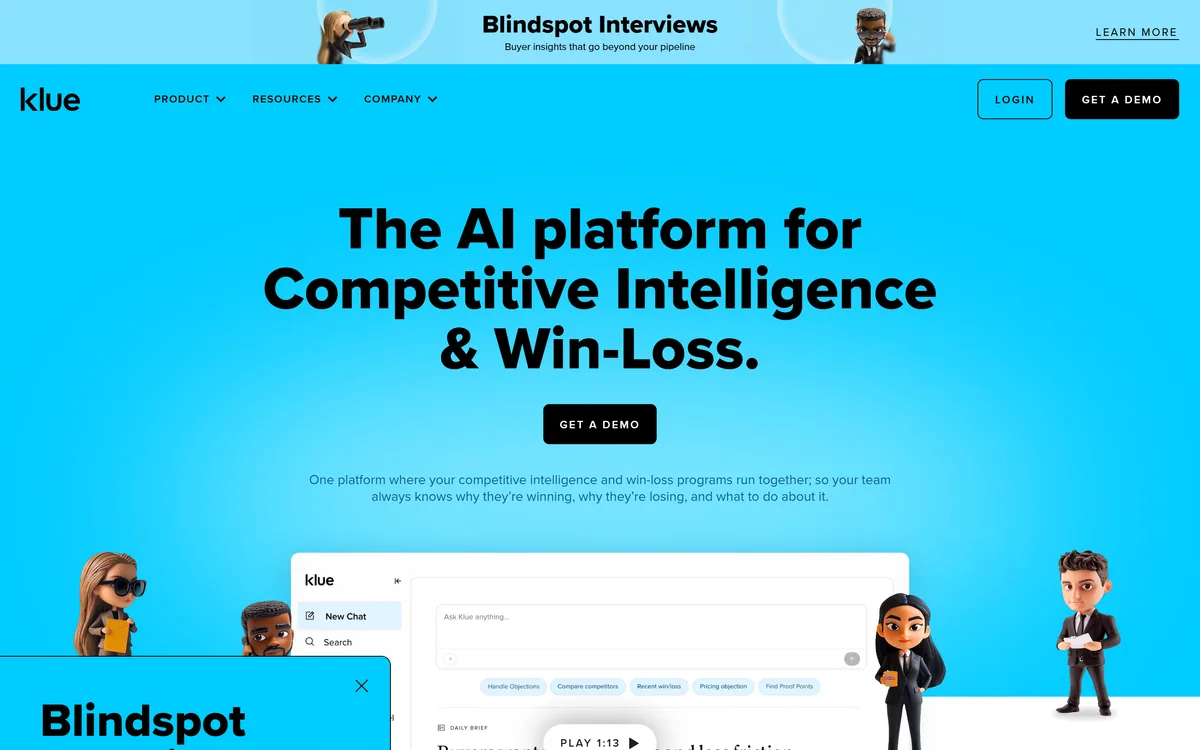
Klue is an AI platform that unites competitive intelligence and win-loss programs: a Compete Agent that collects intel and answers sellers in real time, living battlecards, and a Win-Loss Suite of verified buyer interviews, so revenue teams know why they win and lose and what to do about it.
Sales teams usually learn why they win or lose too late and too anecdotally, and competitive intel lives in a battlecard nobody updates. Klue's idea is to join those two problems, running competitive intelligence and win-loss analysis on one platform so each informs the other.
For sellers that means a Compete Agent delivering cited, deal-specific answers in the moment; for product marketers it means win-loss patterns and living battlecards they can keep current. It sits in the go-to-market stack alongside tools like Clay, but its specific job is competitive and buyer intelligence rather than prospecting data.
This review covers how Klue arms a sales team, who it is built for, how it is sold, and when it is heavier than a team needs, including the data caveat behind win-loss work.
Klue runs competitive intelligence and win-loss together, feeding sellers battlecards.
Klue, The Compete Brief
Klue unites two programs: competitive intelligence and win-loss analysis run on one platform rather than in silos.
A Compete Agent arms sellers: it continuously gathers intel and gives reps cited, deal-specific answers in real time.
Win-loss adds the why: verified buyer interviews explain why deals are actually won and lost.
It is an enterprise GTM tool: most valuable to organisations with real sales motion and PMM capacity, not tiny teams.
Competitive Intel And Win-Loss On One Platform
Klue's core idea is that competitive intelligence and win-loss are the same question seen from two sides: why you win and lose against rivals, and what to do about it. Running them on one platform means the intel you gather and the buyer evidence you collect reinforce each other rather than sitting in separate tools.
The payoff is that insight reaches the people who can act on it. Competitive intel is only valuable if sellers use it in live deals, and win-loss findings only matter if they change positioning and content. Klue's design is about closing that last mile from analysis to action.
It is unambiguously a go-to-market platform for organisations with a real sales motion, competitors worth tracking, and someone, usually product marketing, to own the programs. That framing matters: the value scales with the complexity of your competitive landscape.
The fair framing is that Klue is a mature, category-defining tool for competitive and buyer intelligence, strongest where there is enough sales activity and competition to justify a dedicated platform, and oversized where there is not.
Competitive intel is only valuable if sellers use it in live deals; Klue's design is about closing the last mile from analysis to action.
How Does Klue Arm A Sales Team?
The platform works through an AI agent and battlecards on the intel side, and verified interviews on the win-loss side.
A Compete Agent And Living Battlecards
Klue's Compete Agent acts as an AI research analyst and deal assistant: it continuously collects competitive intel and delivers it to sellers when they need it, answering deal-specific questions, on positioning, objection handling, a named competitor's claims, with cited responses, and it can be queried from an LLM such as Claude. Product marketers keep battlecards current without leaving the conversation.
That in-the-flow delivery is what distinguishes it from a static intel repository. A brand-monitoring tool like BrandMentions watches what is said about you across the web; Klue turns competitive signal into specific, cited answers a rep can use inside a live deal.
Win-Loss Interviews And The Data Caveat
The Win-Loss Suite gathers verified buyer signal, including interviews, so teams understand why deals were actually won or lost from the buyer's perspective, at a depth and scale manual programs rarely reach, and feeds those patterns back into positioning and content.
The honest caveat is that win-loss and competitive intelligence involve collecting and handling data about buyers and competitors, which carries privacy, consent and accuracy responsibilities; buyer interviews in particular should be conducted and stored appropriately. A signal platform like 6sense handles a different, intent-data side of GTM with its own data considerations; with Klue, the quality and integrity of the inputs determine the value of the output.
Who Klue Is Built For In Revenue Teams
Klue is built for revenue teams at organisations with a genuine competitive landscape: product marketers who own competitive and win-loss programs, and sales teams who need reliable, deal-specific answers against named rivals in the moment.
It suits companies where enough deals are won and lost against competitors to make patterns meaningful, and where there is capacity to run the programs and act on the findings, since the platform amplifies a motion rather than creating one.
It fits less well very small teams or early-stage companies without a defined competitive set or the people to run intel and win-loss, and organisations unwilling to handle buyer and competitor data responsibly. Its capabilities are real, but the value depends on your sales volume and competitive complexity, not on the platform alone.
How Klue Is Sold To Organisations
Klue is an enterprise platform sold through demos and tailored plans rather than a simple public price, reflecting its position as a program-level GTM tool. We do not publish prices, which change; check the site or request a demo.
The value question is whether better competitive answers in live deals and credible win-loss insight measurably improve win rates and positioning, which for a team losing deals to rivals it does not fully understand can be a strong return, and for a team without that problem is hard to justify.
Because it is demo-led, the sensible approach is to evaluate it against a real competitive problem you have, bring your actual rivals and recent lost deals, and judge whether the Compete Agent's answers and the win-loss evidence would genuinely change what your team does.
A Grounded Way To Assess Klue
Because Klue is a program-level platform, evaluate it against your real competitive situation, not a generic demo.
Bring your actual named competitors and ask the Compete Agent deal-specific questions.
Check whether its answers are cited, current and genuinely useful in a live deal.
Review a battlecard and judge how easily product marketing could keep it current.
Look at the Win-Loss Suite against a handful of your recent won and lost deals.
Confirm buyer-interview data would be collected and stored appropriately for you.
Pass/fail: Klue is worth it if its intel and win-loss evidence would change what your team does.
Match the investment to your real sales volume and competitive complexity.
Klue Compete Terms
Competitive intelligence
The ongoing gathering and analysis of information about rivals, used to position against them and win deals.
Win-loss analysis
Studying why deals were won or lost, often via buyer interviews, to improve positioning, product and sales approach.
Battlecard
A concise reference sellers use against a specific competitor, covering positioning, objections and proof points.
Compete Agent
Klue's AI analyst and deal assistant that collects intel and gives sellers cited, deal-specific answers in real time.
Klue Competitive-Intel Facts
What it is
A competitive intelligence and win-loss platform
Core
Both programs run together on one platform
Compete Agent
Collects intel and answers sellers in real time
Battlecards
Living battlecards PMMs keep current
Win-Loss Suite
Verified buyer interviews at scale
LLM use
Query intel and update content via your LLM/Claude
Audience
Revenue teams: sellers and product marketers
Tier
Enterprise GTM; sold via demo
Key features of Klue
Unified competitive intel and win-loss
AI Compete Agent
Real-time, cited deal answers
Living battlecards
Win-Loss Suite with buyer interviews
LLM/Claude querying
Objection and claim-validation support
Buyer and prospect voice capture
Pros & cons
Pros
5
Joins competitive intel and win-loss
Delivers intel in the flow of a live deal
Cited, deal-specific seller answers
Keeps battlecards current with low effort
Verified buyer signal at scale
Cons
5
Enterprise-weighted; heavy for small teams
Value needs a real competitive landscape
Requires capacity to run the programs
Buyer-data handling responsibilities
Demo-led, no simple public pricing
Best For
Competitive-intel programs
Win-loss analysis
Product marketing teams
Sales enablement vs rivals
Enterprise GTM
Klue Against Other Intel Platforms
The useful comparison is with other go-to-market and research tools, by the signal each provides.
Living battlecards product marketers can keep current
A Win-Loss Suite with verified buyer interviews
Queryable from an LLM such as Claude
An enterprise GTM tool sold via demo
No prices reproduced here, in line with this site's pricing policy
Klue is a program-level GTM platform whose value scales with your sales volume and competitive complexity. Win-loss and competitive intel involve buyer and competitor data, so collect and store it responsibly; the integrity of the inputs determines the value of the output.
Other Sales And Research Tools
A prospecting-data tool, a brand monitor and an intent platform to weigh alongside Klue.
Klue earns 4.2 as a mature, category-defining platform for competitive and buyer intelligence: it unites competitive intel and win-loss on one platform, arms sellers with a Compete Agent that gives cited, deal-specific answers in the flow of a live deal, and feeds back verified buyer signal through its Win-Loss Suite. It is an enterprise GTM tool whose value scales with your sales volume and competitive complexity, so it is too heavy for very small or early-stage teams, and its win-loss work carries real data-handling responsibilities. For revenue teams with genuine competition, it closes the gap from analysis to action well. AInexfinder Editor Score: 4.2/5.
Klue pricing
AInexfinder does not list plan prices or billing details. For current pricing, plans, and trials, visit the official Klue website.
Vendor pricing, credits, and billing policies change over time. Always confirm on the official site before you buy.
Frequently asked questions
What is Klue?
Klue is an AI platform that unites competitive intelligence and win-loss analysis. It uses a Compete Agent to collect intel and give sellers cited, deal-specific answers in real time, keeps living battlecards current, and runs a Win-Loss Suite of verified buyer interviews.
What does the Compete Agent do?
It acts as an AI research analyst and deal assistant, continuously gathering competitive intel and answering sellers' deal-specific questions, on positioning, objection handling or a competitor's claims, with cited responses, and it can be queried from an LLM such as Claude.
What is win-loss analysis in Klue?
Klue's Win-Loss Suite gathers verified buyer signal, including interviews, so teams understand why deals were actually won or lost from the buyer's perspective, then feeds those patterns back into positioning and content. It adds the 'why' behind competitive outcomes.
Who is Klue for?
Revenue teams at organisations with a genuine competitive landscape: product marketers who own competitive and win-loss programs, and sales teams needing reliable, deal-specific answers against named rivals. It is less suited to very small or early-stage teams without a defined competitive set.
How is Klue different from a brand monitor?
A brand-monitoring tool like BrandMentions watches what is said about you across the web. Klue turns competitive signal into specific, cited answers a seller can use inside a live deal, and pairs it with structured win-loss evidence, which is a different, sales-facing job.
How much does Klue cost?
Klue is an enterprise platform sold through demos and tailored plans rather than a simple public price. We do not publish prices, which change; check the site or request a demo, and evaluate it against a real competitive problem your team actually has.
Does Klue handle data responsibly?
Competitive intelligence and win-loss involve collecting and handling data about buyers and competitors, which carries privacy, consent and accuracy responsibilities, and buyer interviews in particular should be conducted and stored appropriately. The integrity of those inputs determines the value of what Klue produces, so handle them carefully.
Is Klue worth it for a small company?
Usually not until there is a real competitive landscape and the capacity to run the programs. Klue amplifies an existing sales motion rather than creating one, so its value scales with how many deals you win and lose against rivals and whether you can act on the findings.
Does Klue integrate with my CRM and tools?
Klue is built to deliver competitive intel into sellers' workflow and can be queried from an LLM such as Claude, and it typically integrates with common sales and enablement tools. Confirm the specific integrations you need during a demo, since the value depends on intel reaching reps where they already work.
How is Klue different from 6sense?
They solve different go-to-market problems. Klue focuses on competitive intelligence and win-loss, why you win and lose against rivals, while 6sense focuses on intent and account signals, who is in-market to buy. Many teams use both, as they address competition and demand respectively.
Daniel reviews AI tools the slow way — by actually using them on real projects. His reviews cover what works, what breaks, and who each tool is genuinely a good fit for.
Daniel and the AInexfinder editorial team research Klue using public product information, listing evidence, and (when available) hands-on checks. Scores reflect listing completeness and transparency — not paid placement.
Listings may include affiliate or sponsored placements, which are labeled when present. Editorial scores and cons are not sold. See our affiliate disclosure and review methodology.
PitchBud is a press outreach tool that drafts a release with Claude Sonnet, publishes it to a newsroom URL with NewsArticle schema and RSS, matches relevant journalists by their recent work, and drafts personal pitches you review and send yourself.
Outset runs AI-moderated research interviews in video, voice or text, probing dynamically like a human moderator, then synthesises and tags the results automatically. It draws participants from a very large pool across 85+ countries and offers simulated respondents grounded in real human data.
Brandwatch is a Cision-owned enterprise suite covering consumer intelligence, social media management, influencer marketing and media intelligence. It monitors over 100 million sources, applies its Iris AI layer to the results, and is bought by large brands as a single platform rather than as point tools.
Lakmoos AI builds a private reasoning model from a client's existing survey data, then answers new questions as a simulated panel — reporting a similarity score above 98 percent across 20 benchmarking studies, and handling what it says is 20 million questions a week for 50-plus enterprise teams.
Synthetic Users is an AI user-research platform that simulates research participants, from procurement officers to clinicians, so teams can run fast, cheap interviews to explore problems and refine questions. The vendor positions it as a discovery co-pilot, not a replacement for research with real people.
Listomize is an Etsy SEO platform that generates titles, tags, and descriptions within Etsy's own limits, scores listings, optimises 100+ listings from a CSV, tracks competitors and trends, and auto-generates Pinterest pins.