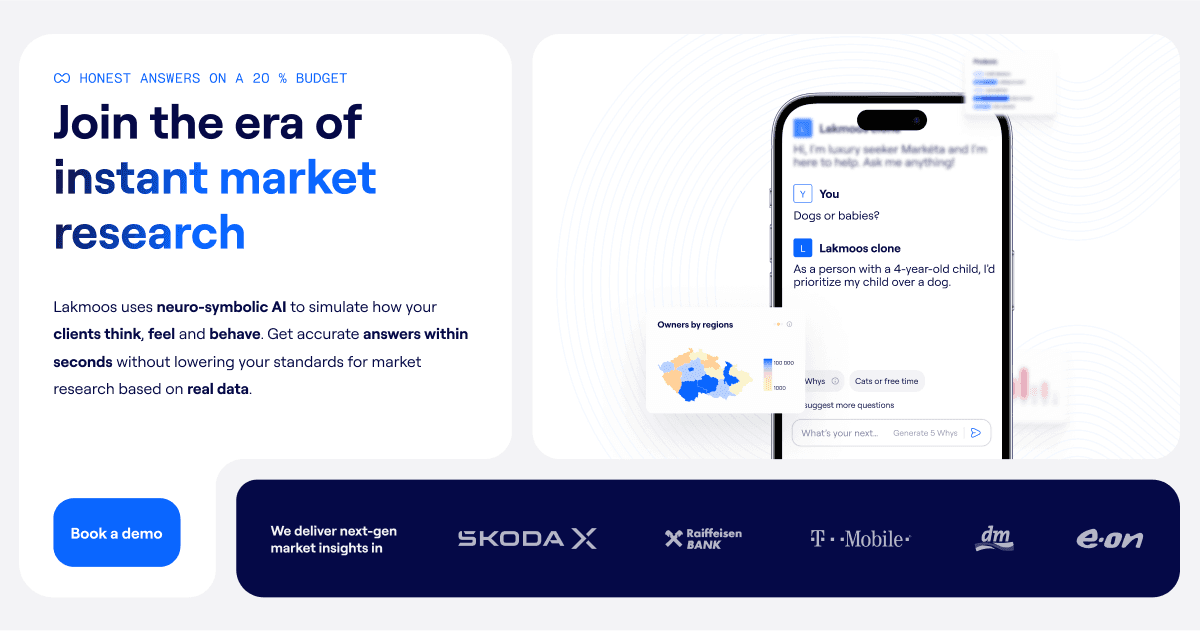
Lakmoos AI builds a private reasoning model from a client's existing survey data, then answers new questions as a simulated panel — reporting a similarity score above 98 percent across 20 benchmarking studies, and handling what it says is 20 million questions a week for 50-plus enterprise teams.
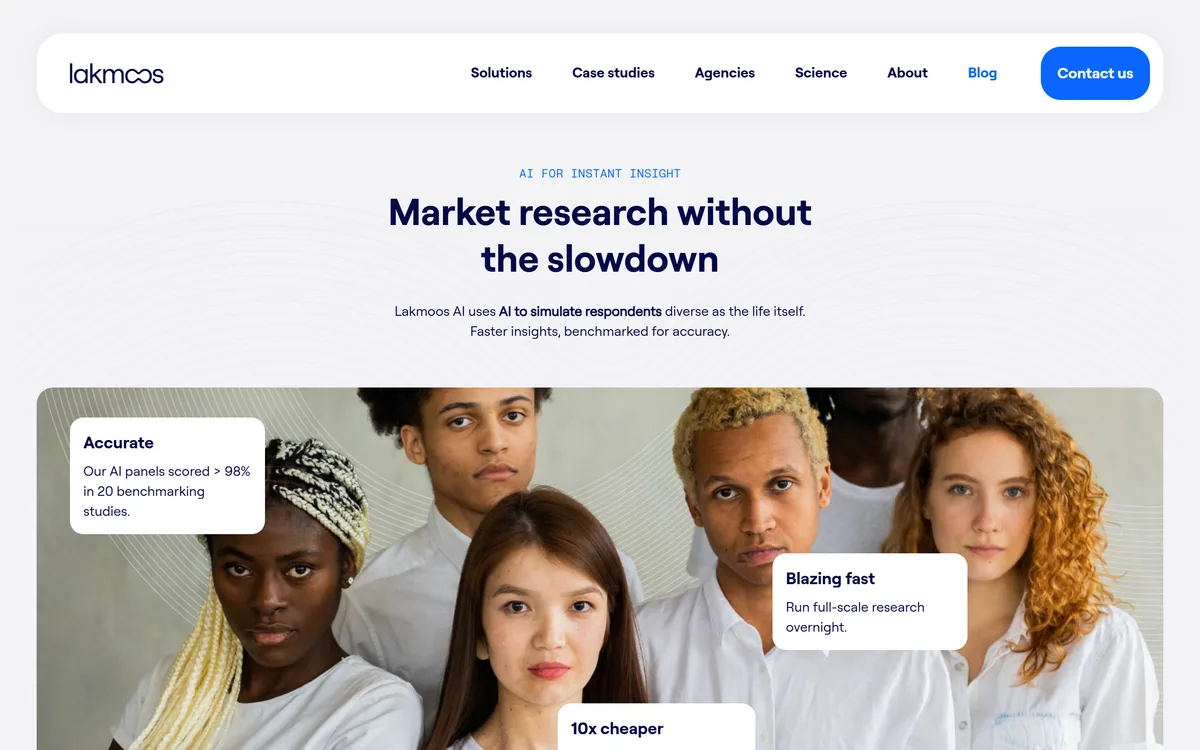
Lakmoos AI's homepage, captured 9 September 2026, showing its simulated respondent positioning.
Lakmoos AI: What A Simulated Panel Delivers
Respondents are simulated, not recruited — surveys are answered by data models rather than by people.
A published validation figure: over 98 percent similarity across 20 client benchmark studies in 2025.
A private reasoning model per client, built from up to 10 of your own past surveys or datasets.
Neuro-symbolic AI, explicitly positioned against persona-prompting a general chatbot.
GDPR-compliant and SOC2-friendly, white-label ready, with ESOMAR AI Solution Compliance in the footer.
Lakmoos AI: Survey Panels That Are Simulated
Lakmoos AI states its proposition without hedging: it uses AI to simulate respondents diverse as the life itself, and it answers surveys with data models instead of real people.
That sentence is the whole product, and it is worth sitting with before reading anything else on the page.
Traditional quantitative research has one irreducible cost, and it is not analysis — it is fieldwork. Finding 400 qualifying people, screening them, incentivising them and waiting for the responses to arrive is what makes a study take six weeks.
Every synthetic-respondent company is making the same bet: that the fieldwork can be modelled rather than performed. Where they differ enormously is in what the model is built from.
Lakmoos is unusually explicit about that. The company states an ambition to replace 20 percent of traditional surveys with real-time insights by 2030, and frames the prize as roughly 30 billion dollars of research cost and 35 billion hours of fieldwork globally each year. Whether or not those projections land, they describe the actual shape of the wager.
Every synthetic-respondent company bets that fieldwork can be modelled rather than performed. What they differ on — enormously — is what the model is built from.
How A Twin Is Built From Real Data
The three-step process on the homepage is the part that distinguishes this from a prompt. You integrate your data as a private data layer, Lakmoos builds your private reasoning model from it, and you then ask unlimited questions of that model.
The pilot description puts numbers on the input: up to 10 of your past surveys or datasets, ingested from CSV, CRM or analytics, focused on one topic.
That direction of travel matters. A general model asked to roleplay a 34-year-old car buyer produces what the internet says such a person says — which is a distribution of published opinion, not a distribution of actual behaviour.
A model fitted to your own historical survey responses is doing something closer to interpolation: you already know how your audience answered 200 questions, and it predicts the 201st.
That is a far more defensible statistical claim, and it is also a sharply narrower one. It explains both why the benchmark scores can be high and why the method has a hard ceiling, which the next section is about. Tools that analyse existing qualitative data, like Thematic, work the same side of the line — they mine what you already collected rather than inventing new respondents.
Can Simulated Respondents Replace Real Ones?
The honest answer is: for some questions, largely yes, and for the questions research usually exists to answer, no. The distinction is not about quality of technology. It is about what kind of thing is being asked.
Simulated panels are strongest where the answer is already latent in data you hold.
Re-cutting an existing study by a segment you did not originally analyse, extending a sample, running follow-up questions you wish you had asked six months ago, testing 30 message variants where you only need a rank order — these are interpolation problems, and interpolation is what a fitted model is genuinely good at.
They are weakest at discovery. A synthetic respondent cannot tell you about a frustration nobody has ever articulated in your data, cannot react to a product category that did not exist when the training surveys were fielded, and cannot surprise you — because being surprised is precisely the signal that the answer was outside the model's support.
There is also a subtler risk that this design partially mitigates. A model fitted to your past respondents inherits whatever was wrong with your past sampling. If your panel over-represented existing customers, so will its simulation, permanently and invisibly. Lakmoos's own framing — augment research, keep studies alive — is more accurate than replacement, and more useful. Simulated counterparts are on firmer ground where nobody treats them as evidence — Hyperbound uses them to train sellers, and practice does not have to be representative of anything.
Use it to extend and re-cut studies you have already fielded.
Do not use it to discover needs nobody has articulated yet.
Check whose voices were in the source surveys — the model inherits that sample.
Rank-order message tests are a fair use; absolute incidence estimates are riskier.
Validate against a small real sample before a decision that is expensive to reverse.
Reading A Ninety-Eight Percent Benchmark
The headline claim is specific enough to evaluate, which is already unusual: over 98 percent similarity score achieved over 20 client benchmark studies in 2025, alongside a separate statement of accuracy proven in 15-plus large-scale validation projects.
Two things about that number deserve stating plainly, and neither is a criticism.
First, a similarity score is a comparison between two distributions of answers, not a percentage of correct predictions. Ninety-eight percent similarity means the simulated panel's answer profile closely tracked the real panel's on the questions tested. It does not mean 98 out of 100 individual answers matched.
Second, benchmark selection is doing invisible work everywhere in this field. Twenty client studies is a real sample and a good deal more than most competitors publish, but they were studies these clients chose to run, on topics where data existed — which is the regime where the method should perform best.
The right response is neither scepticism nor acceptance. It is to reproduce the test on your own question. Lakmoos publishes a science section and a page on synthetic respondents specifically so the method can be examined, which is the behaviour you want from a vendor making a claim like this.
Private Reasoning Models Per Client
The technology page states the approach directly: rather than prompting a general chatbot, Lakmoos uses neuro-symbolic AI to predict what your clients do next, for entire nations as well as niche groups.
Neuro-symbolic is not marketing vocabulary here; it names a real architectural choice.
A purely neural model learns patterns and cannot tell you why it produced an answer. A symbolic layer holds explicit structure — demographic constraints, logical rules, population distributions — that the neural component operates within. In market research that hybrid buys you something specific: a panel that stays demographically coherent instead of drifting toward whatever the underlying model finds most probable.
The per-client model is the other half. Your private data layer stays 100 percent yours, and the security posture is stated as GDPR-compliant, SOC2-friendly, with secure integrations and white-label readiness — the last aimed squarely at agencies reselling the capability.
The footer carries the credential that matters most in this industry: ESOMAR AI Solution Compliance. ESOMAR is the global research profession's standards body, and its AI guidance exists specifically because synthetic data raises questions about what you may call a sample. A vendor referencing it is inviting the comparison rather than avoiding it. Conversational research tools such as Outset take the opposite route to the same goal — real humans, interviewed by an AI moderator at scale.
Running Research You Can Defend
The failure mode with synthetic panels is not a bad result. It is a result nobody can defend six months later when a decision made on it goes wrong.
This sequence produces findings that survive the meeting.
Write down the decision the research will inform before choosing a method.
Ask whether the answer is latent in data you already hold, or genuinely new.
Ingest surveys you trust — the model inherits their sampling, good and bad.
Re-run one study whose real answer you already know, and compare.
State in every output that respondents were simulated, not recruited.
Keep a small real sample for anything expensive or irreversible.
Lakmoos AI: Panels And Validation
Method
AI-simulated survey respondents built on neuro-symbolic AI
Accuracy claim
Over 98 percent similarity across 20 client benchmark studies in 2025
Validation
Stated as proven across 15-plus large-scale validation projects
Throughput
AI respondents answering a stated 20 million questions each week
Adoption
50-plus enterprise teams; clients stated to have run 1,000-plus surveys
Model design
A private reasoning model per client, built from their own data layer
Data ingestion
Up to 10 past surveys or datasets from CSV, CRM or analytics
Services
Talk to your data, augment research, AI panels and AI personas
Elicit — structured evidence from published research
Lakmoos AI: Read From The Science Pages
Last checked . Read from lakmoos.com in a browser session on the date above, with the screenshot captured at the same time.
Positioned as market research without the slowdown, simulating respondents diverse as the life itself
Accuracy stated as AI panels scoring over 98 percent in 20 benchmarking studies
A separate line stating over 98 percent similarity across 20 client benchmark studies in 2025
Accuracy also described as proven in 15-plus large-scale validation projects
AI respondents stated to answer 20 million-plus questions every week
Reach stated as 50-plus enterprise teams and 1,000-plus client surveys run
A three-step process: integrate your data, Lakmoos builds your private reasoning model, ask unlimited questions
Your private data layer stated to stay 100 percent yours
Technology described as neuro-symbolic AI, explicitly contrasted with prompting a general chatbot
Security stated as GDPR-compliant, SOC2-friendly, with secure integrations and white-label readiness
A named case study describing over 200 surveys run in a pilot by an automotive innovation unit
Footer showing Lakmoos AI s.r.o., a Brno address, a VAT number, CzechInvest support and ESOMAR AI Solution Compliance
What we could not confirm: how the similarity score is computed, which questions the 20 benchmark studies covered, or how those studies were selected; the relationship between the 20-study and 15-project validation figures; what the neuro-symbolic architecture consists of in practice; and what the ESOMAR compliance reference has been assessed against. We did not run a study, ingest a dataset or see a simulated panel produce output.
Editor's Verdict
3.9/5
Lakmoos AI is the most carefully argued synthetic-respondent product we have read, because it does the one thing this category usually skips: it publishes a validation number, names how many studies produced it, and links to a science page rather than asserting accuracy in a headline. The model is built from your own past surveys rather than from a general model with a persona prompt, which is a materially different claim and the reason the accuracy figure is even plausible. What it cannot do is discover something your existing data never contained — and that is exactly what the most valuable research is for. AInexfinder Editor Score: 3.9/5.
Lakmoos AI pricing
AInexfinder does not list plan prices or billing details. For current pricing, plans, and trials, visit the official Lakmoos AI website.
Vendor pricing, credits, and billing policies change over time. Always confirm on the official site before you buy.
Frequently asked questions
What does Lakmoos AI actually do?
It answers surveys with data models instead of real people. You supply past research, Lakmoos fits a private reasoning model to it, and you then ask that model unlimited new questions and receive answers as though from a panel.
Is a synthetic panel the same as asking a chatbot to roleplay?
No, and the site draws the distinction itself. A general model roleplaying a persona reproduces published opinion about such people. A model fitted to your own survey history is predicting the next answer from an audience whose previous answers it has actually seen.
What does the 98 percent figure mean?
It is a similarity score — how closely the simulated panel's distribution of answers tracked a real panel's across 20 client benchmark studies in 2025. It is not a claim that 98 out of 100 individual answers were correct.
When should you not use simulated respondents?
For discovery. A model cannot report a frustration nobody has articulated in your data, cannot react to a category that did not exist when the source surveys were fielded, and cannot surprise you — because surprise means the answer sat outside what it learned.
Does it inherit bias from my old surveys?
Yes, structurally. If your historical panel over-represented existing customers, the simulation will too, consistently and invisibly. Check whose voices were in the source data before trusting a result about anyone else.
What is neuro-symbolic AI?
A hybrid that pairs a learned model with explicit rules and structure. For research it keeps a simulated panel demographically coherent rather than drifting toward whatever answer the underlying model finds most probable.
Is my data used to train anything shared?
The site states your private data layer stays 100 percent yours and that a private reasoning model is built for you. Confirm the contractual wording directly, since that is exactly the sort of commitment that belongs in an agreement rather than on a homepage.
What is ESOMAR compliance and why does it matter?
ESOMAR is the market research profession's standards body, and it publishes guidance specifically on AI and synthetic data. A vendor citing it is inviting assessment against a published bar rather than one it defined itself.
How should I validate it for my own use?
Re-run a study whose real answer you already know and compare distributions. That single test tells you more about fitness for your questions than any published benchmark, because it uses your data, your audience and your topic.
Do I have to disclose that respondents were simulated?
You should, in every output. Research gets quoted long after the method is forgotten, and a finding presented without that label will eventually be read by someone who assumes people were asked.
Daniel reviews AI tools the slow way — by actually using them on real projects. His reviews cover what works, what breaks, and who each tool is genuinely a good fit for.
Daniel and the AInexfinder editorial team research Lakmoos AI using public product information, listing evidence, and (when available) hands-on checks. Scores reflect listing completeness and transparency — not paid placement.
Listings may include affiliate or sponsored placements, which are labeled when present. Editorial scores and cons are not sold. See our affiliate disclosure and review methodology.
PitchBud is a press outreach tool that drafts a release with Claude Sonnet, publishes it to a newsroom URL with NewsArticle schema and RSS, matches relevant journalists by their recent work, and drafts personal pitches you review and send yourself.
Brandwatch is a Cision-owned enterprise suite covering consumer intelligence, social media management, influencer marketing and media intelligence. It monitors over 100 million sources, applies its Iris AI layer to the results, and is bought by large brands as a single platform rather than as point tools.
Outset runs AI-moderated research interviews in video, voice or text, probing dynamically like a human moderator, then synthesises and tags the results automatically. It draws participants from a very large pool across 85+ countries and offers simulated respondents grounded in real human data.
Synthetic Users is an AI user-research platform that simulates research participants, from procurement officers to clinicians, so teams can run fast, cheap interviews to explore problems and refine questions. The vendor positions it as a discovery co-pilot, not a replacement for research with real people.
Klue is an AI platform that unites competitive intelligence and win-loss programs: a Compete Agent that collects intel and answers sellers in real time, living battlecards, and a Win-Loss Suite of verified buyer interviews, so revenue teams know why they win and lose and what to do about it.
Listomize is an Etsy SEO platform that generates titles, tags, and descriptions within Etsy's own limits, scores listings, optimises 100+ listings from a CSV, tracks competitors and trends, and auto-generates Pinterest pins.