
BrandMentions is an AI social-listening and brand-monitoring tool that tracks mentions of a brand, product or keyword across the web and social media, for reputation management, competitor tracking, media monitoring and automated reporting, with agency and white-label options.
Thematic
Verified
Thematic sits on top of an existing CX stack and unifies surveys, support tickets, call transcripts, app reviews and CRM notes into one traceable theme model. Its agents discover themes from customer language rather than a predefined taxonomy, score them by business impact, and route the results into the tools teams already use.
4.3Editor Score
getthematic.com5 viewsAdded October 5, 202517K visitors
Every large company already collects more customer feedback than it can read. The problem was never volume — it is that the analysis arrives too late, disagrees between teams, and cannot be defended when someone senior challenges it.
Thematic positions itself against exactly that condition: the feedback is in your CX suite, the answer is not.
Its method is to build themes upward from what customers actually said rather than sorting comments into categories somebody decided on last year.
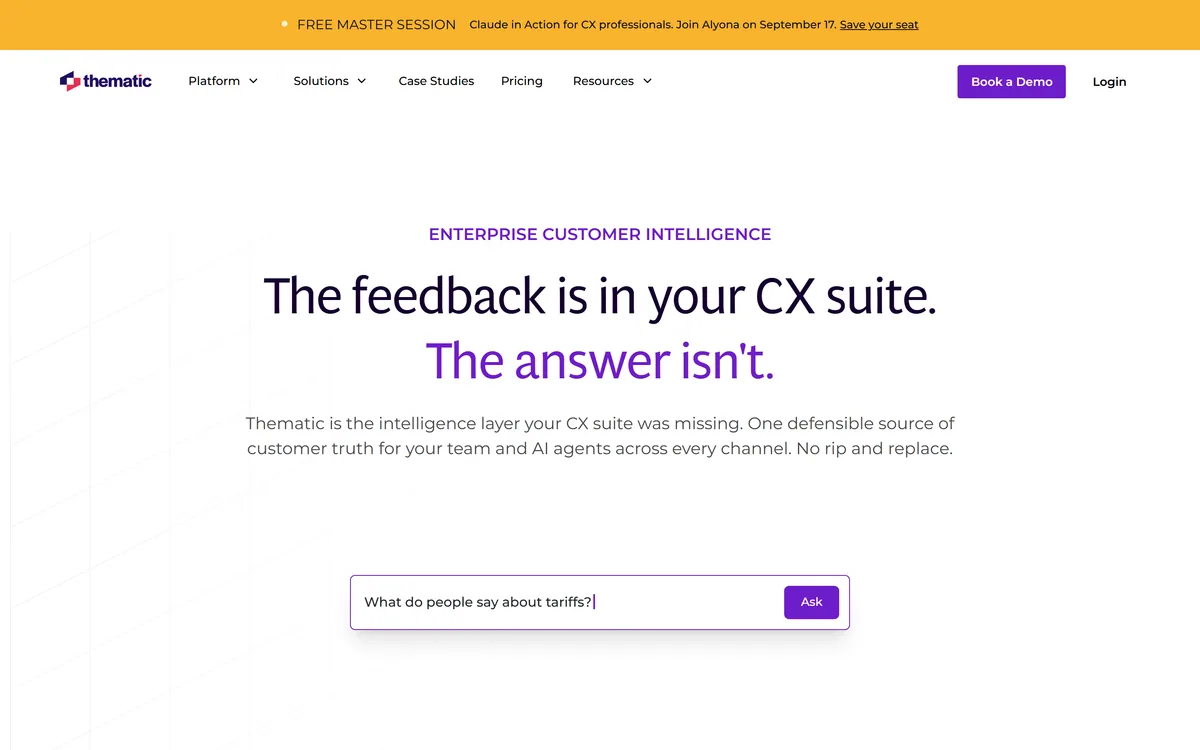
Thematic: One Source Of Customer Truth
- An intelligence layer, not a replacement — it sits on top of an existing CX suite rather than displacing it.
- Themes discovered from customer language, not matched against a taxonomy your team has to maintain.
- Every theme traces to the exact words that created it, which is what makes an insight defensible in a meeting.
- Five channels unified: surveys, support tickets, call transcripts, app reviews and CRM notes.
- A commissioned Forrester study reporting 543% ROI, payback under six months and 69% fewer contact centre calls.
Why Do Feedback Themes Beat Sentiment Scores?
The distinction Thematic draws is between rule-based text analytics working from a taxonomy your team defines and maintains, and themes discovered from customer language without predefined categories.
That difference is not academic. It determines whether your analysis can see anything you were not already looking for.
A taxonomy encodes last year's understanding. It has a bucket for delivery and one for price, and when something genuinely new appears — a change customers experience as a hidden fee, say — it lands in whichever bucket fits worst.
Sentiment scoring has the same blind spot at a coarser resolution. Knowing that sentiment fell three points tells you nothing you can act on, because sentiment is the symptom rather than the cause.
Bottom-up theming inverts it. The categories emerge from the language, so an issue nobody anticipated shows up as itself rather than as noise in an existing bucket — which is the entire point when the thing you need to catch is the thing you did not predict. Structured data has the opposite property — a tool like Quadratic can query it precisely because its categories were fixed in advance.
A taxonomy encodes last year's understanding of your customers. Anything genuinely new lands in whichever bucket fits worst.
Traceability As The Real Differentiator
Thematic states that every theme traces back to the exact words that created it, and that you can see inside a theme, adjust it and steer it.
This is the feature that decides whether an insights platform gets used or quietly abandoned, and it has nothing to do with accuracy.
Analysis fails politically rather than technically. A number appears in a meeting, someone senior disagrees with it, and the analyst cannot show the evidence underneath — so the number loses and the platform loses with it.
Being able to open a theme and read the eleven hundred comments that formed it changes that conversation completely. The disagreement moves from whether the analysis is right to what to do about it.
The site makes the same point against general-purpose summarisation: a confident-sounding summary with no path back to the source language has no institutional memory and cannot be interrogated next quarter. That is a fair characterisation, and it is the strongest argument on the page.
Four Channels And Why App Reviews Lead
The platform's worked example is the most instructive thing on its site: a theme appearing in app store reviews five weeks before the first support ticket, with the company's own survey capturing only a small fraction of it.
Whether or not those exact numbers generalise, the underlying pattern is real and worth understanding.
Channels differ in latency because they differ in effort. Leaving an app review is nearly free and happens at the moment of frustration. Opening a support ticket costs time and only happens once someone has decided the problem is worth reporting. A survey reaches people on the researcher's schedule, not the customer's.
So the fastest signal comes from the channel most companies analyse least, precisely because it is unstructured, unsolicited and inconvenient.
This is the actual argument for unifying channels rather than a generic one about completeness. Reading them together is what turns a lagging measurement into an early warning, and it only works if the same theme model spans all of them — otherwise you are comparing four different vocabularies. Competitive signals sit outside all four, which is what platforms like Intelligence Node exist to read.
- Weight app reviews and call transcripts as early signals, not afterthoughts.
- Ask what a coverage or impact score is calculated against.
- Open a theme and read the raw comments before trusting it.
- Check PII redaction against your own compliance requirements.
- Start with the channels you already own rather than adding new ones.
Reading A Five Hundred Percent ROI Study
Thematic cites a Forrester Total Economic Impact study reporting 543 percent return on investment, payback in under six months, 652,000 dollars in documented annual savings and 69 percent fewer contact centre calls.
A commissioned TEI study is meaningfully stronger evidence than a vendor's own arithmetic, and it still needs reading for what it is.
The methodology is standardised: Forrester interviews real customers, builds a composite organisation from them, and models the financials. The interviews are genuine; the composite is a construct that may resemble no actual company, including yours.
Commissioned studies also select their participants from customers willing to be interviewed, which is not a random sample of outcomes.
The more interesting figure is the one about contact centre calls, because it names a mechanism. Fewer calls is a measurable operational change with an obvious causal path — find the issue driving contacts, fix it, contacts fall. That is the sort of claim a finance team can test, which makes it more useful than the headline percentage.
The Case For An Intelligence Layer
Thematic's commercial framing is unusually direct: it layers on top of your existing stack and then starts to replace it, and the budget case should account for what it removes rather than only what it adds.
The costs it names are the real ones — professional services fees for taxonomy reconfiguration, analyst hours on data wrangling, external consulting for periodic model rebuilds.
Anyone who has run an enterprise CX programme recognises that list, and recognises that those costs are usually invisible because they sit in different budgets from the platform licence.
The layer approach is also the pragmatic one politically. A rip-and-replace project competes with every other priority and needs a sponsor willing to spend capital; a layer that reads what you already collect needs a much smaller decision.
The counter-argument is dependency. A system that gets more valuable the longer it runs is also a system whose theme model and institutional memory live inside one vendor, and any serious evaluation should establish what leaving looks like before the model becomes the organisation's memory of its customers. Attribution platforms such as Cometly accumulate the same kind of irreplaceable history.
Making Customer Feedback Actually Decide Things
Insight platforms fail at the last step. The analysis is right, the report is read, and nothing changes because no team owned the action.
This sequence puts the routing question first, where it belongs.
- Connect the channels you already collect before adding new ones.
- Validate the first themes against issues you already know exist.
- Open the biggest theme and read the raw comments underneath it.
- Decide which team owns which theme before automating any routing.
- Route to the tools those teams already use, not a new dashboard.
- Re-check a fixed theme a quarter later to confirm it actually moved.
Thematic: Platform And Evidence
| Positioning | The customer intelligence layer for CX, sitting on an existing suite |
|---|---|
| Sources ingested | Surveys, support tickets, call centre transcripts, app reviews and CRM notes |
| Connection | Directly from existing systems or a data warehouse |
| Privacy | PII redaction and language translation stated as built in |
| Certification | SOC 2 Type II, per the site |
| Access control | Role-based access and audit controls stated as built in by design |
| Theming | Themes discovered from customer language, each traceable to source comments |
| Scoring | Predicted NPS, churn propensity and effort scores from unstructured feedback |
| Activation | Routes insights into existing tools — tickets, alerts, dashboards and agent workflows |
| Named agents | Theming Agent, Scoring Agent and Predictive Actions |
| Forrester study | 543% ROI, payback under six months, 69% fewer contact centre calls |
| Deployment claim | First analysis within days, with no taxonomy rebuild required |
Key features of Thematic
Ingestion from surveys, tickets, transcripts, app reviews and CRM notes
Bottom-up theme discovery without a predefined taxonomy
Full traceability from theme to source verbatim
Predicted NPS, churn propensity and effort scoring
Role-based views tailored per team
PII redaction and language translation
Routing into tickets, alerts, dashboards and agent workflows
Deployment alongside an existing CX stack
Pros & cons
Pros
7- Bottom-up theming can surface issues nobody thought to categorise
- Traceability to source comments is what makes insight survive a meeting
- Cross-channel unification turns lagging measurement into early warning
- Evidence stronger than the category norm, with a commissioned Forrester study
- Layering rather than replacing lowers the political cost of adoption
- SOC 2 Type II, PII redaction and audit controls stated up front
- The budget case honestly names the costs it displaces
Cons
7- A Forrester composite organisation may resemble no real company, including yours
- Commissioned studies select from customers willing to be interviewed
- The worked example's numbers are not identified as real or illustrative
- Impact and coverage score calculations are not explained on the page
- A theme model that becomes institutional memory creates real vendor dependency
- Clear enterprise software — wrong shape for a small team
- Our capture stopped before the footer, so company details went unread
Best For
- Enterprise CX and customer insights teams
- Organisations with feedback scattered across four or five channels
- Companies paying for taxonomy maintenance every year
- Analysts who have to defend findings to executives
- Teams building CX agents that need a consistent data foundation
Thematic Against Other Analytics Tools
Analytics platforms differ by which signal they are built to read.
| Tool | Reads | Output | Best for |
|---|---|---|---|
| Thematic | Unstructured feedback across channels | Traceable themes with impact scores | Enterprise CX and insights teams |
| Intelligence Node | Competitor and market data | Pricing and assortment signals | Retail and merchandising |
| Cometly | Ad and conversion events | Attribution by channel | Performance marketing |
| Quadratic | Structured data you already have | Spreadsheet analysis with AI | Ad hoc analysis by analysts |
| Describely | Product attributes | Generated product content | Catalogue operations |
Is Thematic Worth An Enterprise Contract?
Buy the intelligence layer when
- Feedback arrives across four or five channels that nobody reads together.
- Different teams tell conflicting stories about the same customer.
- Your taxonomy needs a paid rebuild every year to stay current.
- Insights get challenged in meetings and cannot be defended.
- You are building CX agents and need a consistent foundation for them.
Your survey tool suffices when
- You run one survey a quarter and read the comments yourself.
- Volume is low enough that a person can genuinely process it.
- Your existing CX suite's analytics already answer your questions.
- Nobody owns acting on the insights once they exist.
- You cannot commit to the data connections the platform needs.
More Customer Analytics Tools
Other platforms that turn data into decisions, across different signals.
- Intelligence Node — competitive and market data for retail
- Cometly — attribution across paid channels
- Quadratic — AI analysis of structured data
- Describely — acting on product content at scale
- TextCortex — governed agents across the wider organisation
Thematic: Evidence Read On The Site
Last checked . Read from getthematic.com in a browser session on the date above, with the screenshot captured at the same time.
- Positioned as the customer intelligence layer for CX, described as sitting on an existing suite with no rip and replace
- Five-step flow shown: ingest, unify, understand, prioritise and activate
- Sources listed as surveys, support tickets, call centre transcripts, app reviews and CRM notes
- PII redaction and language translation stated as built in, with SOC 2 Type II certification
- Role-based access and audit controls stated as built in by design
- Theming Agent described as surfacing themes from customer language without a predefined taxonomy
- Every theme stated as traceable back to the exact words that created it
- Scoring Agent described as generating predicted NPS, churn propensity and effort scores from unstructured feedback
- Predictive Actions described as routing insights into existing tools and agent workflows
- A worked example shows app review signal preceding the first support ticket by five weeks
- Forrester Total Economic Impact study cited for 543% ROI, payback under six months and 69% fewer contact centre calls
- Customer quotes displayed with named individuals at organisations including Atombank, Vodafone and Serato
What we could not confirm: our capture ended in the frequently asked questions before reaching the site footer, so we read nothing below that point and make no claim in either direction about what is published there. We also could not confirm the composite organisation behind the Forrester study or how its participants were selected; whether the worked example uses real customer data or an illustration; how impact and coverage scores are calculated; what happens to the theme model if a customer leaves; and pricing, which sits behind a separate page. We did not connect data or run an analysis.
Editor's Verdict
4.3/5Thematic's core argument is that most CX platforms answer the wrong question — they tell you the score moved and not what moved it — and its answer is a theme model built upward from actual customer language rather than downward from a taxonomy somebody maintains. Traceability is what makes it defensible: every theme points back at the exact words behind it. The evidence is stronger than the category norm, with a commissioned Forrester study attached. It is unambiguously enterprise software, and a team running one survey a quarter is not the buyer. AInexfinder Editor Score: 4.3/5.
Thematic pricing
AInexfinder does not list plan prices or billing details. For current pricing, plans, and trials, visit the official Thematic website.
Visit official website for pricingVendor pricing, credits, and billing policies change over time. Always confirm on the official site before you buy.
Reviews
Log in to write a review.
User Reviews
No reviews yet. Be the first to share your experience with Thematic.
Reviewed by Daniel Reed
Assigned reviewer
Daniel ReedSenior AI Tools Reviewer
Daniel reviews AI tools the slow way — by actually using them on real projects. His reviews cover what works, what breaks, and who each tool is genuinely a good fit for.
Hands-on reviewsProduct testingAI software
Daniel and the AInexfinder editorial team research Thematic using public product information, listing evidence, and (when available) hands-on checks. Scores reflect listing completeness and transparency — not paid placement.
- Last verified
- Methodology
- How we review AI tools
- Sources used
- getthematic.com
- AInexfinder listing fields (features, pros/cons, description)
- Public vendor pages when available
- Editorial policy
- Listings may include affiliate or sponsored placements, which are labeled when present. Editorial scores and cons are not sold. See our affiliate disclosure and review methodology.
Related tools
Cometly is a marketing attribution platform for B2B SaaS that connects ad spend to pipeline and closed-won revenue. It links Stripe, HubSpot and Salesforce with ad platforms, sends conversion data back to the networks, and exposes its data through an MCP server. Operated by Comet LLC.

Listomize is an Etsy SEO platform that generates titles, tags, and descriptions within Etsy's own limits, scores listings, optimises 100+ listings from a CSV, tracks competitors and trends, and auto-generates Pinterest pins.
FreemiumBusiness & Marketing

Lahjty (لهجتي) is an Arabic-first marketing platform for MENA campaigns. From one brief it produces dialect-aware ad copy, headlines, campaign images with Arabic text rendered in, dialect-aware voice, and SEO articles grounded in your own brand sources — with a Partner API and an MCP server for teams that want it inside their own workflow.
FreemiumBusiness & Marketing

MaxAEO is an answer engine optimisation platform from HIII PTE. LTD. It tracks how ChatGPT, Gemini, Claude, Perplexity, Copilot, Grok and Google's AI surfaces mention a brand, with sentiment, competitor benchmarking and citation tracing.
Mailjet is a Sinch-owned email platform handling both marketing campaigns and transactional sending from one account. It offers a collaborative drag-and-drop editor, an email API with SMTP relay, AI generation and segmentation, and EU-based data centres.
FreemiumBusiness & Marketing
Explore More
Embed this listing on your site
Featured on AInexfinder