Intelligence Node provides competitive price monitoring, assortment intelligence, digital shelf analytics and PDP content optimisation for enterprise retailers. It states 99% product matching accuracy under SLA, a ten-second refresh rate, and coverage of over a billion products across 190,000 brands. Now an Omnicom company.
intelligencenode.com7 viewsAdded March 7, 20265K visitors
Retail pricing used to move weekly. It now moves continuously, because competitors are running algorithms and shoppers can compare every listing in the time it takes to open a second tab.
The response is not to price faster by hand — it is to know what everyone else is charging, continuously, and for the right products. That second part is where these systems succeed or quietly fail.
Intelligence Node is built for that, at enterprise scale, and it puts a guarantee behind the matching accuracy that everything downstream depends on.
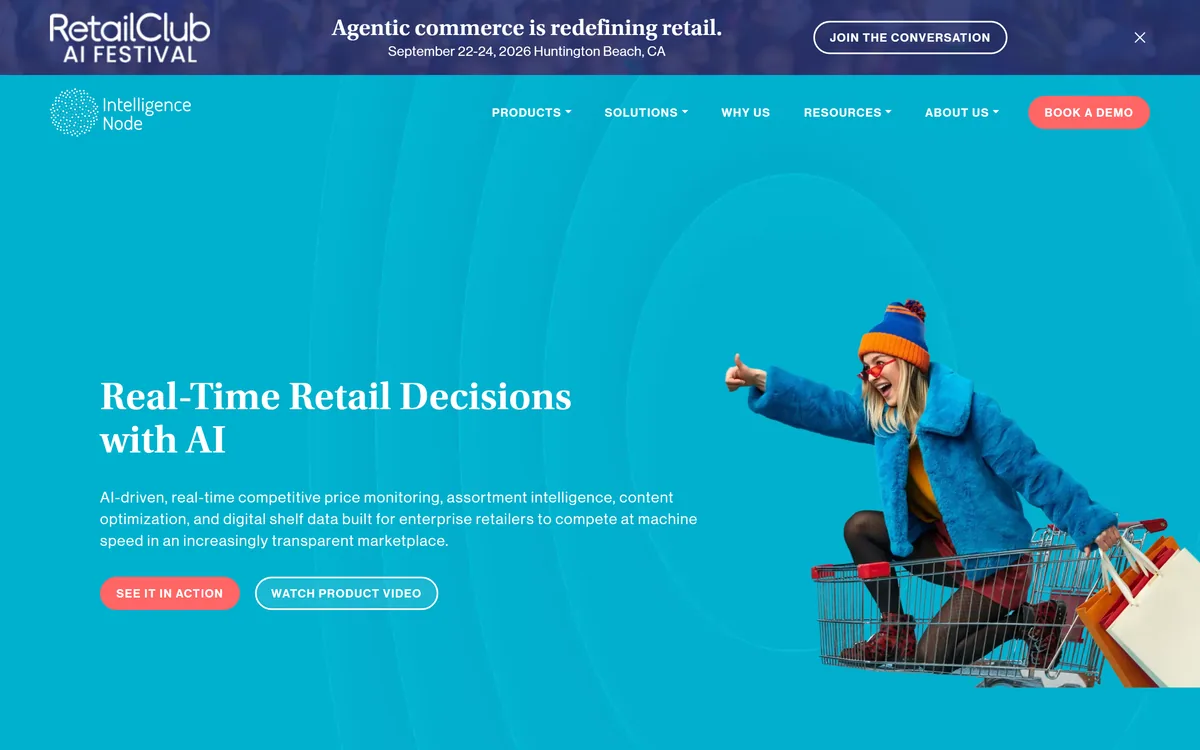
Intelligence Node's homepage, captured 9 September 2026, showing the retail price and shelf intelligence positioning.
Intelligence Node: Prices At Machine Speed
99% product matching accuracy, SLA guaranteed — the number that decides whether any of the rest is usable.
A ten-second refresh rate, described as the fastest in the industry.
Four capabilities: price monitoring, digital shelf analytics, PDP content optimisation and assortment intelligence.
An Omnicom company, with 100+ languages across six continents and a petabyte of data monthly.
Why Does Price Monitoring Need A Ten-Second Refresh?
Intelligence Node states a ten-second refresh rate, describing it as the fastest in the industry, alongside 34,000 pricing opportunities surfaced every minute.
The obvious question is whether that speed is real value or a specification arms race, and the answer depends entirely on your category.
In electronics, marketplaces and anything with algorithmic repricing, prices genuinely move within minutes and a daily snapshot describes a market that has already changed. There, latency is the product.
In categories where prices move seasonally — furniture, much of grocery, most apparel outside promotional windows — a ten-second refresh is measuring noise, and acting on it would produce churn rather than margin.
The honest framing is that refresh rate is a feature you should buy only if your category needs it. What everyone needs is accuracy, and that is a different specification entirely — which is why the matching guarantee is the more important number on the page.
Refresh rate is a feature you should buy only if your category needs it. Accuracy is the one everybody needs.
Matching Accuracy Is The Whole Problem
Intelligence Node states 99% product matching accuracy, SLA guaranteed, and it is the specification that determines whether anything else is usable.
Product matching means deciding that the item on a competitor's site is the same item you sell. That sounds trivial and is the hardest problem in the category, because retailers deliberately make it hard.
The same product appears under different names, in different pack sizes, with retailer-specific model numbers, bundled with accessories, in a different colourway, or as an exclusive variant that exists precisely so it cannot be compared.
A system that matches wrongly does not report an error. It reports a price — for a different product — and you reprice against something that was never comparable. Bad matches produce confident, actionable, wrong decisions.
That is why an SLA on matching is worth more than any dashboard feature, and why the question to ask a vendor is not how many products they cover but what happens contractually when a match is wrong.
Digital Shelf Analytics Explained
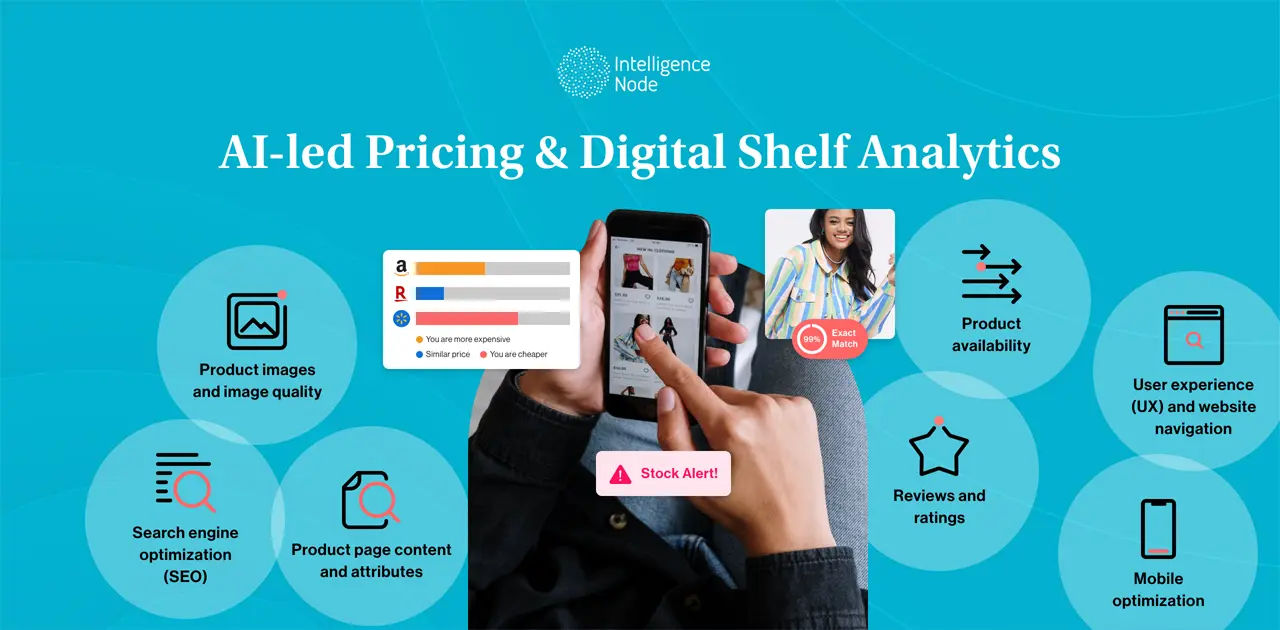
Beyond price, Intelligence Node covers share of search, listing accuracy and consistency, minimum advertised price monitoring, and PDP content auditing for both first-party and third-party sellers.
Digital shelf is the online equivalent of where your product sits in a physical aisle, and the analogy holds better than most retail metaphors. Being invisible in search results is the same as being on the bottom shelf at the back.
Share of search matters because it is a leading indicator. It moves before revenue does, which makes it one of the few retail metrics that gives you time to react rather than a post-mortem.
MAP monitoring is the enforcement half — checking that resellers are not advertising below the price you set — and it is a compliance function rather than an analytical one.
PDP content auditing across third-party sellers addresses a specific modern problem: your product listed by resellers with wrong descriptions, missing attributes and poor imagery, all of which reflects on your brand. Content generation tools such as Describely fix your own listings; this measures everyone else's.
Ask what happens contractually when a product match is wrong, not how many are covered.
Buy refresh speed only if your category actually reprices that fast.
Treat share of search as a leading indicator and watch it weekly.
Check whether coverage includes your specific competitors, not a global count.
Decide who acts on a pricing alert before subscribing to one.
Reading Very Large Scale Numbers
The site publishes a striking set of figures: over a billion unique products, 190,000+ brands, 1,400+ categories, 1.6 trillion+ historical price points, a petabyte of data monthly, and 100+ languages across six continents.
These are impressive and they answer a question most buyers are not actually asking. Total coverage tells you the platform operates at scale; it does not tell you whether your competitors are in it.
Retail is intensely local. A company selling homeware in the Netherlands cares about six specific competitors, and a billion products worldwide is irrelevant if four of those six are not tracked.
The historical depth is the more interesting figure. 1.6 trillion price points means a long time series, which supports questions scale alone cannot answer — how a competitor behaves before a promotion, whether a rival always follows within a week, how elastic a category actually is.
So the useful reading is that scale figures establish credibility and the buying question remains specific: these categories, these competitors, these markets, refreshed at this frequency, matched at this accuracy.
It is also worth separating this from adjacent measurement problems that look similar. Knowing what competitors charge is not the same as knowing whether shoppers can find you, which is what visibility platforms such as Conductor measure, and neither tells you which marketing spend produced the sale — the question Cometly exists to answer.
Retailers frequently buy one of the three and expect answers from all of them. Pricing, discoverability and attribution are separate data problems with separate vendors, and conflating them is how a platform gets blamed for not answering a question it was never watching.
An Omnicom Company And What That Signals
The footer identifies Intelligence Node as an Omnicom company, which is a material fact for a buyer rather than a footnote.
The straightforward reading is stability. Ownership by a large marketing and communications group means resourcing, longevity and the kind of compliance posture enterprise procurement asks about.
It also situates the product strategically. Retail pricing and digital shelf data are valuable to advertising and commerce businesses, so the platform now sits inside a group with adjacent interests in retail media and brand measurement.
For most buyers that is neutral to positive. For a retailer that competes with other Omnicom clients, or that is careful about where its commercial data sits, it is a question worth asking directly during procurement.
The footer also carries a notice asking visitors to trust only communications from the company's own domain, and stating that it works with no third parties for sales or recruitment — a sensible warning to publish, and worth heeding if you are contacted by anyone claiming to represent them.
Evaluating A Retail Intelligence Platform
Retail data contracts are long, expensive and hard to exit, and the evaluation usually focuses on the wrong things — dashboards rather than data quality.
This sequence tests the parts that determine whether the platform is usable at all.
List your actual competitors and markets, and ask for coverage of exactly those.
Supply fifty of your hardest products — bundles, variants, retailer exclusives — and check the matches by hand.
Ask what the matching SLA obliges the vendor to do when accuracy is missed.
Confirm your category actually moves fast enough to need the refresh rate.
Name the person who acts on a pricing alert before the contract starts.
Establish how data leaves the platform if you do not renew.
Retail Data Terms Worth Knowing
The vocabulary these platforms use, and what each term decides.
undefined
undefined
undefined
undefined
undefined
undefined
Intelligence Node: Scale And Ownership
Operating company
Intelligence Node, an Omnicom Company
Product type
Enterprise retail price and shelf intelligence
Capabilities
Competitor price monitoring, digital shelf analytics, PDP content optimisation, assortment and availability
Matching accuracy
99%, SLA guaranteed, per the site
Refresh rate
10 seconds, described as fastest in the industry
Products covered
1 billion+ unique products
Brands
190,000+
Categories
1,400+
Historical data
1.6 trillion+ price points
Data volume
1 petabyte monthly
Reach
100+ languages across six continents
Opportunities
34,000 pricing opportunities every minute, per the site
Integration
Open API
Contact
contact@intelligencenode.com
Key features of Intelligence Node
Competitor price monitoring with a matching accuracy SLA
Ten-second refresh rate
Digital shelf analytics including share of search
Minimum advertised price monitoring
PDP content auditing across first- and third-party sellers
Assortment gap and availability insights
Rule-based price intelligence
Open API integration
Pros & cons
Pros
7
Puts an SLA behind product matching, which is the specification that decides everything
Ten-second refresh is genuinely useful in algorithmically repriced categories
Historical depth supports behavioural questions that coverage alone cannot answer
Covers pricing, content, assortment and compliance rather than pricing alone
Third-party seller content auditing addresses a real and growing brand problem
Open API integration rather than a closed dashboard
Ownership disclosed clearly in the footer
Cons
7
Global scale figures do not tell you whether your specific competitors are covered
Refresh rate is irrelevant in categories that reprice seasonally
How matching accuracy is measured, and what the SLA remedies are, is unstated
The footer carries a notice asking visitors to trust only communications from the company's own domain, and stating it works with no third parties for sales or recruitment
What we could not confirm: pricing, which routes through a demo request; how the 99% matching accuracy is measured and what the SLA obliges the vendor to do when it is missed; which specific retailers and marketplaces are covered in any given market, which matters far more than the global product count; how the ten-second refresh applies across sources; what the implementation timeline actually is; and how data is exported if a contract ends. We did not use the platform.
Editor's Verdict
4.1/5
Everything in competitive price monitoring rests on one unglamorous problem: deciding that a product on somebody else's site is the same product as yours. Get that wrong and every price you act on is a comparison against something else. Intelligence Node puts a 99% matching accuracy figure under an SLA, which is the right thing to guarantee and the thing most competitors describe vaguely. The scale figures are genuinely large, the ten-second refresh is meaningful in fast-moving categories, and being an Omnicom company changes the strategic picture. This is enterprise software, priced and built accordingly. AInexfinder Editor Score: 4.1/5.
Intelligence Node pricing
AInexfinder does not list plan prices or billing details. For current pricing, plans, and trials, visit the official Intelligence Node website.
Vendor pricing, credits, and billing policies change over time. Always confirm on the official site before you buy.
Frequently asked questions
What is Intelligence Node?
Intelligence Node is an enterprise retail intelligence platform covering competitor price monitoring, digital shelf analytics, PDP content optimisation and assortment insights. It states 99% product matching accuracy under SLA, a ten-second refresh rate, and coverage of over a billion products. It is an Omnicom company.
Why is product matching the hard part?
Because retailers make it hard deliberately. The same product appears under different names, pack sizes, retailer-specific model numbers, bundles, colourways and exclusive variants that exist precisely so they cannot be compared. Matching is the problem everything downstream depends on.
What happens when a match is wrong?
The system does not report an error — it reports a price, for a different product, and you reprice against something that was never comparable. Bad matches produce confident, actionable, wrong decisions, which is why an SLA on matching is worth more than any dashboard feature.
Do I need a ten-second refresh rate?
Only if your category needs it. In electronics, marketplaces and anything with algorithmic repricing, prices move within minutes and a daily snapshot is already stale. In seasonal categories a ten-second refresh measures noise, and acting on it produces churn rather than margin.
What is digital shelf analytics?
Measuring where your product sits in online search and category listings — the online equivalent of shelf position. Being invisible in search results is the same as being on the bottom shelf at the back, and share of search moves before revenue does.
Do the scale numbers matter?
They establish credibility and answer a question you are not asking. Retail is intensely local: if you sell homeware in the Netherlands you care about six specific competitors, and a billion products worldwide is irrelevant if four of them are not tracked.
Which figure is the more useful one?
The historical depth. 1.6 trillion price points means a long time series, which supports questions coverage alone cannot answer — how a competitor behaves before a promotion, whether a rival always follows within a week, how elastic a category really is.
What does being an Omnicom company mean for buyers?
Stability and resourcing, plus a strategic question. Retail pricing data is valuable to advertising and commerce businesses, so the platform sits inside a group with adjacent interests. Neutral for most buyers; worth raising in procurement if you compete with other clients of that group.
How should I evaluate it?
Supply fifty of your hardest products — bundles, variants, retailer exclusives — and check the matches by hand. Then ask what the SLA obliges the vendor to do when accuracy is missed. Dashboards are easy to assess and irrelevant compared with data quality.
Is this suitable for a smaller retailer?
Probably not. This is enterprise software with demo-led sales, and a business with a few dozen products checking competitors weekly by hand is not the buyer. The threshold is roughly where manual checking stops being possible at all.
Daniel reviews AI tools the slow way — by actually using them on real projects. His reviews cover what works, what breaks, and who each tool is genuinely a good fit for.
Daniel and the AInexfinder editorial team research Intelligence Node using public product information, listing evidence, and (when available) hands-on checks. Scores reflect listing completeness and transparency — not paid placement.
Listings may include affiliate or sponsored placements, which are labeled when present. Editorial scores and cons are not sold. See our affiliate disclosure and review methodology.
Helium 10 is an all-in-one platform for Amazon, Walmart and TikTok Shop sellers, covering product research, keywords, listing optimisation, advertising, operations and analytics — now fronted by an AI agent and an MCP connector.
Priceva is a cloud pricing intelligence platform that tracks competitor prices and stock across thousands of online stores and marketplaces, alerts on changes and MAP violations, and repricies your own catalogue against rules you define. It also covers digital shelf analytics and price optimisation.
Intelis is a dynamic-pricing platform for e-commerce that monitors competitor prices in real time and automatically repricing your Google Shopping and Shopify listings, with MAP compliance monitoring and Shopping-ad optimisation, used by 200+ Shopify brands.
Vetted is an AI shopping research agent that analyses Reddit threads, YouTube videos, user reviews and expert articles to recommend products, then compares prices across retailers. It runs on iOS, Android and the web, and describes itself as doing your research for you.
Listomize is an Etsy SEO platform that generates titles, tags, and descriptions within Etsy's own limits, scores listings, optimises 100+ listings from a CSV, tracks competitors and trends, and auto-generates Pinterest pins.