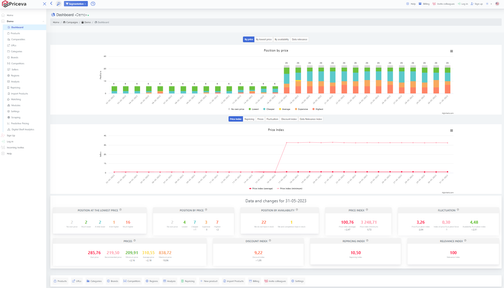
Priceva is a cloud pricing intelligence platform that tracks competitor prices and stock across thousands of online stores and marketplaces, alerts on changes and MAP violations, and repricies your own catalogue against rules you define. It also covers digital shelf analytics and price optimisation.
Automation equivalent to up to 10 full-time staff, +20% revenue growth reported by clients, up to 99% reduction in manual monitoring time
Matching Is The Only Metric That Really Decides This
Every platform in this category advertises coverage, from lightweight trackers like Prisync up to enterprise data providers such as Intelligence Node — thousands of stores, millions of SKUs, daily refreshes. Coverage is the easy part and it is not where these tools succeed or fail.
The hard part is matching: correctly identifying that the product on a competitor's page is the same product you sell. This sounds trivial and is not, for reasons that become obvious the first time you audit a report.
Retailers name the same product differently. Model numbers vary by region. Bundles include an accessory yours does not. A refurbished unit sits next to a new one. A multipack of six is compared against your single. Marketplace listings are frequently created by sellers with no interest in accuracy at all.
When matching goes wrong the failure is expensive and quiet. Your repricing rule drops your price to beat a competitor who is actually selling a smaller or refurbished version. Nobody notices for three weeks because the system reports it as working exactly as configured.
So the 99%+ accuracy figure is the right thing for the vendor to advertise and the wrong thing to accept on trust. Accuracy against what — matching, price extraction, availability? Measured how, and on which categories? These are the questions to ask in a demo rather than after signing.
Bad price data does not announce itself. It shows up as a repricing rule that ran perfectly against the wrong product for a month.
MAP Monitoring Is A Different Product In The Same Box
The feature list mixes two jobs that belong to different buyers, and separating them clarifies who this tool is actually for.
Competitor monitoring is a retailer's problem. You sell things, other people sell the same things, you want to know what they charge so you can decide what to charge.
MAP monitoring is a brand's problem, and it sits closer to the price governance that platforms like Pricefx handle for large B2B sellers. You manufacture something, you set a minimum advertised price, and you need to know which of your resellers is advertising below it — across marketplaces, across regions, across sellers you may not have authorised at all.
The named customers point firmly at the second use case. Vileda and Abbott are manufacturers rather than retailers, and manufacturers buy this class of tool to watch their own distribution rather than their rivals.
It is worth being precise about what MAP monitoring gives you: visibility, not enforcement. The tool tells you a listing is below your stated minimum. What happens next is a commercial conversation governed by your reseller agreements and by competition law, which varies considerably by jurisdiction. Pricing policy is an area where legal advice is genuinely warranted rather than merely prudent.
The related capability — monitoring for listings you did not authorise at all — is often the more immediately actionable output for a brand.
Rule-Based Repricing And Where It Bites
Repricing is where monitoring becomes action, and it is the part that most needs governance before it is switched on.
The mechanism is straightforward. You define rules — match the lowest competitor, stay a fixed amount below a named rival, never go beneath a floor — and the system adjusts prices automatically as the market moves.
For a marketplace seller competing on the buy box this is close to mandatory. Prices move continuously and a human cannot keep up across a catalogue of any size.
Two failure modes are worth designing against explicitly. The first is the race to the bottom: if you match the lowest competitor and they match you, an automated spiral runs until someone hits a floor. Floors are not an optional setting.
The second is brand damage. Constant price movement teaches customers to wait, and a product whose price visibly oscillates reads as untrustworthy. Rate limits on how often and how far a price can move matter as much as the rule itself.
The AI repricing option sits above the rules and is worth interrogating separately: ask what it optimises for, what data it uses, and whether it will explain a specific decision. An unexplainable pricing change is difficult to defend to a commercial director.
Run monitoring only for at least a month before enabling any automatic repricing.
Audit fifty matched products by hand and record how many are genuinely the same item, variant and condition.
Set hard floors before rules, not after — a floor is the only thing standing between you and a spiral.
Cap how far and how often a price may move in a day, to protect against oscillation.
Start automated repricing on a single low-risk category and hold it there for a full trading cycle.
The Data Collection Features Worth Noticing
Four capabilities in the feature list are more technically substantial than they appear and are often the reason a buyer chooses one platform over another.
Cart price monitoring. Many retailers show one price on the product page and a lower one at checkout, precisely to keep the visible price out of comparison tools. Reading the cart price is the difference between tracking the advertised number and the actual one.
Monitoring behind login walls. B2B and trade pricing is frequently only visible to signed-in account holders. If your competition is wholesale rather than retail, this is the capability that matters most.
Product page snapshots. A stored image of the page as it appeared is evidence. For MAP enforcement conversations that is the difference between a claim and a documented one.
Custom collection rules. An escape hatch for the sites that do not fit standard patterns, which in practice is always some of them.
None of it touches how the listing looks, which is a separate job for tools like PhotoRoom. Availability tracking deserves a mention of its own: knowing a competitor is out of stock is frequently more commercially valuable than knowing their price, because it is a short window in which price sensitivity drops.
Cart price monitoring, for retailers who hide the real price until checkout
Login-protected monitoring, for B2B and trade pricing
Product page snapshots, which turn an observation into evidence
Custom collection rules for sites that do not fit the standard pattern
Availability tracking, which flags the windows where price matters least
Reading The Vendor Figures Fairly
Three outcome claims appear on the site and each needs a different kind of scepticism.
Automation equivalent to up to 10 full-time staff. This is a comparison against doing the work manually, and manual competitor price checking genuinely does consume people. Plausible at large catalogue sizes, meaningless at small ones — note the word up to.
Clients reporting 20% revenue growth. Reported by clients rather than measured, and pricing changes rarely happen in isolation from promotions, assortment changes or market movement. Treat it as an illustration of what customers attribute to the tool, not as an expected outcome.
Up to 99% reduction in manual monitoring time. The most defensible of the three, because it describes automation of a task rather than a business result.
None of these are unusual for the category and none are independently audited. The figure that should actually drive your decision is the one nobody publishes: matching accuracy on your specific catalogue, which you can only establish by running a trial and checking by hand.
Key features of Priceva
Automated competitor price monitoring across thousands of SKUs
Instant alerts on price changes and MAP violations
Rule-based repricing to hold a competitive position
AI-assisted repricing as an alternative to fixed rules
Competitor stock and availability tracking
MAP and MSRP compliance monitoring across marketplaces
Price optimisation using sales, stock and demand signals
Digital shelf analytics covering listings, reviews and assortment
Reporting on competitor trends, averages and market position
Cart price monitoring for prices revealed only at checkout
Monitoring behind login-protected trade and B2B sites
Product page snapshots as evidence of a listing at a point in time
XML, CSV and Excel product list uploads
Pros & cons
Pros
6
Broad marketplace coverage spanning both US and European platforms
MAP monitoring makes it useful to brands, not only to retailers
Cart price and login-protected monitoring reach prices most tools cannot see
Page snapshots turn a pricing observation into documentary evidence
Availability tracking surfaces the windows where competitors cannot compete at all
Named manufacturer customers lend credibility to the brand-side use case
Cons
5
Matching accuracy, the metric that actually decides these tools, is not independently verifiable
All published outcome figures are vendor claims without a stated baseline
Automated repricing without floors and rate limits can spiral or damage brand perception
MAP monitoring provides visibility, not enforcement, and enforcement is a legal question
Company headquarters and corporate detail are not stated on the pages reviewed
Best For
Marketplace sellers competing on price at catalogue scale
Brands and manufacturers policing reseller pricing against a MAP policy
Ecommerce retailers with large catalogues and active competitors
Distributors needing visibility of trade pricing behind logins
Category managers tracking assortment and availability as well as price
Priceva Beside Other Pricing Platforms
These overlap heavily on monitoring, and separate on scale, enterprise depth and how much optimisation sits above the raw data.
You sell on marketplaces where prices move faster than anyone can track manually
You are a brand and need visibility of reseller pricing against your MAP policy
Your catalogue is large enough that manual competitor checking has become a job
You need to see trade or B2B pricing that sits behind a login
You want documented evidence of a listing's price at a point in time
Premature If
Your catalogue is small enough that a spreadsheet and a weekly check genuinely works
You compete on service, brand or exclusivity rather than on price
Your products are unique enough that no direct comparison exists
Nobody owns pricing decisions, in which case better data changes nothing
You would enable automatic repricing without floors and rate limits
Other Tools In Pricing And Commerce
The category runs from lightweight competitor tracking to full enterprise price management, and the right choice depends mostly on catalogue size.
Prisync — a simpler competitor tracking and repricing option for smaller catalogues
Intelligence Node — enterprise-scale retail data and market intelligence
Pricefx — enterprise price management for complex B2B pricing
PhotoRoom — the imagery side of the same marketplace listing work
What Was Confirmed On The Site
Last checked . Read from priceva.com during this check, with the screenshot above captured at the same time.
Named modules confirmed on site: Price Monitoring, Price Change Alerts, Repricing Software, Reporting and Price Analytics, Product Availability Tracker, MAP Monitoring, Price Optimization and Digital Shelf Analytics
Coverage stated as more than 10,000 online stores
Marketplaces named on site including Amazon, eBay, Walmart, Google Shopping, Wayfair, Argos, Target Plus, Newegg, Home Depot, Costco, Allegro, Empik and Morele
Scale stated as up to 1 million SKUs and data accuracy as 99%+
Product list upload supported via XML, CSV and Excel
Named customers on site: Vileda, Abbott Nutrition, Arc Company and P2Pet
Vendor outcome claims: automation equivalent to up to 10 full-time staff, +20% revenue growth reported by clients, and up to 99% reduction in manual monitoring time
Headquarters location not stated on the pages reviewed
No plan prices published here, in line with this site's pricing policy
Coverage, accuracy, scale and outcome figures are all vendor claims and were not independently verified. The decisive number for any buyer is matching accuracy on your own catalogue, which only a trial and a manual audit will establish. Minimum advertised price policies and automated repricing both touch competition law, which varies by jurisdiction — take your own legal advice before setting policy.
Editor's Verdict
4.0/5
Priceva has an AInexfinder Editor Score of 4.0/5.
Priceva pricing
AInexfinder does not list plan prices or billing details. For current pricing, plans, and trials, visit the official Priceva website.
Vendor pricing, credits, and billing policies change over time. Always confirm on the official site before you buy.
Frequently asked questions
What does Priceva do?
It tracks competitor prices and stock across marketplaces and online stores, alerts you when prices change or a MAP policy is breached, and can reprice your own catalogue automatically against rules you define.
How accurate is Priceva's price data?
The vendor states 99%+ accuracy. The number that actually matters is product matching accuracy on your own catalogue — whether the competitor listing really is the same item, variant and condition. Audit fifty matches by hand during a trial before trusting any repricing rule.
What is MAP monitoring and who needs it?
Minimum advertised price monitoring watches whether your resellers are advertising below the floor you set. It is a brand and manufacturer requirement rather than a retailer one, and it gives you visibility rather than enforcement — what you do next is governed by your reseller agreements and by competition law.
Is automated repricing risky?
It can be, in two specific ways. Matching the lowest competitor who then matches you produces a race to the bottom, which only a hard floor stops. And visibly oscillating prices train customers to wait, so cap how far and how often a price may move.
Which marketplaces does Priceva cover?
More than 10,000 stores, with Amazon, eBay, Walmart, Google Shopping, Wayfair, Argos, Target Plus, Newegg, Home Depot, Costco, Allegro, Empik and Morele named specifically. The European coverage is broader than many US-centric competitors.
Can Priceva see prices that only appear in the cart?
Yes — cart price monitoring is a stated capability, along with monitoring behind login-protected sites. Both matter because retailers deliberately hide their real price from comparison tools, and trade pricing is usually only visible to signed-in accounts.
How big does my catalogue need to be to justify this?
If a spreadsheet and a weekly manual check still works, you are not there yet. The tipping point is when price monitoring has quietly become somebody's job, or when marketplace prices move faster than anyone can follow.
Daniel reviews AI tools the slow way — by actually using them on real projects. His reviews cover what works, what breaks, and who each tool is genuinely a good fit for.
Daniel and the AInexfinder editorial team research Priceva using public product information, listing evidence, and (when available) hands-on checks. Scores reflect listing completeness and transparency — not paid placement.
Listings may include affiliate or sponsored placements, which are labeled when present. Editorial scores and cons are not sold. See our affiliate disclosure and review methodology.
Helium 10 is an all-in-one platform for Amazon, Walmart and TikTok Shop sellers, covering product research, keywords, listing optimisation, advertising, operations and analytics — now fronted by an AI agent and an MCP connector.
Intelis is a dynamic-pricing platform for e-commerce that monitors competitor prices in real time and automatically repricing your Google Shopping and Shopify listings, with MAP compliance monitoring and Shopping-ad optimisation, used by 200+ Shopify brands.
Vetted is an AI shopping research agent that analyses Reddit threads, YouTube videos, user reviews and expert articles to recommend products, then compares prices across retailers. It runs on iOS, Android and the web, and describes itself as doing your research for you.
Listomize is an Etsy SEO platform that generates titles, tags, and descriptions within Etsy's own limits, scores listings, optimises 100+ listings from a CSV, tracks competitors and trends, and auto-generates Pinterest pins.
Lahjty (لهجتي) is an Arabic-first marketing platform for MENA campaigns. From one brief it produces dialect-aware ad copy, headlines, campaign images with Arabic text rendered in, dialect-aware voice, and SEO articles grounded in your own brand sources — with a Partner API and an MCP server for teams that want it inside their own workflow.