Vetted is an AI shopping research agent that analyses Reddit threads, YouTube videos, user reviews and expert articles to recommend products, then compares prices across retailers. It runs on iOS, Android and the web, and describes itself as doing your research for you.
Buying anything moderately expensive now takes a shape everyone recognises. You search, you get a page of listings that are all four and a half stars, you distrust all of it, and you end up appending a word to your search to find where humans are talking honestly.
That instinct is correct, and it is why a cited-source tool such as Perplexity AI often beats a shopping site outright. Retailer reviews are gamed, sponsored and thin, while a long forum thread about which pan actually survives two years of use contains the information you wanted.
Vetted's proposition is to do that reading for you: analyse Reddit, YouTube, user reviews and expert articles, and return a recommendation. The source choice is right, and the question every reader should hold is who pays for the answer.
What Does Vetted Actually Do?
It reads the sources people actually trust — Reddit, YouTube, user reviews and expert articles — rather than retailer listings and star ratings.
It answers a question, not a search: you ask for the best frying pan and get a recommendation with reasoning, not a filtered grid.
Price comparison across stores runs alongside the recommendation.
Available on iOS, Android and the web, with the mobile apps carrying the fuller feature set.
The business model is not explained on the site, which is the question worth holding while you read any recommendation.
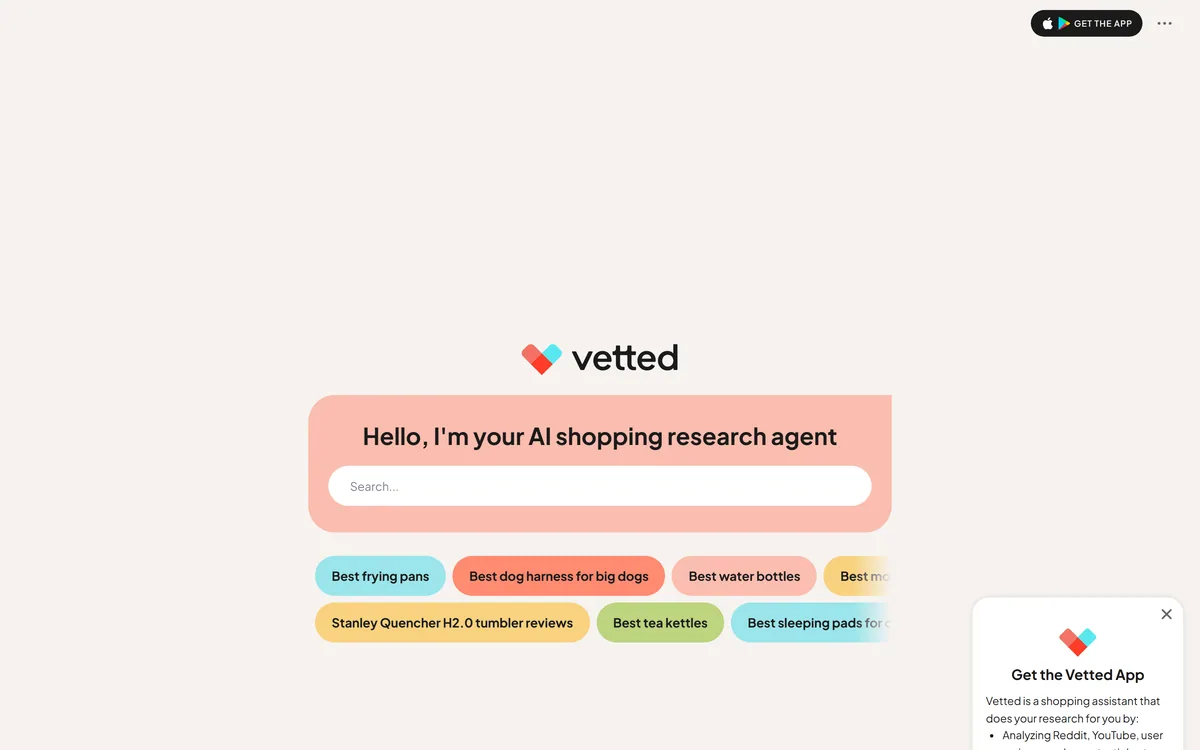
Vetted's homepage, captured 9 September 2026. Example queries like best frying pans sit under the search box, which tells you the intended use precisely.
Why Reddit And YouTube Are The Right Sources
Vetted states it analyses Reddit, YouTube, user reviews and expert articles. That combination is a considered choice rather than a random scrape, and it is worth understanding why it works.
Retailer reviews are structurally poor evidence. They are written within days of purchase, before anything has had a chance to fail, and they are subject to incentivised reviews and review-farming that platforms have never fully controlled. A five-star rating from week one tells you the delivery went well.
Forum discussion carries the opposite properties. People return months later to say a thing broke, and other people who own it argue back. That adversarial quality is what makes it useful — a claim survives a thread only if nobody with the product contradicts it.
Long-form video reviews add the thing text cannot: seeing the product used, at length, by someone who bought several and has opinions about the differences.
The honest caveat is that these sources have their own distortions. Enthusiast communities over-index on durability and specification and under-index on whether something suits an ordinary user. Video reviewers are frequently sent products and are not always clear about it. And any community skews toward the demographics that community attracts. Better sources, not neutral ones.
A retailer review is written before the product has had time to fail. A forum thread is written after it did.
Who Pays For The Recommendation?
This is the question to hold while reading anything a shopping tool tells you, and the site does not answer it.
The economics of the category are well established: comparison and recommendation services generally earn commission when a purchase follows a link. That is entirely legitimate and it is how most of the useful ones survive. What matters is disclosure, because the reader should be able to weigh it.
We could not find an explanation of how Vetted makes money on the pages we read. That is not evidence of anything improper — many products explain this only in their terms — but it does mean the reader cannot calibrate.
The practical response is a habit rather than a suspicion. Read the reasoning rather than the ranking. A recommendation that explains why one product suits your use is doing something a commission cannot fake; a ranked list with no reasoning is not.
And check the price yourself before buying. Comparison tools are usually competitive and rarely exhaustive, and thirty seconds elsewhere is the cheapest verification available.
Where An Answer Beats A Search Results Page
The interaction Vetted offers — ask a question, get a recommendation — is genuinely better suited to buying than a list of links, for a specific reason.
Product decisions are not information retrieval problems. You do not want ten sources about frying pans; you want to know which one to buy given that you have an induction hob, cook most nights and would rather not replace it in two years. A results page cannot hold that context, and a conversation can.
The example queries on Vetted's own homepage make the intended use clear: best frying pans, best water bottles, best sleeping pads. These are the mid-value, high-consideration purchases where research genuinely pays off and where people currently spend an hour they resent.
This is also where the category's real competition sits. General assistants such as Claude answer the same question, and the argument for a specialist is source discipline — reading purchase-relevant material rather than whatever ranks.
The way to judge that is to ask about something you already own and know well. If the recommendation matches what you learned the hard way, the sourcing is working. If it repeats the obvious top result you could have found in one search, it is not adding much. Compare it against what Gemini returns for the same question, since that is the alternative most people already have open.
Describe your constraints, not just the product — hob type, budget, how often you will use it.
Ask about something you already own to calibrate whether its judgement matches yours.
Read the reasoning rather than the ranking; reasoning is the part a commission cannot fake.
Check the price independently before buying, since comparison is rarely exhaustive.
Treat safety-critical purchases — car seats, electrical goods, anything medical — as needing a regulator's advice, not an app's.
What It Cannot Know About You
A recommendation engine reading public discussion has one structural blind spot, and it is worth naming because it decides where this tool is useful.
It knows what is generally good. It does not know what suits you specifically. Those come apart most sharply on the purchases people care about most — the pan that is objectively excellent and too heavy for someone with a wrist injury, the mattress that reviews brilliantly and is wrong for a side sleeper, the laptop everyone recommends that does not run the one application your job depends on.
The sources make this worse rather than better. Enthusiast communities recommend for enthusiasts. A camera thread will steer you toward the body that rewards someone who will learn it properly, which is the wrong advice for someone who wants good photographs of their children with no effort.
The practical move is to supply your constraints explicitly and to treat the answer as a shortlist rather than a verdict. Two or three candidates you then check against your own situation is what this technology is genuinely good for.
For anything where being wrong is expensive or unsafe, the shortlist is where its usefulness ends and a specialist's begins.
Testing Whether Its Judgement Matches Yours
Vetted is free to try on the web, so calibration costs nothing. The point is not whether it gives an answer — it will — but whether the answer is one you would trust.
The bar is step two. A tool that gets a category you know well wrong is not one you can rely on for a category you do not.
Ask about a product you already own and researched properly yourself, where you know what the right answer turned out to be.
Compare its recommendation with what you learned. Agreement means its sourcing works; a confident wrong answer tells you exactly how much to trust it elsewhere.
Now ask the same question with a constraint added — a specific budget, a particular use — and see whether the answer actually changes.
Check whether it explains its reasoning or only ranks. Reasoning is what makes a recommendation checkable.
Price the top recommendation yourself at two retailers and compare with what it showed.
Only then use it for something you do not already understand, which is the actual use case.
How Vetted Makes Its Money
There is no subscription visible on the pages we read, and the product is usable free on the web with fuller features in the mobile apps.
Free to the user in a shopping context almost always means the money comes from the purchase. Affiliate commission is the standard mechanism, and again, that is a normal and defensible way to fund a useful tool.
What we could not establish is confirmation of that, or how it might affect ranking. The footer carries privacy, terms and cookies links, and those documents are where such arrangements are usually described — read them if this matters to you, which for a recommendation tool it reasonably might.
The reader's protection here is not vigilance about the vendor but a habit about the purchase: use it for research, verify the price independently, and buy wherever is actually cheapest.
We do not publish amounts, and in this case there appear to be none to publish for the consumer product.
Vetted: The Confirmed Details
Product type
AI shopping research agent
Sources analysed
Reddit, YouTube, user reviews and expert articles
Core function
Product research, recommendation and price comparison across stores
Interaction
Ask a question in natural language rather than filter a results page
Platforms
iOS, Android and web
Feature depth
Enhanced features stated as available in the mobile apps
Typical queries
Best frying pans, best water bottles, best sleeping pads, product-specific reviews
Cost to user
Free on the web; no subscription found on the pages we read
Published links
Privacy, Terms, Cookies
Key features of Vetted
Natural-language product questions rather than filtered search
Analysis of Reddit threads, YouTube reviews, user reviews and expert articles
Product recommendations with reasoning rather than a ranked grid alone
Price comparison across multiple retailers
iOS and Android apps with a fuller feature set than the web version
Mid-value, high-consideration purchases where an hour of research currently gets spent and resented.
Categories where forum and video reviews are genuinely better than retailer ratings — cookware, outdoor gear, tools.
Getting a shortlist of two or three candidates to check against your own situation.
Comparing prices across retailers once you know what you want.
Anyone who already appends a forum name to their product searches, which is the instinct this automates.
Not the right tool for
Safety-critical purchases — car seats, electrical goods, anything medical — where a regulator's guidance matters more than a recommendation.
Highly personal fit decisions such as mattresses, footwear or anything ergonomic, where general excellence and personal suitability diverge.
Professional equipment where your specific workflow decides, and community consensus is aimed at a different user.
Situations where you need to know the commercial relationship behind a recommendation, since the site does not explain it.
Very cheap purchases, where the research costs more attention than the decision is worth.
What We Could Verify About Vetted
Last checked . Read from vetted.ai, including the footer, with the screenshot above captured in the same session.
Product described as a shopping assistant that does your research for you
Sources stated on the site as Reddit, YouTube, user reviews and expert articles
Price comparison across stores confirmed as a function alongside recommendation
Interaction confirmed from the captured screenshot as a natural-language search box with example queries
Example queries visible on the homepage include best frying pans, best dog harness for big dogs, best water bottles and best sleeping pads
Platforms confirmed as iOS, Android and web, with enhanced features stated for the mobile apps
Footer read directly and confirmed to carry Privacy, Terms and Cookies links
What we could not confirm: the site does not explain how the product makes money, and for a tool that recommends purchases and compares retailer prices that is the most material undisclosed fact; no company legal name, registration or funding detail appears beyond the domain and policy pages; the retailers covered by price comparison are not enumerated; no AI model or provider is named; no user numbers or accuracy data are published; and we did not test recommendation quality.
Other Research And Comparison Tools
For product decisions the real alternatives are general assistants with citations you can follow yourself.
Perplexity AI — answers with citations you can open and check, across any topic
Claude — will reason about your specific constraints rather than general consensus
Gemini — general assistant with shopping surfaces attached
Priceva — the seller-side view of the same pricing data
Mindtrip — the same recommend-and-book pattern applied to travel, with the same incentive question
Editor's Verdict
3.6/5
Vetted scores moderately because its source choice is the right one: Reddit threads, YouTube reviews and expert articles are where people say what a product is actually like after six months, which is exactly the information retailer star ratings do not contain. Doing that reading in seconds is genuine value. It loses ground because a shopping tool that compares prices across stores almost certainly earns from those stores, and the site does not explain how it makes money; because its sources carry their own well-known biases; and because it publishes no company detail beyond the domain and its policy pages. AInexfinder Editor Score: 3.6/5.
Vetted pricing
AInexfinder does not list plan prices or billing details. For current pricing, plans, and trials, visit the official Vetted website.
Vendor pricing, credits, and billing policies change over time. Always confirm on the official site before you buy.
Frequently asked questions
What is Vetted?
Vetted is an AI shopping research agent. You ask a product question in plain language and it analyses Reddit threads, YouTube videos, user reviews and expert articles to recommend products, then compares prices across retailers. It runs on iOS, Android and the web, with fuller features stated for the mobile apps.
Is Vetted free?
It is free to use on the web and no subscription appears on the pages we read. In a shopping context, free to the user usually means revenue comes from the purchase — affiliate commission is the standard model — but the site does not explain this. Read the terms if the commercial relationship matters to you.
Where does Vetted get its recommendations from?
Reddit, YouTube, user reviews and expert articles. That is a better source mix than retailer star ratings, because forum posts are written months after purchase when things have had time to fail, and other owners argue back. Retailer reviews are mostly written within days, before anything could go wrong.
Can I trust Vetted's product recommendations?
Calibrate it before relying on it. Ask about a product you already own and researched yourself, and compare its answer with what you learned. If it matches, its sourcing works; a confident wrong answer in a category you know tells you exactly how much to trust it in one you do not.
Does Vetted make money from the products it recommends?
The site does not say, and we could not establish it. Comparison and recommendation services generally earn commission when a purchase follows a link, which is legitimate and common — but disclosure is what lets a reader weigh it. The practical protection is to read the reasoning rather than the ranking, and check prices independently.
What kinds of products is Vetted good for?
Mid-value, high-consideration purchases where research genuinely pays off — the site's own examples are frying pans, water bottles and sleeping pads. Those are categories where enthusiast forums and long video reviews contain real durability information, and where people currently spend an hour they resent.
When should I not use Vetted?
Safety-critical purchases such as car seats, electrical goods or anything medical, where a regulator's guidance matters more than a recommendation. Also personal-fit decisions like mattresses and footwear, where what is generally excellent and what suits you diverge sharply — and community consensus is usually written for a different body or a different use.
How is Vetted different from asking ChatGPT or Perplexity?
The argument for a specialist is source discipline — reading purchase-relevant discussion rather than whatever ranks well. The argument for a general assistant is that it will reason about your specific constraints and, in Perplexity's case, show citations you can open and judge yourself. Vetted does not appear to expose its sources the same way.
Are Reddit and YouTube reviews actually reliable?
Better than retailer ratings, and not neutral. Forum threads are adversarial, which filters out claims owners contradict — a real advantage. But enthusiast communities over-index on specification and durability rather than ordinary suitability, video reviewers are frequently sent products without always saying so, and every community skews toward the people it attracts.
Does Vetted compare prices across all retailers?
It compares prices across stores, but the retailers covered are not enumerated on the site. Comparison tools are usually competitive and rarely exhaustive, so check the price yourself at one or two other retailers before buying. Thirty seconds of verification is the cheapest protection available on any purchase.
Daniel reviews AI tools the slow way — by actually using them on real projects. His reviews cover what works, what breaks, and who each tool is genuinely a good fit for.
Daniel and the AInexfinder editorial team research Vetted using public product information, listing evidence, and (when available) hands-on checks. Scores reflect listing completeness and transparency — not paid placement.
Listings may include affiliate or sponsored placements, which are labeled when present. Editorial scores and cons are not sold. See our affiliate disclosure and review methodology.
Helium 10 is an all-in-one platform for Amazon, Walmart and TikTok Shop sellers, covering product research, keywords, listing optimisation, advertising, operations and analytics — now fronted by an AI agent and an MCP connector.
Priceva is a cloud pricing intelligence platform that tracks competitor prices and stock across thousands of online stores and marketplaces, alerts on changes and MAP violations, and repricies your own catalogue against rules you define. It also covers digital shelf analytics and price optimisation.
Intelis is a dynamic-pricing platform for e-commerce that monitors competitor prices in real time and automatically repricing your Google Shopping and Shopify listings, with MAP compliance monitoring and Shopping-ad optimisation, used by 200+ Shopify brands.
Listomize is an Etsy SEO platform that generates titles, tags, and descriptions within Etsy's own limits, scores listings, optimises 100+ listings from a CSV, tracks competitors and trends, and auto-generates Pinterest pins.
Lahjty (لهجتي) is an Arabic-first marketing platform for MENA campaigns. From one brief it produces dialect-aware ad copy, headlines, campaign images with Arabic text rendered in, dialect-aware voice, and SEO articles grounded in your own brand sources — with a Partner API and an MCP server for teams that want it inside their own workflow.