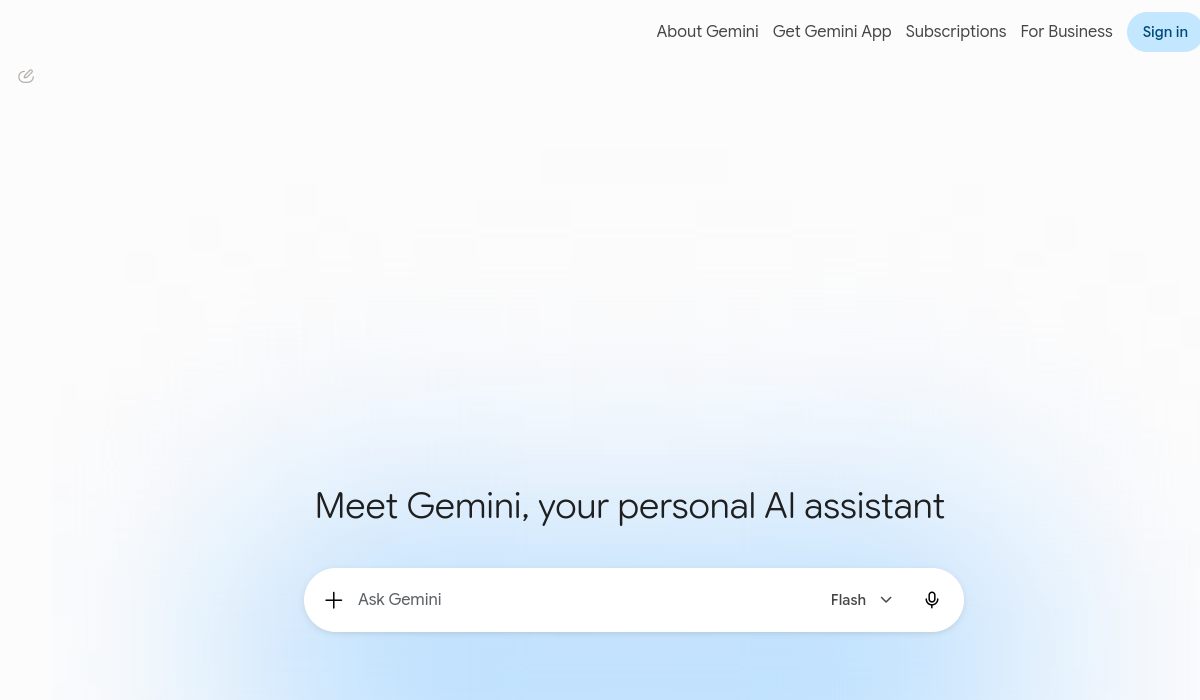
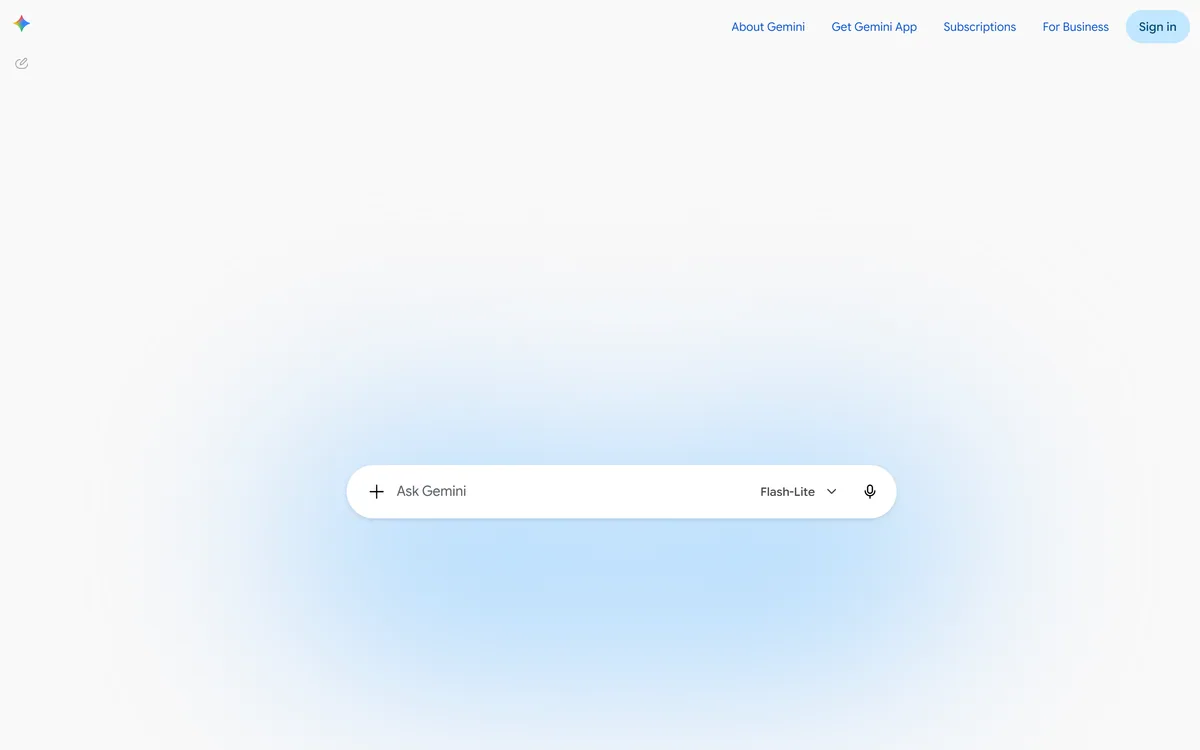
Gemini is Google's AI assistant, combining Deep Research reports, custom Gems, the Canvas workspace, Gemini Live voice conversation, Nano Banana image generation, and Veo video, with access to Gmail, Drive, and Chat when permitted.
Googlegemini.google.com75,018 viewsAdded March 18, 2026500M+ visitors
Gemini is Google's AI assistant, and its distinguishing feature is not the model but the access. With permission, it reads your Gmail, your Drive, and your Chat, which no competitor can do.
Around that sits a substantial product: Deep Research for long cited reports, Gems for reusable custom assistants, Canvas for interactive output, Gemini Live for voice, and generation models for images and video.
This review covers what each part does well, why the Workspace connection is both the main reason to use it and the main thing to think carefully about, and where Gemini still trails.
Gemini's plain chat window hides how much of Google it can reach behind it.
Gemini Feature Map
Maker
Google
Category
General-purpose AI assistant
Research mode
Deep Research, producing multi-page cited reports
Custom assistants
Gems, configured through the Gem Builder
Interactive workspace
Canvas, for prototypes, visuals, and quizzes
Voice
Gemini Live for spoken conversation
Image generation
Nano Banana
Video generation
Veo
Google data access
Gmail, Drive, and Chat, with permission
Free tier
Yes
Deep Research Is The Standout
Deep Research turns Gemini from a chat model into a research agent. It breaks a question into sub-topics, browses across a large number of sites iteratively, follows new links as it finds them, and assembles a multi-page report with citations.
Crucially, it can also draw on your own Gmail, Drive, and Chat when you allow it. A report that combines public sources with your internal documents is something a general chatbot simply cannot produce.
You can upload files and images as sources too, then transform the finished report into interactive visuals or quizzes in Canvas. That pipeline — research, then reshape — is the most complete implementation of the idea currently available.
Gems: Reusable Assistants Without Prompt Engineering
A Gem is a saved, configured version of Gemini for one job. The Gem Builder asks for four things, and that structure is what makes them work for people who would never write a system prompt.
Persona — the role the Gem should play
Task — what it should actually do
Context — how it should go about the task
Format — how the output should be presented
When A Gem Beats A Long Prompt
The value is repetition. If you explain the same background every time you open a chat — your product, your audience, your house style — that explanation belongs in a Gem instead.
Gems also make quality consistent across a team. Five people asking the same Gem get answers shaped the same way, where five separate chats produce five different interpretations of the same request.
Canvas And Interactive Output
Canvas is where Gemini produces something you can manipulate rather than read. Prototypes, visualisations, quizzes, and interactive explanations are built and revised in place.
Its most useful pairing is with Deep Research: take a dense report and turn it into something a colleague will actually engage with. Converting research into a usable artefact is normally a separate job entirely.
For teaching, internal briefings, and anything where the audience will not read ten pages, this closes a real gap.
Live, Nano Banana, And Veo
Gemini Live handles spoken conversation, which suits hands-free use and thinking out loud far better than typing does.
Nano Banana generates images and Veo generates video, both inside the same assistant. Having generation in the same place as research and writing removes the tool-switching that fragments most creative workflows.
None of these is necessarily the strongest option in its own category, but the convenience of one assistant covering text, voice, image, and video is a genuine advantage.
The Workspace Connection, Honestly Assessed
If your working life runs on Gmail, Drive, Docs, and Google Chat, Gemini answers questions no other assistant can. "What did we agree about the renewal" is answerable because the thread is right there.
That is the strongest argument for it and the one that should drive the decision. Assistants without this access require you to fetch and paste the context yourself, which is exactly the work you wanted help with.
It is also the thing to think about before enabling. Granting an assistant read access to years of email is a meaningful decision, and one worth making deliberately rather than by clicking through a prompt.
Model Versions And Plan Names
Google renames things often, which makes older reviews confusing. The paid consumer tier previously called Gemini Advanced is now Google AI Pro, and the most capable model available to it is the current Gemini Pro release.
The practical consequence is that comparisons written even a year ago reference plan names and model versions that no longer exist, while describing capabilities that have since changed substantially.
Check the current tier names on Google's own pages rather than trusting a third-party comparison table.
Where Gemini Falls Short
Consistency is the recurring complaint. Answer quality varies more between sessions than with its main rivals, and the same question can produce a strong response one day and a shallow one the next.
The naming is genuinely confusing. Gems, Canvas, Live, Deep Research, Nano Banana, Veo, Google AI Pro — the product surface is large and poorly signposted, and most users never find features they are already paying for.
Deep Research is slow, which is the right trade for real research but frustrating when you expected a quick answer. And for coding specifically, dedicated tools and rival assistants are generally rated ahead of it.
Workspace access also only pays off if you actually live in Workspace. For a Microsoft 365 organisation, the single biggest advantage evaporates.
Getting Value From It
Build two or three Gems for work you repeat weekly. The Gem Builder's four fields take minutes, and a saved Gem removes the same setup paragraph from every future session.
Use Deep Research for questions worth several minutes of waiting, and ordinary chat for everything else. Most disappointment with Gemini comes from using the wrong mode.
If you enable Workspace access, spend ten minutes first checking what it can reach. The value is real, and so is the reach.
Verdict On Gemini
Gemini's case rests on integration. Deep Research is genuinely excellent, Gems are the most approachable custom-assistant feature on the market, and the ability to reason over your own Gmail and Drive is unmatched.
Choose it if your organisation runs on Google Workspace, if you do research that benefits from combining public and internal sources, or if you want text, voice, image, and video from one assistant. Choose a rival if you need consistent quality above all, if coding is your main use, or if you are a Microsoft shop.
Check Google's own pages for current plan names and limits — this is a product whose naming changes faster than the reviews describing it.
Key features of Gemini
Deep Research producing multi-page cited reports from many sources
Access to your Gmail, Drive, and Chat when permitted
Gems — reusable custom assistants built from persona, task, context, and format
Canvas for interactive prototypes, visuals, and quizzes
Gemini Live for spoken conversation
Nano Banana image generation and Veo video generation
File and image upload as sources for research
Pros & cons
Pros
5
Only major assistant that can reason over your own Gmail, Drive, and Chat
Deep Research is among the best implementations of agentic research available
Gems make custom assistants approachable for non-technical users
Canvas turns dense reports into something colleagues will actually use
Text, voice, image, and video generation in one product
Cons
5
Answer quality is less consistent between sessions than its main rivals
Large, poorly signposted feature set that most users never fully find
Deep Research is slow, which frustrates when a quick answer was expected
Trails dedicated tools and rival assistants on coding
Its biggest advantage disappears entirely outside Google Workspace
Best For
Organisations running on Google Workspace
Researchers combining public sources with internal documents
Teams that need reports turned into briefings and interactive material
Non-technical users who want custom assistants without prompt engineering
Anyone wanting text, voice, image, and video in a single assistant
Editor's Verdict
4.5/5
Gemini has an AInexfinder Editor Score of 4.5/5.
Gemini pricing
AInexfinder does not list plan prices or billing details. For current pricing, plans, and trials, visit the official Gemini website.
Vendor pricing, credits, and billing policies change over time. Always confirm on the official site before you buy.
Frequently asked questions
What can Gemini do that other AI assistants cannot?
Read your own Gmail, Drive, and Chat when you grant permission. That lets it answer questions about your actual correspondence and documents, which assistants without that access cannot do without you pasting the material in.
What is Gemini Deep Research?
A research agent mode. It breaks a question into sub-topics, browses many sites iteratively, follows new links, and produces a multi-page cited report — optionally drawing on your Gmail, Drive, and Chat as well as public sources.
What are Gemini Gems?
Saved, configured versions of Gemini for a specific job. The Gem Builder asks for a persona, a task, context, and an output format, which makes custom assistants workable for people who would never write a system prompt.
Is Gemini Advanced still called that?
No. The paid consumer tier previously known as Gemini Advanced is now Google AI Pro. Google renames plans and models frequently, so check its own pages rather than third-party comparison tables.
Can Gemini generate images and video?
Yes. Nano Banana handles image generation and Veo handles video, both inside the same assistant alongside text and voice, which avoids switching between separate tools.
Is Gemini free?
There is a free tier. Paid plans add the most capable model and higher limits on features such as Deep Research. Check Google's pages for current plan names and what each includes.
Should I use Gemini if my company uses Microsoft 365?
Probably not for the integration reason. Gemini's strongest advantage is reasoning over Gmail, Drive, and Chat, and outside Google Workspace that advantage disappears — leaving you to compare it on model quality alone, where rivals are more consistent.
Daniel reviews AI tools the slow way — by actually using them on real projects. His reviews cover what works, what breaks, and who each tool is genuinely a good fit for.
Daniel and the AInexfinder editorial team research Gemini using public product information, listing evidence, and (when available) hands-on checks. Scores reflect listing completeness and transparency — not paid placement.
Listings may include affiliate or sponsored placements, which are labeled when present. Editorial scores and cons are not sold. See our affiliate disclosure and review methodology.
Claude is Anthropic's AI assistant, available on web, desktop, mobile, and in Chrome, with Projects for persistent context, Artifacts for generated documents and apps, Skills, Connectors, and Claude Code for developers.
Perplexity AI is an answer engine that runs live web searches and returns cited answers, with Deep Research for long agentic reports, Spaces for persistent projects, the Comet browser, and the Sonar API for developers.
ChatGPT is OpenAI's AI assistant, covering conversation, document and image work, web browsing, Projects, Tasks, custom GPTs, agent actions, and the Codex coding agent, across web, desktop, and mobile.
JAIS Chat is a bilingual Arabic and English conversational assistant launched by Core42, part of the UAE's G42 group. It runs on the Jais family of Arabic large language models developed by Inception with MBZUAI and Cerebras, and is built to handle Arabic dialects and cultural context rather than translated English.
Kimi is Moonshot AI's assistant, running on its K3 model and positioned for agentic coding and knowledge work. Its interface opens on a set of output surfaces — slides, sheets, documents, websites, design, deep research and a multi-agent Swarm — alongside scheduled tasks, projects and a desktop app.
Reka is an AI research lab building omni models — Spark, Edge, Flash and Core — that process video, image, audio and text in a single architecture rather than bolting modalities together. It also runs Reka Cloud for training and deployment, video infrastructure available by API or MCP, and a training-data division.