Mindtrip turns a conversation about what you want from a trip into an organised itinerary with maps, photos and reviews, then books hotels, flights, restaurants and experiences through partners including Priceline, Tripadvisor and Viator. Group planning and receipt organisation are built in.
mindtrip.ai8 viewsAdded November 7, 2025376K visitors
Planning a trip is not one task. It is a research problem, a coordination problem, a booking problem and a document-management problem, and most tools solve exactly one of them before handing you back to a browser with nineteen tabs open.
Mindtrip's proposition is to hold all four, where conversational planners such as Layla stop at the recommendation. You describe what you want in conversation, it recommends destinations, hotels, restaurants and activities with photographs, maps and reviews attached, you refine by saving what appeals, and then you book — without leaving.
That completeness is the reason to look at it seriously. It is also the reason to read the incentives carefully, because a product that both recommends and books is being paid by the thing it recommends. This review covers what works, what to verify, and where the interests may not align with yours.
Chat To Itinerary To Booking
It plans and books in the same place, with hotels, flights, restaurants and experiences bookable through partners rather than handed to you as a list.
Start Anywhere builds a plan from what you already have — a screenshot, a photograph or a PDF becomes the basis for recommendations.
Group trips are properly supported, with real-time collaboration, chat, comments and the ability to mention the assistant inside a group conversation.
Confirmations get organised automatically by forwarding them to a dedicated address, which turns a chaotic inbox into a trip file.
Free to use, with iOS apps, a creator programme, and revenue coming from booking partners including Priceline, Tripadvisor and Viator.
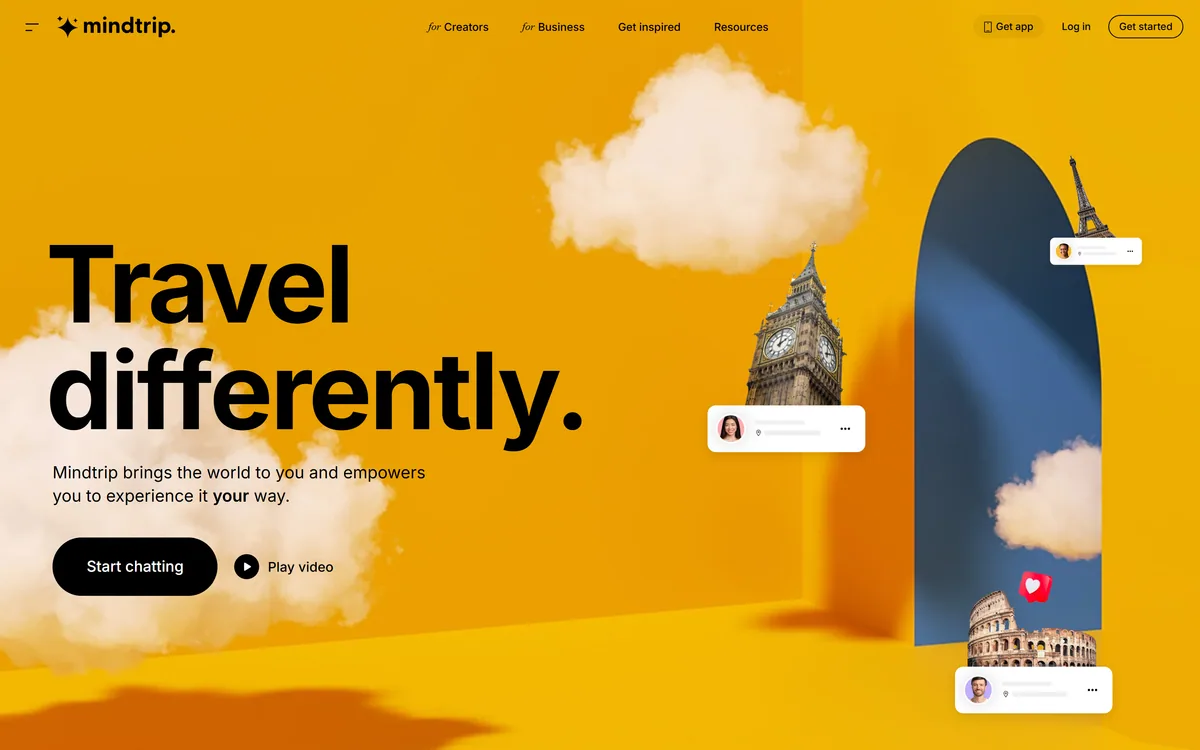
Mindtrip's homepage, captured 9 September 2026. The product leads with planning rather than booking, though booking is where the model closes.
Start Anywhere Is The Cleverest Idea Here
Mindtrip lets you begin from a photograph, a screenshot or a PDF rather than from a typed description, and it is the feature that best understands how travel planning actually happens.
Nobody starts a trip by writing a specification. They save a video of a place, screenshot a friend's recommendation, keep a photograph of a hotel courtyard they liked, and accumulate a folder of fragments with no structure and no location data.
Turning that folder into a starting point is genuinely useful, because the fragments encode preferences the person could not articulate on request. Show a system four saved images and it can infer a taste in a way that answering questions about your travel style does not.
The related import from Google Maps serves the same purpose for people who have been dropping pins in a city list for years — that list is a real record of intent, and it has historically been trapped where it was made.
Test this feature specifically during evaluation, because it is the one that distinguishes Mindtrip from a chat interface with a booking button. If it reads your saved images well, the product is doing something the alternatives are not.
People do not plan trips by describing what they want. They collect screenshots for six months and then try to remember why.
Group Planning Is The Underrated Half
The collaboration features — shared itineraries, real-time editing, group chat, comments, likes, and mentioning the assistant inside the conversation — get less attention than the AI planning and are probably more valuable.
Anyone who has organised a trip for more than three people knows the actual failure mode, and it is not finding a hotel. It is that the discussion happens in a group message, decisions are made in a thread nobody can find later, and one person becomes the unwilling secretary for everyone else.
A shared workspace where suggestions can be commented on, liked and pinned addresses that directly. Being able to mention the assistant inside the group conversation is a neat touch: it answers the question the group is arguing about without anyone leaving the thread.
This is the part of the product with the least competition. Plenty of tools plan trips; very few solve the coordination problem, which is where group travel actually breaks down.
Where The Money Comes From
Mindtrip is free to use and books through partners including Priceline, Tripadvisor, Google Places and Viator, with car rental and tours listed as arriving. That structure tells you how it earns.
This is the standard economics of online travel and there is nothing improper about it. It is worth understanding because it creates a tension the product cannot fully resolve: the best recommendation and the bookable recommendation are not always the same one.
The practical consequences are specific rather than sinister. Accommodation that is not on the partner platforms — small guesthouses, direct-booking properties, apartments listed only locally — is structurally less likely to surface. Restaurants that do not take online reservations are at a similar disadvantage. In many destinations, those are precisely the places worth going.
There is also a price question. Booking platforms are frequently competitive but not reliably cheapest, and many hotels offer better rates or terms when booked directly.
None of this is a reason to avoid the tool. It is a reason to use it as a planning and discovery layer and to spend two minutes checking direct rates before confirming anything substantial. That habit costs nothing and regularly saves more than it costs.
Check the hotel's own website before booking — direct rates and cancellation terms are often better.
Search the destination separately for accommodation outside the major booking platforms.
Treat restaurant suggestions as a starting list, since places without online reservations are underrepresented.
Verify opening times and seasonal closures independently, which is where trip advice most commonly fails.
Confirm visa, entry and vaccination requirements from official sources rather than from any assistant.
Trusting A Recommendation You Did Not Research
Travel is a domain where confidently wrong information has an immediate physical cost. A restaurant that closed last year, a museum shut on Mondays, a route that does not exist in that season — each one is an afternoon of a trip you paid to take.
Mindtrip mitigates this better than a general-purpose assistant does, because recommendations arrive with photographs, maps and reviews attached rather than as unsourced prose — though for checking one specific fact, a cited-source tool such as Perplexity AI remains the safer instrument. Attached evidence is the single most useful safeguard in this category: you can see the place, see where it is, and see what people said about it.
The residual risk sits in the things that change quietly. Opening hours, seasonal closures, whether a booking is required, and whether a place has changed hands are all information that goes stale faster than any index refreshes.
The reasonable working method is to treat the itinerary as a well-researched draft rather than a confirmed plan. Verify the handful of items your trip actually depends on — the ones where being wrong ruins a day — and let the rest be suggestions.
For anything with legal or medical weight, particularly entry requirements and health advice, use official government sources. No travel assistant should be the last word on whether you can enter a country.
Planning A Real Trip As A Test
Travel tools demo well because the demo destination is always somewhere heavily documented. The way to judge one honestly is to point it at somewhere you know.
The bar is step two. A tool that recommends only the obvious in a city you know well will do exactly the same in a city you do not — you just will not be able to tell.
Plan a trip to a city you know intimately, ideally one you have lived in. This is the only way to judge recommendation quality directly.
Check whether it surfaces anything beyond the obvious. If everything it suggests is in the first page of any guidebook, that is your answer about how it will perform where you have no reference.
Now test Start Anywhere: give it four screenshots or photographs you actually saved, and see whether it infers a taste rather than a destination.
Verify five specific facts from the itinerary — opening hours, seasonal closures, whether booking is required — against the venues' own sources. Count the errors.
Invite one other person and plan something together, since the collaboration features are the half with the least competition.
Before booking anything substantial, price the same hotel directly with the property and compare both rate and cancellation terms.
What Mindtrip Costs You
The app is free to use. There is no subscription gate on planning, and the iOS app is a free download.
The revenue model is booking commission, supplemented by a creator programme that pays people for producing itineraries and a business offering for travel companies. The company has raised venture funding, which is what allows the consumer product to stay free while that model matures.
For a user, free is genuinely free here rather than free-with-a-catch, but the catch is structural rather than financial: your recommendations come from a system paid by bookings. That is a fair trade if you know about it and check prices independently.
The consideration worth raising is durability rather than cost, and it is the same question you would ask of any personal organiser such as Saner.ai. Consumer travel products are frequently acquired or repositioned, and a carefully built set of trip plans and saved collections lives inside one company's product. If you are storing years of travel history, find out what export exists before you depend on it.
We do not publish amounts, and in this case there are none to publish for the consumer product.
Mindtrip: Confirmed Details
Product type
AI travel planning with integrated booking
Planning inputs
Conversation, plus Start Anywhere from photos, screenshots or PDFs, and Google Maps import
Recommendation types
Destinations, hotels, flights, restaurants, attractions and events
Presentation
Photos, interactive maps and reviews attached to recommendations
Booking live
Hotels, flights, restaurants and experiences
Booking stated as arriving
Car rentals and tours
Booking partners
Priceline, Tripadvisor, Google Places, Viator
Collaboration
Shared itineraries, real-time group planning, chat, comments and assistant mentions
Document handling
Confirmations organised by upload or by forwarding to a dedicated address
Mobile
iOS app available
Creator programme
Paid programme for users producing itineraries
Pricing model
Free to use; revenue from booking partners
Funding
Venture backed, with a reported raise of 7 million dollars
Legal entity
Mindtrip, Inc.
Who Should Plan With Mindtrip
Good for trips where
You are travelling with a group and the coordination is the hard part, not the destination.
You have collected screenshots and saved places for months and want something to make sense of them.
You want plans and bookings in one place rather than an itinerary you then have to reserve elsewhere.
You are going somewhere well documented, where recommendation coverage will be strong.
Your confirmations are scattered across an inbox and you want them organised without doing it by hand.
Bad for trips where
You want independent recommendations with no commercial relationship to the places suggested.
You are travelling somewhere off the main tourist infrastructure, where partner-platform coverage thins out sharply.
You prioritise small guesthouses and direct-booking properties, which are structurally less likely to surface.
Your trip depends on precise, current logistics — remote transport, seasonal access — that need verification from primary sources anyway.
You enjoy the research itself, in which case a tool that shortcuts it removes the part you wanted.
Other Travel And Planning Tools
Adjacent tools for the parts of a trip Mindtrip does not cover.
Layla — the closest conversational competitor for discovery and inspiration
Perplexity AI — for verifying specific facts with citations you can actually follow
Saner.ai — keeping travel documents and plans organised across a trip
Gamma — if you need to present an itinerary to a group in a shareable format
Otter.ai — capturing the planning conversation itself when a group decides things out loud
Key features of Mindtrip
Conversational trip planning that produces an organised, mapped itinerary
Start Anywhere, generating recommendations from a photo, screenshot or PDF
Google Maps import for saved places collected over years
Integrated booking for hotels, flights, restaurants and experiences through partners
Real-time group planning with shared itineraries, chat, comments and assistant mentions
Automatic organisation of confirmations by upload or email forwarding
Events discovery matched to stated preferences
Saved collections, interactive maps, photos and reviews attached to every recommendation
Pros & cons
Pros
6
Closes the loop from planning to booking rather than handing you a list to research elsewhere
Start Anywhere matches how people actually gather travel ideas — as saved fragments, not specifications
Group collaboration solves the coordination problem, which is where multi-person trips genuinely fail
Recommendations arrive with photos, maps and reviews attached, which is the best available safeguard against confident error
Confirmation forwarding turns a scattered inbox into a trip file with no manual work
Free to use, with no subscription gate on planning
Cons
6
Booking commission creates a structural tension between the best recommendation and the bookable one
Accommodation outside the major partner platforms is less likely to surface, and it is often the most interesting
No AI model or provider is named, and no ranking methodology is published
Opening hours, seasonal closures and venue changes go stale faster than any index refreshes
Coverage will thin outside well-documented destinations, which is exactly where good advice is worth most
Years of saved plans live inside one venture-backed consumer product, so check what export exists
Best For
Group trips where coordination is harder than the planning
Travellers who have collected screenshots and saved pins for months
Anyone who wants planning and booking in a single place
Well-documented city destinations with strong recommendation coverage
People whose confirmations are scattered across an inbox
Mindtrip Against The Travel Planners
The distinction that matters is whether a tool stops at a suggestion or carries through to a reservation.
Keeping the documents and plans in order rather than making them
Reading Mindtrip’s Site And Footer
Last checked . Read from mindtrip.ai, including the footer, with the screenshot above captured in the same session.
Product confirmed as AI travel planning providing personalised recommendations for destinations, hotels, flights, restaurants and attractions in one place
Start Anywhere confirmed on the site as generating recommendations from photos, screenshots or PDFs
Google Maps import confirmed as a supported way to bring in existing saved places
Group planning confirmed with real-time collaboration, group chat, comments, likes and the ability to mention the assistant in conversation
Booking confirmed as live for hotels, flights, restaurants and experiences, with car rentals and tours stated as arriving
Booking partners listed on the site as Priceline, Tripadvisor, Google Places and Viator
Confirmation handling confirmed via upload or by forwarding to a dedicated receipts address
Events discovery confirmed, surfacing concerts, markets and activities matched to stated preferences
iOS app confirmed as available, with the product free to use
A paid creator programme confirmed on the site, alongside business services
Footer read directly and confirmed to link Help, Creator Program, Creator Academy, business services, About, Team, Press, Media Kit, Contact and Resources, with the entity given as Mindtrip, Inc.
What we could not confirm: no AI model or provider is named anywhere on the site; there is no published statement of how recommendations are ranked or whether commercial relationships influence ordering, which matters given the booking-commission model; no accuracy or freshness data is published for opening hours and venue details; the reported funding figure comes from press coverage rather than from the site; and we did not plan or book a trip, so nothing here assesses recommendation quality directly.
Editor's Verdict
3.8/5
Mindtrip scores reasonably because it closes a loop most travel AI leaves open: it plans, organises and books in one place rather than handing you a list you then have to research and reserve elsewhere. Start Anywhere — building recommendations from a screenshot, a photo or a PDF — is the cleverest idea in the category, because it matches how people actually collect travel ideas. Group planning with real-time collaboration is the underrated half. It loses ground because a booking-commission model creates an unavoidable tension between the best recommendation and the bookable one, because no AI model is named, and because trip advice is exactly the kind of confidently-stated content that is expensive to get wrong on arrival. AInexfinder Editor Score: 3.8/5.
Mindtrip pricing
AInexfinder does not list plan prices or billing details. For current pricing, plans, and trials, visit the official Mindtrip website.
Vendor pricing, credits, and billing policies change over time. Always confirm on the official site before you buy.
Frequently asked questions
What does Mindtrip do?
It plans trips through conversation, producing an organised itinerary with photos, interactive maps and reviews, then books hotels, flights, restaurants and experiences through partners including Priceline, Tripadvisor and Viator. It also supports real-time group planning and organises your booking confirmations automatically.
Is Mindtrip free?
Yes. There is no subscription for planning and the iOS app is a free download. The company earns from booking commission through its partners, supplemented by a creator programme and a business offering. Free is genuinely free here, but your recommendations come from a system paid by bookings — check prices directly before confirming anything substantial.
Can Mindtrip actually book my trip?
Yes, for hotels, flights, restaurants and experiences through its partner platforms, with car rentals and tours stated as arriving. That is what distinguishes it from tools that produce an itinerary you then have to reserve elsewhere. Before booking a hotel, price it directly with the property too — direct rates and cancellation terms are often better.
How reliable are Mindtrip's recommendations?
Better than a general assistant's, because recommendations come with photos, maps and reviews attached rather than as unsourced prose. The residual risk is in details that change quietly — opening hours, seasonal closures, whether booking is required, whether a place has changed hands. Verify the handful of items your trip actually depends on.
What is Start Anywhere?
A feature that builds recommendations from a photograph, a screenshot or a PDF rather than from a typed description. It is the cleverest idea in the product, because it matches how people really collect travel ideas — as saved fragments over months. There is also a Google Maps import for places you have been pinning for years.
Is Mindtrip good for planning a trip with friends?
This is arguably its strongest feature and the one with the least competition. Shared itineraries, real-time editing, group chat, comments and the ability to mention the assistant inside the conversation address the actual failure of group travel — decisions lost in a message thread, and one person becoming everyone's unwilling secretary.
Should I trust Mindtrip for visa or entry requirements?
No. Use official government sources for anything with legal or medical weight — visas, entry rules, vaccination requirements. No travel assistant should be the last word on whether you can enter a country, and the consequences of a stale answer land entirely on you at the border.
Daniel reviews AI tools the slow way — by actually using them on real projects. His reviews cover what works, what breaks, and who each tool is genuinely a good fit for.
Daniel and the AInexfinder editorial team research Mindtrip using public product information, listing evidence, and (when available) hands-on checks. Scores reflect listing completeness and transparency — not paid placement.
Listings may include affiliate or sponsored placements, which are labeled when present. Editorial scores and cons are not sold. See our affiliate disclosure and review methodology.
Layla builds day-by-day itineraries from your dates, budget and travel style using live pricing and availability for flights, hotels, trains and activities. Human travel experts can take over at any stage to plan, book and manage the trip end to end. Layla AI GmbH is based in Berlin.
Rodin (Hyper3D) is an AI 3D model generator that turns text prompts or a single image into detailed 3D assets, with 21 styles, generation controls, plugins for Blender, Unity and Unreal, an API and MCP, aimed at game, print, product and avatar creators.
Skybox AI by Blockade Labs generates 360-degree equirectangular panoramas and skyboxes with stated generation times as fast as 15 seconds, 32-bit HDRI export for scene lighting, a Unity plugin, MCP support and direct export to Blender and Unreal.
FPVTune analyses Betaflight blackbox logs with a neural network and returns PID and filter settings as one-click CLI commands. It also offers free crash analysis, motor health checks and a flight time calculator, and charges only when you accept the tuning result.
Instead is an AI agent platform for tax work spanning research across 1,500+ authoritative sources, document extraction from K-1s, W-2s and 1099s, multi-entity planning, and e-filing with the IRS, 48 states and cities across all five entity types. The platform is free, with agent work charged per credit.
Decory is a free mobile AI interior design app that redesigns a room from a photo in about 30 seconds across 15+ styles. It also replaces and removes objects, previews flooring and wall colours, and searches furniture. Operated by The AI Journey Inc., with 500,000+ downloads claimed.