Layla builds day-by-day itineraries from your dates, budget and travel style using live pricing and availability for flights, hotels, trains and activities. Human travel experts can take over at any stage to plan, book and manage the trip end to end. Layla AI GmbH is based in Berlin.
Ask a general assistant to plan a week in Portugal and you get something that reads beautifully and cannot be booked. The hotel closed in 2023, the museum is shut on Mondays, and the train does not run that route.
Layla's answer is to plan against live prices and availability rather than from memory, which is the difference between an itinerary and a piece of travel writing.
The second half is more unusual: human travel experts who can take the plan, book it, and manage changes — which puts a travel agency behind the software.
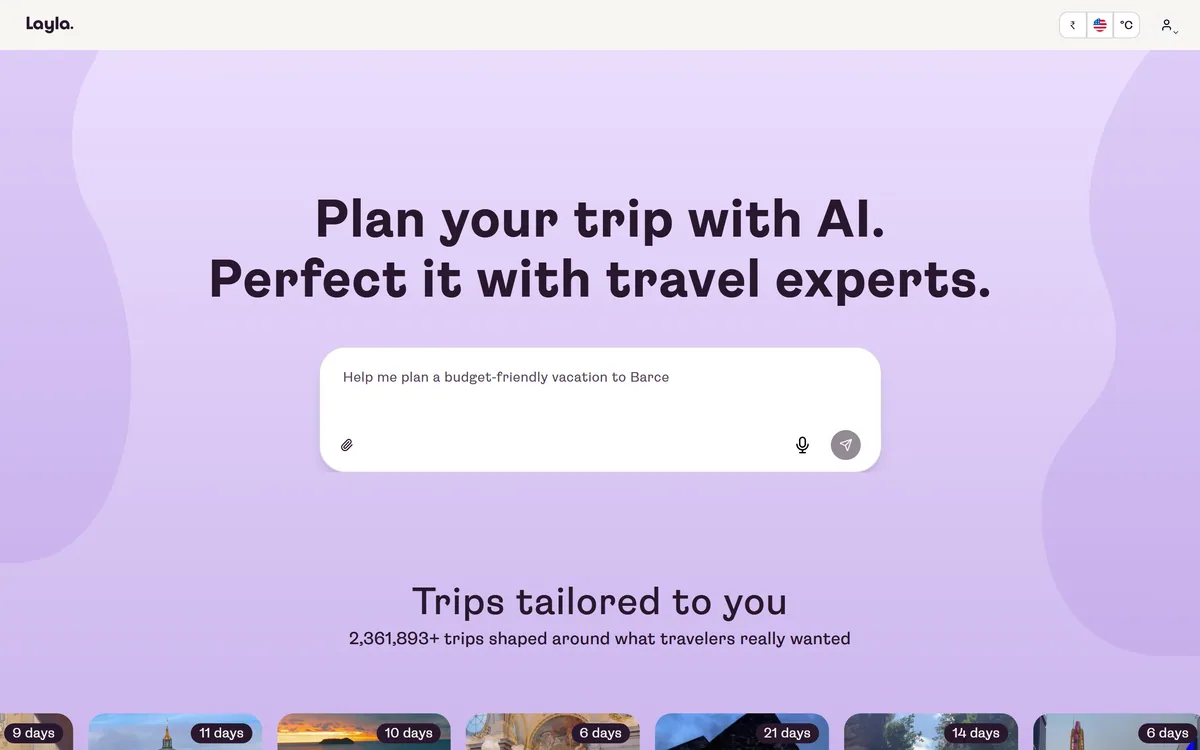
Layla's homepage, captured 9 September 2026, showing example itineraries.
Layla: AI Itineraries Checked By Humans
Live pricing and availability for flights, hotels, trains and activities, rather than plans invented from training data.
Human travel experts who can plan, book and manage a whole trip, or step in at any stage.
2,361,902 itineraries displayed as built, with examples showing duration and party composition.
Multi-city and road trips named as a specialism, with route optimisation between destinations.
Layla AI GmbH, Berlin, with free planning tools and an annual premium subscription.
Why Do AI Trip Plans Usually Disappoint?
Layla states that it builds a day-by-day plan using live pricing and availability, comparing flights, hotels, trains and activities.
That is the fix for the specific failure that makes most AI travel planning worthless, and it is worth being precise about what goes wrong.
A language model asked to plan a trip produces the most plausible itinerary, which is not the same as a real one. It will confidently name a restaurant that closed, a museum with the wrong opening hours, and a journey time that assumes a road that does not exist.
Worse, it is wrong in a way that looks right. Nothing in the output signals which details were retrieved and which were generated, so you discover the difference while standing outside a locked door.
Querying live inventory changes the nature of the output. A hotel that appears is a hotel with rooms at a price; a train that appears runs. That constraint makes the plan less imaginative and considerably more useful — the same reason cited answers matter more than fluent ones in tools like Liner.
A generated itinerary is wrong in a way that looks right. You find out while standing outside a locked door.
Where A Travel Expert Adds Value
Layla's FAQ is explicit that human experts can understand your needs, create an itinerary, find and recommend options, make bookings and update plans as things change.
That is a travel agency, and it is worth understanding what an agent actually provides beyond the booking.
Almost none of it is finding the flight. The value is in what happens when something breaks — a cancelled connection at midnight, a hotel that has lost your reservation, a strike that closes an airport. Someone who can rebook you is worth considerably more than someone who found you a good price.
Agents also carry knowledge that is not written down anywhere a model could read: which resort is next to a building site, which transfer is a two-hour ordeal, which neighbourhood is unpleasant after dark.
The combination is the genuinely interesting proposition here. Let the AI do the tedious comparison work at speed, and bring in a person for judgement and for the moment something goes wrong — which is close to the correct division of labour between the two.
Two Million Itineraries And What They Show
The homepage displays a precise figure — 2,361,902 trips shaped around what travellers really wanted — alongside dozens of example itineraries with durations, destinations and party descriptions.
The examples are more informative than the number, and worth reading as data rather than decoration.
What they reveal is the shape of demand. Trips run from two days to twenty-nine, and party composition varies constantly — solo, couples, families, groups of friends, honeymoons. Destinations spread across Europe, Asia, Australia and India rather than clustering on a handful of stock cities.
That variety is the argument for planning software rather than templates. A two-day Chicago weekend and a twenty-two-day Kuala Lumpur and Bali honeymoon share nothing structurally, and neither fits a pre-built itinerary.
The title's separate claim of being trusted by millions describes a different quantity from trips built, and the site does not reconcile them. Read the trip count, which is specific, rather than the user claim, which is not.
Ask what financial protection a booking through the experts carries.
Give real constraints — budget, pace, mobility — not just a destination.
Use the human expert for the complicated leg, not the whole trip.
Check opening days and seasonal closures yourself before committing.
Confirm prices at the point of booking, not from the plan.
Multi-City Routing And Where It Helps Most
The FAQ names multi-city itineraries and road trips as a specialism, describing route optimisation between destinations across flights, trains and car rental, with places to visit along the way.
This is where software genuinely beats a person working alone, and the reason is combinatorial.
A single-destination trip has few decisions. A five-city trip has an ordering problem, and the number of possible sequences grows fast enough that no traveller evaluates them all — most people pick an order that seems sensible and accept whatever inefficiency follows.
Getting it wrong is expensive in the currency that matters on holiday. A badly ordered route costs a full day of travel and several hundred in unnecessary fares, and the mistake is invisible until you are on the wrong train.
Road trips add a different constraint — driving time between overnight stops — which is exactly the kind of tedious arithmetic worth handing over. The judgement about whether four hours of driving is acceptable on day three remains yours, and that is the part to check rather than accept. General AI search such as Komo will answer questions about a destination and book nothing, while a personal assistant like Khoj works over your own notes instead.
What To Settle Before Money Changes Hands
Layla offers free planning tools with an annual premium subscription, and its experts can make bookings on your behalf. The combination raises questions that a planning tool alone does not.
The first is financial protection. Travel bookings in most jurisdictions carry consumer protections that depend on who sold you what — package travel regulations, airline bonding schemes, card chargeback rights — and those differ sharply between booking direct, booking through an agent, and booking through a platform.
The site does not address this on the pages we read, and it is the single most important thing to establish before letting anyone book a trip for you.
The second is who holds the booking. If a flight changes, whether you or the agent can alter it determines how a disrupted trip goes, and it is worth knowing which name is on the reservation.
None of this is a criticism of the service. It is ordinary due diligence that applies to every travel intermediary, and a company with a German entity and a published imprint is a reasonable place to ask the question rather than a reason to avoid it.
Planning A Trip You Will Actually Take
The failure mode with AI trip planning is accepting a beautiful itinerary that assumes you walk fourteen kilometres a day and enjoy museums.
This sequence produces a plan that survives contact with the actual holiday.
State your real pace and constraints, not your aspirational ones.
Give a genuine budget — it changes every recommendation.
Have it optimise the route order before you choose any hotels.
Verify opening days and seasonal closures for anything you care about.
Bring in a human expert for the leg that worries you most.
Confirm what protection your booking carries before paying.
Layla: Scale And Approach
Company
Layla AI GmbH, described as made in Berlin
Positioning
An AI travel agent and trip planner with human expert support
Planning inputs
Dates, destinations, budget and travel style
Data
Live pricing and availability for flights, hotels, trains and activities
Human service
Experts can plan, book and manage a trip end to end
Displayed trips
2,361,902 itineraries built
Trip types named
Multi-city, road trips, family, solo, couples and honeymoons
Route planning
Optimisation between destinations across flights, trains and car rental
Suggested lengths
Three to five days for city breaks, seven to ten for multi-city
Free tier
Free planning tools with optional upgrades
Premium
An annual subscription for unlimited premium planning features
Sibling product
Roam Around, listed in the footer
Key features of Layla
Day-by-day itinerary generation from dates and style
Live pricing and availability across flights, hotels, trains and activities
Human travel experts who can book and manage a trip
Multi-city and road trip route optimisation
Family, solo, couple and honeymoon planning modes
Itinerary refinement through conversation
Currency and temperature unit selection
Free planning tools with a premium tier
Pros & cons
Pros
7
Plans against live inventory rather than generating plausible itineraries
Human experts can actually book and rebook, which software cannot
Route optimisation solves a genuinely combinatorial problem
Example itineraries show real variety rather than stock destinations
A named German entity with a published imprint
Free planning tools before any subscription decision
The AI and human division of labour is close to the right one
Cons
7
Financial and consumer protection on bookings is not addressed
Whose name holds a booking of record is unstated
Inventory providers behind the live pricing are not named
Trusted by millions and the trip count describe different quantities
Whether experts are employees or contracted agents is unclear
Premium versus free is not broken down feature by feature
Judgement about pace and comfort still has to come from you
Best For
Travellers planning multi-city or road trips
People who want a bookable day-by-day plan
Families balancing sightseeing against downtime
Anyone who would value a person to call when things break
Frequent travellers who plan several trips a year
Layla Against Other Travel Planners
Planning tools differ by whether they retrieve real options or describe likely ones.
Khoj — an assistant over your own notes and documents
Kimi — a general assistant for the surrounding admin
Fillout — collecting preferences from a group before you plan
Layla: Read From The Trip Pages
Last checked . Read from layla.ai in a browser session on the date above, including the full footer and FAQ. The screenshot was captured at the same time.
Positioned as an AI trip planner perfected with travel experts
Described in the FAQ as an AI travel agent creating complete itineraries covering flights, hotels, activities and dining
Stated as using live pricing and availability to build a day-by-day plan
Human travel experts stated as able to plan, book and manage a trip from start to finish
2,361,902 trips displayed as built, with dozens of example itineraries showing duration and party
Multi-city itineraries and road trips named as a specialism with route optimisation
Family, solo, couple and honeymoon planning each addressed in the FAQ
Suggested trip lengths given as three to five days for city breaks and seven to ten for multi-city
Free planning tools stated with optional paid upgrades on an annual basis
Currency and temperature unit selectors present in the interface
Roam Around listed as a separate product in the footer
What we could not confirm: what financial or consumer protection a booking made through Layla's experts carries, which is the most important question before paying and is not addressed on the pages we read; whose name holds a booking of record; which inventory providers supply the live pricing; how the trusted-by-millions claim relates to the trip count; whether the human experts are employees or contracted agents; and how premium differs from free feature by feature. Plan prices are on the site and are not reproduced here. We did not plan or book a trip.
Editor's Verdict
4.0/5
Layla avoids the mistake that makes most AI trip planners useless: it works against live pricing and availability rather than generating a plausible-sounding itinerary from training data. That single decision is the difference between a plan you can book and a plan that falls apart at the first hotel. Adding human travel experts who can actually book and manage the trip is the other half, and it is the half nobody else offers. The question to settle before you commit money is what financial protection a booking through them carries. AInexfinder Editor Score: 4.0/5.
Layla pricing
AInexfinder does not list plan prices or billing details. For current pricing, plans, and trials, visit the official Layla website.
Vendor pricing, credits, and billing policies change over time. Always confirm on the official site before you buy.
Frequently asked questions
What is Layla?
An AI trip planner from Layla AI GmbH in Berlin that builds day-by-day itineraries using live pricing and availability, with human travel experts who can take over to plan, book and manage a trip end to end.
Why do most AI trip plans fail?
Because a language model produces the most plausible itinerary rather than a real one — naming a restaurant that closed, wrong opening hours, a journey that does not run. And nothing in the output signals which details were retrieved and which were invented.
How does live availability change that?
A hotel that appears is a hotel with rooms at a price; a train that appears runs. The plan becomes less imaginative and considerably more useful, because every element in it can actually be booked.
What do the human experts add?
Mostly not finding flights. The value is what happens when something breaks — a cancelled connection at midnight, a lost reservation — plus knowledge no model can read, like which resort is next to a building site.
What should I check before letting them book?
What financial protection the booking carries. Consumer protections differ sharply between booking direct, through an agent and through a platform, and the site does not address it. Ask before paying.
Why does multi-city routing matter?
Because the number of possible orderings grows fast enough that no traveller evaluates them all. A badly ordered route costs a full day of travel and unnecessary fares, and the mistake is invisible until you are on the wrong train.
How many people use it?
The site displays 2,361,902 trips built and separately claims to be trusted by millions. Those describe different quantities and are not reconciled — read the trip count, which is specific.
Is there a free version?
Yes — free planning tools with optional paid upgrades on an annual basis. The site does not break down feature by feature what the premium tier adds, so test the free version against a real trip first.
Can it plan a family trip properly?
The FAQ describes balancing sightseeing with downtime and finding family-friendly accommodation, which are the right considerations. Whether four hours of driving on day three is acceptable remains a judgement you should make rather than accept.
How should I brief it?
With your real pace, budget and constraints rather than aspirational ones. A plan that assumes fourteen kilometres of walking a day and enthusiasm for museums looks excellent and gets abandoned by Tuesday.
Daniel reviews AI tools the slow way — by actually using them on real projects. His reviews cover what works, what breaks, and who each tool is genuinely a good fit for.
Daniel and the AInexfinder editorial team research Layla using public product information, listing evidence, and (when available) hands-on checks. Scores reflect listing completeness and transparency — not paid placement.
Listings may include affiliate or sponsored placements, which are labeled when present. Editorial scores and cons are not sold. See our affiliate disclosure and review methodology.
Mindtrip turns a conversation about what you want from a trip into an organised itinerary with maps, photos and reviews, then books hotels, flights, restaurants and experiences through partners including Priceline, Tripadvisor and Viator. Group planning and receipt organisation are built in.
Rodin (Hyper3D) is an AI 3D model generator that turns text prompts or a single image into detailed 3D assets, with 21 styles, generation controls, plugins for Blender, Unity and Unreal, an API and MCP, aimed at game, print, product and avatar creators.
Skybox AI by Blockade Labs generates 360-degree equirectangular panoramas and skyboxes with stated generation times as fast as 15 seconds, 32-bit HDRI export for scene lighting, a Unity plugin, MCP support and direct export to Blender and Unreal.
FPVTune analyses Betaflight blackbox logs with a neural network and returns PID and filter settings as one-click CLI commands. It also offers free crash analysis, motor health checks and a flight time calculator, and charges only when you accept the tuning result.
Instead is an AI agent platform for tax work spanning research across 1,500+ authoritative sources, document extraction from K-1s, W-2s and 1099s, multi-entity planning, and e-filing with the IRS, 48 states and cities across all five entity types. The platform is free, with agent work charged per credit.
Decory is a free mobile AI interior design app that redesigns a room from a photo in about 30 seconds across 15+ styles. It also replaces and removes objects, previews flooring and wall colours, and searches furniture. Operated by The AI Journey Inc., with 500,000+ downloads claimed.