Instead is an AI agent platform for tax work spanning research across 1,500+ authoritative sources, document extraction from K-1s, W-2s and 1099s, multi-entity planning, and e-filing with the IRS, 48 states and cities across all five entity types. The platform is free, with agent work charged per credit.
instead.com7 viewsAdded February 13, 20266K visitors
Tax software has a specific problem that AI has mostly not touched. Most AI tax tools answer questions — they research, they explain, they summarise — and then hand you back to a thirty-year-old preparation system to actually do the work.
That leaves the tedious half exactly where it was. Research is the interesting part of tax and the smaller part; preparing, reconciling and filing is where the hours go.
Instead's claim is that it replaces the engine rather than sitting beside it, and there is one concrete fact that makes the claim credible rather than aspirational: it can file. E-filing requires IRS authorisation, which is a regulatory process rather than a feature, and it is what separates a tax platform from a tax assistant.
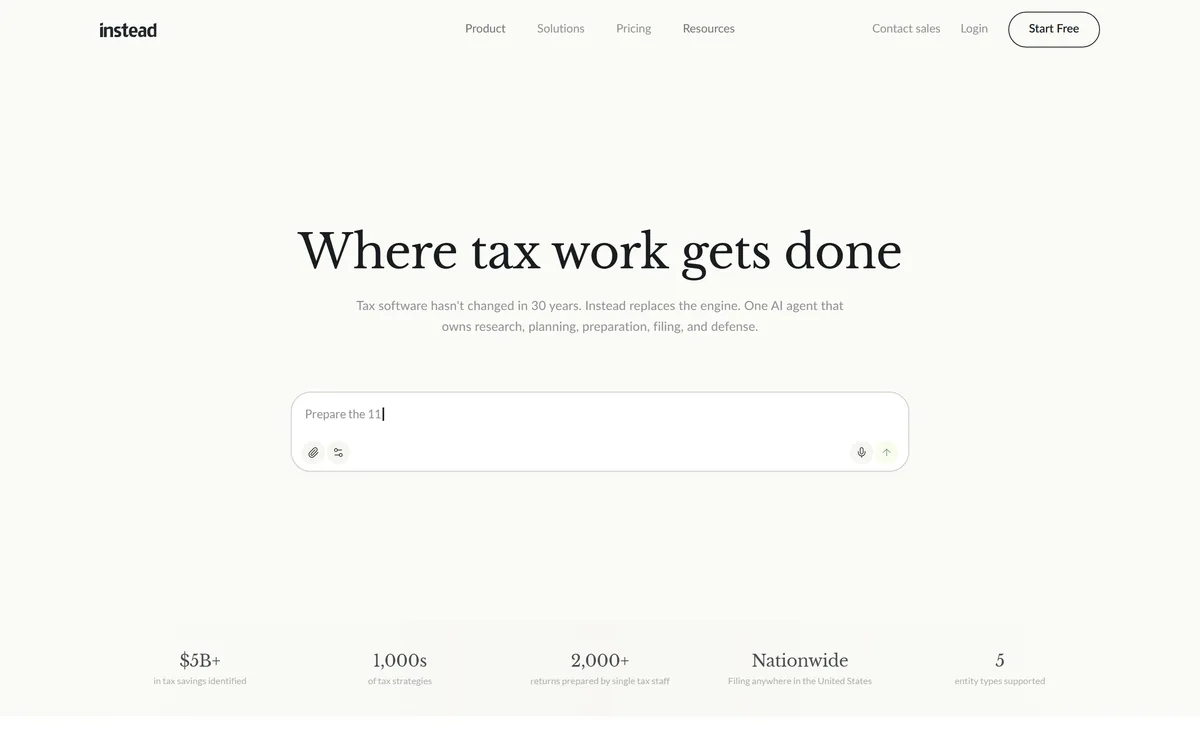
Instead's homepage, captured 9 September 2026. The claim that tax software has not changed in thirty years is the entire positioning.
What Does Instead Actually Own?
Five stages, one agent: research, planning, preparation, filing and defence — rather than research assistance bolted onto existing software.
It can actually file: e-filing with the IRS, 48 states and cities, electronic and print, for all five entity types.
Research across 1,500+ authoritative sources including the Internal Revenue Code, Treasury Regulations and case law.
Multi-entity by design — 1040s link to S corps, partnerships and trusts, which is how real tax situations are actually structured.
The platform is free with unlimited users and entities; agent work is charged per credit on annual agreements.
Why Does IRS E-File Authorisation Matter Most?
Instead states e-filing with the IRS, 48 states and cities, electronic and print filing for all five entity types, and describes itself as the first company in decades to receive IRS approval to e-file.
That authorisation is the most substantive claim on the site, and it is worth explaining why. Becoming an authorised e-file provider is not a matter of building software — it requires application, suitability checks, and passing IRS testing against real transmission requirements. It is a deliberately high barrier, which is why the roster of providers has barely changed in decades.
The practical consequence is what makes it matter. A tool that researches and prepares but cannot file leaves you re-entering the return into another system, which is where errors are introduced and where the time saving evaporates. Filing is the step that closes the loop.
Coverage across all five entity types — 1040, 1120, 1120-S, 1065 and 1041 — is the second half of the claim and equally important. A platform that files individual returns but not the partnership behind them only handles the easy half of most real clients.
This is the checkable, regulatory fact underneath the marketing, and it is the right thing to weigh most heavily.
Authorisation is the line between advice and action, and it is what separates this from research tools. TaxGPT answers tax questions; filing on someone's behalf is a regulated act.
Any tool can research a tax question. Filing requires the IRS to authorise you, which is why that roster has barely changed in decades.
Multi-Entity Linking Reflects How Tax Actually Works
Instead links 1040s, S corps, partnerships and trusts rather than treating each return as a separate job.
That structural decision matters because real tax situations are not isolated returns. A business owner's individual return depends on the K-1 from their S corporation, which depends on how the entity allocated income, which may depend on a trust holding shares.
Traditional software handles these as separate files, so a change to the entity return means someone manually carrying the revised K-1 into the individual return — and remembering to. That handoff is a reliable source of both errors and rework.
Linking them means a change propagates. It also means the planning question — what happens to the owner's total position if we change the allocation — becomes answerable rather than requiring three parallel manual recalculations.
For anyone serving business owners or high-net-worth individuals, that is the difference between a tool that helps with returns and one that helps with a client.
Research Grounded In Authority, Not Absorbed From The Web
The research capability draws on more than 1,500 authoritative sources including the Internal Revenue Code, Treasury Regulations and case law.
Sourcing is the question that decides whether AI is usable in tax at all. A general assistant has absorbed a great deal of tax material of unknown vintage and unknown provenance, and cannot tell you where an answer came from — which is fatal in a field where a threshold changed in April and a position must be defensible in a file.
Reasoning over primary authority is the right architecture, and it is what lets an answer be checked rather than trusted.
The document side complements it: extraction from K-1s, W-2s, 1099s and IRS transcripts. That is the genuinely tedious part of preparation, and unlike research it has an objectively correct answer you can verify against the source document.
The caution belongs where it always belongs in this field. Professional responsibility for a filed return sits with the preparer who signed it, and no software transfers that. Read the authority a research answer cites before relying on it, and verify extracted figures against the documents — a misread figure in a return is your error regardless of what extracted it.
Grounding in primary authority is the same discipline Blue J built its reputation on, and the reason both are more defensible than a general model asked a tax question.
Verify extracted figures against the source document; a misread box on a 1099 becomes your error at signature.
Read the cited authority before relying on a research answer, as you would with any source.
Test currency by asking about a rule that changed in the last twelve months.
Check multi-entity propagation by amending an entity return and confirming the linked 1040 updates.
Keep your own record of what you relied on, since the file must show why a position was taken.
Free Platform, Credits For Agent Work
Instead's pricing structure is unusual and worth understanding: the platform is free with unlimited users and entities, and AI agent work is charged per credit on annual agreements.
This inverts the normal model, and mostly in the customer's favour. Traditional tax software charges per seat and per return, which penalises a growing firm for adding staff and makes every additional client a marginal cost decision.
Charging only for agent work means the software itself imposes no cap. A firm can put every member of staff on it and manage every entity without a licensing conversation, and pay only for the automated work actually performed.
The variable to model is therefore credit consumption per return rather than a seat count. That is genuinely harder to predict in advance and considerably fairer once you know it, because a simple return costs less than a complex one — which is how firms bill their own clients anyway.
The claim of 2,000 returns prepared by a single tax staff member is the figure this structure is meant to support. Treat it as a best case with no stated methodology: return complexity varies enormously, and 2,000 straightforward individual returns is a very different proposition from 2,000 with entity work behind them. Model your own credit consumption on a representative sample before committing to an annual agreement.
Credit pricing for agent work is becoming the norm wherever the agent does something billable — the same shift visible in document platforms like Ironclad and Black Ore.
Piloting It On Returns You Already Filed
Tax software can only be evaluated honestly against returns where the correct answer is already known, and the season structure means you have last year's to test with.
The bar is step three. An extraction error you did not catch is an error you would have signed.
Choose five returns you filed last year across at least two entity types, keeping the filed versions for comparison.
Upload the real source documents — K-1s, W-2s, 1099s, transcripts — and let the platform extract rather than keying anything in.
Check every extracted figure against the source document by hand. This is the step that matters, because at signature the error becomes yours.
Run a research question you already answered last season and compare the conclusion and the cited authority with your own work.
Amend one entity return and confirm the linked individual return updates, since multi-entity propagation is a core claim.
Record the credits consumed across the five, then multiply by your real return volume before signing an annual agreement.
The Accountability Question Nobody Has Settled
An agent that owns research, planning, preparation, filing and defence is doing considerably more than assisting, and the professional implications deserve stating.
The rules have not changed. A return is signed by a preparer, and that signature carries responsibility for accuracy regardless of what produced the figures. Penalties for an inaccurate return land on the taxpayer and, in some circumstances, on the preparer — never on the software.
That means the review obligation grows rather than shrinks as automation increases. When a person prepared a return, the preparer had reasoned through it; when an agent prepared it, the reviewer is seeing the reasoning for the first time, at volume, under the same deadline.
The word defence in the stated scope is the one to probe hardest. Supporting a position under examination means producing the authority and the workpapers behind it, which is genuinely valuable — but the representation before the IRS remains the professional's, and the practical question is what documentation the platform produces to make that defensible.
The security posture is the right shape: SOC 2 certification, IRS-authorised e-file provider status and BDO Alliance USA membership. Ask for the SOC 2 report itself and for written retention and deletion terms before client data moves, as you would with any system holding taxpayer information.
Instead: Scope, Filing And Structure
Product type
AI agent platform for tax research, planning, preparation, filing and defence
Entity types supported
1040 individuals, 1120 C corporations, 1120-S S corporations, 1065 partnerships, 1041 trusts and estates
E-filing coverage
IRS, 48 states and cities; electronic and print filing for all five entity types
Research base
1,500+ authoritative sources including the Internal Revenue Code, Treasury Regulations and case law
Document extraction
K-1s, W-2s, 1099s and tax transcripts
Multi-entity
Links 1040s, S corps, partnerships and trusts
Deliverables
Tax plans, workpapers and strategy memos
Interface
Includes a voice interface for natural conversation
Integrations
Google Drive, OneDrive, Box and 20 more
Compliance
SOC 2 certification; IRS-authorised e-file provider; BDO Alliance USA member
Stated claims
5 billion dollars in tax savings identified; 2,000+ returns prepared by a single tax staff member; first company in decades to receive IRS approval to e-file
Users addressed
CPA firms, tax preparers, corporate tax teams, family offices, businesses and high net worth individuals
Pricing model
Free platform with unlimited users and entities; AI agent work charged per credit on annual agreements
Key features of Instead
Tax research across 1,500+ authoritative sources with primary authority included
Document extraction from K-1s, W-2s, 1099s and IRS transcripts
Multi-entity linking between 1040s, S corps, partnerships and trusts
Tax plan, workpaper and strategy memo generation
E-filing with the IRS, 48 states and cities across all five entity types
Workflow automation for repetitive tax tasks
Voice interface for conversational interaction
Document integrations with Google Drive, OneDrive and Box
Pros & cons
Pros
7
IRS e-file authorisation is a regulatory fact rather than a feature claim, and it closes the loop
Coverage of all five entity types means it handles the entity work behind real client situations
Multi-entity linking removes the manual K-1 handoff where errors and rework originate
Research grounded in primary authority rather than absorbed from general web material
Free platform with unlimited users and entities removes the per-seat constraint on staffing
Credits charged only for agent work is a fairer structure than per-return licensing
SOC 2 and BDO Alliance membership indicate a serious posture for a tax platform
Cons
7
The savings and productivity figures carry no methodology, sample or definition
No credit-per-return rates published, so cost cannot be modelled before a pilot
The first-in-decades e-file approval claim could not be independently verified from the pages we read
An agent owning preparation and filing raises accountability questions the site does not settle
No named customers appear anywhere on the pages we read
United States only, so the entire filing capability is irrelevant elsewhere
Annual agreements mean committing before you know your real credit consumption
Best For
CPA firms wanting research, preparation and filing in one system
Practices serving business owners with linked entity structures
Firms constrained by per-seat tax software licensing
Multi-state filers who need broad jurisdiction coverage
Corporate tax teams and family offices handling several entity types
Instead Against Other Tax AI Tools
The dividing line in tax AI is whether a tool can file. Everything else is assistance, however good.
Tool
Scope
Can it file?
Buyer
Instead
Research through to filing and defence
Yes — IRS authorised, 48 states, all five entity types
Legal operations, shown for comparison of professional AI
Which Practices Should Look At Instead
Worth a serious pilot when
You want research, preparation and filing in one system rather than re-keying between three.
Your clients have entity structures where 1040s depend on K-1s from S corps and partnerships.
Per-seat licensing has been constraining how many staff you put on tax software.
You file across multiple states, where the stated coverage of 48 states plus cities matters.
You can run a proper pilot against last year's completed returns.
Not worth piloting when
You practise outside the United States, where none of the filing coverage applies.
You want research only, where a citation-focused tool is narrower and cheaper.
You cannot predict volume enough to be comfortable with credit-based agent pricing on an annual agreement.
You are committed to an existing tax engine you will not replace — a tool working inside it fits better.
You would sign a return without verifying extracted figures, which is where the responsibility actually sits.
Other Tax And Professional Tools
Compare on scope: research, preparation and filing are three different capabilities and few tools have all three.
Black Ore — automates preparation inside the tax engine you already run, rather than replacing it
Blue J — research with cited authority across three jurisdictions, and no filing
TaxGPT — lighter question-and-answer research for smaller practices
Ironclad — a comparison on how professional AI handles accountability in a regulated workflow
Ivo — another regulated review workflow where the professional stays responsible
Checking What Instead States
Last checked . Read from instead.com, including the footer, with the screenshot above captured in the same session.
Product described as an AI agent platform for tax covering research, planning, preparation, filing and defence
Positioning quoted from the site: tax software has not changed in 30 years, and Instead replaces the engine
Research base stated as 1,500+ authoritative sources including the Internal Revenue Code, Treasury Regulations and case law
Document extraction confirmed for K-1s, W-2s, 1099s and tax transcripts
Multi-entity support confirmed as linking 1040s, S corps, partnerships and trusts
E-filing stated as covering the IRS, 48 states and cities, with electronic and print filing for all five entity types
Entity types confirmed as 1040, 1120, 1120-S, 1065 and 1041
Voice interface confirmed as a stated feature
Integrations listed as Google Drive, OneDrive, Box and 20 more
Compliance stated as SOC 2 certification, IRS-authorised e-file provider status and BDO Alliance USA membership
Pricing structure confirmed as a free platform with unlimited users and entities, with AI agent work charged per credit on annual agreements
Footer read directly and confirmed to carry terms of service, privacy policy, support, blog, firm directory, glossary, tax deadlines, news and careers
What we could not confirm: the 5 billion dollars in tax savings identified and 2,000+ returns per staff member carry no stated methodology, sample or definition; the claim of being the first company in decades to receive IRS approval to e-file could not be independently verified from the pages we read; no credit-per-return rates are published, so cost cannot be modelled before a pilot; no named customers appear; no funding detail is given; and we did not prepare or file a return, so nothing here reflects tested accuracy.
Editor's Verdict
4.2/5
Instead scores well because it did the unglamorous thing that separates a tax product from a tax demo: it obtained IRS authorisation to e-file, across all five entity types, the IRS, 48 states and cities. Research grounded in 1,500 authoritative sources, extraction from real tax documents, and linking 1040s to the S corps and partnerships behind them addresses how tax work actually flows. Free platform with credits charged only for agent work is an honest structure. It loses ground because the headline figures carry no methodology, and because an agent that owns preparation and filing raises accountability questions the site does not settle. AInexfinder Editor Score: 4.2/5.
Instead pricing
AInexfinder does not list plan prices or billing details. For current pricing, plans, and trials, visit the official Instead website.
Vendor pricing, credits, and billing policies change over time. Always confirm on the official site before you buy.
Frequently asked questions
What is Instead?
Instead is an AI agent platform for tax work covering research, planning, preparation, filing and defence. It researches across 1,500+ authoritative sources, extracts data from K-1s, W-2s, 1099s and transcripts, links individual and entity returns, and e-files with the IRS, 48 states and cities across all five entity types.
Can Instead actually file tax returns?
Yes — it states e-filing with the IRS, 48 states and cities, electronic and print, for all five entity types, and describes itself as an IRS-authorised e-file provider. That authorisation is the most substantive fact on the site, because it requires application, suitability checks and IRS testing rather than just building software.
Which entity types does Instead support?
All five: 1040 for individuals, 1120 for C corporations, 1120-S for S corporations, 1065 for partnerships, and 1041 for trusts and estates. Coverage of the entity returns matters because a platform that files individual returns but not the partnership behind them only handles the easy half of most real client situations.
Is Instead free?
The platform itself is free with unlimited users and entities; AI agent work is charged per credit on annual agreements. That inverts the usual model, which charges per seat and per return and penalises firms for growing. The variable to model is credit consumption per return, which is harder to predict and fairer once you know it.
How does multi-entity linking work?
It connects 1040s to the S corps, partnerships and trusts behind them, so a change to an entity return propagates rather than requiring someone to carry a revised K-1 across manually. That handoff is a reliable source of errors and rework in traditional software, where each return is a separate file.
Does Instead reduce my responsibility as the preparer?
No. A return is signed by a preparer, and that signature carries responsibility for accuracy regardless of what produced the figures. Penalties land on the taxpayer and sometimes the preparer, never on the software. If anything the review obligation grows, because a reviewer of agent-prepared work is seeing the reasoning for the first time.
How reliable is the document extraction?
No accuracy figure is published. The important discipline is that extraction has an objectively correct answer you can check — verify every extracted figure against the source document during a pilot. A misread box on a 1099 becomes your error at signature, so this is the step to test hardest with returns you have already filed.
Is Instead available outside the United States?
No. Everything valuable about it — the 1,500 authoritative sources, the five entity types, e-filing with the IRS and 48 states — is United States tax law. For other jurisdictions the filing capability does not apply at all, and a research tool covering your jurisdiction is the relevant category instead.
Are the tax savings figures believable?
Treat them as directional. The 5 billion dollars identified and 2,000+ returns per staff member carry no stated methodology, sample or definition — 2,000 straightforward individual returns is a very different claim from 2,000 with entity work behind them. Model your own credit consumption and throughput on a representative sample before signing an annual agreement.
How does Instead compare with Black Ore?
They take opposite approaches. Black Ore automates preparation inside the tax engine your firm already runs — which is why it integrates with nine of them. Instead replaces the engine and files directly. If you are committed to CCH or UltraTax, Black Ore fits without disruption; if you want to leave that generation of software behind, Instead is the more radical option.
Daniel reviews AI tools the slow way — by actually using them on real projects. His reviews cover what works, what breaks, and who each tool is genuinely a good fit for.
Daniel and the AInexfinder editorial team research Instead using public product information, listing evidence, and (when available) hands-on checks. Scores reflect listing completeness and transparency — not paid placement.
Listings may include affiliate or sponsored placements, which are labeled when present. Editorial scores and cons are not sold. See our affiliate disclosure and review methodology.
Puzzle is AI accounting software that automates categorisation, reconciliation and journal entries while keeping accountant oversight. It covers AI Close, accrual automation, invoicing and revenue recognition, and connects to Stripe, Brex, Ramp, Mercury, Gusto, Deel and Rippling.
Black Ore's Tax Autopilot runs the administrative, preparation, review and audit stages of a US tax return, plugging into the tax software firms already use. It is sold to large CPA firms, backed by a notable investor group, and currently focused on individual returns with entity forms following.
.png)