Puzzle is AI accounting software that automates categorisation, reconciliation and journal entries while keeping accountant oversight. It covers AI Close, accrual automation, invoicing and revenue recognition, and connects to Stripe, Brex, Ramp, Mercury, Gusto, Deel and Rippling.
Almost everything called bookkeeping is mechanical. A transaction arrives, it gets a category, it matches something in a bank feed, and a journal entry records it — the same shapes, thousands of times, and a human doing it is a human doing pattern matching badly at four in the afternoon.
Almost everything called accounting is judgement. Whether a cost is an expense or an asset, when revenue is earned, what a variance means, and whether the numbers tell the story the business thinks they do.
Puzzle's design respects that line. Agents do the first; an accountant reviews and owns the second — which is both the correct answer and the one that keeps the books defensible.
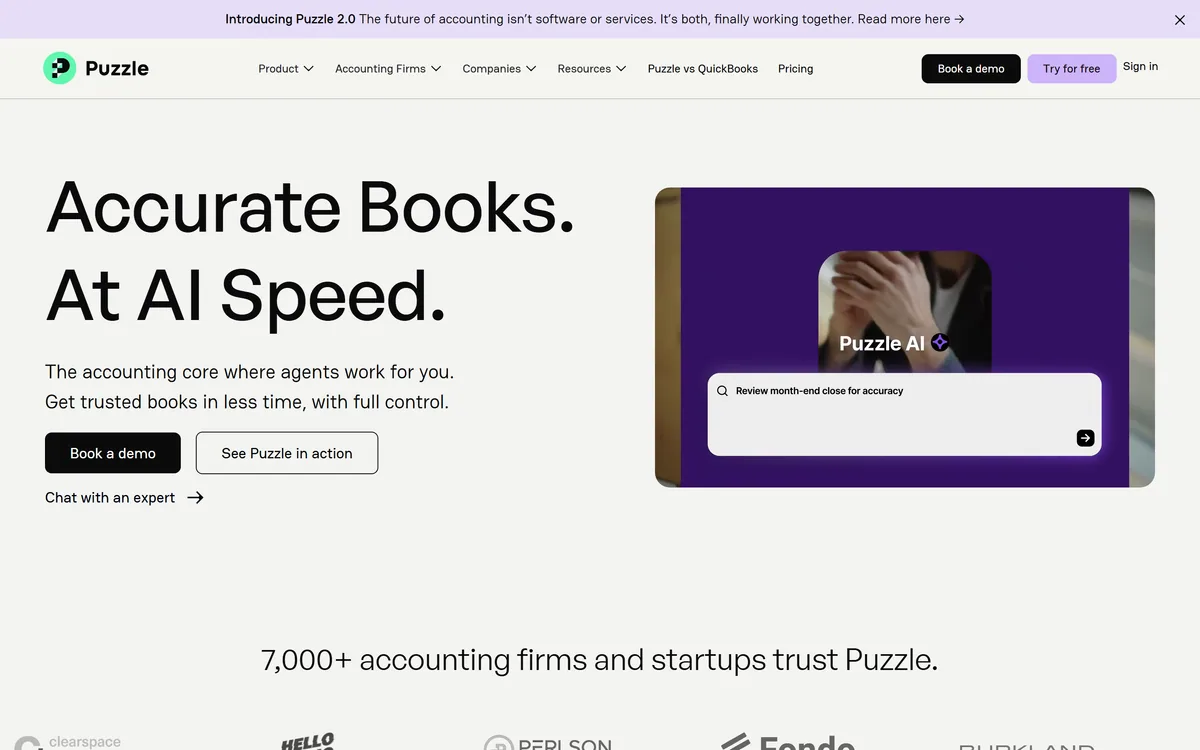
Puzzle's homepage, captured 9 September 2026, showing the AI accounting positioning around the month-end close.
Puzzle In Five Lines Of Accounting
AI Close runs the month-end close with agents handling categorisation, reconciliation and journal entry preparation.
Accrual automation for prepaid expenses and fixed assets — the part small-company books most often get wrong.
Revenue recognition on both a cash and an accrual basis, plus invoicing that reconciles itself.
Accuracy AI is framed as auditable, which is the only framing that matters when a regulator asks.
An API and MCP make it agent-native, so workflows can be built on top rather than only used.
Why Does AI Bookkeeping Need An Accountant Anyway?
Puzzle describes AI agents handling categorisation, reconciliation and journal entry preparation while maintaining accountant oversight and control. That last clause is not a legal disclaimer — it is the product's architecture.
The reason is that accounting errors are asymmetric. A miscategorised coffee purchase costs nothing; a misclassified capital expense, a revenue recognition error, or a missed accrual can misstate a company's financial position for a year and be discovered by an auditor, an investor or a tax authority.
Machines are excellent at the first kind of decision and poor at the second, and the difference is not intelligence. It is that the second requires knowing things that are not in the transaction: what the contract says, what the company intends, how the policy has been applied historically.
This is also why the close is the right unit to automate rather than individual entries. A close has a defined start, a defined end and a review step built into it by convention, which makes it a natural place to insert agents whose work gets checked.
The framing of Accuracy AI as auditable is the part worth taking seriously. An automated entry that cannot be traced to a rule and a source document is a problem waiting to surface, and the ability to show why something was booked is worth more than the speed of booking it.
The same split governs the tax side of a business. Instead automates the mechanical parts of filing while a person remains accountable for what is filed, which is the identical architecture applied to a different obligation.
A miscategorised coffee costs nothing. A missed accrual can misstate a company's position for a year and be found by an auditor.
Accrual Automation Is The Hard Part
Puzzle handles accrual automation for prepaid expenses and fixed assets, and this is the least glamorous feature and the one that fixes the most real problems.
The issue is that small companies keep their books on a cash basis by default, because cash is what the bank feed shows. Money left, so it was an expense. That is simple, and it is wrong in a specific and consequential way.
Pay a year of insurance in January and cash accounting records twelve months of cost in one month. The January books look terrible, the following eleven look artificially good, and any decision made from either is made on a distorted picture.
Accruals fix that by spreading the cost across the period it covers, and fixed asset depreciation does the same for equipment. Both are mechanical once the policy is set — which is exactly why they suit automation and exactly why they get skipped when done by hand.
The consequence of skipping them shows up later and expensively. A company raising money or being acquired will have its books converted to accrual accounting by someone else, and discovering at that point that two years of monthly figures were misleading is a bad moment to have it explained.
Integrations Decide Whether The Books Close
Puzzle connects to Stripe, Brex, Ramp, Mercury, Gusto, Deel and Rippling, with QuickBooks supported for data import.
That list is precisely targeted, and reading it tells you the customer. Stripe is revenue, Brex and Ramp are cards and spend, Mercury is banking, Gusto and Deel and Rippling are payroll — which is the complete transaction surface of a modern startup and almost nothing else.
The reason coverage matters more than features is that an unconnected source becomes manual work, and manual work becomes the reason the close takes a week. One system exporting CSVs that somebody imports by hand undoes most of the automation elsewhere.
Payroll is the integration that matters most and is noticed least. It is the largest expense in most software companies, it has the most complex accounting — accruals, taxes, benefits, timing — and getting it in automatically removes both the biggest error source and the most tedious reconciliation.
QuickBooks appearing as import rather than sync is the significant detail. It signals that Puzzle expects to replace a general ledger rather than sit beside one, which is a bigger commitment than adding a tool and should be evaluated as such.
Firms scaling this way usually run a second stack for tax. Platforms such as Black Ore serve that half, and the two rarely overlap.
Check every transaction source you have against the integration list before committing.
Treat payroll as the integration that matters most, since it is the biggest expense and the messiest.
Set accrual policy explicitly rather than letting defaults decide it.
Insist that every automated entry can be traced to a rule and a source document.
Run a parallel close before switching, not after.
Trialling Accounting Software Safely
Accounting software is unusually risky to change, because the failure mode is not an outage — it is a set of books that were subtly wrong for three months.
Running in parallel is slower and it is the only responsible way to do this.
Pick a closed month whose numbers you already trust, and run it through Puzzle without changing your existing process.
Compare the resulting trial balance line by line against what you actually reported, and investigate every difference rather than the large ones.
Check the accrual treatment specifically, since that is where cash-basis and accrual-basis books diverge most.
Verify each integration pulled everything, by reconciling counts of transactions rather than totals.
Have whoever signs off your accounts review the automated journal entries and confirm each is traceable.
Only switch after two consecutive months where the parallel close matched, and keep the old system readable for a year.
Who Puzzle Is Actually Sold To
The site names four audiences: accounting firms scaling without adding headcount, startups wanting real-time visibility, SMBs wanting accurate books, and finance teams wanting faster closes.
The firm audience is the most interesting of the four, because it changes the product's economics. A firm adopting Puzzle applies it across many clients, which means one sale covers dozens of companies and the software's leverage compounds rather than being limited to one set of books.
It also means the review capacity the design depends on actually exists. A startup automating its close may have nobody qualified to check the agents' work; a firm has that person by definition, which is who the accountant-oversight model assumes.
For a startup the pitch is different and equally real: real-time visibility. Books closed weeks after the month ended answer questions nobody is still asking, and a company whose runway calculation is based on figures from six weeks ago is flying on old instruments.
The agent-native framing — API and MCP alongside the interface — points further ahead than either. It suggests a future where an agent asks the accounting system a question directly rather than a person opening a dashboard, which is a genuine change in what finance software is for.
For the judgement questions that remain after the books close, a research tool grounded in primary authority — Blue J, for instance — is a different purchase entirely.
Puzzle: Integrations And Audience
Product type
AI accounting and bookkeeping platform
AI Close
Month-end close automated with AI agents
Accrual Automation
Prepaid expenses and fixed assets
Invoicing
Send, track and reconcile invoices
Revenue Recognition
Automated on cash and accrual bases
Accuracy AI
Framed on the site as auditable AI accuracy
Developer surface
API and MCP, described as agent-native architecture
Last checked . Read from puzzle.io and its footer navigation, with the screenshot above captured in the same session.
Positioned as AI accounting software automating bookkeeping and the financial close
AI agents confirmed as handling categorisation, reconciliation and journal entry preparation with accountant oversight
AI Close confirmed as automating the month-end close
Accrual Automation confirmed for prepaid expenses and fixed assets
Invoicing confirmed for sending, tracking and reconciling
Revenue Recognition confirmed as automated on cash and accrual bases
Accuracy AI confirmed and described on the site as auditable
API and MCP confirmed, described as agent-native architecture
Integrations confirmed for Stripe, Brex, Ramp, Mercury, Gusto, Deel and Rippling
QuickBooks confirmed as supported for data import
Target audiences confirmed as accounting firms, startups, SMBs and finance teams
Footer sections confirmed for Product, Accounting Firms, Companies, Resources, Support and Company, including Security, Help centre and Certification Training
What we could not confirm: the operating company's legal name or location; pricing and how it scales with transaction volume or entity count; which underlying models the agents use; what accounting standards are supported beyond US practice; whether multi-entity or multi-currency accounting is available; any published accuracy measurement behind Accuracy AI; and how customer financial data is retained. We did not use the product, so nothing here reflects tested accuracy.
Editor's Verdict
4.2/5
Puzzle is well designed around a distinction that a lot of accounting AI blurs: bookkeeping is mechanical and accounting is judgement, and only the first should be automated. Categorisation, reconciliation and journal entry preparation are pattern-matching problems that machines do faster and more consistently than people; whether a cost is capitalised, how revenue is recognised, and what a number means are not. Building agents for the first while keeping accountants in control of the second is the right architecture. Accrual automation is the standout feature, because prepaid expenses and fixed assets are where small-company books quietly go wrong. AInexfinder Editor Score: 4.2/5.
Puzzle pricing
AInexfinder does not list plan prices or billing details. For current pricing, plans, and trials, visit the official Puzzle website.
Vendor pricing, credits, and billing policies change over time. Always confirm on the official site before you buy.
Frequently asked questions
What is Puzzle?
Puzzle is AI accounting software that automates bookkeeping and the month-end close. AI agents handle categorisation, reconciliation and journal entry preparation while accountants keep oversight, and it covers accrual automation, invoicing and revenue recognition, with integrations across Stripe, Brex, Ramp, Mercury, Gusto, Deel and Rippling.
Why keep an accountant in the loop at all?
Because accounting errors are asymmetric. A miscategorised coffee costs nothing; a misclassified capital expense or missed accrual can misstate a company's position for a year and be found by an auditor. Machines are excellent at mechanical decisions and poor at ones requiring knowledge that is not in the transaction.
What does accrual automation actually fix?
The distortion cash accounting creates. Pay a year of insurance in January and cash-basis books record twelve months of cost in one month — January looks terrible, the following eleven look artificially good, and any decision from either is made on a false picture. Accruals spread the cost across the period it covers.
Which systems does Puzzle connect to?
Stripe, Brex, Ramp, Mercury, Gusto, Deel and Rippling, with QuickBooks for data import. That covers a modern startup's whole transaction surface — revenue, cards, banking and payroll — and coverage matters more than features, because an unconnected source becomes the manual work that makes the close take a week.
Does Puzzle replace QuickBooks?
QuickBooks appears as import rather than as a live sync, which signals that Puzzle expects to be your general ledger rather than sit beside one. That is a bigger commitment than adding a tool, and it should be evaluated as a ledger migration — with a parallel close — rather than as a trial.
How should I trial accounting software safely?
In parallel. Take a closed month whose numbers you trust, run it through without changing your existing process, and compare the trial balance line by line — investigating every difference rather than the large ones. Switch only after two consecutive matching months, and keep the old system readable for a year.
What does auditable AI accuracy mean?
That every automated entry can be traced back to a rule and a source document. It is the right claim to make, because an entry nobody can explain is a problem waiting to surface. What is not published is any measurement behind it, so treat the framing as sound and the accuracy figure as unestablished.
Is Puzzle for accounting firms or for companies?
The site names both, plus startups and finance teams. The firm audience is the more natural fit for the design, because the accountant-oversight model assumes a qualified reviewer exists — which a firm has by definition and a small startup frequently does not.
What does agent-native architecture mean here?
An API and MCP alongside the interface, so an AI agent can query and act on the accounting system directly rather than a person opening a dashboard. That points at a real change in what finance software is for — from something you look at to something other software asks questions of.
Will it handle multi-entity or multi-currency accounting?
Not stated on the pages we read, and worth resolving before evaluating if you need either. The integration list and audience framing both point at US-based, single-entity startups, and accounting products that serve that segment well frequently do not extend cleanly to consolidated groups or non-US standards.
Daniel reviews AI tools the slow way — by actually using them on real projects. His reviews cover what works, what breaks, and who each tool is genuinely a good fit for.
Daniel and the AInexfinder editorial team research Puzzle using public product information, listing evidence, and (when available) hands-on checks. Scores reflect listing completeness and transparency — not paid placement.
Listings may include affiliate or sponsored placements, which are labeled when present. Editorial scores and cons are not sold. See our affiliate disclosure and review methodology.
Instead is an AI agent platform for tax work spanning research across 1,500+ authoritative sources, document extraction from K-1s, W-2s and 1099s, multi-entity planning, and e-filing with the IRS, 48 states and cities across all five entity types. The platform is free, with agent work charged per credit.
Black Ore's Tax Autopilot runs the administrative, preparation, review and audit stages of a US tax return, plugging into the tax software firms already use. It is sold to large CPA firms, backed by a notable investor group, and currently focused on individual returns with entity forms following.
.webp)