Black Ore's Tax Autopilot runs the administrative, preparation, review and audit stages of a US tax return, plugging into the tax software firms already use. It is sold to large CPA firms, backed by a notable investor group, and currently focused on individual returns with entity forms following.
blackore.ai8 viewsAdded October 5, 202510K visitors
Tax preparation is one of the few professional workflows where the case for automation writes itself. The work is seasonal, brutally compressed, highly repetitive, and staffed by people who are expensive and increasingly hard to hire.
Black Ore is built for that specific pain, and it is built for the firms that feel it hardest. Tax Autopilot is not a chatbot bolted onto a tax product; it is positioned as an end-to-end system that gathers client documents, classifies them, extracts the data, performs the calculations, assembles the workpapers, flags anomalies for a reviewer and produces an audit-ready package.
What follows covers what the four modules actually do, why the integration list matters more than any feature, how to read the efficiency claims on the homepage, and the questions a firm should get answered before signing.
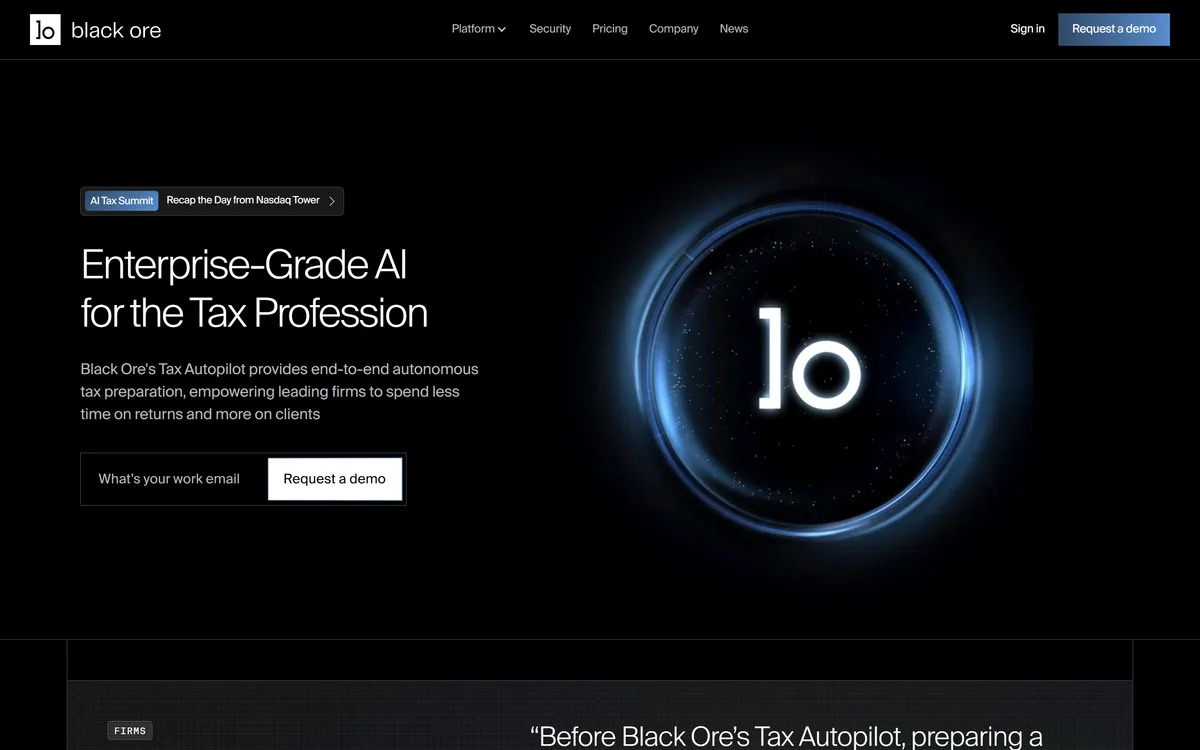
Black Ore's homepage, captured 9 September 2026. The positioning is enterprise from the first line — this is sold to firms, not to individual preparers.
Black Ore At Firm Level
Product
Tax Autopilot — autonomous US tax return preparation
Buyer
Accounting firms, positioned at the largest US CPA firms
Oak HC/FT, Andreessen Horowitz, Founders Fund, General Catalyst, Khosla Ventures, Trust Ventures
Access model
Demo request and sales process; no self-serve tier
Published policies
Privacy Policy and Terms of Service
The Short Version For Firm Leadership
Tax Autopilot covers four stages — admin, preparation, review and audit support — rather than automating one step and leaving the rest manual.
It works inside your existing tax software, with stated integrations for CCH Axcess, ProSystem fx, UltraTax CS, GoSystem Tax RS, Lacerte, ProConnect, ProSeries, Drake and ATX.
Individual returns are the live product. Entity and fiduciary forms are presented as arriving rather than shipped, which sets the realistic scope of a first engagement.
The customer list is the strongest evidence: Baker Tilly, Withum and Grassi among Top 25 firms, with Honkamp and Maxwell Locke & Ritter in the Top 100.
There is no self-serve entry. Access runs through a demo and a sales conversation, so budget and procurement time are part of the cost.
Four Stages, Not One Clever Trick
Most AI tax tools attack a single step — usually document extraction, because it is the easiest to demonstrate; research assistants such as TaxGPT never touch return production at all. Black Ore's structure is broader, and the breadth is the point.
The administrative module generates client data requests, classifies documents as they arrive and assembles the binder and workpapers without someone naming and filing each PDF. Anyone who has run a tax season knows this stage consumes an unreasonable share of junior hours for work that produces no professional judgement.
Preparation extracts figures from source documents, runs the calculations and pushes the result into the firm's tax engine, producing an Excel tie-out package alongside. Review applies anomaly and error detection, gives the reviewer a copilot over the return, and packages it for signoff. The audit module keeps documents indexed with evidence linked to the steps that used them, and exports the package.
The reason the four-stage shape matters is that automating extraction alone rarely changes the economics. If the data lands accurately but a person still has to assemble the binder, chase the missing 1099 and re-key the result into CCH, the saving is a fraction of what the demo implied.
Automating one step of a return changes a task. Automating the handoffs between steps is what changes a season.
Which Returns It Actually Handles Today
Form coverage is the first question to ask, and the site answers it plainly enough: individual returns are the live capability, with fiduciary and partnership forms and the associated K-1 and K-3 schedules presented as arriving rather than shipped.
That is a sensible sequencing decision. Individual returns are the highest-volume, most templated work in most firms, which makes them both the best automation target and the safest place to prove a system.
For a buyer it sets the realistic shape of a first year. If your firm's pain is complex partnership allocations, this is a roadmap conversation rather than a purchase, and analysis tools such as Blue J address a different part of that problem. If your pain is a wall of individual returns between February and April, the live product addresses it. Confirm the current status of each form family in writing before committing — roadmap language moves faster than roadmaps do.
Nine Tax Engines, And Why That List Matters Most
Black Ore states integrations with ATX, CCH Axcess Tax, CCH ProSystem fx, Drake Tax, GoSystem Tax RS, Intuit Lacerte, Intuit ProConnect, Intuit ProSeries and UltraTax CS.
That list is the most commercially serious thing on the site. Tax software is the deepest incumbency in professional services — a firm's engine choice is entangled with its billing, its document management, its staff training and a decade of prior-year returns. A tool that requires migrating off CCH Axcess will not be bought, however good it is.
Nine engines also implies real engineering investment rather than a single connector demonstrated on stage. Each of these products has its own data model, its own import mechanics and its own quirks across versions.
The question to press in a demo is what depth means for your engine specifically. Read-only import of extracted figures and full round-trip write-back with diagnostics are both truthfully described as an integration, and they are entirely different products in practice.
Ask which of the nine integrations your firm's engine uses, and which version it was certified against.
Ask whether data flows one way or round-trips, and what happens when the engine rejects a value.
Ask how prior-year data is used, since carryforward is where most extraction tools quietly break.
Ask what the reviewer sees when the system is unsure — a flagged field is useful, a silently confident wrong number is not.
Ask who is accountable for an error that reaches a filed return, and get the answer from the engagement letter rather than the sales deck.
Reading The Efficiency Numbers Honestly
The homepage carries a set of striking figures: better than 99% accuracy on data extraction, 98% time savings on preparation, 80% lower cost per return, more than double the review speed, and a claim of zero turnaround time.
These deserve scrutiny, and the last one deserves the most. Zero turnaround time is not a measurable quantity — every process has a duration. It reads as marketing emphasis rather than a metric, and its presence alongside the others is a reason to treat the whole set as directional.
The 98% figure is the one to interrogate in a demo. Time savings against what baseline? A return prepared from scratch by a first-year associate with no prior-year file is a very different denominator from a returning client's straightforward filing. Firms measuring their own before-and-after almost always find the honest number is large, real, and considerably below the marketing figure.
None of this means the product does not work. It means the evidence you should weigh is the customer list, not the percentages. Baker Tilly, Withum and Grassi are firms with procurement functions, security reviews and professional liability exposure; they do not deploy a tax system on the strength of a homepage claim. That is a far stronger signal than any number the vendor chose to print.
What A Firm Should Verify Before Signing
Because there is no self-serve tier, evaluation happens inside a sales process. That makes a written checklist more valuable than usual — it is easy to leave a good demo without having asked the questions that matter in April.
Run this sequence rather than reacting to the demo script.
Bring your own returns. Ask to run a sample of real prior-year files, including two you found genuinely difficult, rather than watching a prepared demonstration.
Check the exception path first. Ask to see what happens on a return the system cannot complete, because that is the case that will consume your staff's time.
Get the security review started early. Ask for the SOC 2 report under NDA, plus data residency, retention, deletion and subprocessor detail — not the summary claim on the site.
Confirm form coverage and dates in writing for every form family your firm files in volume.
Pilot on a defined slice of the season with a measured baseline, so your own before-and-after number replaces the vendor's.
Security, And Why It Is The Gating Question Here
A tax platform holds the most sensitive dataset a household has: identifiers, income, dependants, brokerage activity, health-related deductions and the documents behind all of it. For a firm, a breach here is not an IT incident but a professional and regulatory one.
Black Ore states US-based, SOC 2-compliant infrastructure. That is the right claim to make and it is the beginning of the conversation rather than the end of it. A firm should ask which SOC 2 type the report covers, what period it spans, which trust criteria are in scope, and what the exceptions were.
The site publishes its privacy policy and terms of service, which are the documents that actually bind. Read the data-use provisions closely, particularly anything covering model improvement, and get a written answer on whether client data is ever used to develop the product.
For a firm with an information security programme, none of this is unusual diligence — it is the same review a law firm would run before deploying Harvey AI. It is worth stating only because AI vendors are frequently newer than the firms buying them, and the depth of a security programme rarely matches the confidence of a homepage.
Ask for the SOC 2 report itself, its type, and its observation period.
Get an explicit written position on whether client data trains or improves models.
Confirm data residency and the retention and deletion schedule for source documents.
Request the subprocessor list, including which model providers process return data.
Agree breach notification timelines that match your own client commitments.
How Black Ore Is Sold
There is no published price, no free tier and no trial. Access begins with a demo request, which is the standard motion for enterprise software sold to firms with procurement functions.
That structure carries real information. Contact-sales pricing usually means the figure is negotiated against firm size, return volume, seat count and term, and that the vendor expects an implementation alongside the licence. It also means the true cost includes your own people's time: security review, integration work, staff training and a supervised first season.
The investor group — Oak HC/FT, Andreessen Horowitz, Founders Fund, General Catalyst, Khosla Ventures and Trust Ventures — tells you the company is funded to sell this way and is not under pressure to convert self-serve signups. For a buyer, well-funded is mostly good news: the vendor will still exist next season.
Budget for the evaluation as well as the licence. A pilot that measures a real baseline against a real slice of your season is the only way to know what the system is worth to your firm, and it is not free to run.
Key features of Black Ore
Automated client data requests and AI classification of incoming tax documents
Autonomous binder and workpaper assembly, removing manual filing and naming
Data extraction from source documents with automated calculation of the return
Two-way work with the firm's existing tax engine across nine named products
Excel tie-out package generation alongside the prepared return
Anomaly and error detection with a reviewer copilot over the completed return
Team review workflows producing a ready-to-signoff package
Centralised, indexed document storage with evidence linked to each step and exportable audit packages
Pros & cons
Pros
6
Covers the whole return workflow rather than automating extraction and leaving the handoffs manual
Integrates with the nine tax engines large US firms actually run, instead of asking them to migrate
Named Top 25 and Top 100 accounting firms as customers — the strongest available evidence for enterprise software
Investor group implies serious diligence and the funding to still exist several seasons from now
Sensible sequencing: prove the system on high-volume individual returns before entity complexity
Audit module keeps evidence linked to the steps that used it, which is what a reviewer and an examiner both need
Cons
6
Headline efficiency figures carry no stated baseline, sample or methodology, and one of them is not a measurable quantity
Entity and fiduciary coverage is still arriving, so firms whose pain is partnership work are buying a roadmap
No self-serve tier or trial, so evaluation requires entering a sales process and committing staff time
Security posture is stated rather than evidenced publicly — the SOC 2 report is not available without a process
US-only in practice, since the product is built around US forms and US tax software
Integration depth per engine is not published, and read-only import and full round-trip are very different products
Best For
Large and mid-sized US accounting firms constrained by preparer capacity
Firms running high volumes of individual returns through a compressed season
Practices committed to an existing tax engine that they will not replace
Firm leadership able to fund and measure a real pilot
Teams that need an audit trail linking evidence to each step of a return
Where Black Ore Sits Among AI Tools For Professionals
Tax has fewer credible AI entrants than law or research, so the useful comparison spans adjacent professional domains with the same structure: regulated work, incumbent software, and a firm rather than an individual as the buyer.
Tool
Domain
Automation depth
Who buys it
Black Ore
US tax preparation
End to end across admin, prep, review and audit support
Deep in one document type, with the attorney retained in the loop
IP firms and corporate IP departments
Is Black Ore Right For Your Firm?
Worth a demo if
You run individual returns at volume and the February-to-April staffing crunch is your binding constraint.
Your firm already runs one of the nine named tax engines and will not consider replacing it.
You have a procurement and information security function able to run a real vendor review.
You can staff a measured pilot against a genuine baseline rather than judging by demo.
Your growth is capped by preparer capacity rather than by client demand.
Not your firm’s tool if
You are a sole practitioner or a small practice — this is priced and implemented for firms with procurement processes.
Your volume is concentrated in partnership or fiduciary returns, where coverage is still arriving rather than live.
You need to evaluate software by trying it, because there is no self-serve or trial path here.
You want tax research and answers rather than return production; that is a different category of tool.
Your practice is outside the United States, since the product is built around US forms and US tax software.
Our Check On Black Ore
Last checked . Read from blackore.ai, including the footer, with the screenshot above captured in the same session.
Product named as Tax Autopilot and described as end-to-end autonomous tax preparation for accounting firms
Four modules confirmed on the site: Admin, Prepare, Review and Audit, with the capabilities listed under each
Individual returns presented as the live capability, with 1041, 1065 and K-1 and K-3 schedules presented as arriving
Nine tax software integrations listed by name, covering the CCH, Intuit, Thomson Reuters and Drake product families
Named customers listed on the site including Baker Tilly, Withum, Grassi, Honkamp PC, Maxwell Locke and Ritter, and Elevate
Security described on the site as US-based, SOC 2-compliant infrastructure
Investor group listed as Oak HC/FT, Andreessen Horowitz, Founders Fund, General Catalyst, Khosla Ventures and Trust Ventures
Access confirmed as demo request only, with no published self-serve tier or trial
Footer read directly and confirmed to link the Privacy Policy and Terms of Service
What we could not confirm: none of the efficiency figures on the homepage carries a stated methodology, sample or baseline, and we found no independent measurement of them; the claim of zero turnaround time is not a quantity that can be verified; the SOC 2 report itself is not public, so the type, period and scope are unknown from outside; and because there is no self-serve access, nothing here reflects hands-on use of the product.
Adjacent Tools Worth Knowing
Different problems, similar buyers — professional firms automating regulated, document-heavy work.
TaxGPT — tax research and answers, and a realistic option for practices too small for an enterprise deployment
Blue J — analysis of tax law and outcomes rather than preparation of returns
Harvey AI — the equivalent enterprise motion in law, useful as a benchmark for what firm-scale AI procurement looks like
Solve Intelligence — a narrower professional workflow, showing what depth in one document type buys
Cypris — research automation for technical teams, another buyer that evaluates on integration rather than features
Editor's Verdict
4.0/5
Black Ore scores well because the evidence that matters in enterprise software is present: named Top 25 and Top 100 accounting firms as customers, integrations with the nine tax engines those firms actually run, and an investor group that does diligence before writing cheques. The product is also correctly scoped — it works inside the existing tax software rather than asking a firm to replace it. It loses ground because the headline efficiency figures are unattributed and implausibly round, because entity returns are still arriving while only individual returns are live, and because a firm cannot evaluate any of it without entering a sales process. AInexfinder Editor Score: 4.0/5.
Black Ore pricing
AInexfinder does not list plan prices or billing details. For current pricing, plans, and trials, visit the official Black Ore website.
Vendor pricing, credits, and billing policies change over time. Always confirm on the official site before you buy.
Frequently asked questions
What is Black Ore's Tax Autopilot?
An AI platform that runs US tax return preparation end to end for accounting firms, across four stages: administrative work such as client data requests and document classification, preparation and calculation, review with anomaly detection, and audit support with indexed, evidence-linked documentation.
Which tax software does Black Ore work with?
The site lists nine integrations: ATX, CCH Axcess Tax, CCH ProSystem fx, Drake Tax, GoSystem Tax RS, Intuit Lacerte, Intuit ProConnect, Intuit ProSeries and UltraTax CS. Confirm the depth of the integration for your specific engine, because importing extracted values and writing a return back with diagnostics are both described as integration and are very different in practice.
Which tax forms can Black Ore actually handle?
Individual returns are the live capability. Fiduciary and partnership returns, together with K-1 and K-3 schedules, are presented as arriving rather than shipped. If your firm's volume sits in entity work, get current status and dates in writing before committing.
Is Black Ore free, and how is it priced?
It is not free and there is no trial or self-serve tier. Access starts with a demo request and runs through a sales process, which usually means pricing is negotiated against firm size, return volume and contract term. We do not publish amounts. Budget for the evaluation itself — security review, integration work and a supervised pilot season all consume firm time.
How reliable are the accuracy and time-saving figures on the site?
Treat them as directional. None carries a stated baseline, sample or methodology, and the claim of zero turnaround time is not a measurable quantity at all. The stronger evidence is the customer list: firms of that size run security reviews and carry professional liability, so their adoption says more than any percentage.
Is client data safe with Black Ore?
The site states US-based, SOC 2-compliant infrastructure, and publishes a privacy policy and terms of service. That is the right starting point rather than a complete answer. Ask for the SOC 2 report under NDA, along with its type and observation period, plus data residency, retention and deletion terms, the subprocessor list, and an explicit written position on whether client data is used to develop the product.
Can a small accounting practice use Black Ore?
Realistically, no. The product is positioned at the largest US CPA firms, sold through a demo and negotiation, and implemented alongside an existing tax engine. A sole practitioner or small practice is better served by assistive tools such as TaxGPT for research, or by the AI features their existing tax software already ships.
Daniel reviews AI tools the slow way — by actually using them on real projects. His reviews cover what works, what breaks, and who each tool is genuinely a good fit for.
Daniel and the AInexfinder editorial team research Black Ore using public product information, listing evidence, and (when available) hands-on checks. Scores reflect listing completeness and transparency — not paid placement.
Listings may include affiliate or sponsored placements, which are labeled when present. Editorial scores and cons are not sold. See our affiliate disclosure and review methodology.
Instead is an AI agent platform for tax work spanning research across 1,500+ authoritative sources, document extraction from K-1s, W-2s and 1099s, multi-entity planning, and e-filing with the IRS, 48 states and cities across all five entity types. The platform is free, with agent work charged per credit.
Puzzle is AI accounting software that automates categorisation, reconciliation and journal entries while keeping accountant oversight. It covers AI Close, accrual automation, invoicing and revenue recognition, and connects to Stripe, Brex, Ramp, Mercury, Gusto, Deel and Rippling.