Tamarind Bio is a cloud platform that puts the state of the art in computational biology, AlphaFold, RFdiffusion, ProteinMPNN, GROMACS and over a hundred more tools, behind one web interface and API, so scientists can design antibodies, peptides, enzymes and small molecules without deploying anything.
Cypris
Verified
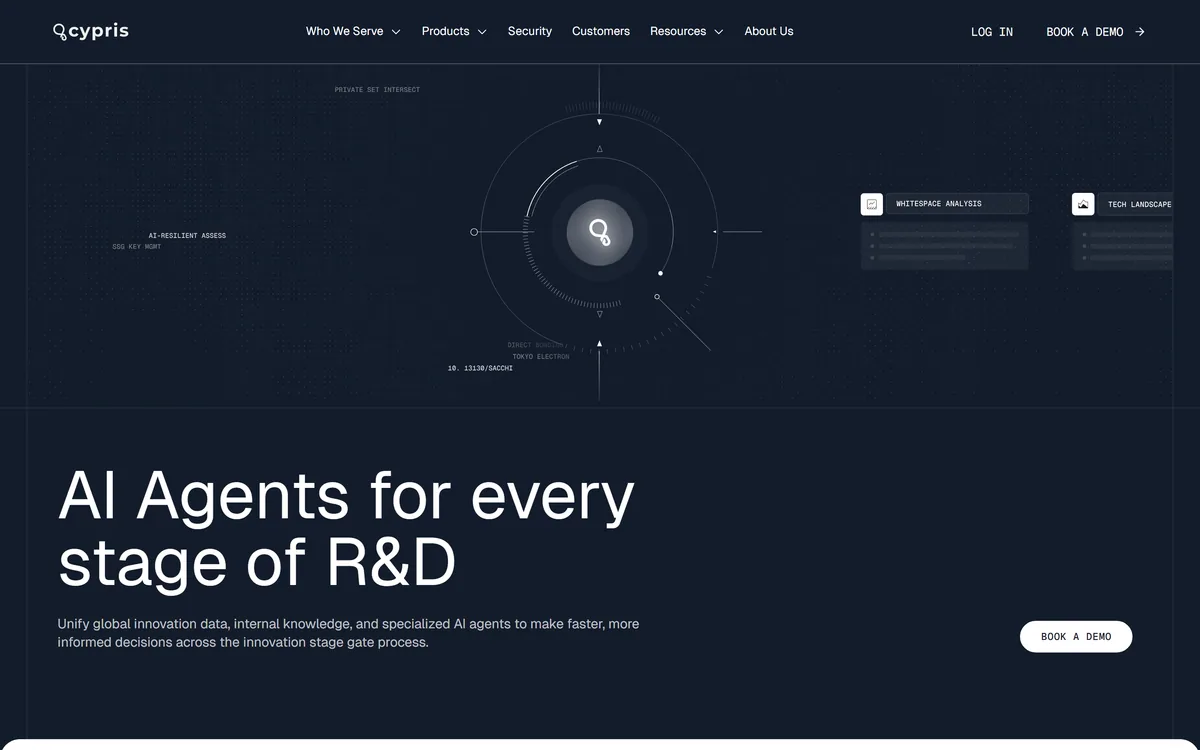
Cypris is an innovation intelligence platform for R&D and IP teams. It searches across patents, scientific literature, chemical compounds and market sources, runs purpose-built agents for technology scouting, prior art and white space analysis, and connects internal project knowledge to that external data.
4.4Editor Score
cypris.ai8 viewsAdded July 3, 20252K visitors
Innovation Intelligence, Briefly
- Cypris is a research intelligence platform that searches patents, scientific papers, chemical data and market sources together, and applies task-specific AI agents to the results — built for R&D and IP teams rather than for general search.
- The corpus is the differentiator: 180M+ patent documents from 150+ countries, 280M+ papers from 20,000+ journals, 120M+ indexed chemical compounds, and 1M+ tracked market sources.
- Agents are scoped by task — technology scouting, literature review, competitive intelligence, prior art, regulatory research and white space identification — rather than one general chat box.
- It joins internal and external knowledge, which is the part most competitors do not attempt: your own project history alongside the global record.
- Named customers include Johnson & Johnson, Honda, Yamaha, NASA and Philip Morris International, and it sells contact-sales to enterprises.
Corpus, Agents And Assurance
| Category | R&D and innovation intelligence, patent and literature research |
|---|---|
| Patent coverage | More than 180 million documents from over 150 countries |
| Scientific literature | More than 280 million searchable papers from over 20,000 journals |
| Chemical data | More than 120 million indexed compounds with vendor resolution |
| Market and news | More than 1 million tracked sources across 200+ countries |
| Named agent tasks | Technology scouting, literature review, competitive intelligence, prior art, regulatory research, white space identification |
| Knowledge management | Unifies internal project data and institutional expertise with external intelligence |
| Research Briefs | Analyst-supported custom reports across patent, scientific, chemical, regulatory and market data |
| Model partnerships | Stated official API partnerships with OpenAI, Anthropic and Google |
| Technical approach | Proprietary R&D ontology, knowledge graph, retrieval-augmented generation grounded in sources |
| Integrations | Connects Claude, ChatGPT and Copilot to Cypris data |
| Assurance | SOC 2 Type II, with the vendor stating zero data training and US-based infrastructure |
| Named customers | Johnson & Johnson, Honda, Yamaha, Philip Morris International, NOV, Brooks Running, Catalent, NASA |
| Charging model | Contact sales, enterprise, seat-based with tiered access; no prices published here |
IP And R&D Terms Used Here
Five terms carry the weight in this field and mean something precise rather than general.
- Prior art
- Any existing public disclosure — patent, paper, product, conference talk — that may invalidate a patent claim. Missing one is the defining failure of a search.
- Freedom to operate
- An assessment of whether commercialising something would infringe existing rights. A legal opinion, informed by search but not produced by it.
- White space
- An area of technology with little existing patent or research activity, sought as an opportunity. Reasoning about absence, which is much harder than retrieval.
- Technology scouting
- Systematically looking outside your organisation for relevant developments, partners or acquisition targets.
- Markush claim
- A chemistry patent claim covering a family of related compounds through a general structure rather than listing each one — a well-known reason chemical patent search is specialised.
Why Patent Search Is Genuinely Hard
It is worth explaining what makes this a real problem, because from outside it looks like search with a bigger index.
Patents are written to be simultaneously legally precise and as broad as the examiner will allow. That produces prose written by lawyers to avoid the obvious word. A patent covering a bicycle brake may never use the phrase bicycle brake — it describes a friction-based deceleration mechanism for a wheeled personal conveyance.
So keyword search fails structurally rather than incidentally. The document you most need is the one that never used your term, and you cannot know it exists to look for it.
The second difficulty is scale with consequences. 180 million documents is not a corpus you sample; in prior art work, missing one document is the entire failure mode. A patent granted over undisclosed prior art can be invalidated later, which is a far more expensive outcome than not filing.
Literature tools like Elicit exist for exactly that half of the problem. The third is that the answer often is not in the patents at all. A published paper, a conference abstract or a product datasheet can be prior art. Searching patents alone leaves a gap that only shows up in litigation.
That combination — obfuscated language, unforgiving scale, and evidence scattered across document types — is exactly the shape of problem semantic search and a domain ontology are suited to, and it is why this category can charge enterprise rates.
The document that sinks your patent is the one that never used your words. Keyword search cannot find it, and that is the whole reason this category exists.
Task-Scoped Agents Beat One Chat Box
Cypris splits its AI into agents named for specific jobs rather than offering a single assistant, and that is a more meaningful design decision than it first appears.
These tasks look similar and differ sharply in what a good answer means. Technology scouting rewards breadth — you want to see everything adjacent, including things you would not have thought to ask about. Prior art rewards exhaustiveness in a narrow band, where a miss is the failure. White space requires reasoning about absence, which is a genuinely different operation from retrieval.
A single general assistant tuned for helpfulness will optimise for a satisfying answer, and a satisfying answer is the wrong target for prior art. What you want there is an uncomfortable one.
The retrieval-augmented approach with sentence-level grounding matters for the same reason. In this field an unsourced assertion is not merely unhelpful — it is unusable, because the output frequently ends up supporting a filing decision or a legal position.
The stated official API partnerships with OpenAI, Anthropic and Google — the providers behind Claude and its peers — are worth noting for a specific reason: enterprise R&D buyers care about where their queries go. Formal partnerships with zero-retention terms are a different posture from consumer API access, and it is the sort of detail that clears a procurement review.
Joining Internal Knowledge To The Global Record
The knowledge management piece is the most underrated part of the platform and the hardest to replace with anything else.
Large R&D organisations have a chronic and expensive problem: they do not know what they already know. Work is done, written up, filed in a project system, and the person who did it moves team or leaves. Three years later a different group runs the same experiment because there was no way to discover the first one.
External databases cannot help with this. No amount of patent coverage tells you that a team in another division tried this in 2021 and abandoned it for a reason that is still valid.
Combining both in one search is a genuinely different capability from either alone. It means a technology scouting query can return the global state of the art alongside your own organisation's prior attempts, which is the actual context a decision needs.
It also raises the question to settle first in any deployment: getting internal knowledge into the system requires it to exist in a usable form. Organisations whose institutional memory is in individual inboxes and personal drives will find that the data preparation, not the software, is the project.
- Pick a technology question your team already researched thoroughly and knows the answer to.
- Run it through the platform and check whether it finds what your analysts found — and what they missed.
- Deliberately test a prior art query in an area where you know of an obscure non-patent reference.
- Assess how internal project data would actually be ingested, and who would maintain it.
- Confirm the data residency and retention terms with your own legal team, not from the marketing page.
Procuring It
This site does not publish plan prices, and Cypris does not either. The structure is what you can plan around.
The model is contact-sales enterprise licensing, appearing to be seat-based with tiered levels of access. There is no self-serve entry point, which is consistent with the customer list and the data licensing underneath.
That last point explains the shape. A platform indexing 180 million patents and 280 million papers is paying for data access, and those upstream costs are why nothing in this category is cheap or metered casually.
Two structural variables usually drive the quote: how many seats, and which data collections and agent capabilities are included at each tier. Chemical and regulatory data in particular are often separately licensed rather than universally included.
The Research Briefs offering is worth understanding as a distinct line item — analyst-supported custom reports are a service, not software, and they are priced and scheduled accordingly.
For anyone comparing this against a general research tool, the honest framing is that you are not paying for the AI. You are paying for licensed access to corpora that are expensive to assemble and maintain, with the AI as the interface to them.
What Still Needs A Human
Three things, and the first is a legal distinction that matters enormously.
A search is not an opinion. Drafting the filing itself is a separate product again — Solve Intelligence occupies that end. Freedom-to-operate and patentability searches inform a legal conclusion; they are not the conclusion. That judgement is made by a qualified attorney who takes professional responsibility for it, and no platform output substitutes for that.
Absence of evidence is the hardest result to trust. White space analysis finds gaps, and a gap in the data can mean nobody has done this, or it can mean everyone tried and failed quietly, or that the work exists in a form the corpus does not cover. Distinguishing those requires domain expertise the tool does not have.
Coverage is never total. Trade secrets are, by design, not in any database. Recent filings are unpublished for eighteen months. Non-English and non-patent literature coverage varies. A confident empty result is the output to be most suspicious of.
Used properly, this compresses the weeks of searching that precede expert judgement — which is a large and genuine saving. It does not compress the judgement itself, and organisations that treat it as though it does are taking a risk the software cannot carry.
- Freedom-to-operate and patentability conclusions remain attorney work
- Recent filings stay unpublished for around eighteen months and are invisible to everyone
- Trade secrets are absent from every database by definition
- An empty white space result may reflect a coverage gap rather than an opportunity
- Internal knowledge is only searchable if it was written down in the first place
Key features of Cypris
Unified search across patents, scientific literature, chemical and market data
Task-specific agents for scouting, prior art, competitive intelligence and white space
Regulatory research agent
Knowledge management joining internal project data to external sources
Analyst-supported Research Briefs
Proprietary R&D ontology for technical concept mapping
Knowledge graph linking concepts and entities
Retrieval-augmented generation grounded in cited sources
Connections to Claude, ChatGPT and Copilot
Stage-gate agents deployable around custom R&D workflows
SOC 2 Type II with stated zero training on customer data
Pros & cons
Pros
6- Corpus breadth across patents, papers and chemicals is the genuine differentiator here
- Task-scoped agents fit a field where the right answer differs sharply by question type
- Source-grounded output is essential when findings feed filing and legal decisions
- Joining internal knowledge to external data solves a real and expensive organisational problem
- Named customers span pharma, automotive, aerospace and consumer, which is a credible spread
- Explicit zero-training terms and formal model partnerships clear enterprise procurement
Cons
6- Contact-sales enterprise licensing with no self-serve entry point
- Chemical and regulatory collections may be licensed separately rather than included
- Internal knowledge search is only as good as what your organisation actually wrote down
- White space results can reflect coverage gaps rather than genuine opportunities
- No platform output replaces an attorney's opinion, which is where the liability sits
- Corpus and certification claims are vendor-stated and not independently audited
Best For
- Corporate R&D teams running continuous technology scouting
- In-house IP teams doing prior art and landscape work
- Pharmaceutical and chemical research organisations
- Innovation and strategy functions tracking competitive activity
- Large organisations trying to make internal research history searchable
Cypris Beside Other Research Platforms
Only some of these overlap; the split is between IP-grade search and general literature work.
| Tool | Corpus | Built for | Depth of assurance |
|---|---|---|---|
| Cypris | Patents, papers, chemicals, market sources | R&D and IP teams in large organisations | SOC 2 Type II, stated zero training on your data |
| Elicit | Academic papers | Systematic literature review | Research-grade, not IP-grade |
| Consensus | Peer-reviewed literature | Quick evidence answers | Consumer and academic |
| Solve Intelligence | Patent documents and prosecution history | Drafting and prosecuting patents | SOC 2 Type II and ISO 27001 |
| Semantic Scholar | Academic papers | Free literature discovery | Open academic resource |
Does Your Organisation Need This?
An R&D Team Should Look If
- You run technology scouting or competitive intelligence as an ongoing function
- Prior art and freedom-to-operate searching is a recurring cost in your business
- Your research spans patents, papers and chemical data rather than one of them
- You have institutional knowledge scattered across teams and no way to search it
- Procurement requires SOC 2 and explicit terms on model training
Nothing Here For You If
- You need occasional literature search rather than continuous intelligence
- You are an individual inventor or a small firm without an enterprise budget
- Your questions are academic rather than commercial or IP-related
- You would treat search output as a legal opinion rather than an input to one
- Your internal knowledge exists only in people's heads and inboxes
Other Tools For Research And IP Work
These divide between drafting patents, searching literature and general reading, and most teams use more than one.
- Solve Intelligence — the drafting and prosecution side of patent work rather than search
- Elicit — systematic literature review for academic and scientific questions
- Consensus — faster evidence answers from peer-reviewed research
- Semantic Scholar — free academic discovery, useful as a sanity check
- Claude — the general model many of these platforms now connect to directly
Corpus Claims And Checks
Last checked . Read from cypris.ai during this check, with the screenshot above captured at the same time.
- Patent coverage stated as more than 180 million documents from over 150 countries
- Scientific literature stated as more than 280 million papers from over 20,000 journals
- Chemical coverage stated as more than 120 million indexed compounds with vendor resolution
- Market and news coverage stated as more than 1 million sources across over 200 countries
- Agent tasks named on site: technology scouting, literature review, competitive intelligence, prior art, regulatory research and white space identification
- Knowledge management described as unifying internal project data with external intelligence
- Research Briefs offered as analyst-supported custom reports
- Technical approach described as a proprietary R&D ontology with knowledge graph and retrieval-augmented generation grounded in sources
- Official API partnerships stated with OpenAI, Anthropic and Google
- SOC 2 Type II certification stated, with zero data training and US-based infrastructure
- Named customers on site: Johnson & Johnson, Honda, Yamaha, Philip Morris International, NOV, Brooks Running, Catalent and NASA
- Access sold through contact sales; no plan prices published here, in line with this site's pricing policy
Corpus sizes, coverage and certification claims are the vendor's own and were not independently audited. No search platform substitutes for a qualified attorney's opinion on patentability or freedom to operate — recent filings remain unpublished for around eighteen months, trade secrets appear in no database, and an empty result may reflect a coverage gap rather than an opportunity.
Editor's Verdict
4.4/5Cypris has an AInexfinder Editor Score of 4.4/5.
Cypris pricing
AInexfinder does not list plan prices or billing details. For current pricing, plans, and trials, visit the official Cypris website.
Visit official website for pricingVendor pricing, credits, and billing policies change over time. Always confirm on the official site before you buy.
Frequently asked questions
What does Cypris do?
It searches patents, scientific papers, chemical compounds and market sources together, and runs purpose-built AI agents over the results for technology scouting, prior art, competitive intelligence, regulatory research and white space analysis.
How much data does Cypris cover?
The vendor states more than 180 million patent documents from over 150 countries, 280 million papers from over 20,000 journals, 120 million indexed chemical compounds, and over a million tracked market sources.
How does Cypris charge?
Contact sales, enterprise, and seat-based with tiered access — there is no self-serve option. That reflects the underlying data licensing more than the software; indexing corpora at this scale is what makes the category expensive.
Can AI replace a patent attorney?
No. Search informs a legal conclusion but is not one — patentability and freedom-to-operate opinions carry professional responsibility that no platform output substitutes for. What these tools compress is the weeks of searching before the judgement, not the judgement.
Why is patent search harder than normal search?
Patents are written to be legally broad, so they systematically avoid the obvious term — a bicycle brake may be described as a friction-based deceleration mechanism. Keyword search structurally fails, and in prior art work missing one document is the whole failure mode.
Does Cypris train models on our data?
The vendor states zero data training, alongside SOC 2 Type II certification and US-based infrastructure, and describes formal API partnerships with OpenAI, Anthropic and Google. Confirm the specific contractual terms with your own legal team rather than relying on a marketing page.
Cypris vs Solve Intelligence — what is the difference?
They sit on opposite sides of the patent lifecycle. Cypris is intelligence and search across a broad corpus for R&D and IP teams; Solve Intelligence is built for drafting and prosecuting the applications themselves. Large organisations often use both.
Reviews
Log in to write a review.
User Reviews
No reviews yet. Be the first to share your experience with Cypris.
Reviewed by Daniel Reed
Assigned reviewer
Daniel ReedSenior AI Tools Reviewer
Daniel reviews AI tools the slow way — by actually using them on real projects. His reviews cover what works, what breaks, and who each tool is genuinely a good fit for.
Hands-on reviewsProduct testingAI software
Daniel and the AInexfinder editorial team research Cypris using public product information, listing evidence, and (when available) hands-on checks. Scores reflect listing completeness and transparency — not paid placement.
- Last verified
- Methodology
- How we review AI tools
- Sources used
- cypris.ai
- AInexfinder listing fields (features, pros/cons, description)
- Public vendor pages when available
- Editorial policy
- Listings may include affiliate or sponsored placements, which are labeled when present. Editorial scores and cons are not sold. See our affiliate disclosure and review methodology.
Related tools
Iktos is an AI and robotics drug-discovery company combining generative molecular design (Makya), AI retrosynthesis (Spaya) and automated synthesis and testing robotics into a design-make-test-analyse loop aimed at shortening early drug discovery, offered to pharma and biotech research teams.
EOSDA Crop Monitoring is a satellite-based precision agriculture platform from EOS Data Analytics. It combines Sentinel-2 and PlanetScope imagery with ten vegetation indices, growth-stage tracking, risk maps, yield estimation and variable-rate application maps.
FreemiumEmerging & Specialized
Insilico Medicine pairs the Pharma.ai software suite — PandaOmics, Chemistry42, inClinico and more — with its own clinical pipeline. Its lead candidate rentosertib, a TNIK inhibitor for idiopathic pulmonary fibrosis, has Phase IIa results published in Nature Medicine.
Persefoni is a carbon-accounting and sustainability-management platform for measuring, reporting and decarbonizing emissions across Scopes 1-3, with a financed-emissions module for financial services and a native AI copilot built on its own carbon-accounting model.
FreemiumEmerging & Specialized
Taranis provides AI crop intelligence from leaf-level aerial imagery, detecting stand counts, weeds, insect damage, nutrient deficiencies and disease pressure across whole fields. Its products include Taranis Yield Impact and Ag Assistant, with a mobile app and web dashboard.
Compare:Cypris vs Tamarind BioCypris vs IktosCypris vs EOSDA Crop MonitoringCypris vs Insilico Medicine
Cypris alternatives Explore More
Embed this listing on your site
Featured on AInexfinder