Tamarind Bio is a cloud platform that puts the state of the art in computational biology, AlphaFold, RFdiffusion, ProteinMPNN, GROMACS and over a hundred more tools, behind one web interface and API, so scientists can design antibodies, peptides, enzymes and small molecules without deploying anything.
Persefoni
Verified
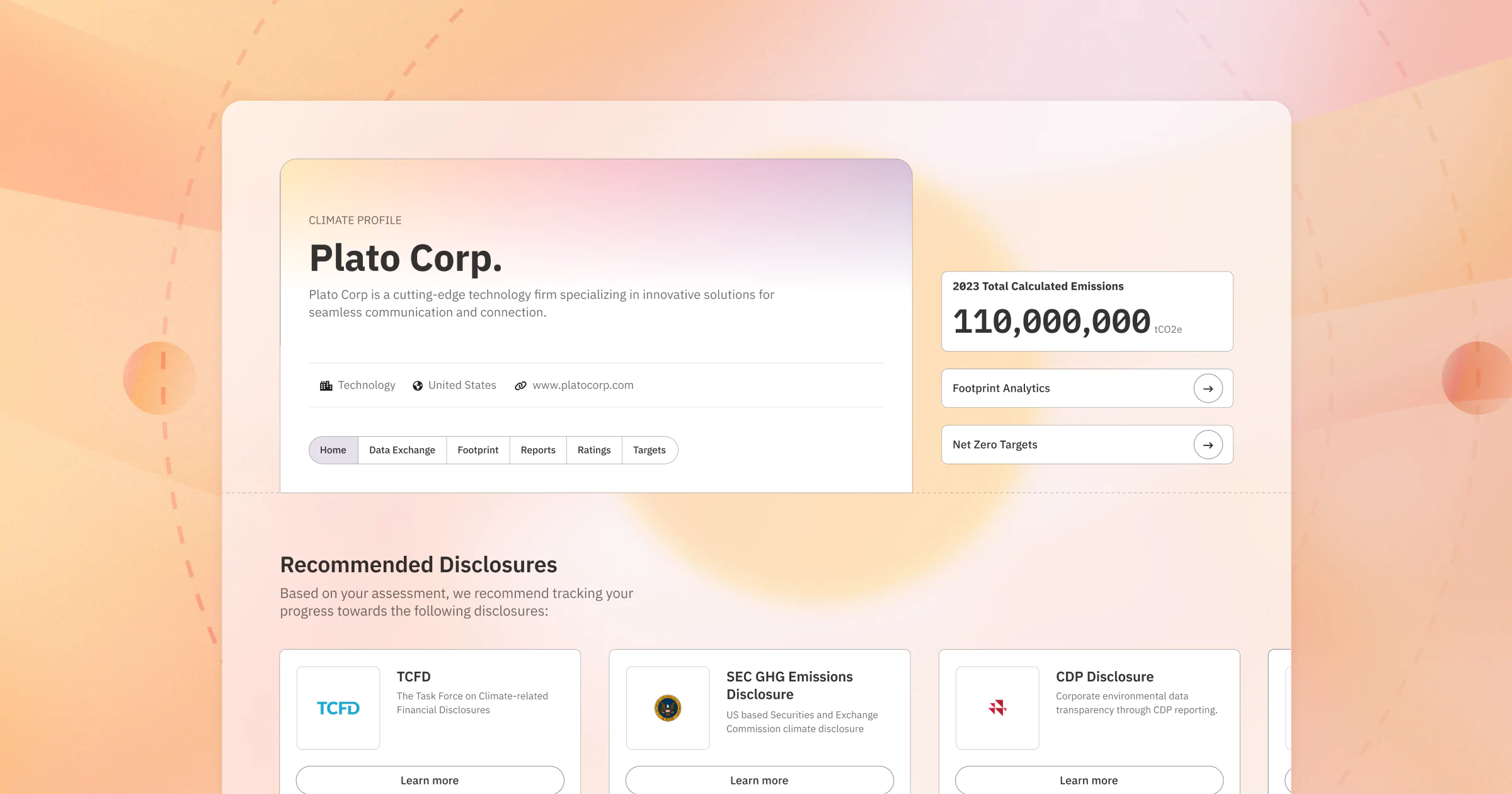
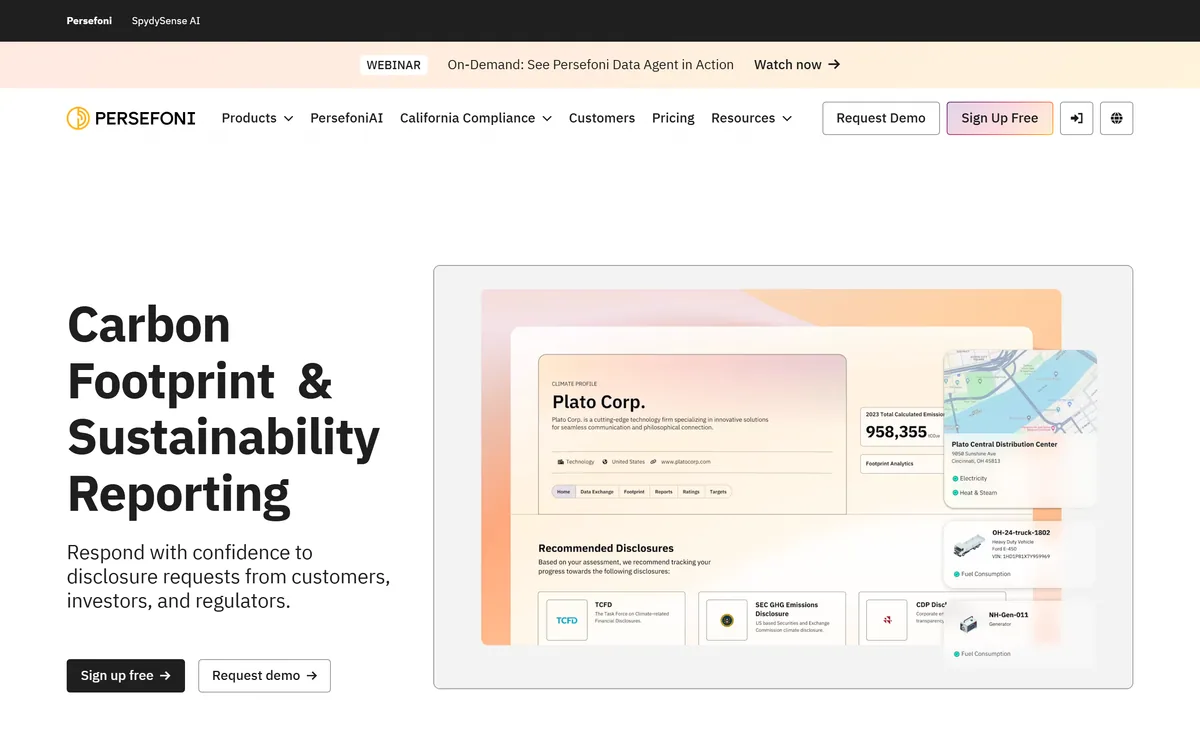
Persefoni is a carbon-accounting and sustainability-management platform for measuring, reporting and decarbonizing emissions across Scopes 1-3, with a financed-emissions module for financial services and a native AI copilot built on its own carbon-accounting model.
4.0Editor Score
persefoni.com8 viewsAdded July 4, 202513K visitors
Climate disclosure has shifted from voluntary goodwill to a regulated, investor-scrutinised obligation, and the hard part is producing numbers that can survive an audit. Persefoni is built around that standard.
It is a carbon-accounting and sustainability-management platform for measuring, reporting and decarbonizing emissions across Scopes 1-3, with a financed-emissions module for financial firms and a native AI copilot built on its own carbon-accounting model. It competes directly with enterprise carbon tools like CO2 AI, with its own lean toward disclosure and finance.
This review covers what Persefoni covers beyond a basic footprint, how to weigh its confident claims, how access is structured, and which teams it fits.
Persefoni, The Quick Take
- Persefoni is a carbon-accounting platform: measure, report and decarbonize emissions, aimed at audit-ready disclosure.
- It spans Scopes 1-3: plus net-zero target setting, reduction modelling and supplier engagement.
- It has a financial-services edge: a dedicated financed-emissions module, plus an AI copilot on its own carbon model.
- Read its claims as claims: 'assurance-grade' and analyst-leader framing are the vendor's, to verify for your case.
Carbon Accounting Aimed At Audit-Ready Reporting
Persefoni's organising idea is that carbon numbers are only useful if they can stand up to scrutiny, from auditors, regulators and investors. So it positions itself around assurance-grade reporting rather than a rough internal estimate.
That framing shapes the product. The emphasis is on defensible, standards-aligned footprints and the reporting workflows that go with major disclosure regimes, which is what a public company or a regulated firm actually needs.
It serves businesses of all sizes on paper, but the depth, especially the financed-emissions and regulatory work, points at larger and financial-sector organisations where the disclosure burden is heaviest.
Carbon numbers are only useful if they can stand up to scrutiny. Persefoni positions itself around assurance-grade reporting rather than a rough internal estimate.
What Does Persefoni Cover Beyond A Footprint?
A footprint is the starting point; Persefoni's breadth is in what it does after you have one.
Scopes, Disclosure And Decarbonization
It measures Scopes 1, 2 and 3, generates reporting aligned to major climate-disclosure regulations, and supports decarbonization through net-zero target setting, reduction modelling and supplier engagement that moves Scope 3 from spend-based estimates toward actuals.
That full arc, measure, disclose, reduce, is the same ambition as a peer like CO2 AI, and the shared hard part is value-chain data. Climate-data tools such as EOSDA Crop Monitoring tackle a different slice of the problem, but all of them live or die on data quality.
Financed Emissions And A Carbon Copilot
Persefoni's distinctive pieces are a financed-emissions module for financial services and portfolio companies, and PersefoniAI Copilot, a chat assistant built on its own carbon-accounting model that answers technical questions, plus anomaly detection across large datasets.
The financed-emissions focus is a real differentiator in a field where most tools stop at operational footprints. For the field-and-satellite side of climate data, a tool like Taranis solves an adjacent problem; Persefoni's lane is the financial ledger of emissions.
Weighing Persefoni's Claims Sensibly
Like its peers, Persefoni's site carries strong signals: analyst-leader recognition, large customer counts, blue-chip names and 'assurance-grade' language. These are genuine maturity markers, but they are vendor-stated, and this review treats them as claims.
The most important distinction is around assurance. 'Assurance-grade' and 'audit-ready' describe a platform designed to support an audit, not a promise that your disclosures will pass one; that verdict belongs to your auditors and the quality of your data.
Similarly, 'Forrester calls Persefoni a leader' is a real third-party signal worth noting, but it is an analyst's framing to attribute, not a fact about your deployment. The underlying platform is credible; the marketing just deserves a clear-eyed read.
How Persefoni Structures Access And Plans
Persefoni offers a free sign-up alongside tiered plans (PRO and ADVANCED), with its AI copilot embedded across plans, plus enterprise agreements and separate services for specific regional compliance regimes. We do not publish prices, which change; check the site.
The value question for a buyer is whether the platform lowers the real cost of compliance, the people-hours, the consultant fees and the risk of a flawed disclosure, against its subscription.
For a regulated or public company, and especially a financial firm with financed-emissions obligations, that case can be strong; for a small business with a light footprint, a simpler tool will usually do the job for less.
A Measured Way To Trial Persefoni
Because the pitch is defensibility, evaluate it against your actual disclosure obligation and your own data.
- Name the exact frameworks and regulations you must report against before you start.
- Build a footprint from a real slice of your data, not a sample, to judge the workflow.
- If you are a financial firm, test the financed-emissions module on a real portfolio slice.
- Try the PersefoniAI Copilot on genuine carbon-accounting questions and check its answers.
- Ask your auditors or assurance provider whether the output fits their process.
- Pass/fail: Persefoni is worth it if it cuts the cost and risk of your reporting on your numbers.
- Treat analyst-leader and assurance-grade claims as signals to verify, not guarantees.
Persefoni Emissions Terms
- Financed emissions
- The emissions attributable to a financial institution's loans and investments; usually the largest part of a financial firm's footprint.
- Assurance-grade
- Reporting built to withstand external audit; a design goal, not a guarantee that a given disclosure will pass assurance.
- Scope 3
- Value-chain emissions beyond a company's own operations and energy; the hardest to measure and often the largest.
- Carbon copilot
- Persefoni's AI chat assistant, built on its own carbon-accounting model, for technical questions and anomaly detection.
Persefoni Carbon Platform Facts
| What it is | A carbon-accounting and sustainability platform |
|---|---|
| Measures | Emissions across Scopes 1, 2 and 3 |
| Reporting | Aimed at audit-ready, regulatory disclosure |
| Decarbonization | Target setting, modelling, supplier engagement |
| Finance edge | A dedicated financed-emissions module |
| AI | PersefoniAI Copilot on its own carbon model |
| Audience | Businesses of all sizes; financial services |
| Model | Freemium plus tiered and enterprise plans |
Key features of Persefoni
Scope 1, 2 and 3 carbon footprints
Audit-ready regulatory and investor reporting
Net-zero target setting and reduction modelling
Supplier engagement for Scope 3 actuals
Financed-emissions module for finance
PersefoniAI Copilot on its own model
Anomaly detection across datasets
Regional compliance services
Pros & cons
Pros
5- Built around defensible, audit-ready reporting
- Distinctive financed-emissions focus
- AI copilot on a purpose-built carbon model
- Covers measure, disclose and reduce
- Strong analyst recognition and references
Cons
5- Overkill for small, simple footprints
- Assurance-grade and leader claims are vendor-stated
- Needs substantial data to be useful
- Compliance alignment is not an assurance guarantee
- Depth suits larger, regulated firms
Best For
- Public and regulated companies
- Financial services firms
- Multi-regime reporting teams
- Net-zero target setters
- Finance-sector sustainability teams
Persefoni Set Against Other Carbon Tools
The useful comparison is with other enterprise carbon platforms and adjacent climate-data tools.
| Tool | Tool | Edge | Best for |
|---|---|---|---|
| Persefoni | Disclosure and financed emissions | Audit-ready reporting plus a copilot | Regulated and financial firms |
| CO2 AI | Corporate + product + supplier | SKU-scale footprints, abatement curves | Large, complex enterprises |
| EOSDA Crop Monitoring | Satellite agri-climate data | Field-level monitoring | Agriculture, not ledgers |
| Taranis | Crop intelligence imagery | In-field insight | Agronomy, adjacent use |
Is Persefoni Suited To Your Disclosures?
Teams Persefoni Is Built To Help
- Public or regulated companies facing audit-ready disclosure
- Financial firms needing financed-emissions measurement
- Sustainability teams juggling multiple reporting regimes
- Organisations setting and modelling net-zero targets
- Teams that want a carbon copilot embedded in the workflow
When Persefoni Is More Than You Need
- Small businesses with a light, simple footprint
- Anyone wanting a cheap one-off estimate
- Teams who will take assurance-grade claims on faith
- Organisations without the data to feed the platform
- Companies with no external disclosure obligation
How We Looked Into Persefoni
Last checked . Read from persefoni.com during this check, with the screenshot above captured at the same time.
- A carbon-accounting and sustainability-management platform
- Measurement across Scopes 1, 2 and 3
- Reporting aligned to major climate-disclosure regulations
- Decarbonization via target setting, modelling and supplier engagement
- A dedicated financed-emissions module for financial services
- PersefoniAI Copilot built on its own carbon-accounting model
- Anomaly detection across large datasets
- A free sign-up plus tiered and enterprise plans
- No plan prices reproduced here, in line with this site's pricing policy
Persefoni's 'assurance-grade', analyst-leader and customer figures are vendor-stated; we report them as claims. Audit-ready design supports your reporting but does not guarantee a disclosure passes assurance.
Other ESG And Reporting Tools
An enterprise carbon peer and two climate-data tools to weigh alongside Persefoni.
- CO2 AI — a corporate-plus-supplier carbon peer
- EOSDA Crop Monitoring — satellite climate data for agriculture
- Taranis — crop intelligence imagery, an adjacent use
Editor's Verdict
4.0/5Persefoni earns 4.0 as a credible, disclosure-focused carbon platform that covers Scopes 1-3, net-zero planning and a genuinely distinctive financed-emissions module, with an AI copilot built on its own carbon model. Its 'assurance-grade' and analyst-leader claims are vendor framing to verify on your own data, and its depth suits larger and financial-sector firms, so smaller businesses should weigh a lighter, cheaper tool. AInexfinder Editor Score: 4.0/5.
Persefoni pricing
AInexfinder does not list plan prices or billing details. For current pricing, plans, and trials, visit the official Persefoni website.
Visit official website for pricingVendor pricing, credits, and billing policies change over time. Always confirm on the official site before you buy.
Frequently asked questions
What is Persefoni?
Persefoni is a carbon-accounting and sustainability-management platform for measuring, reporting and decarbonizing emissions across Scopes 1-3. It adds a financed-emissions module for financial services and a native AI copilot, PersefoniAI, built on its own carbon-accounting model.
What makes Persefoni different from other carbon tools?
Two things stand out: a dedicated financed-emissions module for financial institutions and portfolio companies, which most carbon tools omit, and an AI copilot built on its own carbon-accounting model rather than a generic chatbot. Its overall lean is toward audit-ready disclosure.
Does Persefoni make my disclosures audit-proof?
No. Persefoni is designed to support audit-ready reporting and aligns to major disclosure standards, but 'assurance-grade' describes the platform's intent, not a guarantee your disclosures pass. That verdict depends on your data quality and your auditors or assurance provider.
Who is Persefoni built for?
On paper it serves businesses of all sizes, but its depth, especially financed emissions and regulatory reporting, points at larger, public and financial-sector organisations facing heavy disclosure obligations. Small businesses with a light footprint usually need something simpler.
What is the PersefoniAI Copilot?
It is an AI chat assistant built on Persefoni's own carbon-accounting model, designed to answer technical carbon-accounting questions and support the workflow, with anomaly detection across large datasets. It is embedded across Persefoni's plans rather than sold as a separate add-on.
How is Persefoni priced?
It offers a free sign-up alongside tiered plans such as PRO and ADVANCED, plus enterprise agreements and separate services for specific regional compliance regimes. We do not publish prices, which change; weigh any plan against the compliance cost and risk it reduces for you.
What are financed emissions, and why do they matter?
Financed emissions are those attributable to a financial institution's loans and investments, and they are usually by far the largest part of a financial firm's footprint. Persefoni's dedicated module for measuring them is a meaningful differentiator for banks, asset managers and insurers.
Is Persefoni's analyst recognition meaningful?
Third-party recognition, such as being called a leader by a major analyst firm, is a genuine maturity signal worth noting. But it is the analyst's framing, to attribute rather than state as fact about your deployment; evaluate the platform on your own data and obligation.
How should I evaluate Persefoni?
Name your exact reporting frameworks first, build a footprint from a real slice of your data, and, if you are a financial firm, test the financed-emissions module on a real portfolio slice. Try the copilot on genuine questions and ask your auditors whether the output fits their process.
Is Persefoni worth it for a small company?
Usually not. Its strengths, financed emissions, multi-regime disclosure and net-zero modelling, matter most to larger, regulated and financial-sector organisations. A small business with a light footprint will typically be better served by a simpler, lower-cost carbon tool.
Reviews
Log in to write a review.
User Reviews
No reviews yet. Be the first to share your experience with Persefoni.
Reviewed by Daniel Reed
Assigned reviewer
Daniel ReedSenior AI Tools Reviewer
Daniel reviews AI tools the slow way — by actually using them on real projects. His reviews cover what works, what breaks, and who each tool is genuinely a good fit for.
Hands-on reviewsProduct testingAI software
Daniel and the AInexfinder editorial team research Persefoni using public product information, listing evidence, and (when available) hands-on checks. Scores reflect listing completeness and transparency — not paid placement.
- Last verified
- Methodology
- How we review AI tools
- Sources used
- persefoni.com
- AInexfinder listing fields (features, pros/cons, description)
- Public vendor pages when available
- Editorial policy
- Listings may include affiliate or sponsored placements, which are labeled when present. Editorial scores and cons are not sold. See our affiliate disclosure and review methodology.
Related tools
Iktos is an AI and robotics drug-discovery company combining generative molecular design (Makya), AI retrosynthesis (Spaya) and automated synthesis and testing robotics into a design-make-test-analyse loop aimed at shortening early drug discovery, offered to pharma and biotech research teams.
EOSDA Crop Monitoring is a satellite-based precision agriculture platform from EOS Data Analytics. It combines Sentinel-2 and PlanetScope imagery with ten vegetation indices, growth-stage tracking, risk maps, yield estimation and variable-rate application maps.
FreemiumEmerging & Specialized
Insilico Medicine pairs the Pharma.ai software suite — PandaOmics, Chemistry42, inClinico and more — with its own clinical pipeline. Its lead candidate rentosertib, a TNIK inhibitor for idiopathic pulmonary fibrosis, has Phase IIa results published in Nature Medicine.
Taranis provides AI crop intelligence from leaf-level aerial imagery, detecting stand counts, weeds, insect damage, nutrient deficiencies and disease pressure across whole fields. Its products include Taranis Yield Impact and Ag Assistant, with a mobile app and web dashboard.
CO2 AI is an enterprise sustainability platform that measures, reduces and reports corporate, product and supply-chain emissions in one system, with AI-driven emission-factor matching, product footprints at scale, abatement-cost curves and a supplier hub.
Compare:Persefoni vs Tamarind BioPersefoni vs IktosPersefoni vs EOSDA Crop MonitoringPersefoni vs Insilico Medicine
Persefoni alternatives Explore More
Embed this listing on your site
Featured on AInexfinder