
Tamarind Bio is a cloud platform that puts the state of the art in computational biology, AlphaFold, RFdiffusion, ProteinMPNN, GROMACS and over a hundred more tools, behind one web interface and API, so scientists can design antibodies, peptides, enzymes and small molecules without deploying anything.
CO2 AI
Verified
CO2 AI is an enterprise sustainability platform that measures, reduces and reports corporate, product and supply-chain emissions in one system, with AI-driven emission-factor matching, product footprints at scale, abatement-cost curves and a supplier hub.
4.0Editor Score
co2ai.com10 viewsAdded January 19, 20261K visitors
Corporate carbon accounting has become a reporting obligation, not a nice-to-have, and for a large multinational it is a genuinely hard data problem spanning operations, products and thousands of suppliers. CO2 AI is built for that scale.
It is an enterprise sustainability platform that measures, reduces and reports emissions by connecting corporate, product and supplier data in one system, using AI to match emission factors, flag data gaps and prioritise where to cut. It sits in the same deep-tech-for-enterprise world as climate-data tools like EOSDA Crop Monitoring, but aimed at the carbon ledger rather than the field.
This review covers how CO2 AI turns data into decarbonization, how to read its impressive-sounding numbers with a clear head, how it is sold, and which organisations it actually fits.
CO2 AI, The Core Facts
- CO2 AI is an enterprise carbon platform: measure, reduce and report emissions across corporate, product and supply-chain data in one place.
- It is built for scale and complexity: Scopes 1-3, thousands of product footprints, and a hub for collecting supplier data.
- AI does the heavy lifting: emission-factor matching, anomaly detection and data-gap flagging, with abatement-cost curves to prioritise.
- It is enterprise, demo-led: its strong recognition and ROI figures are vendor claims to verify against your own case.
Carbon Accounting Built For Big, Messy Enterprises
CO2 AI's core claim is that it unifies three things most tools keep separate: the corporate footprint, individual product footprints, and supplier data. For a complex global business, that separation is exactly the problem, so bringing them into one system is a meaningful design choice.
The target user is a lean sustainability team at a large enterprise, people responsible for a reporting and reduction mandate far bigger than their headcount. The pitch is that AI closes that gap by automating the grind of matching activity data to emission factors and spotting anomalies.
It is firmly an enterprise product, not something a small company would adopt, and it reads that way: the language is about audit trails, regulatory frameworks and booking decarbonization the way a finance team books cost savings. Its closest comparison is Persefoni, which leans more toward disclosure and finance; the two are the obvious shortlist for a large enterprise carbon programme.
The pitch is that AI closes the gap between a reporting mandate and a lean team, by automating the grind of matching activity data to emission factors and spotting the anomalies.
How Does CO2 AI Turn Data Into Decarbonization?
The platform moves from measurement to action in stages, which is what separates an accounting tool from a reduction one.
Scopes, Product Footprints And Factor Matching
It builds a corporate footprint across Scopes 1, 2 and 3 as a single source of truth, and generates product carbon footprints at scale from bill-of-materials data. The AI-driven emission-factor matching, anomaly detection and data-gap flagging are what make that tractable for thousands of SKUs.
That data-matching work is the unglamorous heart of carbon accounting, and automating it is where the time savings the vendor advertises would come from, savings worth validating on your own data rather than taking on faith.
Abatement Curves And The Supplier Hub
On the action side, CO2 AI builds marginal abatement cost (MAC) curves to rank which decarbonization levers give the most reduction per unit cost, and runs a Supplier Hub to collect primary data from suppliers and benchmark them.
The supplier piece is where most Scope 3 emissions live and where the data is hardest to get. A satellite-based monitoring tool like Taranis solves a different climate-data problem, but the shared lesson is the same: primary data is the hard part, and a structured way to collect it is a real feature.
Reading CO2 AI's Numbers With A Clear Head
CO2 AI's site is dense with strong figures, large ROI percentages, big accuracy and speed multiples, major-analyst recognition and blue-chip customer names. These are vendor-stated, and this review treats them as claims, not established facts.
That is not a knock; the recognition from well-known analyst firms and the named enterprise customers are real signals of maturity. But a headline like a particular ROI multiple or a time-saving percentage describes the vendor's framing of selected deployments, and your mileage depends entirely on your data and processes.
The same applies to compliance language. CO2 AI aligns to the recognised standards and regulations, but 'aligned to' and 'audit-ready' are about enabling your reporting, not a guarantee your disclosures will pass; your auditors and advisers decide that.
How CO2 AI Is Sold And Priced
CO2 AI is an enterprise, demo-led product: there is no self-serve pricing, and engagement runs through a request-a-demo and connect-your-data motion. We do not publish prices, which are negotiated; the site is the place to start that conversation.
For the buyer, the value question is whether the platform's automation meaningfully reduces the cost of compliance, the people-hours, the consultant fees, the risk of a bad disclosure, relative to a serious annual commitment.
For a large, complex business facing CSRD-style obligations, that case can be strong; for a smaller organisation, this is almost certainly more platform than the mandate requires, and a lighter tool will serve better.
A Grounded Way To Evaluate CO2 AI
Because the marketing is confident, run the evaluation on your own data and your own reporting obligation.
- Name your actual obligation, the frameworks and deadlines you must report against, before the demo.
- Bring a real slice of your data and have CO2 AI build a footprint from it, not a sample.
- Check the AI's emission-factor matches against ones your team already trusts.
- Test the Supplier Hub with a handful of real suppliers to see how collection works in practice.
- Ask your sustainability advisers or auditors whether the output fits their assurance process.
- Pass/fail: CO2 AI is worth it if it cuts the real cost and risk of your reporting, on your numbers.
- Treat every ROI, accuracy and speed figure as a claim to verify, not a result to assume.
CO2 AI Sustainability Platform Facts
| What it is | An enterprise sustainability and carbon platform |
|---|---|
| Measures | Corporate footprints across Scopes 1, 2 and 3 |
| Products | Product carbon footprints at SKU scale |
| AI role | Factor matching, anomaly and gap detection |
| Prioritising | Marginal abatement cost (MAC) curves |
| Suppliers | A Supplier Hub for primary data collection |
| Standards | Aligned to GHG Protocol, SBTi, CSRD and more |
| Model | Enterprise, demo-led, no self-serve pricing |
CO2 AI Carbon-Accounting Terms
- Scope 1, 2, 3
- The three categories of emissions: direct (1), purchased energy (2), and everything across the value chain (3), which is usually the largest and hardest.
- Product carbon footprint
- The emissions associated with a single product across its lifecycle, often built from bill-of-materials data.
- Emission factor
- A coefficient that converts an activity or spend into an emissions estimate; matching data to the right factor is core to carbon accounting.
- MAC curve
- A marginal abatement cost curve, ranking decarbonization levers by how much reduction each delivers per unit of cost.
Is CO2 AI Matched To Your Reporting?
Organisations CO2 AI Can Help
- Large enterprises with a serious disclosure obligation
- Lean sustainability teams stretched across a big mandate
- Businesses needing product footprints at SKU scale
- Companies where Scope 3 and suppliers dominate emissions
- Teams that want to prioritise cuts by cost-effectiveness
When CO2 AI Is The Wrong Scale
- Small or mid-size companies with a light footprint
- Anyone wanting self-serve, low-cost accounting
- Teams who will take ROI and accuracy claims on faith
- Organisations without the data to feed a platform like this
- Those needing only a simple annual estimate
Key features of CO2 AI
Corporate footprint across Scopes 1-3
Product carbon footprints at SKU scale
AI emission-factor matching
Anomaly detection and data-gap flagging
Marginal abatement cost curves
Supplier Hub for primary data
Eco-design and lifecycle hotspot views
Traceability for external verification
Pros & cons
Pros
5- Unifies corporate, product and supplier carbon data
- Automates the grind of factor matching at scale
- Prioritises cuts by cost-effectiveness
- Structured supplier-data collection for Scope 3
- Strong analyst recognition and enterprise references
Cons
5- Enterprise-only; overkill for smaller firms
- ROI and accuracy figures are vendor claims
- Compliance alignment is not an assurance guarantee
- Needs substantial data to be useful
- Demo-led, negotiated pricing
Best For
- Large multinational enterprises
- Lean sustainability teams
- SKU-scale product footprinting
- Scope 3 and supplier-heavy footprints
- Cost-prioritised decarbonization
CO2 AI Next To Other Carbon Platforms
The useful comparison is with other enterprise sustainability and climate-data tools.
| Tool | Tool | Focus | Best for |
|---|---|---|---|
| CO2 AI | Corporate + product + supplier carbon | One system across all three | Large, complex enterprises |
| Persefoni | Audit-ready carbon accounting | Disclosure and financed emissions | Reporting-led programs |
| EOSDA Crop Monitoring | Satellite agri-climate data | Field-level monitoring | Agriculture, not carbon ledgers |
| Taranis | Crop intelligence imagery | In-field insight | Agronomy, adjacent use case |
What We Verified On CO2 AI
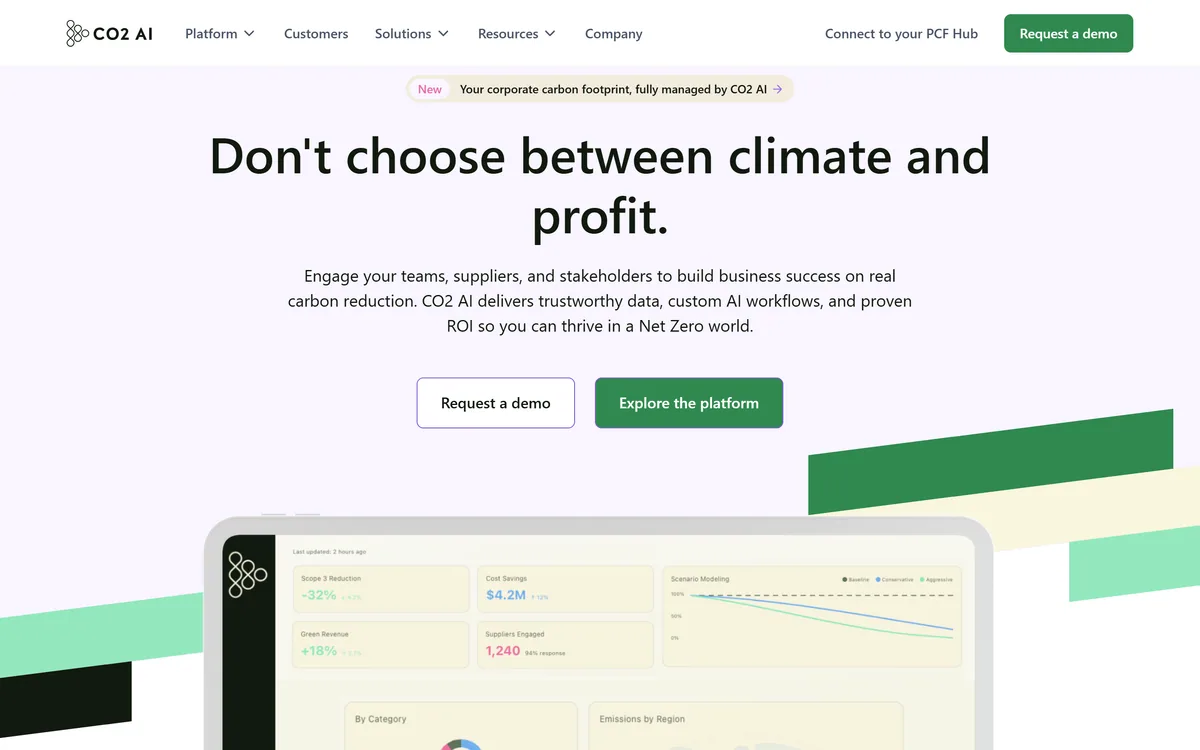
Last checked . Read from co2ai.com during this check, with the screenshot above captured at the same time.
- An enterprise platform to measure, reduce and report emissions
- Corporate footprints across Scopes 1, 2 and 3
- Product carbon footprints generated at SKU scale
- AI-driven emission-factor matching and anomaly detection
- Marginal abatement cost curves for prioritisation
- A Supplier Hub for collecting primary supplier data
- Alignment stated to standards such as GHG Protocol, SBTi and CSRD
- An enterprise, demo-led model with no self-serve pricing
- No plan prices reproduced here, in line with this site's pricing policy
CO2 AI's ROI, accuracy, speed and analyst-recognition figures are vendor-stated; we report them as claims. Compliance alignment enables your reporting but does not guarantee your disclosures pass assurance.
Other Sustainability And Data Tools
A reporting-led carbon peer and two climate-data tools to weigh alongside CO2 AI.
- Persefoni — audit-ready carbon accounting and disclosure
- EOSDA Crop Monitoring — satellite climate data for agriculture
- Taranis — crop intelligence imagery, an adjacent use case
Editor's Verdict
4.0/5CO2 AI earns 4.0 as a serious enterprise carbon platform that unifies corporate, product and supplier emissions in one system and automates the data grind with AI, backed by real analyst recognition and blue-chip references. Its confident ROI, accuracy and compliance claims are vendor-stated and need validating on your own data, and it is firmly enterprise-scale, so smaller organisations should look to a lighter tool. AInexfinder Editor Score: 4.0/5.
CO2 AI pricing
AInexfinder does not list plan prices or billing details. For current pricing, plans, and trials, visit the official CO2 AI website.
Visit official website for pricingVendor pricing, credits, and billing policies change over time. Always confirm on the official site before you buy.
Frequently asked questions
What is CO2 AI?
CO2 AI is an enterprise sustainability platform that measures, reduces and reports emissions by connecting corporate, product and supplier data in one system. It uses AI for tasks like emission-factor matching, anomaly detection and data-gap flagging, and builds abatement-cost curves to prioritise cuts.
Who is CO2 AI built for?
Large, complex global enterprises with a serious reporting obligation, typically served by a lean sustainability team stretched across a big mandate. It is not designed for small or mid-size companies, whose lighter footprint rarely needs a platform of this scale.
What emissions does CO2 AI cover?
It builds corporate footprints across Scopes 1, 2 and 3 as a single source of truth, and generates product carbon footprints at SKU scale from bill-of-materials data. Its Supplier Hub targets Scope 3, where most value-chain emissions and the hardest data live.
Are CO2 AI's ROI and accuracy claims reliable?
They are vendor-stated and should be treated as claims, not established facts. The analyst recognition and named enterprise customers are genuine maturity signals, but any specific ROI, accuracy or speed figure reflects selected deployments and depends on your own data and processes.
Does CO2 AI make my reporting compliant?
It aligns to recognised standards and regulations such as the GHG Protocol, SBTi and CSRD, which enables your reporting, but 'aligned' and 'audit-ready' are not a guarantee your disclosures pass assurance. Your auditors and advisers make that determination.
How is CO2 AI priced?
It is an enterprise, demo-led product with no self-serve pricing; engagement runs through a request-a-demo and connect-your-data motion. We do not publish prices, which are negotiated. Weigh any commitment against the compliance cost and risk it reduces for you.
How does CO2 AI help cut emissions, not just measure them?
It builds marginal abatement cost (MAC) curves that rank decarbonization levers by how much reduction each delivers per unit of cost, and its Supplier Hub collects and benchmarks primary supplier data so Scope 3 reductions can move from spend-based estimates toward actuals.
What does the Supplier Hub do?
The Supplier Hub is a structured way to request and collect primary data from suppliers, such as product footprints and audit proofs, and to benchmark them. Since Scope 3 is usually the largest and least-measured category, a dedicated collection path is a meaningful feature.
Is CO2 AI worth it for a smaller company?
Usually not. It is enterprise-scale, demo-led and data-hungry, built for organisations facing heavy disclosure obligations. A smaller company with a lighter footprint will almost always be better served by a simpler, lower-cost carbon-accounting tool.
How should I evaluate CO2 AI?
Name your actual reporting obligation first, then have CO2 AI build a footprint from a real slice of your data, check its factor matches against ones you trust, test the Supplier Hub with real suppliers, and ask your auditors whether the output fits their assurance process.
Reviews
Log in to write a review.
User Reviews
No reviews yet. Be the first to share your experience with CO2 AI.
Reviewed by Daniel Reed
Assigned reviewer
Daniel ReedSenior AI Tools Reviewer
Daniel reviews AI tools the slow way — by actually using them on real projects. His reviews cover what works, what breaks, and who each tool is genuinely a good fit for.
Hands-on reviewsProduct testingAI software
Daniel and the AInexfinder editorial team research CO2 AI using public product information, listing evidence, and (when available) hands-on checks. Scores reflect listing completeness and transparency — not paid placement.
- Last verified
- Methodology
- How we review AI tools
- Sources used
- co2ai.com
- AInexfinder listing fields (features, pros/cons, description)
- Public vendor pages when available
- Editorial policy
- Listings may include affiliate or sponsored placements, which are labeled when present. Editorial scores and cons are not sold. See our affiliate disclosure and review methodology.
Related tools
Iktos is an AI and robotics drug-discovery company combining generative molecular design (Makya), AI retrosynthesis (Spaya) and automated synthesis and testing robotics into a design-make-test-analyse loop aimed at shortening early drug discovery, offered to pharma and biotech research teams.
EOSDA Crop Monitoring is a satellite-based precision agriculture platform from EOS Data Analytics. It combines Sentinel-2 and PlanetScope imagery with ten vegetation indices, growth-stage tracking, risk maps, yield estimation and variable-rate application maps.
FreemiumEmerging & Specialized
Insilico Medicine pairs the Pharma.ai software suite — PandaOmics, Chemistry42, inClinico and more — with its own clinical pipeline. Its lead candidate rentosertib, a TNIK inhibitor for idiopathic pulmonary fibrosis, has Phase IIa results published in Nature Medicine.
Persefoni is a carbon-accounting and sustainability-management platform for measuring, reporting and decarbonizing emissions across Scopes 1-3, with a financed-emissions module for financial services and a native AI copilot built on its own carbon-accounting model.
FreemiumEmerging & Specialized
Taranis provides AI crop intelligence from leaf-level aerial imagery, detecting stand counts, weeds, insect damage, nutrient deficiencies and disease pressure across whole fields. Its products include Taranis Yield Impact and Ag Assistant, with a mobile app and web dashboard.
Compare:CO2 AI vs Tamarind BioCO2 AI vs IktosCO2 AI vs EOSDA Crop MonitoringCO2 AI vs Insilico Medicine
CO2 AI alternatives Explore More
Embed this listing on your site
Featured on AInexfinder