Iktos is an AI and robotics drug-discovery company combining generative molecular design (Makya), AI retrosynthesis (Spaya) and automated synthesis and testing robotics into a design-make-test-analyse loop aimed at shortening early drug discovery, offered to pharma and biotech research teams.
Tamarind Bio
Verified
Tamarind Bio is a cloud platform that puts the state of the art in computational biology, AlphaFold, RFdiffusion, ProteinMPNN, GROMACS and over a hundred more tools, behind one web interface and API, so scientists can design antibodies, peptides, enzymes and small molecules without deploying anything.
4.1Editor Score
tamarind.bio11 viewsAdded September 12, 20259K visitors
Modern protein engineering runs on a sprawl of brilliant but fiddly open tools, each with its own setup, dependencies and GPU demands. The hard part is rarely the science; it is getting the software to run at all. Tamarind Bio exists to erase that tax.
It is a cloud platform that puts the published state of the art, AlphaFold, RFdiffusion, ProteinMPNN, GROMACS and over a hundred more, behind a single interface and API, with the compute handled for you. It is to molecular design what a model-hosting service like Replicate is to AI models generally: the methods are public, the orchestration is the product.
This review covers what scientists can actually run on Tamarind Bio, who benefits from a no-setup platform, how access is structured, and where it is more than a lab needs.
Tamarind Bio, The Quick Read
- Tamarind Bio is AI infrastructure for biotech R&D: one interface onto the published state of the art in protein and molecule design.
- It hosts 100+ tools: AlphaFold, RFdiffusion, ProteinMPNN, GROMACS, Boltz, Chai-1 and more, with no deployment on your side.
- It scales the compute for you: GPU orchestration and parallelization across hundreds of thousands of inputs, via web UI, API or MCP.
- You keep your IP: it states you own your inputs and derivatives, on a SOC 2 cloud with isolated computations.
Tamarind Bio Platform Facts
| What it is | A cloud platform for computational biology |
|---|---|
| Covers | Antibody, peptide, enzyme, small-molecule design |
| Tool catalogue | 100+ published methods in one interface |
| Named methods | AlphaFold, RFdiffusion, ProteinMPNN, GROMACS |
| Scale | GPU orchestration across huge input batches |
| Access | Web interface, programmatic API, MCP server |
| IP stance | You own your inputs and their derivatives |
| Security | SOC 2 compliant cloud, isolated computations |
One Interface For The State Of The Art In Protein Design
Tamarind Bio's pitch is that the cutting edge of protein engineering is already published, as AlphaFold, RFdiffusion, the MPNN family, GROMACS and dozens more, but almost none of it is easy to run. It gathers that catalogue into one place and handles the deployment, so a scientist can use a method without a literature review and a week of DevOps.
That reframing is genuinely valuable. The bottleneck in computational biology is often not ideas but access: the time between wanting to try a method and actually having it running. Collapsing that to a web interface or an API call changes what a small team can attempt.
It spans the real workflow, too, structure prediction, docking, de novo binder design and molecular-dynamics simulation, rather than a single trick, which is why it reads as infrastructure rather than a point tool.
The bottleneck in computational biology is often not ideas but access: the time between wanting to try a method and having it running. Tamarind collapses that to one interface.
What Can Scientists Actually Run On Tamarind Bio?
The platform organises its catalogue around the molecules you are working on, which keeps a huge tool list navigable.
Antibodies, Peptides, Enzymes And Small Molecules
There are dedicated tracks for antibodies and nanobodies, peptides, enzymes and small molecules. Within them you can design de novo binders, redesign and optimize CDRs for an antigen, predict antibody-antigen binding poses, and score developability properties like thermostability and solubility.
Underpinning those tracks is a catalogue of over a hundred named methods, the kind of breadth that a research-focused search tool like Exa helps you discover in the literature, except here each method is a click away rather than a paper to re-implement.
Compute, Scale And Your Own IP
Tamarind handles the high-performance compute, parallelization and GPU orchestration, so tools can run across hundreds of thousands of inputs without you managing a cluster. Access is through a web interface, a programmatic API, and an MCP server for agentic use.
On the sensitive question of ownership, it states plainly that you own your inputs and their derivatives, on a SOC 2 cloud where each computation is isolated. For a peer in the drug-discovery space such as Insilico Medicine, that end-to-end stack is the whole company; Tamarind instead sells the tooling layer and leaves the IP with you.
Who Gains From A No-Setup Biotech Platform
The clearest win is for small and mid-size biotechs without a dedicated computational infrastructure team. They get access to methods that would otherwise require hiring and months of setup, at the speed of a web app.
It also helps bench scientists who are not ML engineers but want to use ML-driven design in their work, and larger groups that want to standardise on one interface rather than maintain a dozen bespoke deployments.
It is less necessary for organisations that already run their own mature pipelines and have the engineers to maintain them. For them the value is narrower, though even there the breadth of the catalogue and the scaling can be a useful overflow.
How Tamarind Bio Approaches Access And Pricing
Tamarind has a pricing page and a get-started path alongside a book-a-demo and book-a-call motion, which points to a self-serve entry with enterprise agreements for larger needs. We do not reproduce prices, which change; check the site.
Because the real cost of these methods is the compute they consume, the sensible way to weigh it is against what you would otherwise spend standing up and running the same tools yourself, in both cloud bills and engineer time.
For a team doing this occasionally, paying for managed access is almost always cheaper than building; for one running at constant high volume, the maths deserves a closer look, which is exactly what a pilot is for.
A Sensible Way To Pilot Tamarind Bio
Because it is infrastructure, judge it on a real task from your own pipeline rather than a demo molecule.
- Pick a method you already use or have wanted to try, and a real target from current work.
- Run it through the web interface first to gauge the setup time saved versus your own deployment.
- Check the outputs against a result you trust, so you are validating quality, not just convenience.
- If you build pipelines, call the same method through the API or MCP server to test fit.
- Scale one job up to a realistic batch size and watch how the orchestration and cost behave.
- Pass/fail: Tamarind is worth it if it saves meaningful engineer time without compromising the result.
- Confirm the IP and data-isolation terms in the Trust Center satisfy your organisation before committing.
Tamarind Bio Protein-Design Terms
- De novo binder
- A protein or peptide designed from scratch to bind a chosen target, rather than derived from a known one.
- CDR
- The complementarity-determining regions of an antibody, the loops that determine what antigen it binds; a key target for optimization.
- Developability
- How suitable a designed molecule is to make and use, covering properties like thermostability, solubility and aggregation.
- MCP server
- An interface that lets an AI agent call Tamarind's tools programmatically, not just a human through the web UI.
Key features of Tamarind Bio
100+ published methods in one interface
Dedicated antibody, peptide, enzyme and molecule tracks
De novo binder and CDR optimization
Developability prediction and docking
Managed GPU orchestration at massive scale
Web interface plus programmatic API
MCP server for agentic access
SOC 2 cloud with input and IP ownership
Pros & cons
Pros
5- Removes the setup tax on cutting-edge methods
- Huge, curated catalogue in one place
- Scales compute without you managing a cluster
- Clear you-own-your-IP and isolation stance
- API and MCP make it pipeline- and agent-friendly
Cons
5- Less needed by teams with mature pipelines
- Value tied to how much you run
- External compute may clash with strict data policies
- Outputs still require scientific validation
- Breadth can overwhelm a first-time user
Best For
- Small and mid-size biotechs
- Bench scientists without ML ops
- Teams standardising on one interface
- Pipeline and agent builders
- IP-conscious research groups
Tamarind Bio Versus Rolling Your Own Pipeline
The real comparison is not another product but the alternative of deploying these open methods yourself.
| Tool | Approach | Effort | Best for |
|---|---|---|---|
| Tamarind Bio | Managed, no setup | Run 100+ methods via UI/API | Teams without infra engineers |
| Self-hosted pipeline | High, ongoing maintenance | Full control, slow to build | Groups with mature DevOps |
| Insilico Medicine | End-to-end drug discovery | A full pipeline and programs | Partnered discovery, not tooling |
| Replicate | Run AI models via API | General model hosting | Non-bio AI model inference |
Does Tamarind Bio Fit Your Lab?
Teams Tamarind Bio Is Built For
- Small and mid-size biotechs without an infra team
- Bench scientists who want ML design without the ops
- Groups wanting one interface over bespoke deployments
- Teams that value keeping their inputs and derivatives
- Pipelines that can call methods via API or MCP
When Tamarind Bio Is Overkill
- Organisations with mature, well-staffed pipelines
- Work that only needs one simple, well-packaged tool
- Teams whose data policy forbids external compute
- Anyone wanting lab-bench automation, not software
- Groups unwilling to validate outputs before trusting them
What Our Tamarind Bio Review Covered
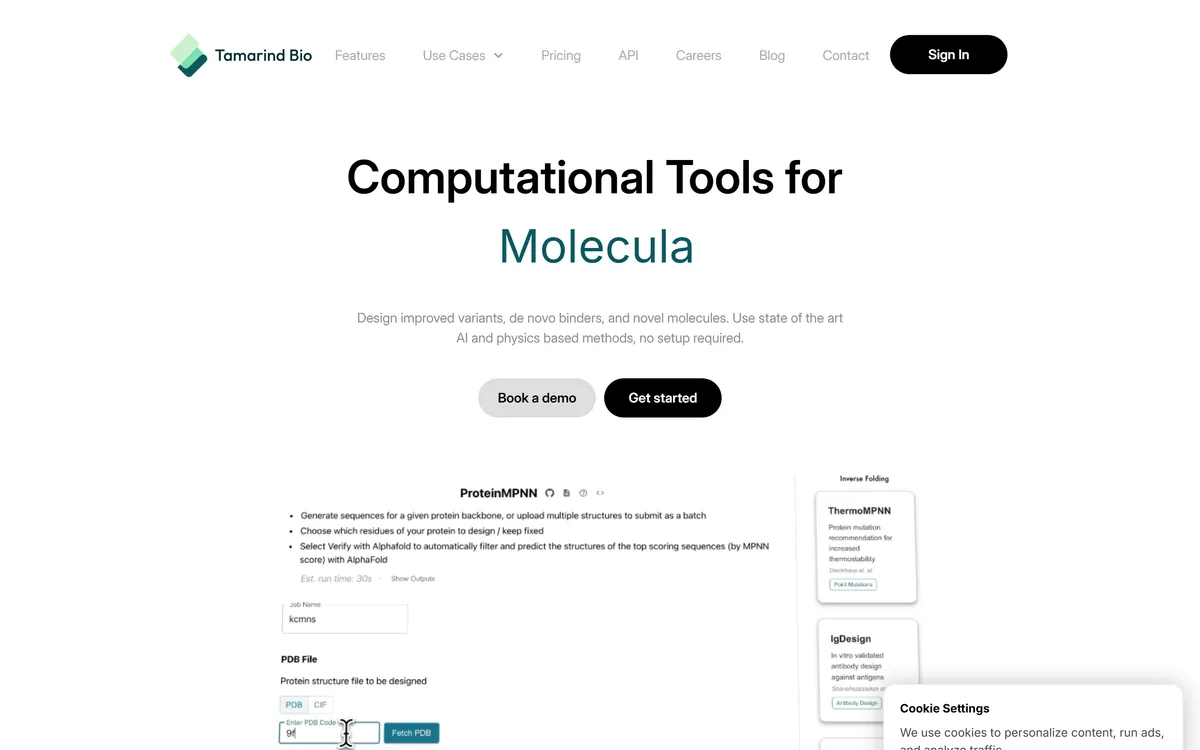
Last checked . Read from tamarind.bio during this check, with the screenshot above captured at the same time.
- A cloud platform for computational biology and molecular design
- Tracks for antibodies, peptides, enzymes and small molecules
- A catalogue of 100+ published methods including AlphaFold and RFdiffusion
- Managed GPU orchestration and parallelization at scale
- Access via web interface, programmatic API and an MCP server
- A stated position that customers own inputs and derivatives
- A SOC 2 compliant cloud with isolated computations and a Trust Center
- Supporting a stated 10,000+ scientists across biotech and biopharma
- No plan prices reproduced here, in line with this site's pricing policy
Tamarind provides general-purpose protein-engineering tooling, including de novo design; we frame it as legitimate R&D infrastructure, with responsible use left to the organisations running it.
Other Deep-Tech And Research Tools
A drug-discovery company, a research search API and a model-hosting platform to weigh alongside Tamarind.
- Insilico Medicine — end-to-end AI drug discovery
- Exa — a search API for finding the research behind the methods
- Replicate — running AI models generally via API
Editor's Verdict
4.1/5Tamarind Bio earns 4.1 for solving a real and dull problem elegantly: it puts over a hundred published, cutting-edge protein-design methods behind one no-setup interface and API, handles the GPU orchestration, and leaves the IP with you on a SOC 2 cloud. Its value is narrower for teams that already run mature pipelines, and every output still needs scientific validation, but for most labs it turns weeks of setup into a click. AInexfinder Editor Score: 4.1/5.
Tamarind Bio pricing
AInexfinder does not list plan prices or billing details. For current pricing, plans, and trials, visit the official Tamarind Bio website.
Visit official website for pricingVendor pricing, credits, and billing policies change over time. Always confirm on the official site before you buy.
Frequently asked questions
What is Tamarind Bio?
Tamarind Bio is a cloud platform that puts the published state of the art in computational biology, such as AlphaFold, RFdiffusion, ProteinMPNN and GROMACS, behind one web interface and API, so scientists can design antibodies, peptides, enzymes and small molecules without deploying any of the tools themselves.
Which tools does Tamarind Bio give access to?
Its catalogue spans over a hundred published methods across structure prediction, docking, de novo design and molecular dynamics, including AlphaFold, RFdiffusion, the ProteinMPNN family, GROMACS, Boltz, Chai-1, ESMFold and many more, all runnable from one interface.
Do I keep ownership of my work on Tamarind Bio?
Yes. The platform states that you own all of your inputs and their derivatives, and that computations run isolated on a SOC 2 compliant cloud with no contamination between them. Confirm the exact terms in its Trust Center for your organisation's requirements.
Who is Tamarind Bio for?
Mainly small and mid-size biotechs without a dedicated computational-infrastructure team, and bench scientists who want to use ML-driven design without becoming ML engineers. Larger groups use it to standardise on one interface instead of maintaining many bespoke deployments.
How does Tamarind Bio handle compute?
It manages the high-performance compute, parallelization and GPU orchestration for you, so methods can run across hundreds of thousands of inputs without you provisioning or maintaining a cluster. You reach it through the web UI, the API, or an MCP server.
Can I use Tamarind Bio programmatically?
Yes. Beyond the web interface it offers a programmatic API and an MCP server, so you can call methods from your own pipelines or let an AI agent run them. That makes it suitable for automated, repeatable workflows, not just interactive use.
How is Tamarind Bio priced?
It has a pricing page with a get-started path plus a book-a-demo and book-a-call motion, indicating self-serve entry with enterprise agreements for larger needs. We do not publish prices; weigh the cost against standing up and running the same methods yourself.
Is Tamarind Bio worth it over self-hosting?
For teams that run these methods occasionally or lack infrastructure engineers, managed access is usually far cheaper than building and maintaining the pipeline. For groups already running mature, well-staffed pipelines, the advantage is narrower and best judged with a pilot.
What kinds of molecules can Tamarind Bio design?
It has dedicated tracks for antibodies and nanobodies, peptides, enzymes and small molecules, covering de novo binder design, CDR optimization against an antigen, binding-pose prediction and developability scoring such as thermostability and solubility.
Does using Tamarind Bio require ML expertise?
No, that is much of the point. It is built so bench scientists can run leading machine-learning methods through a simple interface without a literature review or deployment work, though interpreting and validating the results still needs domain expertise.
Reviews
Log in to write a review.
User Reviews
No reviews yet. Be the first to share your experience with Tamarind Bio.
Reviewed by Daniel Reed
Assigned reviewer
Daniel ReedSenior AI Tools Reviewer
Daniel reviews AI tools the slow way — by actually using them on real projects. His reviews cover what works, what breaks, and who each tool is genuinely a good fit for.
Hands-on reviewsProduct testingAI software
Daniel and the AInexfinder editorial team research Tamarind Bio using public product information, listing evidence, and (when available) hands-on checks. Scores reflect listing completeness and transparency — not paid placement.
- Last verified
- Methodology
- How we review AI tools
- Sources used
- tamarind.bio
- AInexfinder listing fields (features, pros/cons, description)
- Public vendor pages when available
- Editorial policy
- Listings may include affiliate or sponsored placements, which are labeled when present. Editorial scores and cons are not sold. See our affiliate disclosure and review methodology.
Related tools
EOSDA Crop Monitoring is a satellite-based precision agriculture platform from EOS Data Analytics. It combines Sentinel-2 and PlanetScope imagery with ten vegetation indices, growth-stage tracking, risk maps, yield estimation and variable-rate application maps.
FreemiumEmerging & Specialized
Insilico Medicine pairs the Pharma.ai software suite — PandaOmics, Chemistry42, inClinico and more — with its own clinical pipeline. Its lead candidate rentosertib, a TNIK inhibitor for idiopathic pulmonary fibrosis, has Phase IIa results published in Nature Medicine.
Persefoni is a carbon-accounting and sustainability-management platform for measuring, reporting and decarbonizing emissions across Scopes 1-3, with a financed-emissions module for financial services and a native AI copilot built on its own carbon-accounting model.
FreemiumEmerging & Specialized
Taranis provides AI crop intelligence from leaf-level aerial imagery, detecting stand counts, weeds, insect damage, nutrient deficiencies and disease pressure across whole fields. Its products include Taranis Yield Impact and Ag Assistant, with a mobile app and web dashboard.
CO2 AI is an enterprise sustainability platform that measures, reduces and reports corporate, product and supply-chain emissions in one system, with AI-driven emission-factor matching, product footprints at scale, abatement-cost curves and a supplier hub.
Compare:Tamarind Bio vs IktosTamarind Bio vs EOSDA Crop MonitoringTamarind Bio vs Insilico MedicineTamarind Bio vs Persefoni
Tamarind Bio alternatives Explore More
Embed this listing on your site
Featured on AInexfinder