
Tamarind Bio is a cloud platform that puts the state of the art in computational biology, AlphaFold, RFdiffusion, ProteinMPNN, GROMACS and over a hundred more tools, behind one web interface and API, so scientists can design antibodies, peptides, enzymes and small molecules without deploying anything.
Insilico Medicine
Verified
Insilico Medicine pairs the Pharma.ai software suite — PandaOmics, Chemistry42, inClinico and more — with its own clinical pipeline. Its lead candidate rentosertib, a TNIK inhibitor for idiopathic pulmonary fibrosis, has Phase IIa results published in Nature Medicine.
4.6Editor Score
insilico.com10 viewsAdded August 31, 20253K visitors
Almost every company in AI drug discovery makes the same argument: our models find better targets and design better molecules, and one day that will produce a medicine. The argument is hard to check, because the gap between a promising molecule and a clinical result is a decade wide and most firms are still inside it.
Insilico Medicine is interesting because it is further along that road than the argument usually gets. Founded in 2014, it built the Pharma.ai software suite, used that suite to nominate a target and design a molecule against it, took the molecule into humans, and then published the Phase IIa results in a peer-reviewed journal.
This review separates what Insilico sells from what Insilico has proved. Those are different things, and the distinction matters whether you are a biotech evaluating the software or a reader trying to work out how much of the AI-drug story is real yet.
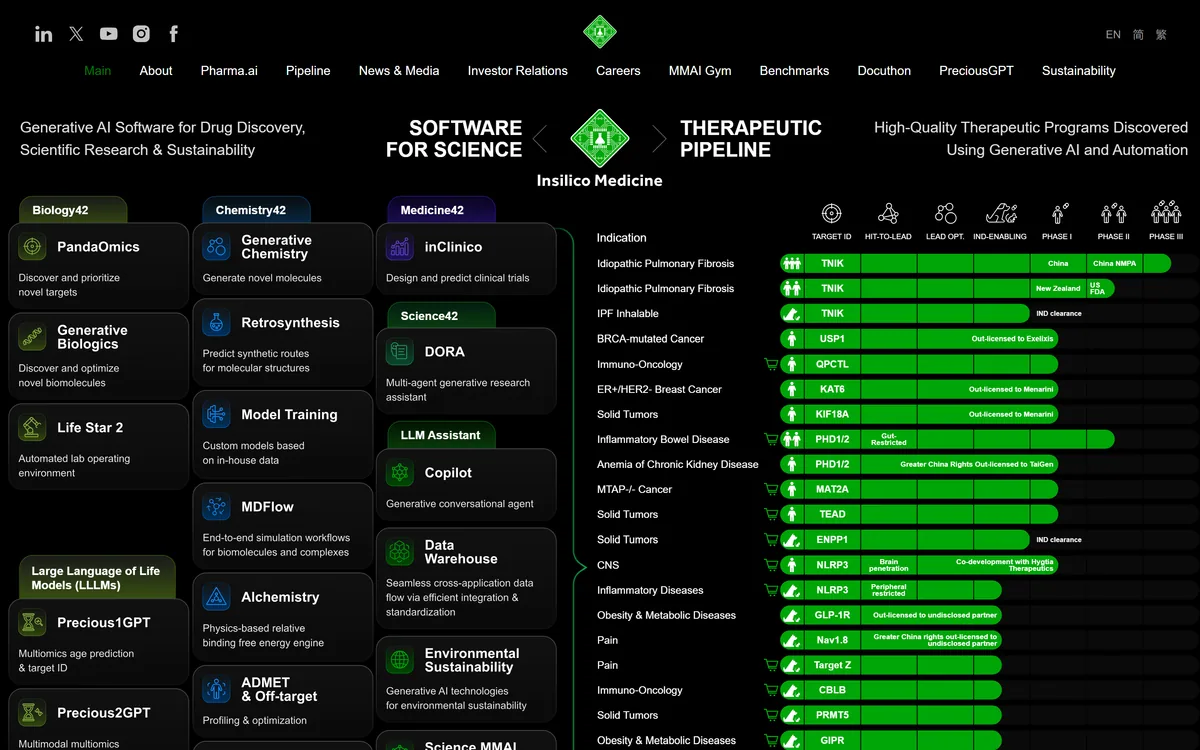
Rentosertib, Pharma.ai, And Why This One Is Different
- It is two businesses in one: Pharma.ai software licensed to other drug companies, and Insilico's own clinical pipeline run on that same software.
- The pipeline is the evidence. Most AI-drug-discovery firms sell a promise; Insilico put a molecule its own tools designed into patients and published what happened.
- Rentosertib (formerly ISM001-055) is a TNIK inhibitor for idiopathic pulmonary fibrosis with Phase IIa results in Nature Medicine.
- The Phase IIa was small — 71 patients, 12 weeks, conducted in China. Encouraging, not conclusive, and the company is preparing Phase III.
- Listed in Hong Kong at the end of 2025, which makes it one of the few AI-native drug companies with public financials to read.
Two Companies Wearing One Name
Understanding Insilico means noticing that it operates on both sides of a transaction it also runs itself.
On one side is Pharma.ai, a suite of software products licensed to pharmaceutical companies and research groups. On the other is Insilico's own therapeutic pipeline, a conventional biotech portfolio of programmes moving through preclinical and clinical stages.
The two are deliberately coupled. The pipeline is the demonstration that the software does something, and the software is the reason the pipeline can be run by a company of Insilico's size. A pure software vendor has to argue that its predictions would have worked; a company running its own trials can point at a result instead.
The pipeline is not a side project. It is the argument for the software, conducted in public and at the company's own expense.
What Sits Inside Pharma.ai
The suite is modular, and each module maps to a distinct stage of the discovery process rather than being one general-purpose model wearing several hats.
Target Discovery With PandaOmics
PandaOmics works on the question that comes before chemistry: which biological target is worth attacking for a given disease. It reads omics data, literature and clinical evidence to rank candidate targets.
This is the stage where AI plausibly adds the most value, because the search space is enormous, the evidence is scattered across decades of publications, and human researchers necessarily specialise narrowly. A PandaOmics Box deployment exists for organisations that need the tooling inside their own infrastructure.
Molecule Design With Chemistry42
Chemistry42 handles generative molecular design — proposing structures that should bind a chosen target while satisfying the many other constraints a drug has to meet — and includes retrosynthesis planning, which asks whether a proposed molecule can actually be made.
That second part is easy to overlook and genuinely important. A generative model unconstrained by synthesis will happily invent elegant molecules that no chemist can build.
Trial Design With inClinico
inClinico addresses clinical trial design and outcome prediction, which is where most drug capital is actually destroyed. Discovery is cheap relative to a failed Phase III.
Alongside these sit Generative Biologics for large-molecule work, Science42: DORA for research assistance, PreciousGPT as a life-sciences language model, Nach01, and MMAI Gym as a training environment.
Reading The Rentosertib Result Honestly
Rentosertib — previously ISM001-055, and written INS018_055 in some papers — is the molecule the whole story rests on. It is a TNIK inhibitor for idiopathic pulmonary fibrosis, a progressive lung disease with few good options. Both the target and the molecule came out of Insilico's own tools.
The Phase IIa was a double-blind, placebo-controlled 12-week study in 71 patients, conducted in China. At the 60 mg once-daily dose, mean forced vital capacity rose 98.4 mL from baseline over the 12 weeks, while the placebo group declined 20.3 mL. The drug was reported as safe and well tolerated across the doses tested, and the results were published in Nature Medicine.
That is a real, peer-reviewed, placebo-controlled result, and it deserves to be treated as one. It is also a 71-patient study over 12 weeks at a single geography — the size and duration at which respiratory trials routinely look encouraging and then fail to confirm. Lung function improving rather than merely declining more slowly is the striking part; whether it holds across a larger and more varied population is exactly what Phase III exists to find out.
- Design: double-blind, placebo-controlled, 12 weeks
- Population: 71 patients with idiopathic pulmonary fibrosis, conducted in China
- Headline signal: mean FVC +98.4 mL from baseline at 60 mg once daily, versus −20.3 mL on placebo
- Safety: reported safe and well tolerated at all doses studied
- Publication: Nature Medicine, which means the data survived external review
Where The Programme Goes Next
The company's stated direction extends rentosertib in three directions at once, which is a reasonable way to spend a positive Phase IIa.
- Prepare Phase III for the oral formulation in idiopathic pulmonary fibrosis — the study that decides whether the Phase IIa signal was real.
- Take the same molecule into kidney fibrosis, on the reasoning that TNIK biology is not lung-specific.
- Develop an inhaled formulation, which received IND clearance from China's CDE and would be the first AI-discovered candidate to enter a direct-to-lung clinical study.
- Keep advancing the wider pipeline — USP1, QPCTL, MAT2A, TEAD, ENPP1, KAT6, FGFR2/3 and PHD programmes across oncology, inflammation and fibrosis.
- Continue licensing Pharma.ai to external groups, so the software revenue is not dependent on any single clinical outcome.
The Part Nobody Should Overclaim
It is worth being precise about what has been shown, because this field attracts imprecision.
What has been demonstrated is that a target-and-molecule pair generated with AI assistance can reach Phase II and produce a credible efficacy signal. That is a meaningful first, and it is more than any competing claim in the category currently supports.
What has not been demonstrated is that AI-designed drugs succeed at a higher rate than conventionally discovered ones. Establishing that needs many programmes, many years, and Phase III outcomes rather than Phase II ones. Insilico is running the experiment, but the experiment is not finished.
It is also worth remembering that the AI shortened the earliest and cheapest part of the process. Chemistry and target selection are not where drug development mostly fails. Trials are, and a trial does not run faster because the molecule inside it was designed by a model.
Insilico At A Glance
| Founded | 2014 |
|---|---|
| Category | Generative AI drug discovery, plus an in-house clinical pipeline |
| Software suite | Pharma.ai |
| Named modules | PandaOmics, PandaOmics Box, Chemistry42, Generative Biologics, inClinico, Science42: DORA, PreciousGPT, Nach01, MMAI Gym |
| Lead candidate | Rentosertib (formerly ISM001-055 / INS018_055), a TNIK inhibitor |
| Lead indication | Idiopathic pulmonary fibrosis |
| Clinical stage | Phase IIa complete and published; Phase III in preparation |
| Peer review | Phase IIa results published in Nature Medicine |
| Listing | Hong Kong IPO completed at the end of 2025 |
| Offices | Cambridge MA, Hong Kong Science Park, Abu Dhabi, Shanghai |
| Advisory board | Includes Michael Levitt, 2013 Nobel laureate in Chemistry |
| Recognition | Fast Company most innovative biotechnology company, 2024 |
Terms You Need To Follow The Story
The rentosertib result is only readable if a handful of terms are clear.
- TNIK
- The protein rentosertib inhibits. Insilico's tools identified it as a fibrosis target, which is the part of the claim that belongs to PandaOmics rather than to chemistry.
- Idiopathic pulmonary fibrosis (IPF)
- A progressive scarring of lung tissue with no known cause and limited treatment options. Existing drugs slow decline rather than reverse it, which is why an increase in lung function draws attention.
- Forced vital capacity (FVC)
- The volume of air a patient can forcibly exhale. It is the standard efficacy endpoint in IPF trials, and it normally falls over time in untreated patients.
- Phase IIa
- An early efficacy study in a small patient group. It is designed to detect a signal and inform dosing, not to prove a drug works — that is Phase III's job.
- Retrosynthesis
- Working backwards from a target molecule to a route for making it. Chemistry42 includes this because a generated molecule nobody can synthesise is not a candidate.
- IND clearance
- Regulatory permission to begin human studies of a formulation. Insilico's inhaled rentosertib received this from China's CDE.
Key features of Insilico Medicine
PandaOmics for AI-driven target discovery from omics and literature data
Chemistry42 for generative molecular design with retrosynthesis planning
inClinico for clinical trial design and outcome prediction
Generative Biologics for large-molecule discovery
PreciousGPT, a language model built for life-sciences work
Science42: DORA as a research assistant across the discovery workflow
PandaOmics Box for deployment inside an organisation's own infrastructure
An in-house clinical pipeline spanning fibrosis, oncology and inflammation
Pros & cons
Pros
5- The only AI drug discovery claim in the category backed by published, placebo-controlled Phase II data
- Software modules map to real stages of discovery rather than being one model rebranded several times
- Retrosynthesis planning keeps generated molecules within what chemists can actually make
- Running its own pipeline aligns the company with outcomes rather than software renewals
- Public listing means financials and pipeline disclosures can be read rather than guessed at
Cons
5- The Phase IIa was small, short and single-geography — encouraging rather than conclusive
- AI shortens the cheapest part of drug development; trials remain the expensive, slow, failure-prone part
- Enterprise discovery software with no realistic path for individual researchers to evaluate it
- Success rates for AI-designed drugs versus conventional ones remain unproven for the whole field
- The two-sided model means software buyers are also, in some indications, competing with their vendor
Best For
- Biotech discovery teams evaluating target-identification or generative-chemistry platforms
- Medicinal chemists who need synthesisability built into generative design
- Investors and analysts tracking whether AI drug discovery is producing clinical results
- Researchers working on fibrosis, TNIK biology, or the indications in Insilico's pipeline
- Anyone assessing how far the AI-drug-discovery field has actually got
How Insilico Sits Against Other AI-Bio Platforms
These tools all apply machine learning to biology, but they are answering different questions and are at very different stages of proof.
| Tool | What it does | Clinical evidence | Who buys it |
|---|---|---|---|
| Insilico Medicine | Target discovery, molecule design, trial design — plus its own pipeline | Phase IIa published in Nature Medicine | Pharma companies licensing Pharma.ai; public investors |
| Iktos | Generative chemistry and synthesis planning | Software partnerships rather than an owned clinical asset | Medicinal chemistry teams inside drug companies |
| Tamarind Bio | Runs structural biology and protein models as infrastructure | Not applicable — tooling, not a therapeutics programme | Computational biologists who want models without the DevOps |
| Cypris | R&D and innovation intelligence across patents and literature | Not applicable — a research intelligence layer | Strategy and R&D teams scoping a field |
| Elicit | Systematic literature search and evidence extraction | Not applicable — a research assistant | Researchers doing reviews rather than discovery |
Who Should Actually Be Looking At This
Worth Your Attention If
- You run discovery at a biotech and are evaluating whether to license target-discovery or generative-chemistry software
- You need generative chemistry that accounts for synthesisability rather than producing unmakeable structures
- You want AI drug discovery claims you can check against a peer-reviewed clinical result
- You follow the field as an investor and want a company with published financials rather than private projections
- You are researching TNIK, fibrosis biology, or the specific programmes in Insilico's pipeline
Not The Right Call When
- You want a lightweight research assistant rather than an enterprise discovery platform
- You are a student or individual researcher — this is not tooling sold to individuals
- You need proof that AI-designed drugs succeed more often than conventional ones, which no company can yet supply
- Your work is in clinical practice rather than discovery
- You want a tool you can trial in an afternoon; enterprise discovery software does not work that way
Adjacent Tools In Research And Discovery
Different layers of the same problem — finding a target, designing a molecule, and reading the literature that surrounds both.
- Iktos — generative chemistry and synthesis planning, sold as software rather than paired with an owned pipeline
- Tamarind Bio — runs structural biology models as managed infrastructure for computational teams
- Cypris — maps the patent and literature landscape around an R&D question
- Elicit — extracts findings from published papers, useful before any discovery work starts
- Consensus — searches scientific literature for what the evidence base actually says
Sources Behind This Entry
Last checked . Read from insilico.com during this check, alongside the company's own announcements and press coverage of the Nature Medicine publication and the Hong Kong listing. The screenshot above was captured at the same time.
- Pharma.ai module names — PandaOmics, PandaOmics Box, Chemistry42, Generative Biologics, inClinico, Science42: DORA, PreciousGPT, Nach01, MMAI Gym — taken from Insilico's own product pages
- Pipeline targets including TNIK, USP1, QPCTL, MAT2A, TEAD, ENPP1, KAT6, FGFR2/3 and 3CLPro listed on the company's pipeline page
- Rentosertib Phase IIa design and FVC figures taken from the Nature Medicine publication as reported by Insilico and by independent coverage
- Hong Kong IPO completed at the end of 2025, reported by trade press covering the listing
- Office locations in Cambridge MA, Hong Kong Science Park, Abu Dhabi and Shanghai read from the company's own contact details
- Michael Levitt's advisory board membership and the Fast Company 2024 recognition stated on Insilico's site
- Company details, investor relations, privacy and cookies pages confirmed present in the site footer
- No plan prices published here, in line with this site's pricing policy
The caution about Phase IIa evidence is a general point about early-stage clinical data and applies to every trial of that size, not to this programme specifically. Nothing here should be read as medical or investment advice.
Editor's Verdict
4.6/5Insilico Medicine has an AInexfinder Editor Score of 4.6/5.
Insilico Medicine pricing
AInexfinder does not list plan prices or billing details. For current pricing, plans, and trials, visit the official Insilico Medicine website.
Visit official website for pricingVendor pricing, credits, and billing policies change over time. Always confirm on the official site before you buy.
Frequently asked questions
Has Insilico Medicine actually produced a drug?
Not an approved one. It has taken rentosertib, a molecule designed with its own tools against a target its own tools nominated, through a Phase IIa study with published results. That is further than any comparable claim in the category, and still several years short of an approved medicine.
What did the rentosertib Phase IIa show?
In a double-blind, placebo-controlled 12-week study of 71 idiopathic pulmonary fibrosis patients in China, the 60 mg once-daily group saw mean forced vital capacity rise 98.4 mL from baseline while the placebo group declined 20.3 mL. The drug was reported safe and well tolerated. The results were published in Nature Medicine.
Is that result strong enough to rely on?
It is a genuine peer-reviewed signal, and lung function improving rather than declining is unusual in IPF. It is also 71 patients over 12 weeks in one country — the scale at which respiratory trials often look good and later fail to confirm. Phase III is what settles it, and Insilico is preparing one.
What is the difference between PandaOmics and Chemistry42?
PandaOmics answers 'what should we attack?' by ranking biological targets from omics data and literature. Chemistry42 answers 'what molecule attacks it?' by generating candidate structures and checking they can be synthesised. They are consecutive stages, not alternatives.
Can a smaller company license Pharma.ai?
The suite is sold to pharmaceutical companies and research organisations, and PandaOmics Box exists for groups that need it inside their own infrastructure. It is enterprise software with an enterprise sales process rather than something you sign up for and try.
Does AI make drug development faster overall?
It compresses target selection and molecule design, which are the earliest and cheapest stages. Clinical trials — where most time, money and failure live — run at the same speed regardless of how the molecule was found. Expect the saving to show up in years of discovery, not years of development.
Is Insilico a software company or a biotech?
Both, deliberately. Pharma.ai is licensed to external customers, and the in-house pipeline uses the same tools. The pipeline exists partly as evidence the software works, which is why the clinical results matter more to the software business than they would at a normal biotech.
Reviews
Log in to write a review.
User Reviews
No reviews yet. Be the first to share your experience with Insilico Medicine.
Reviewed by Daniel Reed
Assigned reviewer
Daniel ReedSenior AI Tools Reviewer
Daniel reviews AI tools the slow way — by actually using them on real projects. His reviews cover what works, what breaks, and who each tool is genuinely a good fit for.
Hands-on reviewsProduct testingAI software
Daniel and the AInexfinder editorial team research Insilico Medicine using public product information, listing evidence, and (when available) hands-on checks. Scores reflect listing completeness and transparency — not paid placement.
- Last verified
- Methodology
- How we review AI tools
- Sources used
- insilico.com
- AInexfinder listing fields (features, pros/cons, description)
- Public vendor pages when available
- Editorial policy
- Listings may include affiliate or sponsored placements, which are labeled when present. Editorial scores and cons are not sold. See our affiliate disclosure and review methodology.
Related tools
Iktos is an AI and robotics drug-discovery company combining generative molecular design (Makya), AI retrosynthesis (Spaya) and automated synthesis and testing robotics into a design-make-test-analyse loop aimed at shortening early drug discovery, offered to pharma and biotech research teams.
EOSDA Crop Monitoring is a satellite-based precision agriculture platform from EOS Data Analytics. It combines Sentinel-2 and PlanetScope imagery with ten vegetation indices, growth-stage tracking, risk maps, yield estimation and variable-rate application maps.
FreemiumEmerging & Specialized
Persefoni is a carbon-accounting and sustainability-management platform for measuring, reporting and decarbonizing emissions across Scopes 1-3, with a financed-emissions module for financial services and a native AI copilot built on its own carbon-accounting model.
FreemiumEmerging & Specialized
Taranis provides AI crop intelligence from leaf-level aerial imagery, detecting stand counts, weeds, insect damage, nutrient deficiencies and disease pressure across whole fields. Its products include Taranis Yield Impact and Ag Assistant, with a mobile app and web dashboard.
CO2 AI is an enterprise sustainability platform that measures, reduces and reports corporate, product and supply-chain emissions in one system, with AI-driven emission-factor matching, product footprints at scale, abatement-cost curves and a supplier hub.
Compare:Insilico Medicine vs Tamarind BioInsilico Medicine vs IktosInsilico Medicine vs EOSDA Crop MonitoringInsilico Medicine vs Persefoni
Insilico Medicine alternatives Explore More
Embed this listing on your site
Featured on AInexfinder