Tamarind Bio is a cloud platform that puts the state of the art in computational biology, AlphaFold, RFdiffusion, ProteinMPNN, GROMACS and over a hundred more tools, behind one web interface and API, so scientists can design antibodies, peptides, enzymes and small molecules without deploying anything.
Iktos
Verified
Iktos is an AI and robotics drug-discovery company combining generative molecular design (Makya), AI retrosynthesis (Spaya) and automated synthesis and testing robotics into a design-make-test-analyse loop aimed at shortening early drug discovery, offered to pharma and biotech research teams.
4.1Editor Score
iktos.ai7 viewsAdded February 1, 20262K visitors
Early drug discovery is slow because designing a promising molecule, working out how to synthesise it, and testing it are three separate, painstaking jobs. Iktos tries to join them into one accelerating loop.
It is an AI-and-robotics company whose Makya platform generates drug-like molecules, whose Spaya platform plans their synthesis routes, and whose robotics automate the make-and-test steps, feeding results back to the design stage. It sits among deep-tech discovery platforms like Insilico Medicine and protein-design tooling such as Tamarind Bio.
This review covers how Iktos aims to shorten the discovery cycle, who it is built for, how it is sold, and where it is more than a team needs, treating it as a research platform rather than a source of finished drugs.
Iktos, The Science Brief
- Iktos is an AI-and-robotics drug-discovery company: generative molecule design plus AI retrosynthesis plus automated synthesis and testing.
- Makya designs, Spaya plans routes: its generative platform proposes molecules; its retrosynthesis platform works out how to make them.
- Robotics closes the loop: automated synthesis and biological testing feed results back to improve the next design.
- It is a research platform, not a drug: it accelerates discovery; it does not deliver approved therapeutics.
Generative AI And Robotics Pointed At Drug Design
Iktos's distinctive stance is that it does not stop at software. Where many AI discovery tools generate candidate molecules and hand them off, Iktos couples generative design with physical robotics that synthesise and test, aiming for a closed design-make-test-analyse loop.
That integration is the interesting part, because the bottleneck in discovery is often the gap between a computer's suggestion and a wet-lab result. Automating more of that cycle is a genuine attempt to compress the timeline, which the company frames as shortening the discovery phase substantially.
It is, importantly, a research platform and a discovery partner, not a maker of approved medicines. We frame it strictly as tooling for scientists; any claim about speed or outcomes is Iktos's own, and real-world drug approval depends on a long regulated process far beyond any software.
The bottleneck in discovery is often the gap between a computer's suggestion and a wet-lab result. Iktos couples generative design with robotics to automate more of that cycle.
How Does Iktos Shorten The Discovery Cycle?
The platform is really several products working as one pipeline.
Makya Design And Spaya Retrosynthesis
Makya is the generative-AI platform for de novo drug design, with a focus on synthetic accessibility, multi-parameter optimization and 3D constraints, so the molecules it proposes are ones chemists could plausibly make. Spaya then plans real retrosynthetic routes to synthesise them.
Pairing design with synthesis planning matters, because a brilliant molecule nobody can make is useless. An evidence-and-research assistant such as Eve serves a different corner of the science stack, but the shared theme is grounding AI output in what is actually actionable.
Robotics And The DMTA Loop
Iktos Robotics automates synthesis, purification, analysis and biological testing, including in-cellulo imaging for targets like protein-protein interactions and molecular glues, and feeds the data back to Makya to refine the next round of designs.
This design-make-test-analyse (DMTA) loop running with robotics is what the company means by moving toward "autonomous labs". The Iktos Engine exposes APIs for agentic workflows and computational-chemistry pipelines, so teams can wire parts of this into their own systems.
Who Iktos Is Built For In Pharma
Iktos is built for medicinal and computational chemistry teams at pharma, biotech and academic institutions, groups running real discovery programmes who can feed and act on its loop.
It suits organisations that want either the software platforms (Makya, Spaya) to augment their own chemists, or a deeper discovery collaboration where Iktos's pipeline and robotics are brought to bear on a target. The company cites a substantial number of collaborations and an in-house pipeline across named therapeutic areas.
It is not a tool for anyone outside that world; there is no consumer or general-developer use. For teams without the scientific capacity to use and validate its output, the platform's power is simply not addressable.
How Iktos Is Sold To Research Teams
Iktos is an enterprise, relationship-led business: Makya is offered as a SaaS platform, alongside discovery collaborations and partnerships, and engagement runs through demos and direct contact rather than public pricing. We do not publish prices; there are none listed.
For a research organisation, the value question is whether the platform meaningfully compresses the design-make-test cycle or improves hit quality relative to its cost and the effort of integration, which only a scoped pilot or collaboration can answer.
Because the stakes and spend in drug discovery are high, this is a procurement and scientific-evaluation decision, not a sign-up, and should involve the team's own chemists from the start.
A Measured Way To Evaluate Iktos
Because it is a scientific platform, evaluate it on a real target with your own chemists in the loop.
- Define a real discovery problem and the criteria a useful candidate must meet.
- Have Makya propose molecules and judge their synthetic accessibility with your chemists.
- Use Spaya to check whether the proposed synthesis routes are realistic for your lab.
- If relevant, scope a robotics or collaboration engagement on a bounded target.
- Validate a subset of outputs experimentally rather than trusting the model's ranking.
- Pass/fail: Iktos is worth it if it improves hit quality or speed on your own programme.
- Treat timeline and outcome claims as the vendor's; drug approval is a long regulated process beyond any tool.
Iktos Drug-Discovery Terms
- De novo design
- Generating novel molecules from scratch to meet a target profile, rather than screening existing libraries.
- Retrosynthesis
- Working backward from a target molecule to find a practical sequence of reactions to synthesise it; Spaya's job.
- DMTA loop
- The design-make-test-analyse cycle of drug discovery; Iktos automates more of it with robotics.
- Synthetic accessibility
- How feasible it is to actually make a proposed molecule; a design constraint Makya optimises for.
Iktos Drug-Discovery Facts
| What it is | An AI-and-robotics drug-discovery company |
|---|---|
| Makya | Generative AI for de novo molecule design |
| Spaya | AI-driven retrosynthesis route planning |
| Robotics | Automated synthesis, analysis and testing |
| Loop | Design-make-test-analyse, toward autonomous labs |
| Iktos Engine | APIs for agentic comp-chem workflows |
| Audience | Pharma, biotech and academic research teams |
| Model | Enterprise SaaS plus discovery collaborations |
Key features of Iktos
Makya de novo molecule design
Multi-parameter and 3D-constraint optimization
Spaya retrosynthesis route planning
Robotics for automated synthesis and testing
In-cellulo imaging screening
Design-make-test-analyse loop
Iktos Engine APIs
Discovery collaboration option
Pros & cons
Pros
5- Couples generative design with physical robotics
- Grounds designs in synthetic accessibility and real routes
- Closes the design-make-test loop
- Serves both platform users and deep collaborations
- Named pipeline and many stated collaborations
Cons
5- Only addressable by drug-discovery teams
- Timeline and outcome claims are vendor-stated
- Enterprise, relationship-led, no public pricing
- Outputs still need experimental validation
- No consumer or general-developer use
Best For
- Pharma discovery teams
- Biotech chemists
- Robotics-driven discovery
- Academic discovery labs
- Teams that validate experimentally
Iktos Next To Other Discovery Platforms
The useful comparison is with other deep-tech science platforms, each covering a different slice.
| Tool | Tool | Focus | Best for |
|---|---|---|---|
| Iktos | Design + retrosynthesis + robotics | A closed discovery loop | Pharma/biotech discovery programmes |
| Insilico Medicine | End-to-end AI drug discovery | A full pipeline and programs | Partnered discovery |
| Tamarind Bio | Protein-design tooling | Running published methods | Computational biology |
| Eve | AI for a different science need | Research support | Adjacent use |
Does Iktos Fit Your Discovery Pipeline?
Research Teams Iktos Helps
- Medicinal and computational chemistry teams in pharma
- Biotechs wanting generative design plus synthesis planning
- Groups exploring robotics-driven, closed discovery loops
- Academic labs with real discovery programmes
- Teams that can validate AI-proposed molecules experimentally
When Iktos Is Beyond Your Needs
- Anyone outside drug discovery and chemistry
- Teams without the scientific capacity to act on its output
- Those expecting finished or approved drugs
- Projects needing a quick, self-serve tool
- Anyone who would take its timeline claims as proven
What Our Iktos Research Found
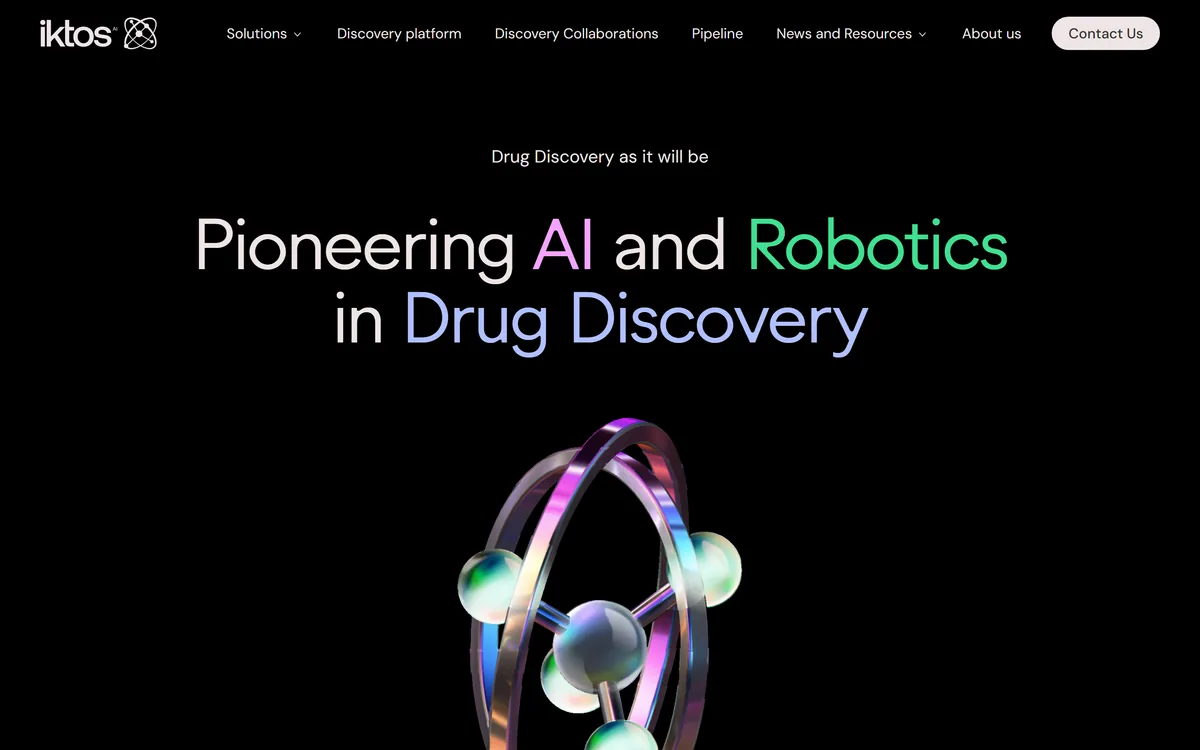
Last checked . Read from iktos.ai during this check, with the screenshot above captured at the same time.
- An AI-and-robotics drug-discovery company founded in Paris
- Makya generative-AI platform for de novo molecule design
- Spaya AI-driven retrosynthesis route planning
- Iktos Robotics for automated synthesis, analysis and biological testing
- A design-make-test-analyse loop toward autonomous labs
- Iktos Engine APIs for agentic computational-chemistry workflows
- A stated 60+ collaborations and an in-house pipeline across named areas
- An enterprise SaaS and discovery-collaboration model, demo-led
- No prices reproduced here, in line with this site's pricing policy
Iktos is a research platform, not a maker of approved drugs. Its timeline and pipeline claims are vendor-stated; experimental validation and regulated approval lie far beyond any software.
Other Deep-Tech Science Tools
A drug-discovery peer, a protein-design platform and an adjacent research tool to weigh alongside Iktos.
- Insilico Medicine — end-to-end AI drug discovery
- Tamarind Bio — protein-design tooling for computational biology
- Eve — AI for an adjacent research need
Editor's Verdict
4.1/5Iktos earns 4.1 for a genuinely ambitious approach: coupling generative molecule design (Makya) and AI retrosynthesis (Spaya) with lab robotics into a closed design-make-test-analyse loop aimed at compressing early drug discovery. It is a research platform for pharma and biotech teams, not a source of finished drugs; its speed and pipeline claims are the vendor's, outputs need experimental validation, and it is addressable only by teams with real discovery capacity. AInexfinder Editor Score: 4.1/5.
Iktos pricing
AInexfinder does not list plan prices or billing details. For current pricing, plans, and trials, visit the official Iktos website.
Visit official website for pricingVendor pricing, credits, and billing policies change over time. Always confirm on the official site before you buy.
Frequently asked questions
What is Iktos?
Iktos is an AI-and-robotics drug-discovery company. Its Makya platform generates drug-like molecules, its Spaya platform plans how to synthesise them, and its robotics automate synthesis and biological testing, feeding results back to the design stage in a design-make-test-analyse loop for pharma and biotech research.
Does Iktos make approved drugs?
No. Iktos is a research platform and discovery partner that aims to accelerate the early design-make-test cycle. Turning a candidate into an approved medicine requires a long, regulated development and trials process far beyond any software, so treat its role as discovery tooling, not drug delivery.
What are Makya and Spaya?
Makya is Iktos's generative-AI platform for de novo molecule design, optimising for synthetic accessibility, multiple parameters and 3D constraints. Spaya is its AI-driven retrosynthesis platform that works out realistic routes to synthesise a target molecule. Together they link design to how a molecule would actually be made.
What does the robotics part do?
Iktos Robotics automates synthesis, purification, analysis and biological testing, including in-cellulo imaging for targets like protein-protein interactions and molecular glues. The results feed back to Makya to refine the next round of designs, which is what the company means by moving toward autonomous labs.
Who is Iktos for?
Medicinal and computational chemistry teams at pharma, biotech and academic institutions running real discovery programmes. It is not a consumer or general-developer tool; using it well requires the scientific capacity to feed its loop and to validate the molecules it proposes experimentally.
How is Iktos sold?
It is enterprise and relationship-led: Makya is offered as a SaaS platform alongside discovery collaborations and partnerships, with engagement through demos and direct contact rather than public pricing. We do not publish prices; evaluation is a procurement and scientific decision, not a sign-up.
Does Iktos really shorten drug discovery?
The company frames its integrated loop as substantially shortening the early discovery phase, but that is a vendor claim. Whether it compresses your timeline or improves hit quality depends on your target and integration, which a scoped pilot or collaboration with your own chemists can test.
Can I integrate Iktos into my own systems?
Yes, in part. The Iktos Engine exposes APIs for agentic workflows and computational-chemistry pipelines, so teams can wire elements of the platform into their own systems rather than using only the hosted Makya and Spaya interfaces. The robotics side is a deeper, collaboration-led engagement.
What is retrosynthesis and why does it matter?
Retrosynthesis works backward from a target molecule to find a practical sequence of reactions to make it. It matters because a molecule that cannot be synthesised is useless, so pairing generative design with realistic route planning keeps Iktos's suggestions actionable rather than theoretical.
Who should not use Iktos?
Anyone outside drug discovery and chemistry, teams without the scientific capacity to act on and validate its output, and anyone expecting a quick self-serve tool or finished drugs. Its value is concentrated in serious, well-resourced discovery programmes that can use and verify its results.
Reviews
Log in to write a review.
User Reviews
No reviews yet. Be the first to share your experience with Iktos.
Reviewed by Daniel Reed
Assigned reviewer
Daniel ReedSenior AI Tools Reviewer
Daniel reviews AI tools the slow way — by actually using them on real projects. His reviews cover what works, what breaks, and who each tool is genuinely a good fit for.
Hands-on reviewsProduct testingAI software
Daniel and the AInexfinder editorial team research Iktos using public product information, listing evidence, and (when available) hands-on checks. Scores reflect listing completeness and transparency — not paid placement.
- Last verified
- Methodology
- How we review AI tools
- Sources used
- iktos.ai
- AInexfinder listing fields (features, pros/cons, description)
- Public vendor pages when available
- Editorial policy
- Listings may include affiliate or sponsored placements, which are labeled when present. Editorial scores and cons are not sold. See our affiliate disclosure and review methodology.
Related tools
EOSDA Crop Monitoring is a satellite-based precision agriculture platform from EOS Data Analytics. It combines Sentinel-2 and PlanetScope imagery with ten vegetation indices, growth-stage tracking, risk maps, yield estimation and variable-rate application maps.
FreemiumEmerging & Specialized
Insilico Medicine pairs the Pharma.ai software suite — PandaOmics, Chemistry42, inClinico and more — with its own clinical pipeline. Its lead candidate rentosertib, a TNIK inhibitor for idiopathic pulmonary fibrosis, has Phase IIa results published in Nature Medicine.
Persefoni is a carbon-accounting and sustainability-management platform for measuring, reporting and decarbonizing emissions across Scopes 1-3, with a financed-emissions module for financial services and a native AI copilot built on its own carbon-accounting model.
FreemiumEmerging & Specialized
Taranis provides AI crop intelligence from leaf-level aerial imagery, detecting stand counts, weeds, insect damage, nutrient deficiencies and disease pressure across whole fields. Its products include Taranis Yield Impact and Ag Assistant, with a mobile app and web dashboard.
CO2 AI is an enterprise sustainability platform that measures, reduces and reports corporate, product and supply-chain emissions in one system, with AI-driven emission-factor matching, product footprints at scale, abatement-cost curves and a supplier hub.
Compare:Iktos vs Tamarind BioIktos vs EOSDA Crop MonitoringIktos vs Insilico MedicineIktos vs Persefoni
Iktos alternatives Explore More
Embed this listing on your site
Featured on AInexfinder