Darrow describes itself as an AI lab building legal exposure management, ingesting regulatory filings, incident data and litigation patterns to surface emerging risk for law firms, insurers and compliance teams. It states 5M+ signals detected monthly across 50+ exposure categories.
Eve
Verified
Eve builds EveOS for plaintiff-side firms in personal injury, employment, medical malpractice, workers' compensation and Social Security disability. It runs intake, structures medical records, drafts demands and discovery, audits open matters nightly, and answers plain-English questions about the firm's own numbers.
4.2Editor Score
eve.legal8 viewsAdded October 22, 20254K visitors
Legal AI has spent three years being sold to large defence firms and corporate legal departments, where Harvey AI set the template. Eve went the other way, and the choice explains almost everything good about the product.
Plaintiff firms have a different economic structure. They are paid contingently, so time spent is capital at risk rather than billable. Their bottlenecks are specific and well known: reading medical records, drafting demands, chasing providers for documents, answering the phone when a case walks in at nine at night, and noticing the file that has quietly gone stale.
EveOS is organised around those bottlenecks rather than around generic legal research. This review covers what each module does, why the medical chronology work is the most defensible part, what the numbers on the site can and cannot support, and what a managing partner should verify before signing.
What EveOS Actually Runs
- Plaintiff side only, across personal injury, labour and employment, medical malpractice, workers' compensation, and Social Security and disability. That narrowness is the product's main advantage.
- Medical chronologies are the standout capability — automated review of records into a timeline, which is the most tedious and most error-prone task in a personal injury file.
- An auditor runs nightly over open matters, surfacing buried injuries and treatment gaps rather than waiting for someone to re-read the file.
- Security answers the right questions: SOC 2 Type 2, HIPAA compliance, encryption in transit and at rest, US-only data residency, and a statement that client data does not train shared models.
- Backed by a large Series B led by well-known venture firms, which matters when you are handing a vendor the operational core of your practice.
Plaintiff-Side Only, And That Is A Design Decision
Most legal AI products describe themselves as practice-agnostic, which usually means they were built for document review and then pointed at everything else.
Eve names its practice areas and its side of the case. That restriction is what lets the software be opinionated: it can assume there is a client with injuries, a treatment history, an insurer, a demand, and a contingency fee that makes speed worth money. A defence-side or transactional tool — Spellbook works inside Word on contracts, for instance — cannot assume any of those things, so it ends up shipping a search box.
The visible result is a set of modules that map to how a plaintiff firm actually runs — intake, a data layer that structures records and bills, an auditor over open matters, drafting agents for demands and discovery, and an analyst that answers questions about the firm's own performance.
The cost of the same decision is obvious. If your practice is defence-side, transactional, family or immigration, this is not a product you can adapt. Specialisation cuts both ways and here it cuts sharply.
A tool that knows there is an insurer, a treatment history and a contingency fee can make decisions a general-purpose legal assistant is not permitted to make.
The Analyst Is Quietly The Most Interesting Module
Alongside the drafting tools sits a module that answers plain-English questions about the firm: live revenue, margins, settlement pacing.
This is unglamorous and probably the highest-value component for firm leadership. Plaintiff practices routinely run on partner intuition about which case types pay and how long matters take, because assembling that picture means pulling data from a case management system, an accounting system and a spreadsheet nobody trusts.
It also carries an underappreciated risk: an answer given in confident prose is harder to sanity-check than a report with a visible query behind it. Before relying on a figure for a business decision, reconcile it once against your accounting system. If it matches, you have found something genuinely useful. If it does not, you have learned that early rather than in a partners' meeting.
Medical Chronologies Are The Unglamorous Win
If you asked a personal injury paralegal which task they would hand to a machine first, most would name medical record review without pausing.
A serious injury file can run to thousands of pages from multiple providers, in inconsistent formats, much of it scanned, with the clinically significant material scattered through routine notes. Turning that into a chronology is slow, requires real attention, and is where fatigue produces expensive misses.
Eve automates the review into a timeline, and pairs it with a nightly auditor that re-reads open matters to surface injuries that were buried in the records and gaps in treatment that will be used against the client later.
The nightly cadence is the part worth noticing. Records arrive continuously over a matter's life, and the traditional failure mode is that nobody re-reads the file after the initial review. A system that looks again every night addresses a real structural weakness rather than an imagined one.
The necessary caution is that extraction from scanned medical records is genuinely hard, and a missed entry in a chronology is a live risk to the case. Treat the output as a first pass produced by a tireless reader, verified by a person before it drives strategy — which is how the firm's professional obligations require it to be treated in any event.
- Best-fit tasks: chronology construction, treatment-gap detection, provider and bill reconciliation, first-draft demands.
- Supervise closely: anything where a missing record changes the value of the claim.
- Verify independently: dates, provider names and figures that will appear in a filed document.
- Do not delegate: the judgement about what the chronology means for strategy and settlement posture.
The Settlement Numbers Deserve A Second Look
The site carries strong claims: firms handling substantially more cases, settlements 15 to 30 per cent higher, demand letters produced far faster, discovery response times cut dramatically, and a named firm reporting a large jump in annual case volume.
Separate these into two kinds, because they are not equally checkable. Process metrics — how long a demand takes to draft, how quickly discovery responses go out — are plausible and measurable inside a firm. A tool that turns a multi-hour drafting task into a review task genuinely does that.
Outcome metrics are a different matter. Attributing a higher settlement to software requires holding constant the venue, the adjuster, the injury severity, the policy limits, the firm's willingness to try the case and the general movement of the insurance market. Those are the variables that actually determine settlement value, and no software vendor can control for them.
That does not make the figure false. A better-documented demand supported by a complete chronology very plausibly settles higher, and every experienced plaintiff lawyer believes something like this. It means the number is customer-reported experience rather than a measured effect, and should be weighed as such.
The stronger evidence sits elsewhere: a large Series B from investors who conducted diligence, a long list of named firms willing to be associated publicly, and a stated count of firms on the platform. Named references are worth more than percentages, and they are the thing to ask for.
Privilege Is The Whole Security Question
For a law firm, vendor security is not an IT matter. Client confidentiality is an ethical obligation, and in these practice areas the files also contain medical records, which brings a second regulatory regime with it.
Eve's published answers are the right ones. Its security page states SOC 2 Type 2, encryption at rest for all databases and TLS in transit, hosting on AWS with all data located in the United States, least-privilege access with quarterly reviews, background checks and security training for staff, annual third-party penetration testing, and a formal incident response process. Elsewhere the site states HIPAA compliance and that client data is not used to train shared models, with isolation at organisation, user and workflow level.
That set covers the questions a firm's professional responsibility counsel will ask. Two things are worth pursuing directly rather than accepting from a web page: the subprocessor list, including which model providers process matter content, and the retention and deletion schedule when an engagement ends.
Neither absence is unusual — most vendors keep both behind an NDA — but both belong in your file before client material moves. If you carry cyber liability cover, your insurer will want the same answers, and the review is the same shape an accounting firm would run on Black Ore.
- Ask for the SOC 2 Type 2 report itself, with its observation period and any exceptions.
- Request the subprocessor list and confirm which model providers see matter content.
- Get retention and deletion terms in writing, including what happens at termination.
- Confirm the no-training commitment appears in the contract, not only on the website.
- Check the terms against your jurisdiction's rules on confidentiality and supervision of non-lawyer assistance.
How To Pressure-Test Eve In A Pilot
There is no trial and no published price, so evaluation happens through a sales process. A written plan protects you from judging the product by its demo.
The bar to clear is step two. If the chronology on a file you know well misses something material, that is the finding — not a reason to look at the next feature.
- Choose three closed matters you know intimately, including one that was document-heavy and one that settled badly.
- Run the medical chronology on all three and check it against what you know is in the file. Count the misses and the inventions separately; they are different failure modes with different consequences.
- Have it draft a demand for a matter whose demand you already wrote, then compare. Judge it against your own work product, not against a blank page.
- Put the analyst module against a number you can independently verify in your accounting system, and reconcile.
- Run intake in parallel with your existing process for two weeks rather than switching, so a missed lead is caught by the old path.
- Only then discuss commercial terms, with your own measurements in hand instead of the vendor's percentages.
How Eve Is Bought
There is no free tier, no trial and no published pricing. Access begins with a demo and proceeds through a sales conversation, which is standard for software sold into firms rather than to individuals.
In this category, contact-sales pricing usually means the figure scales with firm size, seat count, matter volume and contract term, and that implementation and onboarding are part of the engagement rather than a self-serve signup.
The site does offer a way to think about value, presenting the return in terms of additional settlement value earned annually. Treat that framing as a sales instrument. The honest version of the same calculation is one you run yourself after a pilot, using your own measured before-and-after on demand turnaround and case capacity.
Budget for the evaluation itself. A serious pilot consumes partner and paralegal time, and that time is the real cost of getting this decision right.
Eve: The Firm-Level Facts
| Product | EveOS — an AI platform for plaintiff law firms |
|---|---|
| Practice areas | Personal injury, labour and employment, medical malpractice, workers' compensation, Social Security and disability |
| Side of the case | Plaintiff only |
| Core modules | Analyst, Intake, Auditor, Agents, Atlas data layer |
| Document capabilities | Medical chronologies, demand letters, complaints, discovery, legal research with citations |
| Intake | 24/7 call answering, lead scoring, contract signing |
| Auditing cadence | Nightly review of active matters for buried injuries and treatment gaps |
| Security | SOC 2 Type 2, HIPAA compliance, encryption at rest and TLS in transit, annual penetration testing |
| Data residency | AWS, all data located in the United States |
| Model training | Client data stated as not used to train shared models; isolation at organisation, user and workflow level |
| Funding | Series B of 103 million dollars, from Spark Capital, Andreessen Horowitz, Lightspeed and Menlo Ventures |
| Company | Founded 2023, based in San Mateo, California |
| Access model | Demo and sales process; no trial or published pricing |
Which Firms Eve Fits
Right for your firm if
- You run plaintiff matters in personal injury, employment, medical malpractice, workers' compensation or disability.
- Medical record review is a genuine bottleneck and paralegal capacity limits how many cases you can carry.
- Your intake leaks — calls missed after hours become cases that went to the firm advertising next to you.
- You want firm performance data without assembling it by hand from three systems.
- You can staff a real pilot on closed matters rather than judging the product by demonstration.
Wrong for your firm if
- You practise on the defence side, or in transactional, family or immigration law — the specialisation that makes it good makes it inapplicable.
- You are a solo or very small practice without the volume to justify enterprise software and an implementation.
- You need to try software before buying, since there is no trial and no published pricing.
- Your firm cannot supervise AI-produced work properly, because the professional obligation to verify does not transfer to a vendor.
- You practise outside the United States, where the data residency, the forms and the procedural assumptions do not apply.
Key features of Eve
Medical chronologies built automatically from provider records into a reviewable timeline
Nightly auditing of active matters, surfacing buried injuries and treatment gaps
24/7 intake with call answering, automatic lead scoring and contract signing
Demand letter generation matched to the firm's own style and formatting
Drafting of complaints, discovery requests and responses, and good faith letters
Atlas data layer that structures records, bills and calls without manual entry
Plain-English analyst over firm data covering revenue, margins and settlement pacing
Built-in legal research with source citation
Pros & cons
Pros
6- Built for one side of specific practice areas, so the workflow assumptions are correct rather than generic
- Medical chronology and nightly re-auditing target the real bottleneck in plaintiff work
- Security posture answers the questions a firm must ask: SOC 2 Type 2, HIPAA, US residency, no shared-model training
- Intake covering after-hours calls addresses a leak that costs plaintiff firms real cases
- The analyst module gives firm leadership numbers that usually require assembling three systems by hand
- Well funded by named investors, which matters when a vendor holds your operational core
Cons
6- Useless outside plaintiff practice — defence-side, transactional, family and immigration firms cannot adapt it
- Settlement and revenue improvements are customer-reported with no methodology, and outcome effects are close to unprovable
- No trial and no published pricing, so evaluation requires a sales process and committed firm time
- Extraction from scanned medical records is genuinely hard, and a missed entry carries real case risk
- Subprocessor list and data retention schedule are not published, though both matter for privileged material
- Confident prose answers from the analyst module are harder to sanity-check than a report with a visible query behind it
Best For
- Plaintiff firms in personal injury, employment, medical malpractice and workers' compensation
- Practices where medical record review limits how many cases can be carried
- Firms losing intake to missed after-hours calls
- Managing partners who want firm performance data without manual assembly
- Growing practices that need capacity before they need more headcount
Eve Against Other Legal AI Platforms
The useful axis in legal AI is not capability but constituency. Who a product was built for predicts what it will do well.
| Tool | Built for | Strongest capability | Where it will not help |
|---|---|---|---|
| Eve | Plaintiff firms in injury, employment and disability | Medical chronologies, demand drafting and nightly matter auditing | Defence, transactional, family or immigration practice |
| Harvey AI | Large law firms and corporate legal departments | Research, analysis and drafting across broad corporate practice | The contingency-fee operational workflow Eve targets |
| Spellbook | Transactional lawyers working in Word | Contract drafting and review inside the document | Litigation workflow and medical records |
| Luminance | Contract analysis at enterprise scale | Reviewing large contract populations for risk and obligation | Case management or plaintiff-side matter progression |
| Solve Intelligence | Patent attorneys | Drafting and prosecuting patent applications | Anything outside intellectual property |
More Legal And Professional AI
Different constituencies, comparable questions about supervision, confidentiality and what a firm can actually verify.
- Harvey AI — the large-firm and corporate counterpart, and the usual benchmark for legal AI procurement
- Spellbook — transactional drafting inside Word, for firms whose work is contracts rather than claims
- Luminance — contract analysis at scale, a different shape of document problem
- Solve Intelligence — shows what depth in a single document type buys in a regulated practice
- Black Ore — the same enterprise motion in accounting, useful for comparing how professional firms evaluate AI vendors
Our Verification Of Eve
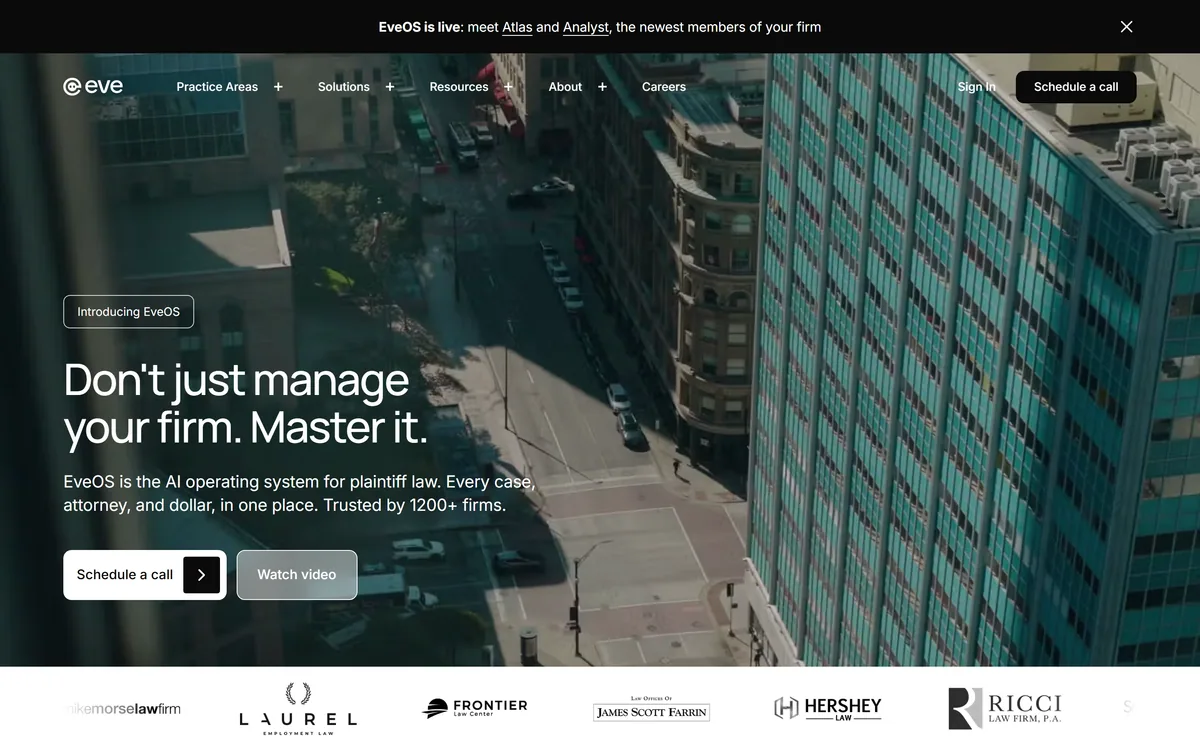
Last checked . Read from eve.legal, including the dedicated security page, with the screenshot above captured in the same session.
- Product identified as EveOS and described as an AI operating system for plaintiff law firms
- Practice areas confirmed as personal injury, labour and employment, medical malpractice, workers' compensation, and Social Security and disability, plaintiff side only
- Modules confirmed on the site as Analyst, Intake, Auditor, Agents and Atlas, with medical chronologies, demand letters, discovery and legal research described
- Nightly auditing of active matters described as surfacing buried injuries and treatment gaps
- Security page read directly: SOC 2 framework with third-party assessment, databases encrypted at rest, TLS in transit, AWS hosting with all data in the United States, least-privilege access with quarterly reviews, background checks, annual penetration testing and a formal incident response process
- HIPAA compliance and a statement that client data is not used to train shared models, with isolation at organisation, user and workflow levels
- Funding stated as a Series B of 103 million dollars from Spark Capital, Andreessen Horowitz, Lightspeed Venture Partners and Menlo Ventures
- Company details confirmed as founded in 2023 and based in San Mateo, California
- Named client firms listed publicly, including Mike Morse Law Firm, Law Offices of James Scott Farrin, Hershey Law and Ricci Law Firm
- No trial, no published pricing and no self-serve signup found; access begins with a demo request
What we could not confirm: the settlement uplift, case volume and revenue growth figures are customer-reported with no published methodology, and settlement outcomes depend on venue, injury severity, policy limits and trial posture that no vendor can control for; the SOC 2 report itself is not public, so its type, period and exceptions are unknown from outside; the subprocessor list and data retention schedule are not published; and we did not use the product, so nothing here reflects hands-on testing.
Editor's Verdict
4.2/5Eve scores highly because it is built for one side of one kind of practice and shows it — medical chronologies, demand drafting and nightly matter auditing are the actual bottlenecks in plaintiff work, not generic document search. SOC 2 Type 2, HIPAA compliance, US data residency and a stated refusal to train shared models on client data are the right answers to the questions a firm must ask, and a large Series B means the vendor will still be there mid-matter. It loses ground because the settlement and revenue figures on the site are customer-reported with no methodology, because attributing a larger settlement to software is close to unprovable, and because nothing on the site tells a firm what it will pay. AInexfinder Editor Score: 4.2/5.
Eve pricing
AInexfinder does not list plan prices or billing details. For current pricing, plans, and trials, visit the official Eve website.
Visit official website for pricingVendor pricing, credits, and billing policies change over time. Always confirm on the official site before you buy.
Frequently asked questions
What is Eve, and what does EveOS do?
Eve builds EveOS, an AI platform for plaintiff law firms. It handles intake including after-hours calls, structures medical records and bills into usable data, builds medical chronologies, drafts demands, complaints and discovery, audits open matters nightly for buried injuries and treatment gaps, and answers plain-English questions about the firm's own revenue and settlement pacing.
Which practice areas does Eve support?
Personal injury, labour and employment, medical malpractice, workers' compensation, and Social Security and disability — all on the plaintiff side. It is not built for defence-side, transactional, family or immigration practice, and that restriction is deliberate rather than a gap.
Is Eve free, and what does it cost?
It is not free and there is no trial. Access starts with a demo and runs through a sales conversation, which in this category normally means pricing scales with firm size, seats, matter volume and term, with implementation included. We do not publish amounts. Budget for the pilot as well as the licence, because a proper evaluation consumes partner and paralegal time.
Is client data safe with Eve, given privilege and medical records?
Eve's security page states SOC 2 Type 2, encryption at rest and TLS in transit, AWS hosting with all data in the United States, least-privilege access with quarterly reviews and annual penetration testing. It also states HIPAA compliance and that client data is not used to train shared models. Ask additionally for the SOC 2 report itself, the subprocessor list including model providers, and written retention and deletion terms.
Can Eve really increase settlement values by 15 to 30 per cent?
That is customer-reported experience, not a measured effect. Settlement value is driven by venue, adjuster, injury severity, policy limits and whether a firm will try the case — variables no vendor can hold constant. The plausible mechanism is real: a better-documented demand backed by a complete chronology tends to settle better. Treat the percentage as a claim and ask for named references instead.
How does Eve compare with Harvey AI?
They are built for different firms. Harvey targets large law firms and corporate legal departments with broad research, analysis and drafting. Eve targets plaintiff practices and is organised around their specific operational bottlenecks — intake, medical records, demands and matter auditing. Neither is a substitute for the other; the choice is decided by what kind of firm you run.
Does using Eve reduce a lawyer's responsibility for the work?
No. Professional obligations to supervise and to verify remain with the lawyer, and no vendor arrangement transfers them. Treat chronologies as a first pass by a tireless reader and drafts as first drafts, verifying dates, provider names and figures before anything reaches a filed document.
Reviews
Log in to write a review.
User Reviews
No reviews yet. Be the first to share your experience with Eve.
Reviewed by Daniel Reed
Assigned reviewer
Daniel ReedSenior AI Tools Reviewer
Daniel reviews AI tools the slow way — by actually using them on real projects. His reviews cover what works, what breaks, and who each tool is genuinely a good fit for.
Hands-on reviewsProduct testingAI software
Daniel and the AInexfinder editorial team research Eve using public product information, listing evidence, and (when available) hands-on checks. Scores reflect listing completeness and transparency — not paid placement.
- Last verified
- Methodology
- How we review AI tools
- Sources used
- eve.legal
- AInexfinder listing fields (features, pros/cons, description)
- Public vendor pages when available
- Editorial policy
- Listings may include affiliate or sponsored placements, which are labeled when present. Editorial scores and cons are not sold. See our affiliate disclosure and review methodology.
Related tools

Harvey is an AI platform for legal and professional services — agents, a Vault for documents, Knowledge, Spaces, and Contract Intelligence — used by firms including A&O Shearman, Latham & Watkins, and Norton Rose Fulbright.
Solve Intelligence is an AI platform for patent work, covering application drafting, office action responses, invalidity and claim-mapping charts, freedom-to-operate reviews and portfolio analysis. It is used by over 700 in-house IP teams and law firms, with SOC 2 Type II and ISO 27001 certification and no training on customer data.
Ivo is AI contract review for in-house legal teams. It applies redlines directly in Microsoft Word or Google Docs, evaluates agreements against your playbooks and historical contracts, benchmarks clauses by governing law and industry, and queries executed contracts in plain language.
Spellbook reviews and drafts contracts inside Word and Google Docs, redlining against a firm's own playbooks, comparing terms to thousands of similar agreements, and indexing signed contracts for search — used by a stated 5,000-plus legal teams in 80-plus countries.
Luminance is a contract platform from Luminance Technologies Ltd. spanning Draft, Negotiate, Analyze, Comply, Investigate and Collaborate. It describes a mixture-of-experts architecture using probabilistic consensus across multiple models, with over 1,000 customers named on the site.
Explore More
Embed this listing on your site
Featured on AInexfinder