
Eve builds EveOS for plaintiff-side firms in personal injury, employment, medical malpractice, workers' compensation and Social Security disability. It runs intake, structures medical records, drafts demands and discovery, audits open matters nightly, and answers plain-English questions about the firm's own numbers.
Ivo
Verified
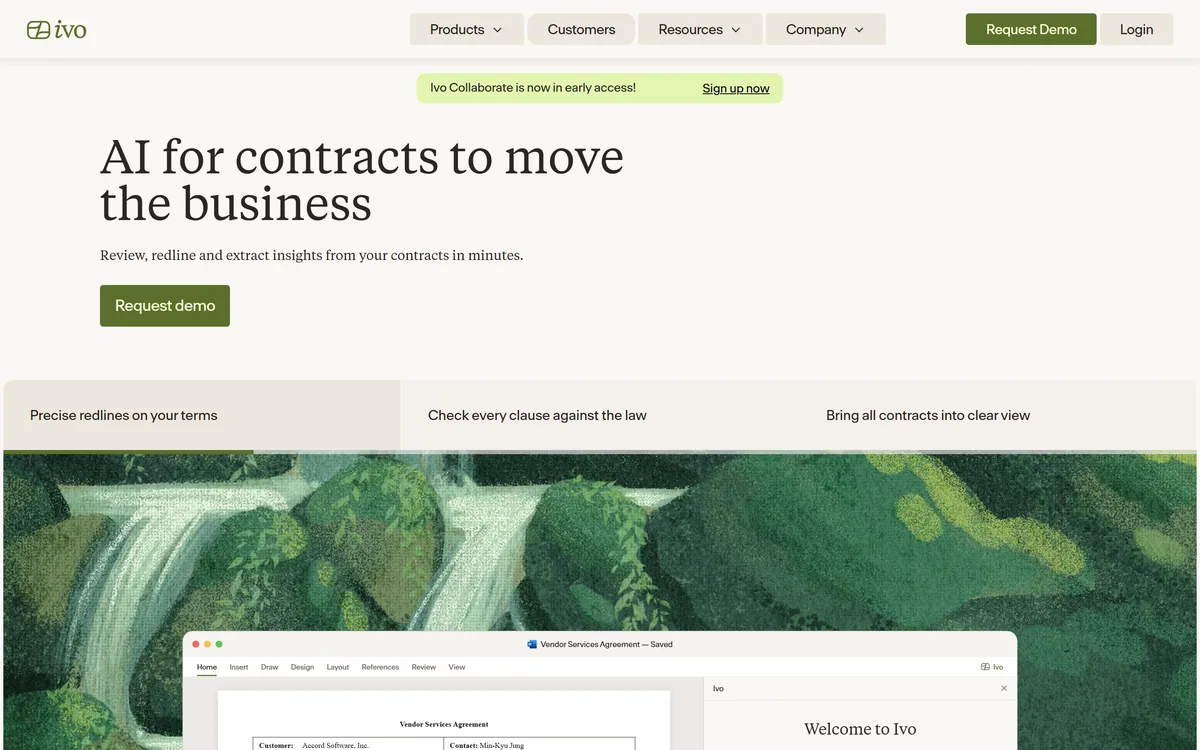
Ivo is AI contract review for in-house legal teams. It applies redlines directly in Microsoft Word or Google Docs, evaluates agreements against your playbooks and historical contracts, benchmarks clauses by governing law and industry, and queries executed contracts in plain language.
4.4Editor Score
ivo.ai8 viewsAdded March 1, 20264K visitors
Every in-house legal team has the same bottleneck and it is not interesting work. Vendor agreements, NDAs, order forms and data processing addenda arrive faster than anyone can read them, and most are ninety per cent identical to the last one.
The skill is spotting the ten per cent that differs, and specifically the parts that differ from what your company will accept — which is not the same as what a textbook considers standard. Your company may care intensely about liability caps and not at all about governing law, or the reverse.
That distinction is where most contract AI falls down and where Ivo's design starts. It reviews against your playbook rather than a generic one, and it does it in the document where lawyers already work.
What Does Ivo Do To A Contract?
- It applies redlines in Word or Google Docs, in the document itself, rather than producing a report you then have to act on.
- It reviews against your playbook, your historical agreements and the deal context — not a generic standard.
- Clause benchmarking by governing law, contract type, party role and industry, which is context a junior lawyer would not have.
- Four products: Review for redlining, Assistant for research and comparison, Intelligence for querying executed contracts, and Collaborate in early access.
- SOC 2 and ISO 27001 certified, GDPR and CCPA compliant, with a stated commitment never to train AI models on customer data.
Why Does Reviewing In Word Matter So Much?
Ivo applies redlines directly in Microsoft Word and Google Docs. That sounds like an integration detail and it is the reason lawyers will use it.
Contract negotiation happens in Word with tracked changes. It has for thirty years, counterparties expect it, and no legal technology has changed that — because the counterparty's lawyer at another company is not going to log into your platform.
Tools that produce a separate review report create work rather than removing it: someone reads the report, decides which findings to accept, and then makes the changes in Word by hand. The analysis was automated and the labour was not.
Applying redlines in the document itself removes that translation step entirely. What comes back is a marked-up contract you can review, adjust and send — the same artefact you would have produced yourself, faster.
The thing to test is fidelity rather than existence. Does it preserve the counterparty's existing tracked changes and comments? Does formatting survive? A tool that produces clean redlines on a clean document and mangles a third-round negotiation draft has solved the easy half.
Working inside Word is the difference between a tool lawyers adopt and one they trial. Platforms like Ironclad ask the organisation to move its process; this asks nobody to move anything.
The counterparty's lawyer is never going to log into your platform. That single fact is why contract AI has to work inside Word.
Your Playbook Beats A Generic Standard
Ivo evaluates contracts against playbooks, historical agreements and deal context, and can convert your templates and repository contracts into working playbooks.
That last capability is the practical unlock. Most legal teams do not have a written playbook — they have institutional knowledge about what the company accepts, held by two or three people and applied inconsistently by everyone else.
Deriving a playbook from agreements you have already signed turns that tacit knowledge into something explicit and checkable. It also surfaces an uncomfortable and useful fact: what you actually agreed to is often not what you believe your position is.
Reviewing against historical agreements rather than a standard is the correct approach for a second reason. Your negotiating position depends on who you are dealing with — a large customer extracts terms a small vendor does not — and a generic reviewer flagging every deviation from an ideal produces noise rather than judgement.
Clause Benchmarking Is The Genuinely New Capability
Ivo benchmarks clauses by governing law, contract type, party role and industry. This is the feature that gives a reviewer something they could not easily get otherwise.
The question a lawyer asks constantly and can rarely answer with data is whether a term is market. Is a twelve-month liability cap normal for a software agreement under English law where we are the customer? Experienced practitioners develop intuition about this; nobody has statistics.
Segmenting by all four dimensions is what makes the answer meaningful. Market terms differ sharply between jurisdictions, between contract types, between being the supplier and the customer, and between industries. A benchmark that ignores those is an average of incomparable things.
The caveat to hold is that any benchmark reflects the population it was computed from, and that population is not disclosed. Whether it is drawn from public filings, customer agreements or licensed data changes what the number means — and a benchmark drawn mostly from large-company agreements will mislead a small one.
Ask about the basis directly. It does not make the feature less useful; it changes how much weight a specific number should carry in a negotiation.
Benchmarking is also where it diverges from drafting assistants. Spellbook helps you write the clause; benchmarking tells you whether the clause you were sent is unusual.
- Ask what population the clause benchmarks are computed from, since that determines what they mean.
- Check benchmarks in your specific governing law rather than accepting a global figure.
- Confirm the party-role distinction is applied, because supplier and customer positions are not comparable.
- Use benchmarks to inform judgement rather than to settle a negotiation, which they cannot do.
- Test whether the playbook derived from your own contracts matches what you believe your position is.
The Data Commitment Is Stated Clearly
Ivo states SOC 2 certification, ISO 27001 certification, GDPR and CCPA compliance, and that it never trains AI models on customer data.
That last sentence is the one that matters most and the one legal teams ask about first. Contracts are among the most commercially sensitive documents a company holds — pricing, terms, customer identities, negotiating positions — and a tool that learned from them would be learning from every customer's confidential material.
Stating it plainly rather than burying it in terms is the right behaviour, and it is not universal in this category. The follow-up for procurement is to confirm the commitment appears in the contract rather than only on the website, because a marketing statement is not an enforceable obligation.
The two certifications cover different things and both are useful: SOC 2 attests to operational controls, ISO 27001 to a maintained information security management system. A Trust Center is referenced from the footer, which is where the reports would live.
The customer list makes the security posture more credible than the certifications alone do. Meta, Uber, IBM, Intel, Coinbase and Atlassian all run vendor security reviews that are considerably more demanding than a typical questionnaire, and passing them repeatedly is evidence a badge is not.
Data commitments are worth reading side by side across vendors. Luminance and Harvey AI both publish them, and the differences matter for privileged material.
Testing Contract AI Against Reviews You Already Did
The only honest way to evaluate contract review is against agreements where you know what the right answer was, because a plausible-sounding redline on an unfamiliar contract tells you nothing.
The bar is step three. A reviewer that misses something your team caught is a reviewer you cannot leave unsupervised on that agreement type.
- Take ten agreements your team reviewed in the last six months, keeping your own markup separately.
- Let Ivo derive a playbook from your executed contracts, then read that playbook. It will tell you what you actually agree to, which is frequently a surprise.
- Run the ten and compare its redlines with yours. Count the misses and the false flags separately — they have different consequences.
- Test on a third-round negotiation draft with counterparty tracked changes and comments, not a clean document. Fidelity on messy documents is the real test.
- Check a clause benchmark against something you know the market position on, in your governing law, and see whether it matches your experience.
- Ask for reference calls before committing — with customers of this profile, you should get them.
The Details Ivo Keeps Behind Sales
No pricing appears anywhere on the pages we read, and access runs through a sales process. That is standard for legal technology sold to in-house teams.
More notable is the absence of any accuracy figure. Contract review has a measurable notion of correctness — did it catch the deviations a lawyer would — and no vendor in this category publishes it, Ivo included. The reason is presumably that the number depends entirely on the agreement type and the playbook, which is fair, and it still means the only evaluation is your own.
No headquarters location appears on the pages we read either, though a named legal entity, a registered trademark and a Trust Center are all present.
The Collaborate product is listed as early access, which is honest labelling and worth reading as such — early access means it is not yet something to build a process around.
We do not publish amounts. Request pricing alongside the SOC 2 and ISO reports, and ask specifically whether the no-training commitment is contractual rather than a website statement.
Ivo: The Product Facts
| Product type | AI contract review and redlining for in-house legal teams |
|---|---|
| Products | Review, Assistant, Intelligence, and Collaborate (early access) |
| Where it works | Microsoft Word and Google Docs, applying redlines in the document |
| Review basis | Your playbooks, historical agreements and deal context |
| Benchmarking | Clauses benchmarked by governing law, contract type, party role and industry |
| Playbook creation | Converts templates and repository contracts into working playbooks |
| Assistant capabilities | Comparison against prior agreements, tracking legal changes, regulation research with compliance flagging |
| Intelligence capabilities | Plain-language queries over contracts, unified timeline of agreements and amendments, deviation identification |
| Certifications | SOC 2, ISO 27001; GDPR and CCPA compliant |
| Data commitment | Stated as never training AI models on customer data |
| Named customers | Meta, Uber, IBM, Atlassian, Canva, DoorDash, Intel, Reddit, Coinbase, Pinterest, Mitsubishi, AVEVA, CDW, Strava |
| Legal entity | Ivo AI, Inc., with Ivo as a registered trademark |
| Pricing model | Not disclosed; access through sales |
Which Legal Teams Ivo Fits
An excellent fit when
- Your bottleneck is volume of routine agreements rather than complex bespoke work.
- Your lawyers negotiate in Word and will not adopt anything that moves them out of it.
- You have institutional knowledge about acceptable terms that has never been written down.
- You want to know whether a term is market in your jurisdiction, not in general.
- Confidentiality is the blocking concern, and an explicit no-training commitment resolves it.
Not worth the setup when
- You need workflow, approvals, signature and obligation management, which is a full CLM rather than a reviewer.
- Your contracts are highly bespoke, where playbook comparison has little to compare against.
- You want published accuracy data before deciding, since none exists in this category.
- You need a self-serve tool you can try today, as access runs through sales.
- Your volume is low enough that review is not actually your constraint.
Key features of Ivo
Redlines applied directly in Microsoft Word and Google Docs
Review against your own playbooks and historical agreements
Automatic playbook creation from templates and executed contracts
Clause benchmarking segmented by governing law, contract type, party role and industry
Comparison of a document against prior agreements to surface deviations
Regulation research with compliance flagging
Plain-language querying of executed contracts without manual tagging
Unified timeline view of agreements and their amendments
Pros & cons
Pros
7- Works inside Word and Google Docs, where contract negotiation actually happens
- Applying redlines in the document removes the translation step a review report creates
- Reviewing against your playbook rather than a generic standard produces judgement rather than noise
- Deriving a playbook from executed contracts turns tacit institutional knowledge into something checkable
- Clause benchmarking by four dimensions gives context a lawyer cannot easily obtain otherwise
- An explicit no-training commitment on customer data, stated plainly rather than buried
- Customer list includes companies whose vendor security reviews are genuinely demanding
Cons
6- No pricing published anywhere, so cost requires a sales process
- No accuracy or evaluation data for redlining, leaving your own testing as the only measure
- The population behind clause benchmarks is not disclosed, which changes what a benchmark means
- Not a full CLM — no workflow, signature or obligation management
- Collaborate is early access, so it is not something to build a process around yet
- No headquarters or funding detail is published
Best For
- In-house legal teams drowning in routine agreements
- Lawyers who negotiate in Word and will not move platform
- Companies whose acceptable terms exist as institutional knowledge rather than a document
- Teams that want to know whether a clause is market in their jurisdiction
- Organisations where confidentiality is the blocking objection to contract AI
Ivo Against Other Contract Tools
Contract technology splits by what it operates on and where it runs. Those two facts determine whether lawyers actually adopt it.
| Tool | Scope | Works in Word? | Reviews against |
|---|---|---|---|
| Ivo | Review, redline and query executed contracts | Yes — redlines applied in the document | Your playbook and historical agreements |
| Ironclad | The whole contract lifecycle including workflow and signature | Word integration within a wider platform | Playbook, inside a managed workflow |
| Spellbook | Drafting and review | Yes — built as a Word add-in | General standards plus your context |
| Luminance | Analysis across large contract populations | Platform-based | Risk patterns across a population |
| Harvey AI | Broad legal work beyond contracts | Platform-based | Legal material and firm documents |
Other Contract And Legal AI Tools
Compare on scope first — a reviewer, a lifecycle platform and a research tool are three different purchases.
- Ironclad — the full lifecycle platform if workflow and obligations are the problem, not review
- Spellbook — the closest Word-native comparison, generally lighter and aimed at smaller teams
- Luminance — analysis across a whole contract population rather than review of one agreement
- Harvey AI — broader legal work for firms rather than in-house contract review
- Blue J — a comparison on how professional AI should handle cited authority
Where These Ivo Facts Came From
Last checked . Read from ivo.ai, including the footer, with the screenshot above captured in the same session.
- Product described as AI contract review for in-house legal teams, positioned as reviewing, redlining and extracting insights in minutes
- Redlines confirmed as applied directly in Microsoft Word or Google Docs
- Review basis confirmed as playbooks, historical agreements and deal context
- Clause benchmarking confirmed by governing law, contract type, party role and industry
- Playbook creation confirmed as converting templates and repository contracts into working playbooks
- Assistant product confirmed as comparing documents against prior agreements, tracking legal changes and conducting regulation research with compliance flagging
- Intelligence product confirmed as querying contracts in plain language without manual tagging, with a unified timeline of agreements and amendments
- Collaborate confirmed as currently in early access
- Certifications stated as SOC 2 and ISO 27001, with GDPR and CCPA compliance
- Data commitment quoted from the site: never training AI models on customer data
- Named customers listed including Meta, Uber, IBM, Atlassian, Canva, DoorDash, Intel, Reddit, Coinbase, Pinterest, Mitsubishi, AVEVA, CDW and Strava
- Legal entity given as Ivo AI, Inc.; footer confirmed to carry product pages, customer stories, blog, FAQs, Trust Center, about, careers, contact, privacy and terms
What we could not confirm: no pricing is published anywhere on the pages we read; no accuracy figure or evaluation data is given for the redlining, which is true across this whole category but means your own testing is the only evaluation; the population underlying the clause benchmarks is not disclosed, which determines what a benchmark number actually means; no headquarters location appears; no funding detail is stated; and we did not use the product, so nothing here reflects tested redline quality.
Editor's Verdict
4.4/5Ivo scores highly for two decisions that together make it usable by lawyers rather than admired by procurement. It works inside Microsoft Word and Google Docs, where contract negotiation actually happens and will keep happening, rather than asking anyone to move. And it reviews against your playbook and your historical agreements rather than a generic standard, which is the difference between useful redlines and a list of clauses a textbook would prefer. SOC 2, ISO 27001, and an explicit commitment never to train on customer data are the right answers, and the customer list is remarkable. It loses ground because no pricing exists publicly and no accuracy data is published. AInexfinder Editor Score: 4.4/5.
Ivo pricing
AInexfinder does not list plan prices or billing details. For current pricing, plans, and trials, visit the official Ivo website.
Visit official website for pricingVendor pricing, credits, and billing policies change over time. Always confirm on the official site before you buy.
Frequently asked questions
What is Ivo?
Ivo is AI contract review for in-house legal teams. It applies redlines directly in Microsoft Word or Google Docs, evaluates agreements against your own playbooks and historical contracts, benchmarks clauses by governing law and industry, and lets you query executed contracts in plain language.
Does Ivo work inside Microsoft Word?
Yes, and this is the most important thing about it. Contract negotiation happens in Word with tracked changes and will keep happening there, because the counterparty's lawyer is never going to log into your platform. Applying redlines in the document removes the step where someone reads a report and makes the changes by hand.
How does Ivo know what my company accepts in a contract?
It reviews against your playbook, and it can derive that playbook from your templates and executed contracts. Most legal teams have no written playbook — they have institutional knowledge held by two or three people. Turning that into something explicit is genuinely useful, and it often reveals that what you agreed to differs from what you believe your position is.
What is clause benchmarking?
It answers whether a term is market, segmented by governing law, contract type, party role and industry. All four dimensions matter — market terms differ between jurisdictions, between being supplier and customer, and between sectors. Ask what population the benchmarks are computed from, since that determines what a specific number actually means.
Does Ivo train on my contracts?
The site states plainly that it never trains AI models on customer data. That is the right commitment and the right way to state it, given contracts contain pricing, terms and negotiating positions. Confirm it appears in your contract rather than only on the website — a marketing statement is not an enforceable obligation.
Is Ivo free, and what does it cost?
No pricing is published anywhere on the pages we read, and access runs through a sales process — standard for legal technology sold to in-house teams. Request pricing alongside the SOC 2 and ISO 27001 reports, and ask whether the no-training commitment is contractual.
How accurate is Ivo's contract review?
No accuracy figure is published, which is true across this entire category — the number depends on agreement type and playbook, so a single figure would be misleading. Test it against ten agreements your team already reviewed, keeping your own markup separately, and count misses and false flags apart. Those have different consequences.
Is Ivo a replacement for a CLM system?
No. Ivo reviews and redlines contracts and lets you query executed ones; it does not manage workflow, approvals, signature or ongoing obligations. If your problem is that contracts stall in handoffs or that renewals get missed, you need a lifecycle platform such as Ironclad. If your problem is review volume, Ivo is the narrower and more focused answer.
How does Ivo compare with Spellbook?
Both work inside Word, which is the right architecture. Ivo puts more weight on reviewing against your own playbook and historical agreements, plus clause benchmarking and querying executed contracts. Spellbook is generally lighter and aimed at smaller teams and firms. Test both on the same ten agreements you have already reviewed.
Which companies use Ivo?
The site names Meta, Uber, IBM, Atlassian, Canva, DoorDash, Intel, Reddit, Coinbase, Pinterest, Mitsubishi, AVEVA, CDW and Strava. That matters beyond social proof: companies of that size run vendor security reviews far more demanding than a typical questionnaire, and passing them repeatedly is stronger evidence than a certification badge alone.
Reviews
Log in to write a review.
User Reviews
No reviews yet. Be the first to share your experience with Ivo.
Reviewed by Daniel Reed
Assigned reviewer
Daniel ReedSenior AI Tools Reviewer
Daniel reviews AI tools the slow way — by actually using them on real projects. His reviews cover what works, what breaks, and who each tool is genuinely a good fit for.
Hands-on reviewsProduct testingAI software
Daniel and the AInexfinder editorial team research Ivo using public product information, listing evidence, and (when available) hands-on checks. Scores reflect listing completeness and transparency — not paid placement.
- Last verified
- Methodology
- How we review AI tools
- Sources used
- ivo.ai
- AInexfinder listing fields (features, pros/cons, description)
- Public vendor pages when available
- Editorial policy
- Listings may include affiliate or sponsored placements, which are labeled when present. Editorial scores and cons are not sold. See our affiliate disclosure and review methodology.
Related tools

Harvey is an AI platform for legal and professional services — agents, a Vault for documents, Knowledge, Spaces, and Contract Intelligence — used by firms including A&O Shearman, Latham & Watkins, and Norton Rose Fulbright.
Solve Intelligence is an AI platform for patent work, covering application drafting, office action responses, invalidity and claim-mapping charts, freedom-to-operate reviews and portfolio analysis. It is used by over 700 in-house IP teams and law firms, with SOC 2 Type II and ISO 27001 certification and no training on customer data.
Spellbook reviews and drafts contracts inside Word and Google Docs, redlining against a firm's own playbooks, comparing terms to thousands of similar agreements, and indexing signed contracts for search — used by a stated 5,000-plus legal teams in 80-plus countries.
LegalOn is a contract lifecycle platform from LegalOn Technologies, Inc. covering intake, review, redlining, storage and analysis, built on more than 135 attorney-authored playbooks across industries and countries, with a Microsoft Word integration and agentic workflows.
Paxton AI is a legal assistant covering research, drafting and document analysis, with medical chronology and billing summary tools for personal injury work. It serves personal injury, family, employment, defence and corporate practices, and states SOC 2, ISO and HIPAA compliance.
Explore More
Embed this listing on your site
Featured on AInexfinder