Head-to-Head
Ivo vs Spellbook
How these two emerging & specialized tools stack up, from our reviews of each — to help you pick the right emerging & specialized tool in 2026.
Our Verdict
There's barely a point between Ivo and Spellbook in our reviews. Pick Ivo if you want redlines applied directly in Microsoft Word and Google Docs; choose Spellbook for contract redlining inside Word and Google Docs. On pricing, both are paid, so trials are how you test the fit.
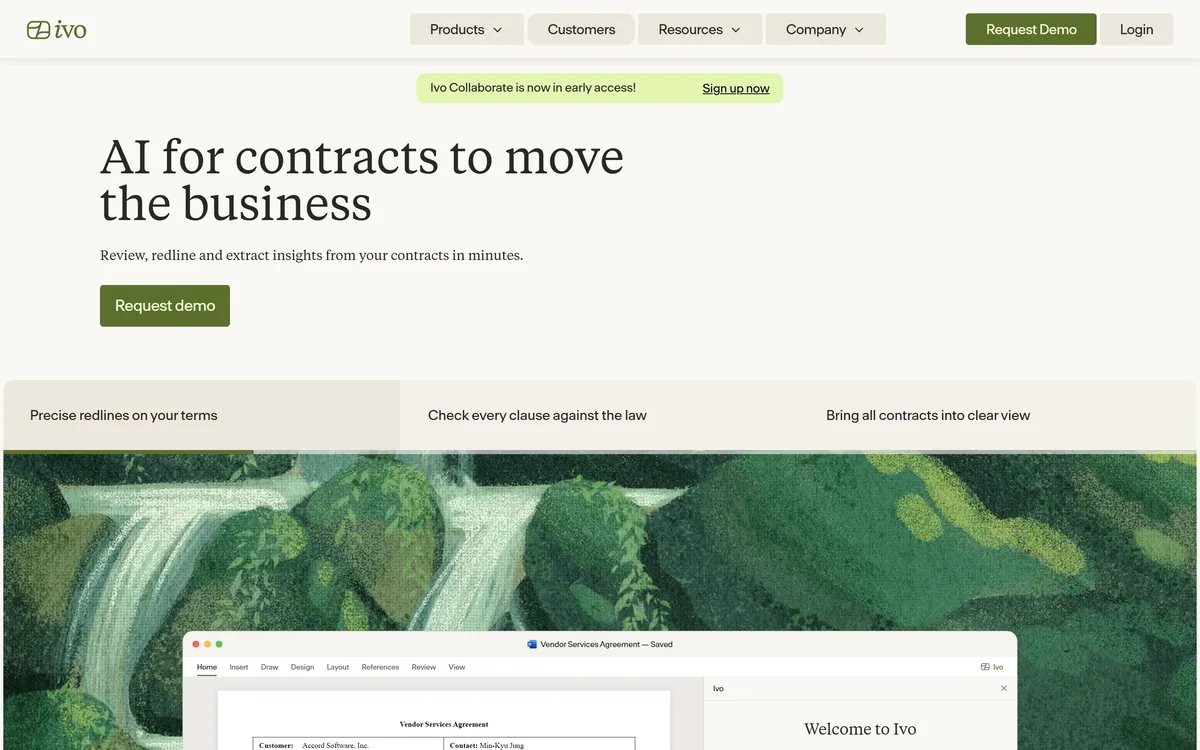
Ivo
PaidEditor Score · Very good
Best for: In-house legal teams drowning in routine agreements

Spellbook
PaidEditor Score · Very good
Best for: In-house legal teams handling high volumes of routine agreements
Ivo vs Spellbook: Side by Side
| Detail | ||
|---|---|---|
| Editor Score | 4.4/5 | 4.4/5 |
| Pricing model | Subscription | Subscription |
| Free plan | No | No |
| Best for | In-house legal teams drowning in routine agreements | In-house legal teams handling high volumes of routine agreements |
| Review last verified | Sep 2026 | Sep 2026 |
Quick Verdict: Which Should You Choose?
Short answer: a winner is called only where the data decides one. Fit — what each tool is built for — is covered in Who Should Pick Which below.
| Factor | Ivo | Spellbook | Winner |
|---|---|---|---|
| Editor Score | 4.4 | 4.4 | Level |
| Free to start | No | No | Neither |
| Overall | Depends on your use case |
Ivo: Strengths and Trade-offs
Ivo scores highly for two decisions that together make it usable by lawyers rather than admired by procurement. It works inside Microsoft Word and Google Docs, where contract negotiation actually happens and will keep happening, rather than asking anyone to move. And it reviews against your playbook and your historical agreements rather than a generic standard, which is the difference between useful redlines and a list of clauses a textbook would prefer. SOC 2, ISO 27001, and an explicit commitment never to train on customer data are the right answers, and the customer list is remarkable. It loses ground because no pricing exists publicly and no accuracy data is published.
What It Does Well
- Works inside Word and Google Docs, where contract negotiation actually happens
- Applying redlines in the document removes the translation step a review report creates
- Reviewing against your playbook rather than a generic standard produces judgement rather than noise
- Deriving a playbook from executed contracts turns tacit institutional knowledge into something checkable
Where It Falls Short
- No pricing published anywhere, so cost requires a sales process
- No accuracy or evaluation data for redlining, leaving your own testing as the only measure
- The population behind clause benchmarks is not disclosed, which changes what a benchmark means
Spellbook: Strengths and Trade-offs
Spellbook has made two decisions that matter more than any feature. It lives inside Word and Google Docs rather than asking lawyers to work somewhere else, which is the difference between a tool that gets used and one that gets demoed. And it states zero data retention — its model providers never train on, learn from or store client documents — which is the precondition for a confidentiality-bound profession using anything at all. The published compliance set now includes the EU AI Act, which almost nobody in this category lists yet.
What It Does Well
- Runs inside the tools lawyers already use rather than beside them
- Playbooks encode institutional memory rather than generic best practice
- Zero retention named at provider level, where the uncertainty usually sits
- Compliance set includes the EU AI Act, which few vendors list yet
Where It Falls Short
- Output quality tracks playbook effort, which teams routinely underestimate
- Market standard data can erode a negotiating position if used as an argument
- Bespoke or novel agreements remain outside what a first pass helps with
Who Should Pick Which?
 Pick Ivo for…
- In-house legal teams drowning in routine agreements
- Lawyers who negotiate in Word and will not move platform
- Companies whose acceptable terms exist as institutional knowledge rather than a document
 Pick Spellbook for…
- In-house legal teams handling high volumes of routine agreements
- Law firms doing transactional work at scale
- Organisations that cannot search their own signed contracts
Bottom line: it comes down to fit, not a single winner — Ivo leans into redlines applied directly in Microsoft Word and Google Docs, while Spellbook is built for contract redlining inside Word and Google Docs. Both are paid, so start each on a trial before you commit.
Frequently Asked Questions
Is Ivo Better Than Spellbook?
What Is the Difference Between Ivo and Spellbook?
Is Ivo or Spellbook Cheaper?
Which Is Better for Beginners, Ivo or Spellbook?
More Emerging & Specialized Comparisons
Other head-to-heads in the same category.
About the Author
Senior AI Tools Reviewer
Daniel leads AInexfinder's tool reviews. He researches each tool from its own pricing, documentation and policies, checks its claims against independent sources, and writes up what it does well, where it falls short and who it genuinely suits.
Keep Exploring
Last updated September 2026. Scores are each tool's Editor Score, or a provisional estimate marked “Est.” while its full review is pending — see our methodology.