Eve builds EveOS for plaintiff-side firms in personal injury, employment, medical malpractice, workers' compensation and Social Security disability. It runs intake, structures medical records, drafts demands and discovery, audits open matters nightly, and answers plain-English questions about the firm's own numbers.
Paxton AI
Verified
Paxton AI is a legal assistant covering research, drafting and document analysis, with medical chronology and billing summary tools for personal injury work. It serves personal injury, family, employment, defence and corporate practices, and states SOC 2, ISO and HIPAA compliance.
3.7Editor Score
paxton.ai7 viewsAdded April 28, 20264K visitors
Legal AI has a credibility problem it earned honestly, and everyone in the profession knows the shape of it.
Lawyers have been sanctioned for filing briefs containing citations to cases that do not exist, produced by tools that generated something plausible and were believed. That happened repeatedly, publicly, and it set the standard by which every legal AI product is now judged.
Which makes the first question about any of them the same: where do the citations come from, and how would you know if one were invented. Paxton's site does not answer it, and that absence matters more than any feature.
Paxton AI For Small Firms, In Brief
- An all-in-one legal assistant covering research, document analysis, drafting and what it calls thought partnership.
- Medical chronologies and billing summaries — the strongest feature, aimed squarely at personal injury practice.
- Five practice areas: personal injury, family, employment, defence and corporate.
- It compares itself to Westlaw and LexisNexis directly, alongside Harvey, CaseText and vLex.
- SOC 2, ISO adherence and HIPAA stated, which the medical records work makes necessary rather than optional.
Which Sources Does A Legal AI Actually Search?
Paxton describes contextual research drawing on a vast knowledge database, and does not name a single legal source, database or jurisdiction coverage on the page we read.
That omission is significant rather than pedantic, because in legal research the corpus is the product. A tool searching a licensed, updated case-law database is doing something categorically different from a tool searching whatever was in a model's training data.
The distinction shows up in two ways that matter. Currency: case law changes, and a decision from last month either exists in your corpus or does not. And completeness: knowing that a search covered all federal appellate decisions is what lets you rely on the absence of a case.
It also determines the fabrication risk. A tool retrieving from a real database and citing what it found can be wrong about relevance; a tool generating a citation from a model's memory can be wrong about existence, and those are not comparable failures.
None of this means Paxton fabricates anything — we have no evidence either way, and the site does not claim a fabrication rate to test. It means the question is unanswered on the marketing pages, and it is the first question a firm should put to the vendor before anything else.
Contrast that with Blue J, which built its reputation on grounding answers in primary tax authority and says so plainly. Naming the corpus is itself a form of evidence.
A tool that retrieves from a real database can be wrong about relevance. A tool generating a citation from memory can be wrong about existence.
Medical Chronologies Are The Sharpest Feature
Paxton lists Medical Chronologies and Medical Billing Summaries, and these are the most defensible things in the product.
A medical chronology is a dated, ordered account of a plaintiff's treatment, assembled from records that arrive as hundreds of pages of scanned notes from multiple providers in no order, in handwriting, with duplicates.
Building one is a paralegal's least favourite task and it is entirely mechanical: extract dates, providers, complaints, findings and treatments, then sort. That is close to an ideal application for a language model, and the time saving is enormous rather than marginal.
It is also lower-risk than research. A chronology is verifiable against source pages, and an error is a wrong date you can check, not a case that never existed. The work product is checkable in a way a research memo is not.
Billing summaries follow the same logic and touch damages directly. Both explain why HIPAA compliance appears in the certification list — this feature involves protected health information by definition, and any firm using it inherits that obligation.
Comparing Itself To Westlaw Is A Statement
Paxton's footer includes a Compare section naming Westlaw Precision, LexisNexis, Harvey, CaseText and vLex. That set is worth reading carefully.
Westlaw and LexisNexis are the incumbent research platforms, with decades of editorial infrastructure — headnotes, citators, classification systems — behind them. Naming them is a confident claim about substitutability from a young product.
Harvey and CaseText are the AI-native comparison, and vLex sits between the two. Listing all five says the product wants to be evaluated both as a research replacement and as an AI assistant, which are different purchases with different buyers.
The realistic read is about firm size. A large firm is not dropping Westlaw, because its citator is a professional-liability control as much as a research tool. A small firm paying for one platform is exactly who a challenger can win.
That is also who benefits most. A five-lawyer personal injury practice cannot afford enterprise legal research, and an assistant that handles research, drafting and chronologies for one subscription changes what that practice can take on.
For plaintiff-side work the overlap with Eve is worth mapping, and for drafting inside Word rather than researching, Spellbook is the narrower comparison.
- Ask which databases are searched and how current they are, before anything else.
- Verify every citation independently — no legal AI removes that obligation.
- Start with medical chronologies, where output is checkable against source pages.
- Treat HIPAA as your obligation too, not only the vendor's, once records are uploaded.
- Test on matters you already closed, where you know what the research should find.
The Citation Question Nobody Should Skip
This deserves its own section because it is the single professional risk that matters, and it is not hypothetical.
Lawyers in multiple jurisdictions have faced sanctions for filing documents citing fabricated authority. In every reported instance the pattern was identical: the tool produced a citation that looked entirely correct, and nobody checked it before filing.
The uncomfortable part is that fabricated citations are convincing. They have plausible case names, plausible reporters, plausible years and plausible pin cites, because the model has learned the shape of a citation extremely well. Nothing about the format signals the problem.
The only reliable defence is verification in a source you trust, every time, without exception. A citator check is not optional diligence — it is the control that stands between an AI research tool and a bar complaint.
That obligation exists regardless of vendor, and no product removes it. What a vendor can do is make it easier by linking directly to the retrieved source, and whether Paxton does that is something to test in a trial rather than assume from the marketing.
This is true of every vendor in the category, Harvey AI included. The obligation follows the lawyer, not the software licence.
Testing Legal Research Against Work You Already Did
The right evaluation for legal AI is retrospective, because you already know the answers.
Run it on matters you closed, where the research memo exists and the outcome is known.
- Take five closed matters across your actual practice areas, including one that turned on an unusual authority.
- Ask the same research questions you asked at the time, without hinting at what you found.
- Verify every citation it returns in a source you trust, and record any that do not exist.
- Check what it missed as carefully as what it found, since omission is the quieter failure.
- Run a medical chronology against one you built by hand, and diff the dates and providers.
- Ask the vendor directly which databases are searched and how often they update, before signing anything.
Key features of Paxton AI
Contextual legal research across the product's knowledge database
Quick-Start Drafting for producing first drafts of legal documents
Comprehensive Document Analysis of uploaded material
Medical Chronologies built from scanned treatment records
Medical Billing Summaries for damages work
Thought Partnership framing for exploratory legal questions
Coverage across personal injury, family, employment, defence and corporate practice
Pros & cons
Pros
6- Medical chronologies target a genuinely mechanical, miserable and high-volume task
- Chronology output is verifiable against source pages, unlike a research memo
- One subscription covering research, drafting and analysis suits small firms
- HIPAA compliance is present, which the medical records work makes necessary
- Naming Westlaw and LexisNexis in a comparison is a confident, checkable position
- Practice-area focus is specific rather than claiming to serve all of law
Cons
6- No legal databases or jurisdictional coverage are named anywhere we could find
- No citation-accuracy or hallucination claim is published, in a field where that is the central risk
- No benchmark, evaluation or independent assessment is offered
- The underlying models are undisclosed
- Pricing, company size and location are all unpublished
- Retention policy for uploaded medical records is not stated
Best For
- Personal injury firms drowning in medical records
- Small practices that cannot justify enterprise research subscriptions
- Firms wanting drafting and research from one tool
- Paralegal teams whose chronology work is the bottleneck
- Practices in the five areas the product explicitly serves
Paxton Beside Other Legal Research Tools
Legal AI divides by who buys it and what its answers are grounded in.
| Tool | Grounding | Typical buyer | Best for |
|---|---|---|---|
| Paxton AI | An unnamed knowledge database | Small and mid-size firms | Research, drafting and medical chronologies on one subscription |
| Harvey AI | Firm material plus legal corpora | Large firms and in-house teams | Enterprise legal work with firm-specific context |
| Blue J | Primary tax authority | Tax practitioners | Answers that must trace to statute and case law |
| Spellbook | Your own documents, in Word | Small firms | Drafting and review rather than research |
| Eve | Plaintiff-side case material | Plaintiff firms | The same personal injury practice from another angle |
Is Paxton Right For Your Firm?
A fit for your practice when
- You run a personal injury practice and medical chronologies consume paralegal hours.
- You are a small firm that cannot justify enterprise research pricing.
- Your practice areas match the five the product names.
- You want research, drafting and document analysis on one subscription.
- You will verify every citation regardless of which tool produced it.
Stay with your incumbent when
- Your professional-liability position depends on a citator you already trust.
- You need stated database coverage and update frequency before committing.
- Your practice areas fall outside the five named on the site.
- You cannot meet HIPAA obligations for medical records you would upload.
- Nobody in the firm will own the verification step, which is non-negotiable.
Paxton AI: Features And Compliance
| Operating company | Paxton AI |
|---|---|
| Positioning | The all-in-one AI legal assistant |
| Named features | Quick-Start Drafting, Comprehensive Document Analysis, Contextual Research, Thought Partnership, Medical Chronologies, Medical Billing Summaries |
| Practice areas | Personal injury, family law, employment law, defence work, corporate law |
| Legal sources | Described as a vast knowledge database; no named databases or jurisdictions on the page we read |
| Compliance | SOC 2, ISO adherence, HIPAA |
| Comparison set | Westlaw Precision, LexisNexis, Harvey, CaseText, vLex |
| Footer sections | Platform, Solutions, Resources, Compare, plus legal disclaimers and policies |
Other Legal AI Tools
Legal AI splits by firm size, by practice area and by what the answers are grounded in.
- Harvey AI — the large-firm end of the same category
- Blue J — grounding answers in primary authority, in tax specifically
- Spellbook — drafting and review in Word rather than research
- Eve — plaintiff-side work, overlapping with the personal injury use case
- LegalOn — contract review against attorney-written playbooks
Paxton Site, Read Closely
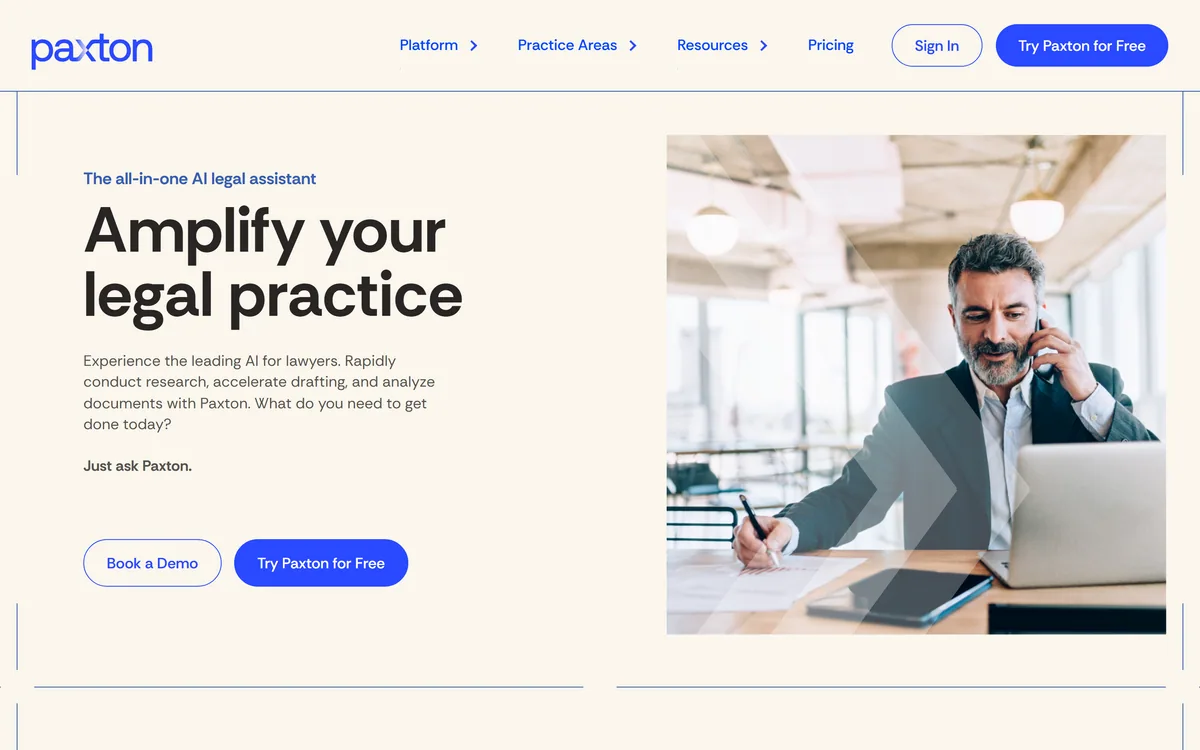
Last checked . Read from paxton.ai and its footer navigation, with the screenshot above captured in the same session.
- Positioned on the site as the all-in-one AI legal assistant
- Named features confirmed as Quick-Start Drafting, Comprehensive Document Analysis, Contextual Research and Thought Partnership
- Medical Chronologies and Medical Billing Summaries confirmed as named features
- Practice areas confirmed as personal injury, family law, employment law, defence work and corporate law
- Legal sources referenced only as a vast knowledge database, with no named databases or jurisdictions on the page we read
- Compliance stated as SOC 2 compliant, ISO standards adherent and HIPAA compliant
- Footer Compare section confirmed, naming Westlaw Precision, LexisNexis, Harvey, CaseText and vLex
- Footer sections confirmed for Platform, Solutions, Resources and Compare, plus legal disclaimers and policies
What we could not confirm: which legal databases are searched, their jurisdictional coverage or update frequency, none of which appear on the page we read; whether citations link to retrieved sources; any citation-accuracy or hallucination-rate claim, of which none is made; any published benchmark; which underlying models are used; pricing; company size, location or funding; and how uploaded medical records are stored, retained or deleted. Nothing here alleges that the product fabricates citations — we simply could not find the information a firm would need to assess that risk. We did not use the product.
Editor's Verdict
3.7/5Paxton's sharpest feature is the one least discussed: medical chronologies and billing summaries for personal injury work. Building a chronology from hundreds of pages of medical records is genuinely miserable, entirely mechanical, and exactly what a language model should do — which is a better argument than anything on the general research side. Comparing itself directly against Westlaw and LexisNexis is a confident position for a young product. The score is held down by what is not published: no named legal databases, no citation-accuracy claim, and no benchmark, in a field where a fabricated citation has ended careers. AInexfinder Editor Score: 3.7/5.
Paxton AI pricing
AInexfinder does not list plan prices or billing details. For current pricing, plans, and trials, visit the official Paxton AI website.
Visit official website for pricingVendor pricing, credits, and billing policies change over time. Always confirm on the official site before you buy.
Frequently asked questions
What is Paxton AI?
Paxton AI is an all-in-one legal assistant covering contextual research, quick-start drafting, document analysis and what it calls thought partnership, plus medical chronologies and billing summaries. It names personal injury, family, employment, defence and corporate law as its practice areas, and states SOC 2, ISO and HIPAA compliance.
Which legal databases does Paxton search?
The site refers to a vast knowledge database without naming any source, jurisdiction or update frequency on the page we read. That is the first question to put to the vendor, because in legal research the corpus is the product: a licensed, updated case-law database is categorically different from whatever was in a model's training data.
Can I trust citations from a legal AI?
Not without verifying them, from any vendor. Lawyers have been sanctioned in multiple jurisdictions for filing briefs citing cases that do not exist, and in every reported instance the citation looked entirely correct — plausible case name, reporter, year and pin cite. Format signals nothing. A citator check is the control, not optional diligence.
What are medical chronologies and why do they matter?
A dated, ordered account of a plaintiff's treatment, assembled from hundreds of pages of scanned records arriving from multiple providers in no order. Building one is entirely mechanical and universally disliked, which makes it close to an ideal task for a language model — and unlike research, the output is checkable against the source pages.
Is Paxton a replacement for Westlaw?
It names Westlaw Precision and LexisNexis in its comparison set, which is a confident claim. The realistic answer depends on firm size: a large firm is not dropping Westlaw, because its citator functions as a professional-liability control. A small firm paying for one platform is exactly the buyer a challenger can win.
Does Paxton publish an accuracy benchmark?
No benchmark, hallucination rate or independent evaluation appears on the pages we read. In a field where the central professional risk is fabricated authority, the absence of any published accuracy claim is worth noting — and it is not an allegation that the product fabricates, simply that there is nothing published to assess.
Why does Paxton need HIPAA compliance?
Because medical chronologies and billing summaries involve protected health information by definition. The certification covers the platform; the obligation extends to your firm's handling of those records once uploaded. What is not stated is how those records are retained or deleted afterwards, which is worth resolving before the first upload.
Which practice areas does Paxton serve?
Personal injury, family law, employment law, defence work and corporate law. The specificity is a positive — a tool claiming to serve all of law equally is claiming something implausible — but it also means firms outside those five should expect materially less relevant behaviour.
How should a firm evaluate it?
Retrospectively, on closed matters where you already know the answers. Take five, including one that turned on an unusual authority, ask the same research questions without hinting at what you found, verify every returned citation, and check what it missed as carefully as what it found. Omission is the quieter failure.
Who is accountable if the AI gets something wrong?
The lawyer, always and everywhere. No legal AI carries professional liability, and filing something you did not verify is your act regardless of what produced the draft. The practical implication is that these tools save research time rather than research responsibility, and someone in the firm must own that distinction explicitly.
Reviews
Log in to write a review.
User Reviews
No reviews yet. Be the first to share your experience with Paxton AI.
Reviewed by Daniel Reed
Assigned reviewer
Daniel ReedSenior AI Tools Reviewer
Daniel reviews AI tools the slow way — by actually using them on real projects. His reviews cover what works, what breaks, and who each tool is genuinely a good fit for.
Hands-on reviewsProduct testingAI software
Daniel and the AInexfinder editorial team research Paxton AI using public product information, listing evidence, and (when available) hands-on checks. Scores reflect listing completeness and transparency — not paid placement.
- Last verified
- Methodology
- How we review AI tools
- Sources used
- paxton.ai
- AInexfinder listing fields (features, pros/cons, description)
- Public vendor pages when available
- Editorial policy
- Listings may include affiliate or sponsored placements, which are labeled when present. Editorial scores and cons are not sold. See our affiliate disclosure and review methodology.
Related tools
Darrow describes itself as an AI lab building legal exposure management, ingesting regulatory filings, incident data and litigation patterns to surface emerging risk for law firms, insurers and compliance teams. It states 5M+ signals detected monthly across 50+ exposure categories.

Harvey is an AI platform for legal and professional services — agents, a Vault for documents, Knowledge, Spaces, and Contract Intelligence — used by firms including A&O Shearman, Latham & Watkins, and Norton Rose Fulbright.
Solve Intelligence is an AI platform for patent work, covering application drafting, office action responses, invalidity and claim-mapping charts, freedom-to-operate reviews and portfolio analysis. It is used by over 700 in-house IP teams and law firms, with SOC 2 Type II and ISO 27001 certification and no training on customer data.
Ivo is AI contract review for in-house legal teams. It applies redlines directly in Microsoft Word or Google Docs, evaluates agreements against your playbooks and historical contracts, benchmarks clauses by governing law and industry, and queries executed contracts in plain language.
Spellbook reviews and drafts contracts inside Word and Google Docs, redlining against a firm's own playbooks, comparing terms to thousands of similar agreements, and indexing signed contracts for search — used by a stated 5,000-plus legal teams in 80-plus countries.
Explore More
Embed this listing on your site
Featured on AInexfinder