Eve builds EveOS for plaintiff-side firms in personal injury, employment, medical malpractice, workers' compensation and Social Security disability. It runs intake, structures medical records, drafts demands and discovery, audits open matters nightly, and answers plain-English questions about the firm's own numbers.
Darrow
Verified
Darrow describes itself as an AI lab building legal exposure management, ingesting regulatory filings, incident data and litigation patterns to surface emerging risk for law firms, insurers and compliance teams. It states 5M+ signals detected monthly across 50+ exposure categories.
3.9Editor Score
darrow.ai6 viewsAdded August 12, 20255K visitors
Legal technology has a shape. Something happens, a matter opens, and software helps you manage the documents, research the law and track the workflow. Every product in the category assumes the event already occurred.
Darrow's argument is that this makes the entire field structurally reactive. By the time litigation starts, the decisions that mattered were made months earlier by people who did not know they were making them.
Its proposition is to read the signals that precede legal exposure — filings, incidents, market shifts, litigation patterns — and turn them into something a firm, an insurer or a compliance team can act on.
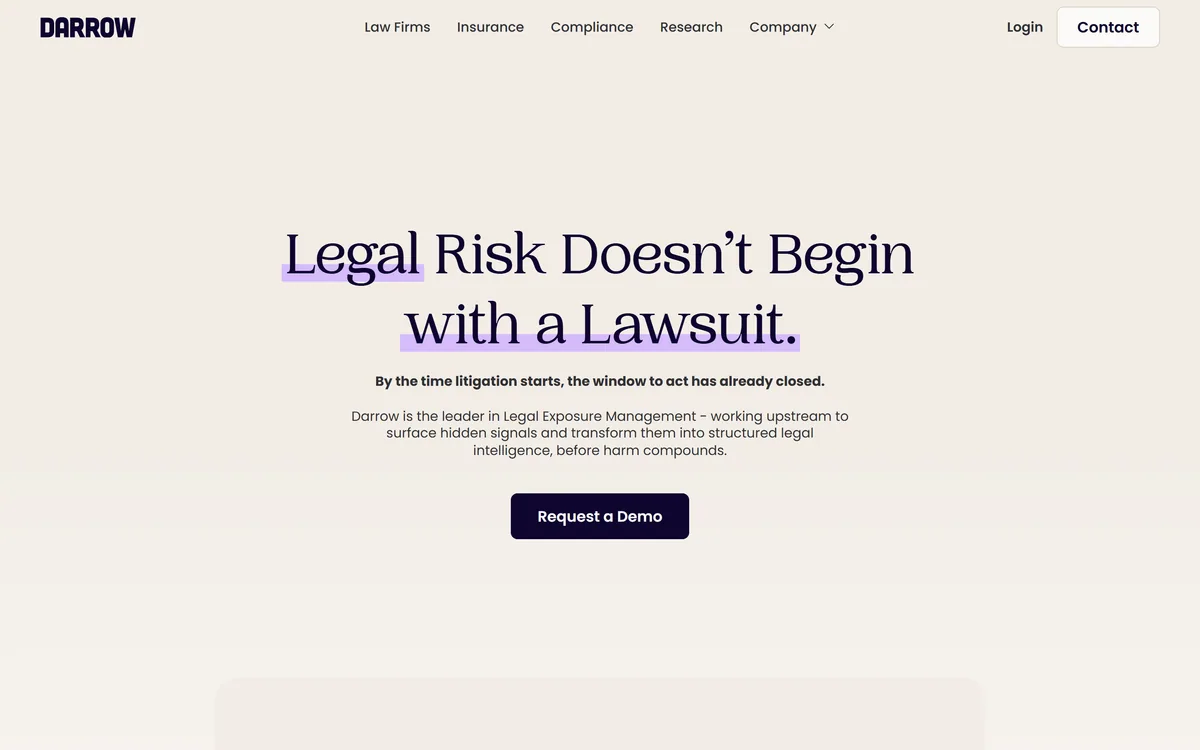
Darrow: Legal Risk Before The Lawsuit
- Upstream by design — the stated premise is that legal risk does not begin with a lawsuit, and by then the window to act has closed.
- Three audiences: law firms finding cases, insurers pricing risk, and compliance teams avoiding exposure.
- Describes itself as an AI lab studying how legal exposure emerges, with a structured knowledge base underneath.
- 5M+ signals monthly across 50+ exposure categories, with 22K+ legal professionals and 10K+ active matters claimed.
- Darrow Inc., with an Underwriting Platform for insurers alongside the law firm product.
What Is Legal Exposure Management?
Darrow states that signals of legal risk are everywhere — in regulatory filings, incident data, market shifts and litigation patterns — but that the legal system has no structured way to read them, leaving it permanently reactive.
The diagnosis is accurate and slightly uncomfortable. Legal exposure is not a secret; it is public and distributed, sitting in filings nobody correlates and incidents nobody connects to the obligations they breach.
What is missing is the connective structure. Knowing that a company had a safety incident is not the same as knowing which obligation it implicates, what enforcement has historically followed, and how quickly.
Darrow describes exactly that structure: a knowledge base connecting the laws that create obligations, the organisational weaknesses that emerge when they are not met, and the enforcement actions that follow.
That is a coherent model and a genuinely different one from search. Research tools such as CoCounsel answer what the law says; this claims to answer where the law is about to be tested, which is a prediction rather than a retrieval.
Legal exposure is not a secret. It is public and distributed, sitting in filings nobody correlates and incidents nobody connects to the obligations they breach.
Signals, Knowledge And Agents
Darrow describes a three-layer system: data ingesting raw signals at scale, knowledge interpreting them through legal context, and agentic AI reasoning across the intelligence to identify what matters.
The layering is the right way to think about the problem, and the middle layer is where the difficulty concentrates.
Ingestion is mostly an engineering exercise — filings and incident reports are public, structured to varying degrees, and available. Volume is a cost problem rather than a conceptual one.
Interpretation is not. Deciding that a specific incident implicates a specific obligation in a specific jurisdiction requires legal judgement encoded as structure, and the quality of that encoding determines whether the output is intelligence or noise.
The agentic layer then sits on top, ranking and filtering. It is worth remembering that reasoning over an imperfect knowledge base produces confident output regardless — so the thing to interrogate in a demo is the middle layer, not the interface.
Three Audiences With Opposite Interests
Darrow names law firms, insurers and compliance teams as its audiences, and states each use case plainly: firms identify emerging litigation opportunities earlier, insurers detect exposure and price risk, and compliance teams surface exposure before it becomes a crisis.
Those are not three variations of one customer. A plaintiff firm wants to find companies with exposure; a compliance team wants its own company not to be found. The same intelligence serves both, pointed in opposite directions.
That is not improper — this is public information analysed systematically, and both sides using better information is how adversarial systems are supposed to work. It is, however, worth understanding as a buyer.
For a compliance team the specific value is knowing what a well-resourced adversary can see about you. Reading your own external digital footprint through the same lens is a defensive exercise with a clear rationale.
For insurers the proposition is different again, and closest to a conventional one: better inputs to pricing. That is the audience where the value is easiest to test, because underwriting outcomes are measurable in a way that litigation opportunity is not.
- Interrogate the knowledge layer in a demo, not the interface.
- For compliance, treat it as seeing what an adversary can see about you.
- Ask what a signal means operationally before assuming it is actionable.
- Remember prediction and retrieval are different claims with different evidence.
- Ask how false positives are handled, since exposure alerts have a cost of their own.
Calling Yourself An AI Lab
Darrow describes itself as an AI lab studying how legal exposure emerges across the modern economy, which is an unusual self-description for a commercial legal product.
The framing does real work. A lab implies research rather than tooling, and a durable knowledge asset rather than a workflow feature — which fits a business whose value is a structured understanding of how obligations, weaknesses and enforcement connect.
It also sets a standard the company can be held to. Research organisations publish, and a research claim invites the question of what has been published and where.
The site does reference a Research section and domain coverage, which is more than most vendors offer. Whether that constitutes research in the sense the framing implies is something a buyer should look at directly rather than infer.
The pragmatic reading is that the label signals where the defensibility lies. Anyone can ingest filings; the claim is that the interpretive layer is hard-won and accumulated — a similar argument to the one contract analysis platforms such as Luminance make about their document understanding.
Evaluating Legal Intelligence Claims
Predictive legal intelligence is among the harder categories to evaluate, because the counterfactual is unavailable and the successes are unfalsifiable.
The published numbers are scale rather than outcome. 5M+ signals monthly, 50+ exposure categories, 22K+ legal professionals and 10K+ active matters describe how much is happening, not how often it was right.
That is not evasive — outcome metrics genuinely are hard here. A matter that was identified early and settled well has no control group, and a warning that prevented a crisis leaves no evidence it would have occurred.
What can be tested is retrospective. Ask the system to describe exposure in a sector as of eighteen months ago and compare that against what actually happened, which is the closest available thing to a measurable claim.
The second useful question is about precision. A system surfacing five million signals monthly is necessarily filtering aggressively, and how aggressively — and what it discards — determines whether the output is a short list worth reading or a feed nobody opens.
The comparison worth making is against narrower risk products. Patent platforms such as DeepIP also assess exposure, but within a bounded corpus where the question — does this claim read on that technology — has a checkable answer. Economy-wide exposure prediction has no equivalent boundary, which is exactly what makes it valuable and hard to verify at once.
Putting Exposure Intelligence To Work
The failure mode with any intelligence product is subscribing to a feed that nobody has time to read and nobody is accountable for acting on.
This sequence establishes the workflow before the subscription, which is the opposite of how these purchases usually happen.
- Decide which side you are on — finding exposure or avoiding it — since the workflows differ entirely.
- Name the person who reads alerts and the person who decides what to do about them.
- Run a retrospective test on a period where you know what actually happened.
- Ask what a typical week's output volume looks like, not what the system can detect.
- Define what makes a signal actionable for you, in writing, before go-live.
- Review after a quarter whether any signal changed a decision — and stop if none did.
Darrow: Scale And Company
| Operating company | Darrow Inc. |
|---|---|
| Category | Legal exposure management |
| Self-description | An AI lab studying how legal exposure emerges across the modern economy |
| Premise | Legal risk does not begin with a lawsuit |
| Audiences | Law firms, insurers, compliance teams |
| Architecture | Data ingestion, a legal knowledge layer, and agentic reasoning |
| Knowledge base | Connects laws creating obligations, organisational weaknesses and enforcement actions |
| Signals | 5M+ detected monthly, per the site |
| Categories | 50+ legal exposure categories covered |
| Professionals | 22K+ powered by Darrow's intelligence, per the site |
| Matters | 10K+ active matters connected |
| Insurer product | An Underwriting Platform |
| Copyright | © 2026 Darrow Inc. |
Is Darrow For Your Practice?
Relevant when
- You are a plaintiff firm whose practice depends on identifying matters early.
- You underwrite risk and want better inputs than historical claims data.
- You run compliance and want to see what an adversary can see about you.
- Your organisation has a large and messy external digital footprint.
- Somebody is accountable for acting on what an alert says.
Not your problem when
- Your work begins when a client walks in with a problem.
- You need research and drafting rather than risk detection.
- Nobody has capacity to read a signal feed, however good it is.
- You cannot define in advance what would make a signal actionable.
- Your compliance obligations are narrow and already well monitored.
Key features of Darrow
Ingestion of regulatory filings, incident data and litigation patterns
A structured legal knowledge base linking obligations to enforcement
Agentic reasoning to identify what matters in the signal volume
Coverage across 50+ legal exposure categories
An Underwriting Platform for insurers
Compliance monitoring of an organisation's external digital footprint
Case portfolio building for law firms
Published Research and Domain Coverage sections
Pros & cons
Pros
7- Attacks a genuinely underserved problem — the reactive shape of legal technology
- The three-layer architecture is a coherent and honest description of the difficulty
- Public, distributed information analysed systematically is a legitimate advantage
- Serving compliance teams gives defenders the same visibility as adversaries
- The insurer use case is the one where value can actually be measured
- A named operating company with published policy and research sections
- Scale figures published specifically rather than vaguely
Cons
7- Published numbers describe volume, not accuracy or outcomes
- Predictive claims are inherently hard to falsify from outside
- The same intelligence serves opposing interests, which buyers should understand
- The quality of the interpretive knowledge layer determines everything and is opaque
- Filtering five million monthly signals into a usable list is undescribed
- Jurisdiction and domain coverage are not stated on the pages we read
- Requires an accountable reader, or the feed becomes another ignored subscription
Best For
- Plaintiff firms whose practice depends on early case identification
- Insurers seeking forward-looking inputs to underwriting
- Compliance teams at organisations with large external footprints
- Legal operations groups building risk monitoring capability
- Firms that can name who acts on an alert before subscribing
Darrow Against Other Legal Platforms
Legal technology divides by when in the lifecycle it becomes relevant.
| Tool | When it helps | What it produces | Best for |
|---|---|---|---|
| Darrow | Before a matter exists | Exposure signals and intelligence | Firms, insurers and compliance teams working upstream |
| CoCounsel | Once a matter exists | Cited research and drafts | Research and drafting on live matters |
| Luminance | During review | Analysis across document sets | Diligence and large review exercises |
| ContractSafe | After signature | Findable contracts and alerts | Knowing what you already agreed |
| DeepIP | Across the patent lifecycle | Drafts, prosecution and FTO risk | Intellectual property specifically |
More Legal Intelligence Tools
Other legal products, grouped by where in a matter's life they apply.
- CoCounsel — research and drafting once a matter exists
- Luminance — analysis across large document sets
- DeepIP — risk and freedom-to-operate in patents
- ContractSafe — the obligations you have already signed up to
- LegalOn — reviewing terms before they become exposure
Darrow: Verified From Darrow Inc.
Last checked . Read from darrow.ai in a browser session on the date above, with the screenshot captured alongside.
- Positioned around legal risk not beginning with a lawsuit
- Described as the leader in Legal Exposure Management, working upstream
- Law firms, insurers and compliance teams named as audiences with distinct use cases
- Described as an AI lab studying how legal exposure emerges across the modern economy
- A structured knowledge base described, connecting laws, organisational weaknesses and enforcement actions
- A three-layer architecture described: data, knowledge and agentic reasoning
- 5M+ signals detected monthly stated
- 50+ legal exposure categories stated
- 22K+ legal professionals and 10K+ active matters stated
- An Underwriting Platform listed for insurers
- Footer confirms © 2026 Darrow Inc. with Cookie policy, Privacy policy, Terms of use, Research, Domain Coverage and Newsroom
What we could not confirm: pricing, which routes through a demo request; which jurisdictions and domains are actually covered, since we did not open the Domain Coverage page; the research the AI lab framing implies, which we saw referenced but did not read; how the 5M+ signal figure is filtered down to what a customer sees; how accuracy or precision is measured, if at all; and what data sources feed ingestion. Nothing here is legal advice, and no claim about any company's exposure is made or implied.
Editor's Verdict
3.9/5Almost all legal technology arrives after something has happened — a matter exists, documents need reviewing, research needs doing. Darrow's premise is that the signals of legal exposure are visible earlier, in regulatory filings, incident data and market activity, and that nobody reads them systematically. That is a genuinely different proposition and an intellectually serious one. What makes it hard to score higher is that the same intelligence serves law firms looking for cases and compliance teams trying to avoid becoming one, which are opposite interests, and that predictive claims about litigation are the hardest kind to verify from outside. AInexfinder Editor Score: 3.9/5.
Darrow pricing
AInexfinder does not list plan prices or billing details. For current pricing, plans, and trials, visit the official Darrow website.
Visit official website for pricingVendor pricing, credits, and billing policies change over time. Always confirm on the official site before you buy.
Frequently asked questions
What is Darrow?
Darrow is a legal exposure management platform from Darrow Inc. that ingests regulatory filings, incident data, litigation patterns and market activity, interprets them through a structured legal knowledge base, and surfaces emerging risk for law firms, insurers and compliance teams. It describes itself as an AI lab.
What does working upstream mean?
Acting before litigation exists. Darrow's stated premise is that by the time a lawsuit starts, the window to act has already closed — and that the signals preceding exposure are public but nobody reads them systematically or connects them to the obligations they implicate.
How does the system actually work?
Three layers: ingestion of raw public signals at scale, a knowledge layer interpreting them through legal context, and agentic reasoning that ranks what matters. The middle layer is where the difficulty concentrates, and it is what to interrogate in a demo rather than the interface.
Why is the knowledge layer the hard part?
Because ingestion is an engineering exercise — filings are public and available — while deciding that a specific incident implicates a specific obligation in a specific jurisdiction requires legal judgement encoded as structure. Reasoning over an imperfect knowledge base still produces confident output.
Does it serve both sides of a dispute?
Effectively yes. Plaintiff firms want to find companies with exposure; compliance teams want their company not to be found. The same intelligence points in both directions. That is how adversarial systems are meant to work, but it is worth understanding as a buyer.
What is the value for a compliance team?
Seeing what a well-resourced adversary can see about you. Reading your own external digital footprint through the same analytical lens is a defensive exercise with a clear rationale, and it is the use case where the buying logic is most straightforward.
Can predictive legal intelligence be verified?
Not easily, and the published figures do not attempt it — 5M+ signals and 50+ categories describe volume rather than accuracy. The closest available test is retrospective: ask the system to describe exposure in a sector as of eighteen months ago, and compare against what happened.
What should I ask about volume?
What a typical week's output looks like, not what the system can detect. Five million monthly signals means aggressive filtering, and how aggressively — and what gets discarded — decides whether you receive a short list worth reading or a feed nobody opens.
Is this a research tool?
No — different claim entirely. Research tools answer what the law says by retrieving authority. Darrow claims to answer where the law is about to be tested, which is a prediction, and predictions require a different kind of evidence than retrieval does.
How should I trial it?
Decide which side you are on first, since the workflows differ entirely. Name who reads alerts and who decides what to do about them. Define in writing what makes a signal actionable, and review after a quarter whether any signal actually changed a decision.
Reviews
Log in to write a review.
User Reviews
No reviews yet. Be the first to share your experience with Darrow.
Reviewed by Daniel Reed
Assigned reviewer
Daniel ReedSenior AI Tools Reviewer
Daniel reviews AI tools the slow way — by actually using them on real projects. His reviews cover what works, what breaks, and who each tool is genuinely a good fit for.
Hands-on reviewsProduct testingAI software
Daniel and the AInexfinder editorial team research Darrow using public product information, listing evidence, and (when available) hands-on checks. Scores reflect listing completeness and transparency — not paid placement.
- Last verified
- Methodology
- How we review AI tools
- Sources used
- darrow.ai
- AInexfinder listing fields (features, pros/cons, description)
- Public vendor pages when available
- Editorial policy
- Listings may include affiliate or sponsored placements, which are labeled when present. Editorial scores and cons are not sold. See our affiliate disclosure and review methodology.
Related tools

Harvey is an AI platform for legal and professional services — agents, a Vault for documents, Knowledge, Spaces, and Contract Intelligence — used by firms including A&O Shearman, Latham & Watkins, and Norton Rose Fulbright.
Solve Intelligence is an AI platform for patent work, covering application drafting, office action responses, invalidity and claim-mapping charts, freedom-to-operate reviews and portfolio analysis. It is used by over 700 in-house IP teams and law firms, with SOC 2 Type II and ISO 27001 certification and no training on customer data.
Ivo is AI contract review for in-house legal teams. It applies redlines directly in Microsoft Word or Google Docs, evaluates agreements against your playbooks and historical contracts, benchmarks clauses by governing law and industry, and queries executed contracts in plain language.
Spellbook reviews and drafts contracts inside Word and Google Docs, redlining against a firm's own playbooks, comparing terms to thousands of similar agreements, and indexing signed contracts for search — used by a stated 5,000-plus legal teams in 80-plus countries.
LegalOn is a contract lifecycle platform from LegalOn Technologies, Inc. covering intake, review, redlining, storage and analysis, built on more than 135 attorney-authored playbooks across industries and countries, with a Microsoft Word integration and agentic workflows.
Explore More
Embed this listing on your site
Featured on AInexfinder