Eve builds EveOS for plaintiff-side firms in personal injury, employment, medical malpractice, workers' compensation and Social Security disability. It runs intake, structures medical records, drafts demands and discovery, audits open matters nightly, and answers plain-English questions about the firm's own numbers.
DeepIP
Verified
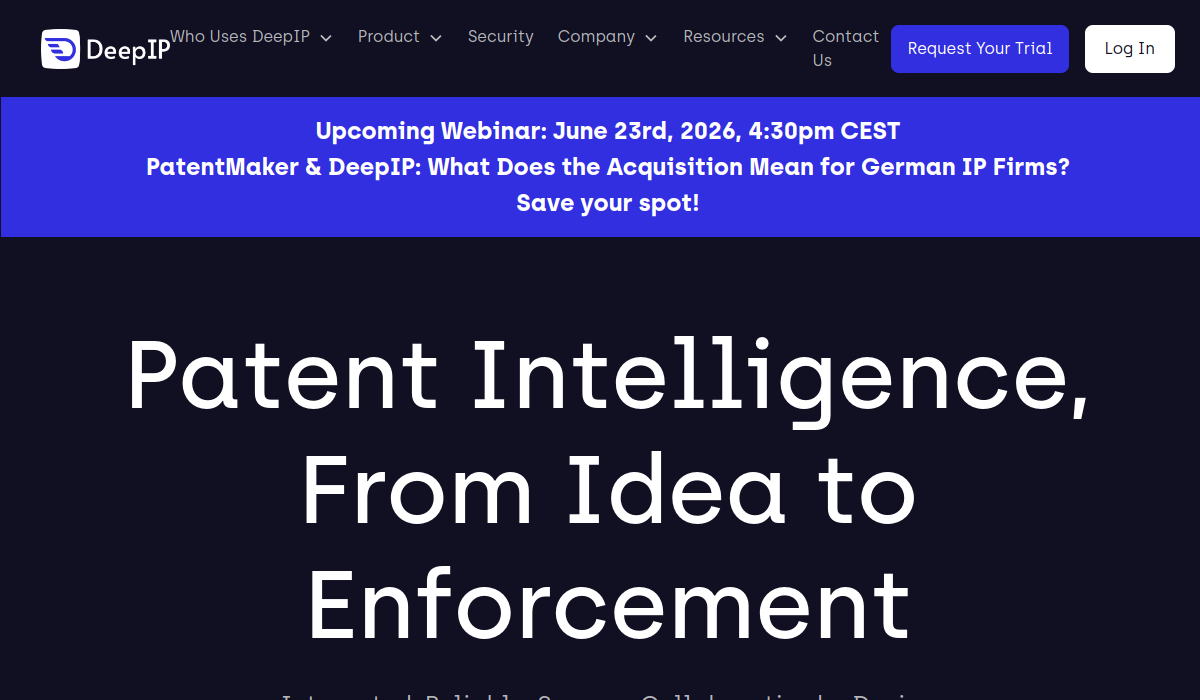
DeepIP is a patent intelligence platform covering ideation, prior art, drafting, prosecution and risk assessment. It generates jurisdiction-compliant applications with USPTO and EPO checks, integrates with Microsoft Word, and states $40M raised at Series B with SOC 2 Type 2 and ISO 27001.
4.0Editor Score
deepip.ai5 viewsAdded April 22, 20267K visitors
Patent drafting is one of the few kinds of legal writing where the form is almost as constrained as the content. Claims have a grammar, specifications have required parts, and jurisdictions have rules that are checkable rather than arguable.
That structure is exactly what makes the work suitable for automation, and exactly what makes automation dangerous. A specification that is merely competent is fine; a claim drafted slightly too narrowly is a defect that surfaces years later, in litigation, when it cannot be fixed.
DeepIP's approach is to cover the whole lifecycle rather than a single step, from the invention disclosure through to freedom-to-operate analysis.
DeepIP: Patents From Idea To Enforcement
- Five lifecycle stages: ideation, prior art, drafting, prosecution and risk assessment, in one platform.
- Full application generation from invention disclosures, with USPTO and EPO compliance checks and Word integration.
- Prior art search with semantic understanding, across a corpus the site describes with two different figures.
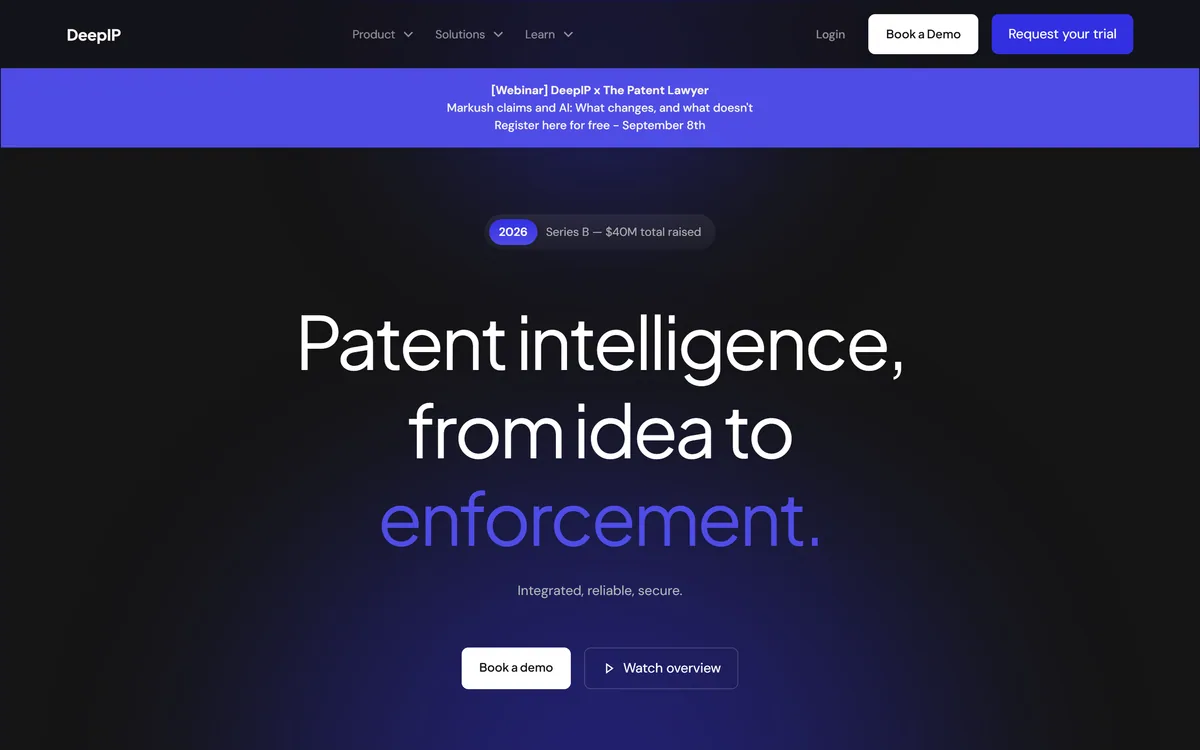
- Series B, $40M total raised, per the homepage.
- US-based Microsoft Azure deployment with SOC 2 Type 2 and ISO 27001, cited in a customer's own words.
Can AI Draft A Patent Application?
DeepIP states that it generates complete, jurisdiction-compliant patent applications from invention disclosures — claims, specifications and abstracts, structured and ready for review — with USPTO and EPO compliance checks and Microsoft Word integration.
The honest framing is that different parts of an application have very different risk profiles, and treating them identically is the mistake.
The specification is largely descriptive. It explains the invention, its embodiments and its context, at length and in a conventional structure, and it is exactly the kind of long structured prose where generation from a disclosure genuinely saves hours.
Claims are a different craft. Their scope determines what the patent is worth, and a claim that is slightly too narrow surrenders coverage a competitor will use, while one slightly too broad invites invalidation. Both errors are invisible on the page and expensive later.
The site's own phrasing — structured and ready for review — is the correct positioning and worth taking literally. The reasonable use is generation of the bulk with attorney judgement concentrated on claim scope, which is where the value of the professional actually sits, in the same way CoCounsel positions drafting as work product requiring verification.
A claim slightly too narrow surrenders coverage a competitor will use. One slightly too broad invites invalidation. Both errors are invisible on the page and expensive later.
Prior Art Search At Scale
DeepIP describes semantic prior art search, surfacing relevant results in minutes rather than hours, and patentability assessment producing structured novelty and non-obviousness evaluations with confidence scores.
Semantic search is a real improvement over keyword search here, for a reason specific to patents: the same invention is routinely described in completely different vocabulary across jurisdictions, decades and drafting styles.
A keyword search misses prior art that used different words for the same mechanism, which is the most dangerous kind to miss, because it is the kind an examiner or an opponent will eventually find.
Confidence scores on patentability assessment are useful and require careful reading. A confidence score reflects how certain the system is given what it found — not how certain you should be, which also depends on what it did not find.
The practical discipline is to treat a clean prior art result as a reason to continue rather than as clearance. Absence of evidence in a search is weaker than it feels, particularly across languages and older filings.
Two Different Patent Counts On One Site
The site displays 150M+ patents indexed and searchable in one place, while the prior art search module describes searching across 120M+ patents.
We are noting this as an observation rather than a criticism, because there are ordinary explanations. The two numbers may count different things — total indexed records against patents available to one specific module, or documents against families — and pages are updated at different times.
It is worth raising only because corpus size is one of the few objectively comparable specifications in this category, and it is the kind of number a buyer will quote internally.
The useful question in a demo is not which figure is correct but what the corpus actually contains: which jurisdictions, whether non-English filings are included and how, how far back coverage extends, and whether applications as well as grants are searchable.
Those details matter far more than the headline. A 150 million document index heavy on one jurisdiction is less useful for freedom-to-operate work than a smaller one with genuine international depth.
- Generate the specification freely; concentrate attorney time on claim scope.
- Treat a clean prior art result as a reason to continue, not as clearance.
- Ask what the corpus contains, not how large it is.
- Read confidence scores as certainty given what was found, not overall.
- Confirm where drafts are processed and stored before any disclosure goes in.
Security Claims In A Confidential Field
A customer quotation on the site describes extensive due diligence on DeepIP's security infrastructure, citing deployment on US-based Microsoft Azure servers together with SOC 2 Type 2 and ISO 27001.
Security matters more in patent work than in almost any other legal application, for a reason specific to the field: an unfiled invention disclosure is the most confidential document a technology company produces.
Public disclosure before filing can destroy patentability outright in many jurisdictions. That makes the handling of pre-filing material a substantive legal question rather than an IT procurement one.
Naming the hosting arrangement and specific certifications is the right level of detail, and citing it through a customer who performed diligence is more credible than asserting it directly.
What certifications do not tell you is retention and training use. Whether disclosures are retained after drafting, and whether any client material contributes to model improvement, are separate questions to get answered in writing — the same questions that matter for contract platforms such as LegalOn handling privileged material.
Reading The Efficiency Numbers
DeepIP publishes four figures: 150M+ patents indexed, 25k+ applications drafted with the platform, up to 70% drafting time reduction on a full application, and 2h+ saved per attorney per day.
The two efficiency claims are the ones that would drive a business case, and they are the ones with the least stated basis on the page.
Up to 70% is a ceiling rather than an average, and the phrasing is doing work — up to permits a distribution where most cases save considerably less. That is standard marketing language rather than anything improper, but it should be read as such.
2h+ saved per attorney per day is the more striking claim, since it implies a substantial fraction of a working day. Whether that reflects measured practice, projection, or best-case users is not stated.
The 25k+ applications drafted figure is the most useful of the four, because it describes something that happened rather than something saved. Volume of real use is weak evidence of quality but strong evidence that the product functions at scale.
This is a common pattern in legal AI, and worth recognising. Scale figures — documents indexed, signals processed, matters connected, as platforms like Darrow also publish — describe how much is happening rather than how often it was right, because outcome data in legal work is genuinely difficult to collect.
Trialling Patent AI Responsibly
A patent workflow is the wrong place to learn a tool's limits in production, because the errors are latent and surface at the worst possible moment.
This sequence tests the system against outcomes you already know before it touches anything unfiled.
- Settle data handling in writing first — retention, training use and processing location.
- Run it against a granted patent you drafted and compare claim scope carefully.
- Run prior art search on a matter where you know what the examiner eventually cited.
- Use generation for specifications first, keeping claims fully attorney-drafted.
- Record which sections were machine-generated, for your own file.
- Expand into prosecution responses only once drafting output has proved reliable.
DeepIP: Modules And Funding
| Product type | Patent intelligence platform |
|---|---|
| Positioning | Patent intelligence, from idea to enforcement |
| Lifecycle stages | Ideation, prior art, drafting, prosecution, risk assessment |
| Modules | Patent drafting, office action responses, prior art search, patentability assessment, risk assessment |
| Compliance checks | USPTO and EPO |
| Integration | Microsoft Word |
| Corpus | 150M+ patents stated site-wide; 120M+ stated in the prior art module |
| Applications drafted | 25k+, per the site |
| Efficiency claims | Up to 70% drafting time reduction and 2h+ saved per attorney per day |
| Funding | Series B, $40M total raised |
| Hosting | US-based Microsoft Azure, per a customer quotation |
| Certifications | SOC 2 Type 2 and ISO 27001, per a customer quotation |
| Sectors | ICT, mechanical, biology, chemistry, in-house counsel and law firms |
| Copyright | © 2026 DeepIP |
Key features of DeepIP
Full patent application generation from invention disclosures
USPTO and EPO compliance checking
Microsoft Word integration
Semantic prior art search
Patentability assessment with confidence scores
Office action response generation with case law citations
Freedom-to-operate and invalidity risk assessment
Patent drawings generation and an AI reviewer
Pros & cons
Pros
7- Covers the full lifecycle rather than one isolated step
- Specification generation is genuinely well matched to long structured drafting
- Semantic search addresses the real prior art problem of differing vocabulary
- Jurisdiction compliance checks catch formal errors before they cost a round trip
- Word integration meets patent attorneys where they already work
- Security posture stated specifically, and cited through a customer's own diligence
- Sector-specific positioning across ICT, mechanical, biology and chemistry
Cons
7- Two different corpus figures appear on the site without explanation
- The 70% and 2h+ efficiency claims carry no published methodology
- Up to 70% is a ceiling, and the phrasing permits a much lower average
- Claim scope is where value lives and where automation is riskiest
- Retention and training use for unfiled disclosures are not addressed
- Jurisdiction and language coverage of the corpus are unstated
- Pricing requires a demo or trial request
Best For
- IP practices with drafting volume beyond current attorney capacity
- In-house patent teams filing across USPTO and EPO
- Firms where prior art search is consuming claim-strategy time
- Companies running freedom-to-operate checks before product launches
- Practices that can settle data handling terms for pre-filing material
DeepIP Against Other IP Tools
Legal AI products differ by which body of law and which document type they handle.
| Tool | Domain | What it produces | Best for |
|---|---|---|---|
| DeepIP | Patents | Applications, prior art, prosecution responses | IP practices and in-house patent teams |
| CoCounsel | General law | Research and cited drafts | Litigation and advisory work |
| LegalOn | Contracts | Clause review against standards | Commercial agreements |
| Darrow | Emerging exposure | Risk signals | Finding matters before they exist |
| Ivo | Contracts | Playbook-driven review | In-house commercial teams |
DeepIP: Confirmed From The Product Pages
Last checked . Read from deepip.ai in a browser session on the date above, with the screenshot captured alongside.
- Positioned as patent intelligence, from idea to enforcement
- Series B with $40M total raised displayed on the homepage
- Five lifecycle stages listed: ideation, prior art, drafting, prosecution, risk assessment
- Full application generation from invention disclosures stated, covering claims, specifications and abstracts
- USPTO and EPO compliance checks and Microsoft Word integration stated
- Office action response generation with case law citations listed as a module
- Semantic prior art search stated, described in-module as across 120M+ patents
- 150M+ patents indexed and searchable stated site-wide
- Patentability assessment with confidence scores listed
- Risk assessment listed, covering freedom-to-operate and invalidity analysis
- 25k+ applications drafted, up to 70% drafting time reduction and 2h+ saved per attorney per day displayed
- A customer quotation citing US-based Microsoft Azure deployment, SOC II Type 2 and ISO 27001
- Footer confirms © 2026 DeepIP with Privacy, Terms and Cookies pages
What we could not confirm: pricing, which routes through a demo or trial request; how the 150M+ and 120M+ corpus figures differ, which may be an ordinary distinction between total records and module scope; the methodology behind the 70% and 2h+ efficiency claims; which jurisdictions and languages the corpus actually covers, which matters far more than its size; whether invention disclosures are retained after drafting or contribute to training; the operating entity and its location; and which models are used. Nothing here is legal advice.
Does DeepIP Fit Your IP Practice?
Worth a trial when
- Drafting volume exceeds what your attorneys can handle at current staffing.
- Prior art search is consuming hours that should go to claim strategy.
- You file across both USPTO and EPO and compliance checks would save rework.
- Freedom-to-operate assessment is a recurring need before product launches.
- You can settle data handling terms for pre-filing disclosures in writing.
Stay manual when
- Your filing volume is low enough that setup exceeds the saving.
- You cannot get retention and training-use terms confirmed for unfiled disclosures.
- Your jurisdictions are outside the corpus's real coverage.
- You would use generated claims without full attorney redrafting.
- Your practice is trade marks or copyright rather than patents.
More Legal And IP Tools
Adjacent legal products covering other document types and stages.
- CoCounsel — general legal research and drafting
- LegalOn — contract review against standard positions
- Darrow — risk intelligence ahead of litigation
- Ivo — playbook-driven commercial contract review
- ContractSafe — storing and finding executed agreements
Editor's Verdict
4.0/5Patent work is unusually well suited to AI assistance, because so much of it is highly structured writing against known formal requirements — and unusually unforgiving of it, because a claim drafted slightly wrong is a defect you may only discover in litigation years later. DeepIP covers the whole lifecycle rather than one step, which is the right ambition, and its security posture is stated specifically, which matters more here than in almost any other category. Two things temper the score: the site displays two different patent-corpus figures, and the headline efficiency claims carry no published methodology. AInexfinder Editor Score: 4.0/5.
DeepIP pricing
AInexfinder does not list plan prices or billing details. For current pricing, plans, and trials, visit the official DeepIP website.
Visit official website for pricingVendor pricing, credits, and billing policies change over time. Always confirm on the official site before you buy.
Frequently asked questions
What is DeepIP?
DeepIP is a patent intelligence platform covering ideation, prior art, drafting, prosecution and risk assessment. It generates full applications from invention disclosures with USPTO and EPO compliance checks and Word integration, and states $40M raised at Series B.
Can AI safely draft a patent application?
Different parts carry very different risk. The specification is long, structured, descriptive prose where generation genuinely saves hours. Claims are a different craft entirely — their scope determines what the patent is worth, and errors there are invisible on the page and expensive years later.
So what should an attorney still do?
Claim scope, primarily. That is where professional value actually sits, and it is where a slightly narrow claim surrenders coverage a competitor will use while a slightly broad one invites invalidation. The site's own phrase — structured and ready for review — should be taken literally.
Why does semantic prior art search matter?
Because the same invention is routinely described in completely different vocabulary across jurisdictions, decades and drafting styles. Keyword search misses prior art that used different words for the same mechanism — which is the most dangerous kind, since an examiner or opponent will eventually find it.
Is a clean prior art result clearance?
No. Treat it as a reason to continue rather than as safety. Absence of evidence in a search is weaker than it feels, particularly across languages and older filings, and a confidence score reflects certainty given what was found — not certainty about what was missed.
Why do two different patent counts appear?
The site shows 150M+ indexed site-wide and 120M+ in the prior art module. There are ordinary explanations — different scopes, documents versus families, pages updated at different times. The more useful question is what the corpus contains rather than which number is right.
What should I ask about the corpus?
Which jurisdictions, whether non-English filings are included and how, how far coverage extends historically, and whether pending applications are searchable alongside grants. A large index heavy on one jurisdiction is less useful for freedom-to-operate work than a smaller international one.
Why is security especially important here?
Because an unfiled invention disclosure is the most confidential document a technology company produces, and public disclosure before filing can destroy patentability outright in many jurisdictions. Handling of pre-filing material is a substantive legal question, not an IT procurement one.
Do the certifications cover data retention?
No. SOC 2 Type 2 and ISO 27001 describe security controls, not what happens to your content. Whether disclosures are retained after drafting and whether any material contributes to model improvement are separate questions to settle in writing before uploading anything unfiled.
How should I trial it?
Against outcomes you already know. Run it on a granted patent you drafted and compare claim scope carefully, and run prior art search on a matter where you know what the examiner eventually cited. Use generation for specifications first, keeping claims fully attorney-drafted.
Reviews
Log in to write a review.
User Reviews
No reviews yet. Be the first to share your experience with DeepIP.
Reviewed by Daniel Reed
Assigned reviewer
Daniel ReedSenior AI Tools Reviewer
Daniel reviews AI tools the slow way — by actually using them on real projects. His reviews cover what works, what breaks, and who each tool is genuinely a good fit for.
Hands-on reviewsProduct testingAI software
Daniel and the AInexfinder editorial team research DeepIP using public product information, listing evidence, and (when available) hands-on checks. Scores reflect listing completeness and transparency — not paid placement.
- Last verified
- Methodology
- How we review AI tools
- Sources used
- deepip.ai
- AInexfinder listing fields (features, pros/cons, description)
- Public vendor pages when available
- Editorial policy
- Listings may include affiliate or sponsored placements, which are labeled when present. Editorial scores and cons are not sold. See our affiliate disclosure and review methodology.
Related tools

Harvey is an AI platform for legal and professional services — agents, a Vault for documents, Knowledge, Spaces, and Contract Intelligence — used by firms including A&O Shearman, Latham & Watkins, and Norton Rose Fulbright.
Solve Intelligence is an AI platform for patent work, covering application drafting, office action responses, invalidity and claim-mapping charts, freedom-to-operate reviews and portfolio analysis. It is used by over 700 in-house IP teams and law firms, with SOC 2 Type II and ISO 27001 certification and no training on customer data.
Ivo is AI contract review for in-house legal teams. It applies redlines directly in Microsoft Word or Google Docs, evaluates agreements against your playbooks and historical contracts, benchmarks clauses by governing law and industry, and queries executed contracts in plain language.
Spellbook reviews and drafts contracts inside Word and Google Docs, redlining against a firm's own playbooks, comparing terms to thousands of similar agreements, and indexing signed contracts for search — used by a stated 5,000-plus legal teams in 80-plus countries.
LegalOn is a contract lifecycle platform from LegalOn Technologies, Inc. covering intake, review, redlining, storage and analysis, built on more than 135 attorney-authored playbooks across industries and countries, with a Microsoft Word integration and agentic workflows.
Explore More
Embed this listing on your site
Featured on AInexfinder