

HubSpot AI is branded Breeze — an assistant plus a set of agents for prospecting, content, customer service, campaigns, nurture, and revenue, all running on live CRM data, with an Agent Builder for custom ones.
FreemiumBusiness & Marketing
ContractSafe is AI-enabled contract management focused on search, automated renewal alerts and lifecycle tracking, with intake forms, templates, approvals and e-signature. It charges by contract volume rather than per seat, so every plan includes unlimited users. Operated by ContractSafe LLC in Malibu, California.
Ask a company where its contracts are and you will get a list: a shared drive, somebody's email, a filing cabinet, the finance folder, and a system two people were trained on in 2022.
The consequence is not disorganisation so much as risk. Nobody knows which agreements auto-renew next month, what was actually agreed with the vendor who is now in dispute, or whether a clause you are relying on exists.
ContractSafe's argument is that this is fundamentally a findability problem rather than a workflow problem, and that solving findability is worth more than any amount of process sophistication.
| Operating company | ContractSafe LLC |
|---|---|
| Address | 23823 Malibu Road, Suite 50-197, Malibu, CA 90265 |
| Product type | AI-enabled contract management |
| Positioning | Control your contracts without complications |
| Pricing basis | Number of active contracts, not seats |
| Users | Unlimited on every plan, per the site |
| Plan names | Organize, Finalize and Maximize |
| Core capabilities | Search, AI data extraction, automated alerts, lifecycle tracking |
| Create-to-sign | Intake forms, templates, approvals and e-signature in one flow |
| Editing | Microsoft Word or in-app, with version history |
| Integrations | CRM and other tools, set up by the vendor's team |
| Copyright | © 2026 ContractSafe LLC |
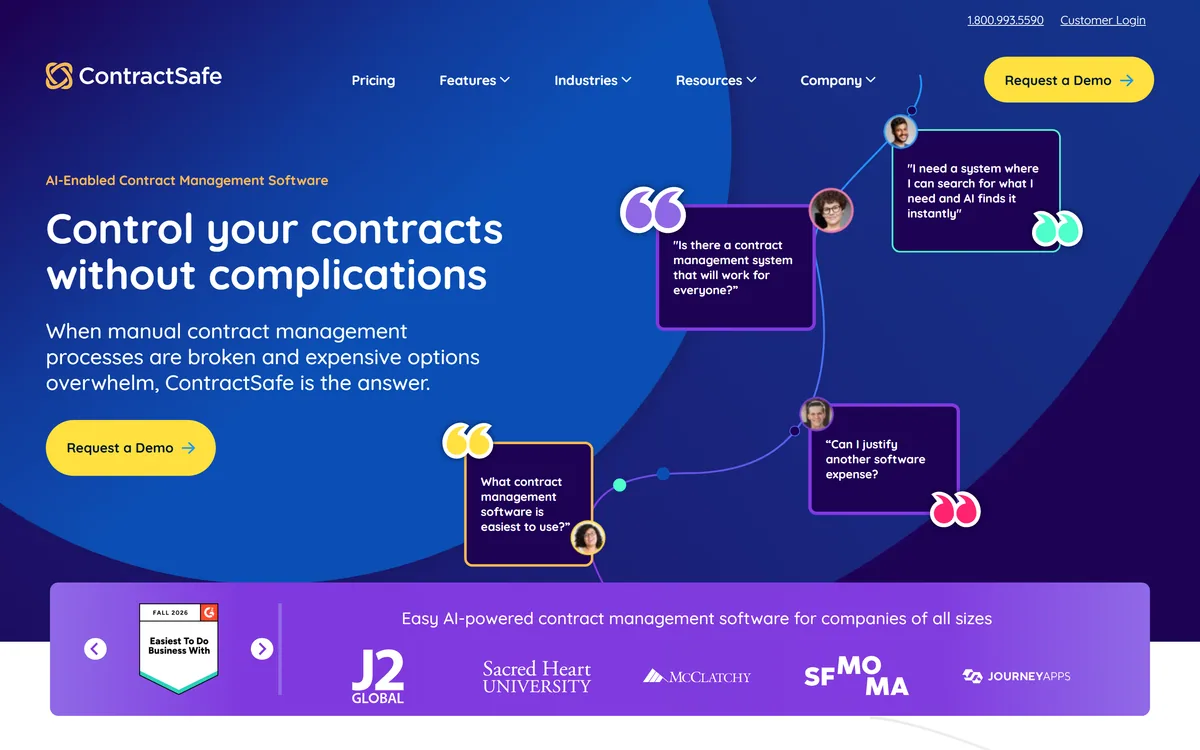
ContractSafe opens with questions in a customer's voice — needing a system where you can search and AI finds it instantly, wanting something that works for everyone, and asking whether another software expense can be justified.
That framing identifies the real failure mode accurately. Contract management projects rarely fail because the software could not do something; they fail because most of the organisation never used it.
Two things cause that. The system is complex enough to need training, so only a few people learn it. And it is priced per seat, so licences get rationed to those few people by a finance decision that makes perfect sense in isolation.
The result is that the system holds a partial truth. Legal's contracts are in it, sales agreements are in a folder, the office lease is in an email, and the system is now actively misleading because people believe it is complete.
Unlimited users addresses the second cause directly, and simplicity addresses the first. Neither is a technical achievement, and together they are the difference between a system of record and an expensive archive.
A contract system holding only some of the contracts is worse than no system, because people believe it is complete.
The site leads with search and AI-powered data extraction, and that ordering is correct even though search is the least impressive-sounding capability in the category.
The reason is that nearly every real contract question is a retrieval question. What did we agree about liability, when does this expire, which agreements have this clause, what did the last version say.
Answering those from a filing system requires knowing where to look, which requires already knowing what you are looking for. Full-text search across every agreement, with the key terms extracted, changes that from a research task into a question.
Extraction is what makes search useful rather than merely possible. Knowing a document mentions a renewal date is not the same as knowing the date, and the difference is whether an alert can fire.
This is a different problem from clause review — assessing whether terms are acceptable, which is what tools like Ivo and LegalOn do at the negotiation stage. Storage answers what did we sign; review answers should we sign this.
ContractSafe describes automated alerts that keep you calm and confident about critical dates, with renewal notifications called out specifically.
This is the feature that justifies the purchase on its own, and it is worth being blunt about why: auto-renewing contracts nobody noticed are one of the most reliable sources of wasted spend in any organisation.
The mechanism is always the same. Someone signs a two-year agreement with a ninety-day notice period, that person leaves, the renewal window passes unremarked, and the company is committed for another two years to something it no longer uses.
The reason it keeps happening is not carelessness. It is that the obligation to act lives inside a document nobody re-reads, and human memory is a poor scheduler across two-year horizons.
An alert moves that obligation out of the document and into a calendar. It is unglamorous automation and it routinely pays for the software many times over — the same logic that makes obligation tracking valuable in adjacent finance systems such as Puzzle.
The positioning is explicit — easy and affordable contract management without a bell or whistle in sight — and taking that seriously means understanding what is absent.
Deep clause-level analytics are the first gap. Comparing thousands of agreements to find every non-standard indemnity is an enterprise CLM capability, and tools built for that scale of analysis such as Luminance exist for a reason.
Complex negotiation workflow is the second. Multi-party redlining with position tracking and playbook enforcement is a different product with a different price and a much longer implementation.
Obligation management is the third. Knowing a contract exists and knowing whether you are complying with its service levels are separate problems, and the second requires connecting to operational systems.
The judgement to make is honest rather than technical: does your organisation have those problems today, or does it have a findability problem that it has been solving with a much more expensive tool? Most companies are in the second category and have been sold the first.
Contract system rollouts fail at the migration stage more often than at the software stage, usually because the perfect became the enemy of the loaded.
This sequence prioritises completeness over tidiness, because an incomplete system is the one failure you cannot recover from.
Full-text search across every stored contract
AI data extraction of key terms and dates
Automated alerts for renewals and critical dates
Lifecycle tracking showing what is in progress or stuck
Intake forms, templates and approval flows
E-signature within the same flow
Editing in Microsoft Word or in-app with version history
Unlimited users on every plan
Legal software divides by whether it stores agreements, reviews them, or researches the law.
| Tool | What it does | Pricing basis | Best for |
|---|---|---|---|
| ContractSafe | Stores, searches and tracks executed contracts | Contract volume, unlimited users | Companies that cannot find their agreements |
| Ironclad | Full contract lifecycle and workflow | Enterprise | Complex negotiation and approval processes |
| Ivo | Reviews contracts against your playbook | Per user | Deciding whether to sign something |
| Luminance | Analyses large document sets | Enterprise | Diligence and clause-level analytics at scale |
| CoCounsel | Legal research and drafting | Enterprise | The law rather than your agreements |
Last checked . Read from contractsafe.com in a browser session on the date above, with the screenshot captured alongside.
What we could not confirm: how accurate the AI data extraction is in practice, which determines whether alerts can be trusted; where contract data is hosted and what security certifications apply, which we did not read; which CRM and other integrations are actually available; whether the vendor-managed integration setup carries a cost; how migration of an existing archive is handled; and how the product compares against the fourteen named competitors, since we read only ContractSafe's own pages. We did not use the product.
Products covering the stages either side of storing an executed agreement.
Most contract management projects fail the same way: a powerful system gets bought, three people learn it, and everyone else keeps emailing PDFs. ContractSafe's positioning — easy and affordable, without a bell or whistle in sight — is aimed squarely at that failure, and the two decisions that back it are unlimited users on every plan and pricing by contract volume rather than per seat. That combination removes the reason organisations restrict access, which is the reason adoption dies. It is deliberately less capable than enterprise CLM, and for most companies that is the correct trade. AInexfinder Editor Score: 4.1/5.
AInexfinder does not list plan prices or billing details. For current pricing, plans, and trials, visit the official ContractSafe website.
Visit official website for pricingVendor pricing, credits, and billing policies change over time. Always confirm on the official site before you buy.
Log in to write a review.
No reviews yet. Be the first to share your experience with ContractSafe.
Assigned reviewer
Daniel ReedSenior AI Tools Reviewer
Daniel reviews AI tools the slow way — by actually using them on real projects. His reviews cover what works, what breaks, and who each tool is genuinely a good fit for.
Daniel and the AInexfinder editorial team research ContractSafe using public product information, listing evidence, and (when available) hands-on checks. Scores reflect listing completeness and transparency — not paid placement.
HubSpot AI is branded Breeze — an assistant plus a set of agents for prospecting, content, customer service, campaigns, nurture, and revenue, all running on live CRM data, with an Agent Builder for custom ones.
Clay is go-to-market data infrastructure built around waterfall enrichment: instead of one provider, it queries a marketplace of more than 200 in sequence until a field is filled. Claygent AI agents research companies and people, and the results push into a CRM, ad platforms or a native sequencer.
Trellus is an AI dialer that works inside Salesloft, Outreach and HubSpot, offering parallel dialling of up to five lines, real-time call guidance, conversational analytics, voice agents for practice and inbound, and a LinkedIn tool, aimed at multiplying sales conversations.
AutogenAI is an enterprise platform for writing proposals, bids and grant applications. It covers the workflow from qualifying an opportunity through drafting, research, review and compliance, using custom language engines built on each customer's own tone of voice and content library.
Aviso is an agentic revenue intelligence platform for go-to-market teams. It covers forecasting, pipeline inspection, conversation and relationship intelligence, coaching, sales engagement and customer success, with more than 30 prebuilt agentic workflows and a no-code studio for building new agents.
Ironclad is an AI contract lifecycle management platform covering create, review, sign, store, analyze and fulfill. Jurist is its agentic AI contract partner for legal review, Ironclad AI runs behind every workflow stage, and 20+ integrations connect it to Salesforce, Word, Slack, DocuSign and SAP.