
HubSpot AI is branded Breeze — an assistant plus a set of agents for prospecting, content, customer service, campaigns, nurture, and revenue, all running on live CRM data, with an Agent Builder for custom ones.
FreemiumBusiness & Marketing
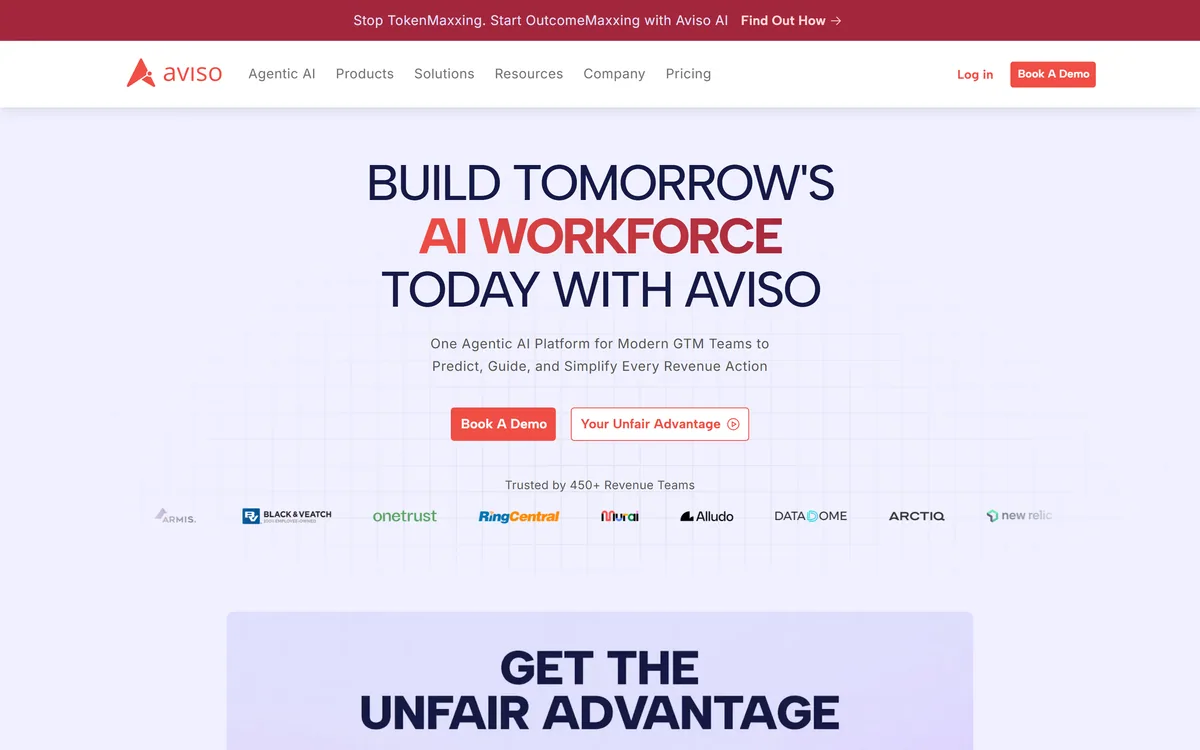
Aviso is an agentic revenue intelligence platform for go-to-market teams. It covers forecasting, pipeline inspection, conversation and relationship intelligence, coaching, sales engagement and customer success, with more than 30 prebuilt agentic workflows and a no-code studio for building new agents.
| Category | Revenue intelligence and agentic go-to-market automation |
|---|---|
| Agent scale | More than 30 out-of-the-box agentic workflows and over 50 task-based agents |
| Agent building | No-code GTM Agent Studio for building and deploying agents without engineering |
| Core modules | Conversation Intelligence, Relationship Intelligence, Coaching and Enablement, Marketing Intelligence, Sales Engagement, Revenue Forecasting, Pipeline Inspection, Deal Acceleration, Customer Success Intelligence, Reports and Analytics, GTM Team Collaboration |
| Mobile | App with predictive forecasting and pipeline management |
| Stated forecast accuracy | Nearly 100%, per the vendor |
| Vendor-stated results | 40% increase in average win rate, 70%+ improvement in net new revenue closed per AE, 36% net new revenue increase per rep across customers of a year or more |
| Stated customer base | 450+ revenue teams |
| Leadership | CEO and President, Trevor A. Rodrigues-Templar |
| Not published | Named customers beyond an anonymised reference, specific integrations, funding or headquarters |
| Charging model | Not disclosed; contact sales implied. No prices published here |
Nearly 100% forecasting accuracy is the headline number and it needs addressing first, because it is the kind of claim that should make a buyer more careful rather than more interested.
Sales forecasting predicts human decisions made by people outside your company. Whether a deal closes depends on a buyer's budget approval, a competitor's counter-offer, an internal reorganisation, a champion leaving, or a procurement process nobody told you about. No model has access to any of that.
So what could the figure plausibly describe? Most likely aggregate accuracy at the quarter level across a whole book of business, where individual deal errors offset each other — some deals slip, others pull forward, and the total lands close. That is a genuine and useful capability, and it is a very different claim from predicting deals.
It might also describe accuracy in the final week of a quarter, when most outcomes are effectively known. Being accurate about a quarter that is nearly over is not the hard part.
The number that would actually be useful is not published anywhere in this category: accuracy at the start of a quarter, measured against outcome, compared against what the sales leader's own manual forecast would have said. That comparison is the whole question and nobody publishes it.
None of this means the forecasting is bad. It means the headline is doing marketing work rather than analytical work, and a buyer should ask what specifically was measured, over what horizon, and against what baseline.
A forecast predicts decisions made by people who do not work for you. Nearly a hundred percent accuracy is not a capability claim — it is a question about what was measured.
This is the dependency that determines whether any revenue intelligence platform works, and it is rarely stated by vendors.
Forecasting, pipeline inspection and deal scoring all reason over your CRM: what stage deals are in, when they were last touched, what the close date says, who is involved. If reps update Salesforce on the Friday before a quarter closes, in a hurry, to whatever keeps their manager quiet, then the platform is reasoning over fiction.
The industry's standing joke about CRM hygiene exists because the problem is universal. Deals sit in stage four for five months. Close dates get pushed rather than re-examined. Contacts are missing. Notes are absent.
There is a genuine counter-argument in Aviso's favour here, and it is the strongest thing in the product's design. Conversation intelligence and relationship intelligence generate their own data rather than depending on rep input. Call recordings and email traffic exist whether or not anyone updates a record, and a platform reading those knows something the CRM does not.
Top-of-funnel agents like Artisan never see this stage at all. Relationship intelligence specifically addresses single-threading — a deal where the rep knows one person and that person leaves. That signal comes from email and calendar patterns, not from a field someone forgot to fill.
So the practical evaluation question is which parts of the platform generate their own data and which parts inherit your CRM's quality. The first group works regardless; the second is only as good as your hygiene, and no vendor can fix that for you.
Fifty task agents and thirty workflows is a large number and numbers are easy. The no-code studio for building your own is the part that is structurally interesting.
The reason is that sales processes differ enormously between companies in ways software vendors consistently underestimate. Stage definitions, qualification frameworks, approval thresholds, what counts as a commit — all of these are local, and a platform shipping fixed workflows forces you to adopt someone else's assumptions or abandon the feature.
Letting revenue operations build agents without engineering addresses that directly. RevOps teams typically sit close to the process, know exactly where the manual work is, and cannot get engineering time — which is precisely the profile a no-code builder serves.
The prebuilt library then works as a starting point rather than a constraint: take the closest workflow, adapt it to how you actually operate.
The caution is the standard one for no-code agent platforms, and it is worth planning for. Fifty agents that anyone can extend becomes fifty-plus-thirty agents nobody owns within a year. Agents that act on records, send messages or update forecasts need the same governance as any automation — who can create them, who reviews them, what they may touch, and how you turn one off.
Ask specifically what an agent is permitted to do without approval, since the difference between an agent that recommends and one that acts is where the risk lives.
This site does not publish plan prices, and neither does Aviso — the pricing page exists but discloses nothing, which implies contact sales.
In revenue intelligence the quote is almost always per seat, sometimes tiered by which modules are included. Conversation intelligence in particular is frequently priced separately because recording, transcribing and analysing calls carries real cost per user.
The variable to establish early is who counts as a seat. Some platforms charge for every rep whose calls are recorded; others only for people who log in to view analysis. On a large sales floor those two definitions produce very different numbers.
The second question is which modules are in the base. A platform listing eleven modules almost certainly does not include all eleven at the entry tier, and forecasting plus conversation intelligence — the two most people actually want — are commonly split.
The comparison worth running is against Gong and Clari, which occupy the same market with more established positions. Aviso's argument against them is breadth and the agent studio rather than depth in any single module, and that is the axis to test.
For a smaller sales team, the honest framing is that this whole category is priced for organisations with a dedicated revenue operations function. If nobody owns forecasting as a job, the platform will not be adopted regardless of what it costs.
Three customer-outcome figures appear and they share the same structural problem, which is worth understanding once and applying to every vendor in this category.
Established incumbents such as Clari publish figures with the same structural problem. 40% increase in average win rate. 70%+ improvement in net new revenue closed per AE. 36% net new revenue increase per rep across customers of a year or more.
The problem is attribution rather than honesty. Companies that buy revenue intelligence platforms are almost never only buying software — they are usually hiring a RevOps leader, tightening stage definitions, introducing deal reviews and improving CRM discipline at the same time. The platform arrives with the reform, and the improvement belongs to all of it.
There is also a selection effect. Organisations willing to invest in this category tend to be growing and professionalising already, so their numbers would likely have improved regardless.
The third figure is the most carefully worded and therefore the most revealing: measured across customers of a year or more. That excludes anyone who churned, which is the group whose results would have pulled the average down.
None of this makes the platform ineffective. It means published percentages in this market describe correlation inside a self-selected sample, and the only number that will tell you anything is your own — measured before you start, against a quarter you actually forecast.
Five terms that decide whether a revenue intelligence pitch means anything to you.
Revenue forecasting with predictive modelling
Pipeline inspection across early and mature stages
Conversation intelligence over recorded sales calls
Relationship intelligence surfacing single-threaded deals
Coaching and enablement workflows
Marketing intelligence
Sales engagement tooling
Deal acceleration
Customer success intelligence
More than 30 prebuilt agentic workflows from BDR to CRO
Over 50 task-based agents
No-code GTM Agent Studio for building custom agents
Mobile app with forecasting and pipeline management
This is an established category with entrenched competitors, so the question is what Aviso does that they do not.
| Tool | Strength | Agent building | Position |
|---|---|---|---|
| Aviso | Breadth across 11 modules, forecasting-led | No-code studio for custom agents | Challenger on breadth |
| Gong | Conversation intelligence depth | Fixed workflows | Category leader on calls |
| Clari | Forecasting and revenue operations | Fixed workflows | Established forecasting incumbent |
| Artisan | Autonomous outbound prospecting | Agent-native | Top of funnel, not forecasting |
| Apollo.io | Contact data and sequencing | Not applicable | Prospecting rather than intelligence |
Revenue teams typically buy one tool for the top of the funnel and another for managing what is already in it.
Last checked . Read from aviso.com during this check, with the screenshot above captured at the same time.
The nearly 100% forecast accuracy claim cannot describe deal-level prediction, since forecasts depend on decisions made by people outside your company — ask what was measured, over what horizon, and against what baseline. Outcome percentages are customer-reported without controls, and the 36% figure explicitly measures only customers retained a year or more, which excludes those who churned. All forecasting quality inherits your CRM data quality, which no vendor can fix.
The no-code agent studio is the genuinely differentiated part — most competitors ship fixed workflows, and letting a revenue operations team build its own without engineering is a real answer to how differently sales processes are run. It is marked down heavily for a nearly 100% forecast accuracy claim that no forecasting system can support, and for percentage outcomes attributed to the platform with no baseline or control. AInexfinder Editor Score: 3.9/5.
AInexfinder does not list plan prices or billing details. For current pricing, plans, and trials, visit the official Aviso website.
Visit official website for pricingVendor pricing, credits, and billing policies change over time. Always confirm on the official site before you buy.
Log in to write a review.
No reviews yet. Be the first to share your experience with Aviso.
Assigned reviewer
Daniel ReedSenior AI Tools Reviewer
Daniel reviews AI tools the slow way — by actually using them on real projects. His reviews cover what works, what breaks, and who each tool is genuinely a good fit for.
Daniel and the AInexfinder editorial team research Aviso using public product information, listing evidence, and (when available) hands-on checks. Scores reflect listing completeness and transparency — not paid placement.
HubSpot AI is branded Breeze — an assistant plus a set of agents for prospecting, content, customer service, campaigns, nurture, and revenue, all running on live CRM data, with an Agent Builder for custom ones.
Clay is go-to-market data infrastructure built around waterfall enrichment: instead of one provider, it queries a marketplace of more than 200 in sequence until a field is filled. Claygent AI agents research companies and people, and the results push into a CRM, ad platforms or a native sequencer.
Trellus is an AI dialer that works inside Salesloft, Outreach and HubSpot, offering parallel dialling of up to five lines, real-time call guidance, conversational analytics, voice agents for practice and inbound, and a LinkedIn tool, aimed at multiplying sales conversations.
AutogenAI is an enterprise platform for writing proposals, bids and grant applications. It covers the workflow from qualifying an opportunity through drafting, research, review and compliance, using custom language engines built on each customer's own tone of voice and content library.
Ironclad is an AI contract lifecycle management platform covering create, review, sign, store, analyze and fulfill. Jurist is its agentic AI contract partner for legal review, Ironclad AI runs behind every workflow stage, and 20+ integrations connect it to Salesforce, Word, Slack, DocuSign and SAP.
Gainsight is a customer success and retention platform that turns product, engagement and support signals into scored risk and the right action, spanning customer success, product experience, community and education, with agentic AI across all of it.