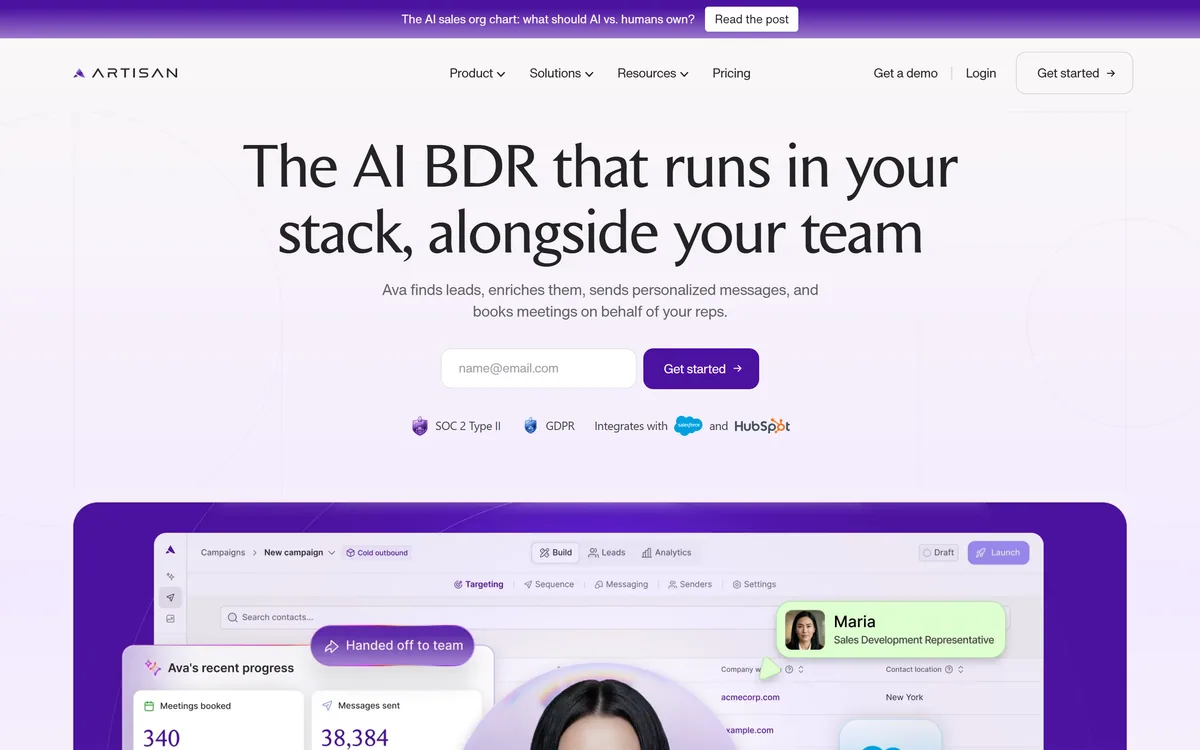
Artisan builds AI workers it calls Artisans. The first, Ava, is an autonomous business development rep that sources and enriches B2B leads, writes and sends personalised outreach across email and LinkedIn, handles replies and books meetings — consolidating the data, deliverability and sequencing stack into one product.
Outbound sales is one of the few white-collar functions built almost entirely out of repeatable steps. Find companies matching a profile. Find the right person. Verify the email. Research something specific enough to open with. Write. Send. Follow up four times. Handle the reply. Book the meeting.
Every one of those steps has a software vendor attached to it, which is why a typical outbound stack is five or six tools with a junior rep in the middle moving data between them and doing the parts nothing automates.
Artisan's argument is that the person in the middle is the wrong shape for the job. This review covers what consolidating that stack actually fixes, why deliverability is the constraint everyone underestimates, how to read the AI-employee framing, and the specific conditions where Clay or a human rep remains the better answer.
The pitch is not a better sequencer. It is that the sequencer no longer needs a person driving it.
The AI BDR Proposition
Artisan is an outbound sales platform built around Ava, an autonomous AI business development representative that finds B2B leads, writes personalised outreach, sends it, handles the replies and books meetings.
Consolidation is the real product. Ava replaces a stack that normally means separate vendors for contact data, enrichment, email deliverability, sequencing, dialling and intent signals.
Founded in 2023 by Jaspar Carmichael-Jack, San Francisco-based, with a $25 million Series A led by Glade Brook Capital alongside HubSpot Ventures, Y Combinator and Day One Ventures.
Ava 2.0 is the current generation, positioned for enterprise teams rather than only startups.
Charging is credit-based with tiers from startup through enterprise — you buy capacity for the agent to work, not a seat for a person.
Consolidation Is A Bigger Claim Than Autonomy
The headline is the autonomous agent. The more defensible value is the stack it collapses, and it is worth separating the two.
A functioning outbound operation typically runs a contact database, an enrichment layer, an email verification and deliverability service, a sequencing platform, an intent-data provider and a dialler. A typical stack pairs Apollo.io for data with Instantly for sending. Six contracts, six renewal dates, six admin surfaces, and integration seams between all of them.
Those seams are where outbound actually breaks. Data goes stale between the database and the sequencer. A contact gets emailed twice by two different sequences. Deliverability degrades and nobody notices for a fortnight because the tool that sends is not the tool that monitors.
One system holding all of it can, in principle, close those gaps — it knows what it sent, to whom, from which domain, and how that domain is performing.
The honest caveat is that consolidation always trades depth for coherence. A specialist enrichment platform will do enrichment better than a bundled one; a dedicated deliverability service will monitor more carefully. You are buying fewer seams at the cost of some ceiling on each component, which is the same bargain every all-in-one suite offers.
Outbound rarely fails because the copy was bad. It fails in the joins between six tools, which is exactly what nobody is watching.
Deliverability Is The Constraint Nobody Budgets For
Any tool that makes sending easier runs into the same wall, and it is worth understanding before you evaluate any product in this category.
Email providers have spent two decades getting good at detecting bulk unsolicited mail. Volume from a new domain, low reply rates, spam complaints, and identical message bodies are all signals that route mail to a folder nobody opens.
The cruel arithmetic is that a tool which lets one person send ten times more email does not produce ten times more meetings. It produces more sending, worse engagement metrics, and eventually a domain that cannot reach an inbox at all — including for the humans who share it.
This is why deliverability appears in Artisan's own list of consolidated functions, and why it is the right thing to interrogate hardest in a demo. Ask specifically: does it use separate sending domains, how is warm-up handled, what happens to sending when reply rates fall, and can it be configured to stop rather than push through.
The signal to look for is a product that limits sending on your behalf. A system with no brakes is not more powerful — it is a faster route to a burned domain.
Personalisation helps here and only partially. Genuinely researched outreach earns replies; personalisation tokens filled from a database do not, and recipients tell the difference immediately.
Run it on a dedicated sending domain, never your primary corporate domain.
Start at low daily volume and hold there through a full warm-up period.
Read the first fifty messages it writes before any of them send.
Watch reply rate rather than open rate — opens are unreliable and easy to flatter.
Agree in advance what reply rate triggers a pause, and confirm the platform can enforce it.
Reading The AI Employee Framing
Artisan names its products Artisans and gives them human names. That is a deliberate positioning choice and it is worth being clear-eyed about what it does.
The framing is useful in one respect: it sets the right expectation about scope. Ava is not a feature you add to a workflow, it is an attempt to own an entire function end to end. Buyers who evaluate it as a sequencer will misjudge it.
The framing is misleading in another. An employee exercises judgement, learns your market by talking to people in it, notices that a segment has gone quiet and asks why. An agent executes a defined loop very consistently. Those are different things, and the gap shows up specifically in strategy — deciding who to target and what to say — rather than in execution.
In practice the good outcome is not that you stop needing a person. It is that one person can own the strategy for what previously took a team to execute: choosing segments, writing the positioning, reading what came back, and adjusting.
That is a genuinely valuable change and it is a smaller claim than the marketing makes. Teams that buy it expecting to remove headcount rather than redirect it tend to be disappointed.
Assisted rather than autonomous tools like Amplemarket make a smaller version of the same bet. The backing suggests the market takes the category seriously — a $25 million Series A led by Glade Brook Capital, with HubSpot Ventures participating, which is a notable investor for a product living next to a CRM.
Credits, Not Seats
This site does not publish plan prices. The structure matters more anyway, and Artisan's is genuinely different from the tools it replaces.
Artisan charges on a credit-based model, with tiers spanning startup through enterprise. You are buying the agent's capacity to work rather than a licence for a person to log in.
That is the correct shape for the product and it changes how you budget. Seat-based tools cost the same whether a rep sends ten emails or a thousand; a credit model scales with activity, which means cost tracks volume rather than headcount.
It also means the failure mode is different. With seats, waste looks like an unused licence. With credits, waste looks like capacity spent on a badly chosen segment — you can burn a month's allocation on outreach to the wrong people far faster than a human rep could.
Three things to establish before signing: what specifically consumes a credit (contacts sourced, emails sent, enrichments, replies handled — they are not equivalent), whether unused credits roll over, and what the annual commitment is. Enterprise tiers in this category are usually annual.
Because targeting quality now directly determines cost efficiency, the discipline that used to be about protecting a rep's time is now about protecting your balance.
Where A Human Rep Or A Specialist Still Wins
Being specific here is more useful than another feature list.
Complex, high-value, few-target sales. If your total addressable market is 200 companies and each deal is transformative, automated outreach is the wrong instrument. Those relationships are built by a person who knows the industry, and volume tooling actively damages them.
Anything requiring genuine domain credibility. Selling to clinicians, engineers or lawyers means the first message has to demonstrate that you understand their work. Generated research reads as generated to a specialist audience faster than to anyone else.
When your problem is targeting, not sending. If you do not yet know who buys from you, automating outreach scales a guess. Clay and similar data-first tools are built for working that out.
Regulated and consent-based markets. Cold outreach obligations differ sharply by jurisdiction — the rules covering unsolicited commercial email in the EU and UK are materially stricter than in the US, and automation does not change who is responsible for compliance.
Enterprise sales with a small named-account list
Technical audiences who detect generic research instantly
Companies still working out their ideal customer profile
Markets where cold email consent rules are strict
Any motion where the relationship, not the volume, is the asset
Key features of Artisan
Autonomous lead sourcing against an ideal customer profile
Contact enrichment built into the same system
Personalised outreach writing across email and LinkedIn
Automated sending with deliverability handled in-platform
Reply handling and conversation continuation
Meeting booking without human intervention
Intent signal incorporation
Dialler functionality within the consolidated stack
Enterprise-oriented Ava 2.0 generation
Pros & cons
Pros
5
Consolidating six tools into one removes the seams where outbound actually breaks
Owning sending and deliverability together means the system can see its own damage
Credit-based charging scales with activity rather than headcount
Serious backing, including HubSpot Ventures, suggests staying power in a churning category
The end-to-end framing sets accurate expectations about scope, unlike bolt-on AI features
Cons
6
All-in-one always trades component depth for coherence — specialists go deeper on each part
Volume sending risks domain reputation, and the damage is slow and quiet
Generated research reads as generated to specialist audiences
Credits can be burned rapidly on a badly chosen segment, unlike an idle seat
The AI-employee framing oversells judgement, which stays firmly with your team
Cold outreach compliance remains yours regardless of what sends the message
Best For
Startups without budget for a full SDR team
Sales teams with a large, well-defined addressable market
Companies already paying for several overlapping outbound tools
HubSpot Ventures, Y Combinator, Day One Ventures, BOND, Soma Capital, Oliver Jung
Charging model
Credit-based, with tiers from startup through enterprise; no prices published here
Should An Agent Own Your Outbound?
Hire The Agent If
You run high-volume outbound to a large, well-understood addressable market
You already know your ideal customer profile and the problem is execution capacity
You are paying for four or more separate outbound tools and feeling the seams
Someone will own strategy and read what comes back rather than leaving it running
You can run it on a dedicated sending domain with proper warm-up
Keep The Humans If
Your market is a few hundred named accounts and each relationship matters
You sell to specialists who will spot generated research immediately
You have not yet worked out who actually buys from you
Nobody will monitor deliverability, which is where this fails quietly
Your jurisdiction's cold outreach rules make volume sending a compliance problem
The Rest Of The Outbound Stack
Artisan aims to replace several of these at once, which makes them the right comparison set.
Clay — data-first list building when targeting is the actual problem
Apollo.io — the established database plus sequencing combination
Instantly — focused on deliverability and sending at volume
Amplemarket — AI-assisted rather than autonomous outbound
HubSpot AI — the CRM most of this eventually has to write into
Sources Behind These Claims
Last checked . Read from artisan.co during this check, with the screenshot above captured at the same time and funding details corroborated against independent coverage.
Ava described on site as an autonomous AI BDR that finds and enriches B2B leads, writes and sends personalised outreach, handles replies and books meetings
Consolidated stack stated on site as B2B data, enrichment, deliverability, sequencing, dialler and intent signals
Ava 2.0 announced by the company as its autonomous AI BDR for enterprise teams
Charging described by the vendor as credit-based with tiers from startup through enterprise
Founding year of 2023 and founder Jaspar Carmichael-Jack reported in independent coverage
San Francisco headquarters reported in independent coverage
$25 million Series A led by Glade Brook Capital, with HubSpot Ventures, Y Combinator, Day One Ventures, BOND, Soma Capital and Oliver Jung named among investors in press reports
An earlier seed round is also referenced in the company's own published announcements
Pricing, blog, careers and legal pages present in the site footer
No plan prices published here, in line with this site's pricing policy
Capability claims are the vendor's own and were not independently tested. Cold outreach is regulated differently by jurisdiction and automation does not transfer responsibility for compliance — the rules covering unsolicited commercial email in the EU and UK are materially stricter than in the US. Take your own advice before running volume outreach into a new market.
Editor's Verdict
3.8/5
Artisan has an AInexfinder Editor Score of 3.8/5.
Artisan pricing
AInexfinder does not list plan prices or billing details. For current pricing, plans, and trials, visit the official Artisan website.
Vendor pricing, credits, and billing policies change over time. Always confirm on the official site before you buy.
Frequently asked questions
What is an AI BDR?
A software agent that performs the business development rep function — finding companies that match your profile, identifying contacts, writing and sending outreach, handling replies and booking meetings — without a person driving each step. Artisan's is called Ava.
How does Artisan charge?
On a credit-based model with tiers from startup to enterprise, so you buy the agent's capacity to work rather than seats. Establish exactly what consumes a credit — sourcing, sending, enrichment and reply handling are not equivalent — and whether credits roll over.
Will AI outbound hurt my domain reputation?
It can, and this is the risk to interrogate hardest. More sending with lower engagement is precisely what triggers spam filtering. Use a dedicated sending domain, warm it properly, watch reply rate rather than opens, and confirm the platform can be made to stop rather than push through.
Can Ava replace a human sales rep?
It can replace the execution, not the judgement. The realistic outcome is that one person owns strategy — segments, positioning, reading the responses — for work that previously took a team to execute. Teams expecting to remove headcount rather than redirect it are usually disappointed.
Artisan vs Clay — which should I use?
They solve different problems. Clay is for working out who to target and building precise lists; Artisan is for running the whole outbound motion once you know. If your targeting is still a guess, automating outreach just scales the guess.
Who is behind Artisan and how well funded is it?
It was founded in 2023 by Jaspar Carmichael-Jack and is based in San Francisco. It raised a $25 million Series A led by Glade Brook Capital, with HubSpot Ventures, Y Combinator and Day One Ventures among the investors named in press coverage.
Is automated cold email legal?
It depends entirely on where your recipients are. Consent requirements for unsolicited commercial email are materially stricter in the EU and UK than in the US, and using an agent to send does not shift responsibility away from you. Get your own advice before opening a new market.
Daniel reviews AI tools the slow way — by actually using them on real projects. His reviews cover what works, what breaks, and who each tool is genuinely a good fit for.
Daniel and the AInexfinder editorial team research Artisan using public product information, listing evidence, and (when available) hands-on checks. Scores reflect listing completeness and transparency — not paid placement.
Listings may include affiliate or sponsored placements, which are labeled when present. Editorial scores and cons are not sold. See our affiliate disclosure and review methodology.
Livestorm is a browser-based, all-in-one webinar and video-engagement platform that runs the full event lifecycle, registration, live engagement, AI transcription, on-demand replays and analytics, with CRM integrations and an EU-hosted, ISO 27001 posture, aimed at marketing teams.
Partnero runs affiliate, referral, influencer and newsletter referral programs from a single account, each with its own commission rules and branded portal. It states unlimited partners and no transaction fees on every plan, and its AI builds a launch-ready program from a description of your business.
6sense is an account-based marketing and revenue-intelligence platform that captures buying signals, resolves identities and predicts buying stages, turning raw data into cited GTM intelligence delivered to sales, marketing, ads and AI agents via APIs and MCP.
Listomize is an Etsy SEO platform that generates titles, tags, and descriptions within Etsy's own limits, scores listings, optimises 100+ listings from a CSV, tracks competitors and trends, and auto-generates Pinterest pins.
Lahjty (لهجتي) is an Arabic-first marketing platform for MENA campaigns. From one brief it produces dialect-aware ad copy, headlines, campaign images with Arabic text rendered in, dialect-aware voice, and SEO articles grounded in your own brand sources — with a Partner API and an MCP server for teams that want it inside their own workflow.
MaxAEO is an answer engine optimisation platform from HIII PTE. LTD. It tracks how ChatGPT, Gemini, Claude, Perplexity, Copilot, Grok and Google's AI surfaces mention a brand, with sentiment, competitor benchmarking and citation tracing.